
Blue Ocean vs. Red Ocean: How to Choose Your Path to Growth14 min read

Every business eventually faces the same challenge: how to find new growth.
The existing market gets crowded, competitors multiply, and profits get squeezed. This leads to a fundamental strategic question.
Is it better to keep fighting for a bigger piece of the existing pie, or should you bake a completely new one?
This is not just a theoretical exercise. It’s a choice between two very different paths.
One path involves direct, head-to-head competition in a known market. The other involves venturing into new territory to create a market all your own.
Business scholars W. Chan Kim and Renée Mauborgne gave these two paths memorable names: Red Oceans and Blue Oceans.
What is a Red Ocean Strategy?
Red ocean strategy is the traditional and most common approach to business.
It’s about competing in an existing market and trying to do it better than your rivals. The main goal is to capture a larger share of the customers that already exist.
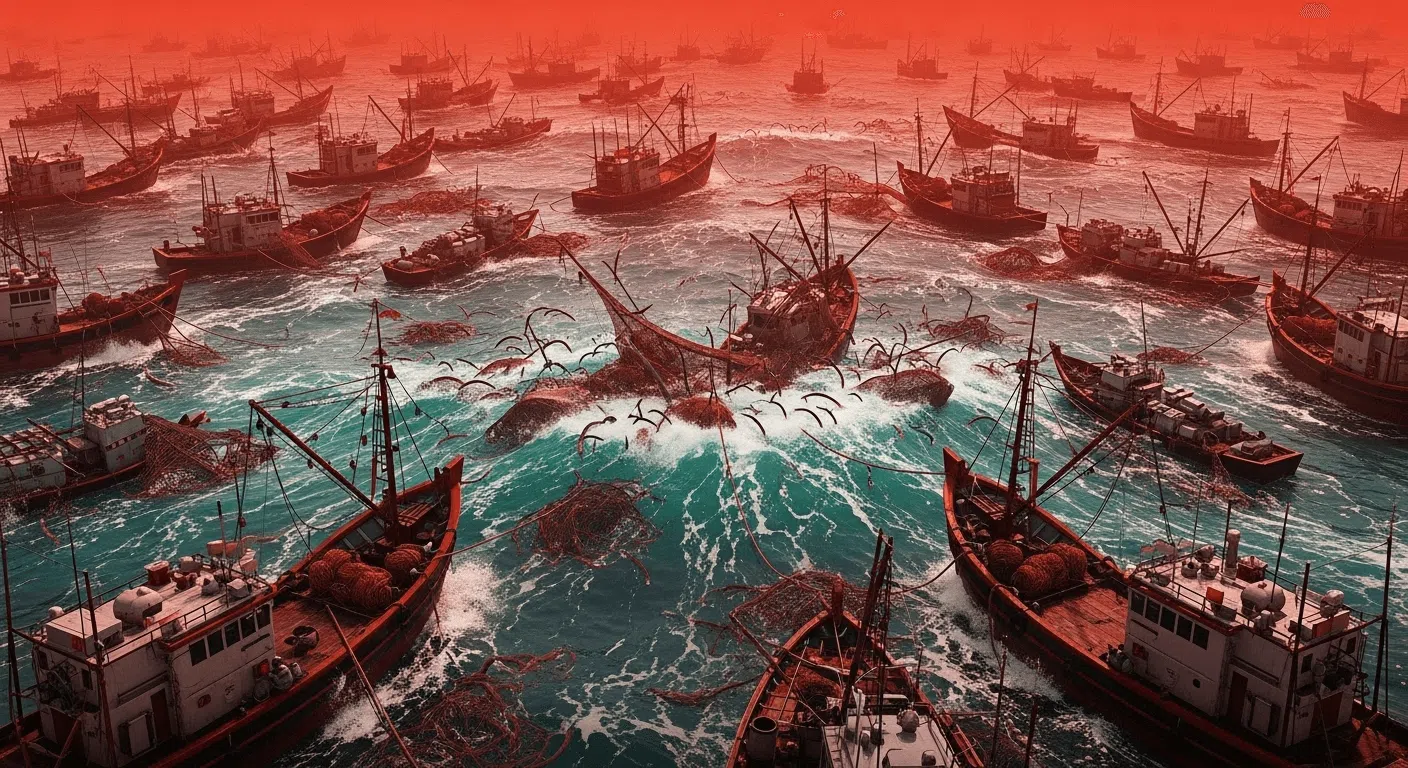
This usually means making a choice between two classic competitive positions.
A company can either differentiate its products to justify a higher price or become a cost leader to offer a lower price.
All of the company’s activities, from marketing to logistics, are then aligned to support that single choice. It’s a familiar battle fought on a well-known field.
Key Traits of Red Ocean Markets
Markets guided by red ocean thinking share a few distinct traits:
- Known and saturated markets: Industry rules are well-understood and boundaries are set. Most potential customers are already served.
- Intense, zero-sum competition: The market is crowded; one company’s gain is another’s loss.
- Exploiting existing demand: Focus is on winning existing customers, not creating new ones.
- The value-cost trade-off: A core red ocean belief, stating a company must choose between high value/high cost or reasonable value/low cost. Pursuing both is seen as impossible.
Despite the intense competition, a red ocean strategy has its advantages.
The biggest is reduced market risk. You’re selling to a market where demand is already proven. There’s no need to guess if people will want your product.
Established markets also offer predictability and clear ways to measure success. You can benchmark against competitors and use existing data to plan your next move.
For companies that already have strong brands, loyal customers, and efficient supply chains, competing in a red ocean is a logical way to use those strengths.
Mastering this competition is necessary for business survival, and the profits it generates often provide the fuel needed to explore new blue oceans.
The Blue Ocean Strategy
Blue ocean strategy is a completely different approach. It’s not about beating the competition; it’s about making the competition irrelevant.
A company enters a “blue ocean” by creating a new market without competitors, shifting focus from existing market division to creating new demand.
Instead of accepting the current market’s limitations and rules, blue ocean strategists look for ways to redefine them.
This approach views market boundaries not as fixed, but as something that can be reshaped by a company’s actions.
The Core Idea: Value Innovation
The engine of blue ocean strategy is value innovation.
This is the simultaneous pursuit of differentiation and low cost, an idea that directly challenges the central rule of conventional strategy.
Value innovation breaks the value-cost trade-off. Instead of choosing between more value or lower cost, it finds a way to achieve both.
This is done by re-examining the factors an industry competes on.
A company pursuing value innovation eliminates or reduces the features that customers don’t value as much, which lowers costs.
It simultaneously introduces new, value-adding features, creating a leap in value for both the company and its customers.
The Search for “Noncustomers”
A key principle of blue ocean strategy is to look beyond the industry’s current customers.
The real opportunity often lies with “noncustomers”, which refers to the people who are not currently buying from the industry at all.
Understanding why noncustomers choose not to participate in a market allows a company to find the main problems that, if solved, could unlock huge new demand.
For example, Casella Wines created the hugely successfulwine brand by targeting beer and cocktail drinkers, who were noncustomers of the wine industry.
They made wine less intimidating and easier to drink.
Similarly, Cirque du Soleil created a new market by targeting adults who went to the theater, not the families with children who were the traditional customers of the circus.
A Head-to-Head Comparison: Red Ocean vs. Blue Ocean
The choice between these two strategies: red ocean is about competing within the existing rules. Blue ocean is about changing the rules entirely.
The table below offers a clear, side-by-side comparison:
| Characteristic | Red Ocean Strategy | Blue Ocean Strategy |
|---|---|---|
| Industry Landscape | Operates within existing industries (known market space) | Creates new industries (unknown market space) |
| Competition | The goal is to beat the competition head-to-head. | Competition is made irrelevant by creating a new market. |
| Demand | Focuses on capturing a greater share of existing demand. | Focuses on creating and capturing entirely new demand. |
| Core Logic | Adheres to the Value-Cost Trade-Off (differentiation OR low cost). | Breaks the Value-Cost Trade-Off (differentiation AND low cost). |
| Customer Target | Focuses on the industry’s existing customers. | Targets the industry’s noncustomers. |
| Risk Profile | High competitive risk but low market creation risk. | Low initial competitive risk but high market creation risk. |
The table highlights several important distinctions:
- Demand: Red ocean strategy is a fight over a limited number of existing customers. Blue ocean strategy is about creating a much larger market by attracting people who have never been customers before.
- The Strategic Choice: The value-cost trade-off is the foundation of red ocean thinking. The ability to break this trade-off through value innovation is what powers blue ocean creation.
- Risk: The two strategies don’t offer a choice between high and low risk, but between different types of risk. A red ocean path minimizes the risk that no one will want your product but maximizes the risk of being beaten by a competitor. A blue ocean path minimizes the risk from competitors at first but maximizes the risk that your new idea won’t catch on.
Tools for Finding Your Blue Ocean
Blue ocean strategy is more than just a theory. It comes with a set of practical tools to help companies systematically find and create new markets.
The strategy canvas is a diagnostic tool that helps you visualize the current state of your market.
It’s a simple graph that maps out the key factors an industry competes on (like price, service, and quality) and shows how different companies perform on those factors.
Plotting major players’ strategies reveals if you’re in a red ocean; competitors’ curves often look identical in mature industries.
The Four Actions Framework: Redesign Your Value
Once the strategy canvas shows you where you stand, the four actions frameworkhelps you create a new strategy.
It challenges you to rethink industry logic by asking four key questions, which are organized into the eliminate-reduce-raise-create (ERRC) grid.
- Eliminate: What factors that the industry takes for granted should be completely eliminated?
- Reduce: What factors should be reduced well below the industry standard?
- Raise: What factors should be raised well above the industry standard?
- Create: What factors should be created that the industry has never offered?
The “eliminate” and “reduce” actions are the primary drivers of cost savings, pushing companies to cut out features that customers no longer value.
This allows a company to lower its cost structure and offer a more accessible price.
Meanwhile, the “raise” and “create” actions push a company to discover new sources of value and offer things the industry has never seen.
The Six Paths Framework: Look for New Opportunities
The six paths framework is a brainstorming guide that helps you look for blue ocean opportunities in unconventional places.
It provides six structured ways to reconstruct market boundaries:
- Look across alternative industries
- Look across strategic groups within industries
- Look across the chain of buyers
- Look across complementary products and services
- Rethink the functional-emotional orientation of an industry
- Participate in shaping external trends over time
These paths are designed to shift a manager’s perspective away from direct competitors and toward new sources of inspiration.
They encourage a company to find value in places that the rest of the industry has ignored.
Systematically going through these different paths allows a company to find hidden opportunities that its rivals have completely missed.
This structured process makes the search for a blue ocean less about a random stroke of genius and more about a deliberate strategic method.
How Real Companies Applied These Strategies
Looking at real-world examples is the best way to understand how these strategies work in practice.
Red Ocean Masters: Thriving in the Fight
Red ocean success demands relentless execution and deep competitive understanding to lead in crowded markets.
Here are a couple of examples:
- Coca-Cola: Maintained dominance in the beverage industry through powerful branding and distribution.
- Ryanair: Succeeded in the airline industry with a ruthless cost-leadership strategy.
Coca-Cola’s strategy is built on its globally recognized brand and a distribution system that makes its products available everywhere.
These two factors create a massive competitive barrier that is difficult for any rival to overcome.
Ryanair, on the other hand, wins by being the cheapest option available, a result of its extreme focus on operational efficiency.
The airline’s success shows that a pure red ocean approach of stealing customers with an unbeatable price advantage can be highly effective.
Blue Ocean Pioneers: Creating New Frontiers
Blue ocean pioneers thrive by making competition irrelevant, not by beating it. They achieve significant growth by redefining market boundaries and creating new demand.
Here are two iconic examples:
- Cirque du Soleil: Reinvented the circus industry by targeting adults with a theatrical, artistic show.
- Nintendo Wii: Avoided the console wars by creating a new market of casual gamers with motion controls.
Cirque du Soleil thrived by creating a unique entertainment form, attracting a new audience, and commanding premium prices due to a lack of direct competition.
Nintendo’s Wii redefined video games, making competition with Sony and Microsoft irrelevant for a time, leading to one of the best-selling consoles.
How to Choose the Right Strategy for Your Business
The decision to pursue a red or blue ocean strategy is not a simple one. The right path depends on your company’s unique situation and capabilities.
Look Outside (Analyze Your Industry)
Start by conducting a thorough analysis of the external business environment. This helps you understand current market opportunities and threats.
You should ask the following questions:
- How mature and saturated is our market?
- How intense is the competition?
- Are there major technological or social trends we could use to reshape our market?
A saturated, slow-growth market or hyper-competitive environment signals a need for a blue ocean shift to survive or thrive.
You must also identify emerging trends that could reshape the industry. These shifts can be leveraged to find new opportunities that competitors have not yet recognized.
Look Inside (Assess Your Company’s DNA)
A strategy is only viable if the organization has the capacity to execute it. An honest internal assessment is just as important as an external one.
Consider these internal factors:
- Resources: Do we have the money and talent to invest in a high-risk, long-term project?
- Risk tolerance: Are we more comfortable with competitive risk or market risk?
- Culture: Does our company culture encourage experimentation and learning from failure?
Blue ocean ventures demand high initial investment with uncertain profit. Red ocean strategies suit companies with fewer resources due to their predictability.
The organization’s culture must also align with the chosen path, as a successful blue ocean shift requires a mindset that embraces experimentation.
A risk-averse culture focused on efficiency is more likely to fail when attempting a radical market-creating move.
The Portfolio Approach: Doing Both
For many established companies, the best approach is not to choose one strategy over the other, but to manage a portfolio of both.
They can use the stable profits from their core red ocean business (their “settlers”) to fund the exploration of high-risk, high-reward blue ocean initiatives (their “pioneers”)).
The strategic challenge then becomes finding the right balance between exploiting the present and exploring the future.
From Idea to a Sustainable Business
Creating a brilliant strategy is only the first step; the real challenge lies in execution and ensuring long-term success.
Overcoming Internal Hurdles
Executing a major strategic shift is never easy because it often runs into significant internal resistance. Leaders must overcome four key organizational hurdles:
- Cognitive hurdle: Getting people to see the need for change
- Resource hurdle: Finding resources without a huge new budget
- Motivational hurdle: Getting people excited to act
- Political hurdle: Dealing with internal opposition
These hurdles can stop even the best strategies before they start. Overcoming them requires strong leadership focused on clear communication and targeted influence.
Successfully navigating these issues is less about massive new resources and more about smart, focused change management.
Without this, the organization will default to the status quo, and the new strategy will fail.
Why Every Blue Ocean Eventually Turns Red
Blue oceans offer temporary uncontested market space, attracting competitors due to high growth and profits.
As imitators and new entrants arrive, they begin to compete on the same factors of value that the pioneer established. Competition intensifies, pressuring prices and margins.
Calm blue waters inevitably become bloody red oceans as market share battles intensify. Innovators must anticipate this natural market cycle.
Building Defenses and Renewing Your Strategy
A strong blue ocean strategy has built-in defenses that make it hard for competitors to quickly copy your success, despite imitation being inevitable.
- Systemic alignment: The entire business model is hard to replicate.
- Brand image conflict: Copying may clash with a competitor’s brand.
- Cost advantages: Rapid scaling creates a lasting cost advantage.
- Customer loyalty: A leap in value earns strong brand loyalty.
A blue ocean strategy, a new business system, is harder for competitors to copy than a single feature.
However, the ultimate key to long-term growth is to engage in a cycle of renewal. When you see your blue ocean starting to turn red, it’s the signal to begin looking for the next one.
Charting Your Course for Future Growth
The choice between competingin red oceans and creating blue oceans is the central challenge for any business seeking growth.
Red oceans demand competitive mastery from established businesses to balance present management with future creation for long-term success.
While knowing the theory is important, execution is what truly matters. Tools like Accept Mission can help by engaging your organization in the innovation process
It helps you activate your teams with a platform that can:
- Gamify innovation challenges
- Engage employees in strategy
- Capture and develop new ideas
- Overcome resistance to change
Turning strategy execution into an engaging game helps you overcome the motivational hurdles that often derail ambitious projects.
This continuous renewal is vital for long-term success, enabling your organization to consistently discover new blue oceans as markets evolve.
If you’re ready to chart your own blue ocean, see how our tools can bring your strategy to life. Book a demo with Accept Mission today to get started.












 English
 Dutch
 Portuguese
 Spanish
 French
 German
 Arabic
