
Governance as a Service: Stage-Gates That Speed Decisions, Not Slow Them9 min read

Governance is the word innovation teams love to hate. It promises clarity, then shows up as a calendar of review meetings nobody can cancel.
Run as a service, governance earns its place by delivering three things:
- Faster decisions, so good projects stop waiting weeks for a yes.
- Earlier kills, so weak projects free capital instead of draining it.
- A clean audit trail, so no one reconstructs the reasoning weeks later.
That’s the whole test. Get those three right and stage-gates start to speed decisions instead of slowing them.
The intent behind governance is sound. Someone has to decide which projects live, which pivot, and which quietly burn budget for another two quarters.
The mechanism is what rots, not the intent. Keep it lean and the gates stay fast; let it drift and they calcify into bureaucracy.
Why Lean Governance Turns Bureaucratic
Bureaucratic drift is almost never a decision; it accumulates. Nobody signs off on “let’s add another review board,” yet a year later the funnel is thick with them.
Four patterns do most of the damage:
| Pattern | What It Looks Like | What It Costs |
|---|---|---|
| Asymmetric rigor | Heavy entry gates, weak or absent exit and kill discipline | Zombie projects clog the funnel and starve the strong ones |
| Oversized boards | Large panels, long meetings, authority spread across too many people | Nothing gets decided; accountability diffuses |
| Gate meetings as theater | Reviews that rubber-stamp or defer rather than choose | Decisions get tabled, momentum dies between gates |
| Ambiguous decision rights | No clear owner of the yes or the no | Escalation delays, rework, and quiet stalemates |
None of them is a process flaw you can fix by adding a step. Each is a governance design that stopped serving the teams and started serving itself.
The entry gate feels productive, so it grows; the exit gate feels harsh, so it withers. That imbalance is where most of the trouble starts.
What Governance as a Service Actually Means
Reframe the whole thing. The teams building inside the funnel are the customers of governance, not its subjects.
A service is judged by what it delivers to the people using it. Everything else is packaging.
The useful design target here is minimum viable governance: the least governance required to manage real risk while still enabling speed. That target has a ceiling and a floor:
| Boundary | What Happens When You Cross It |
|---|---|
| Above the ceiling | Controls become bottlenecks, and teams route around them with shadow workarounds |
| Below the floor | Risk exposure creeps in unmanaged |
The job is to live in the band between.
The payoff for getting the band right isn’t abstract. Its precursor, minimum viable policy, halved complex-decision time and surfaced three times more opportunities than peers.
This is where structure and transparency across the innovation journey actually live. Its precision matters more than its volume.
The whole game is three deliverables and the discipline to stay inside the band.
Size the Gate to the Risk
Not every project deserves the same gate.
Treating a low-risk process tweak like a bet-the-quarter platform launch is how standing committees fill up with work they should never see.
Tier by risk. Route volume away from the panels that cost the most to convene.
| Risk Tier | Oversight | Route |
|---|---|---|
| High | Full board review | Business case plus committee decision |
| Mid | Lightweight gate with pre-configured controls | Single accountable owner decides |
| Low | Autonomous | Async intake form, proceed by default |
The high-risk lane keeps its rigor because rigor is proportionate there. The other two lanes exist to protect that rigor by keeping trivial decisions out of the room.
This isn’t a novel idea. Cooper’s later work scaled the model to project size, with a lightweight two-stage, two-gate path for small, low-risk projects.
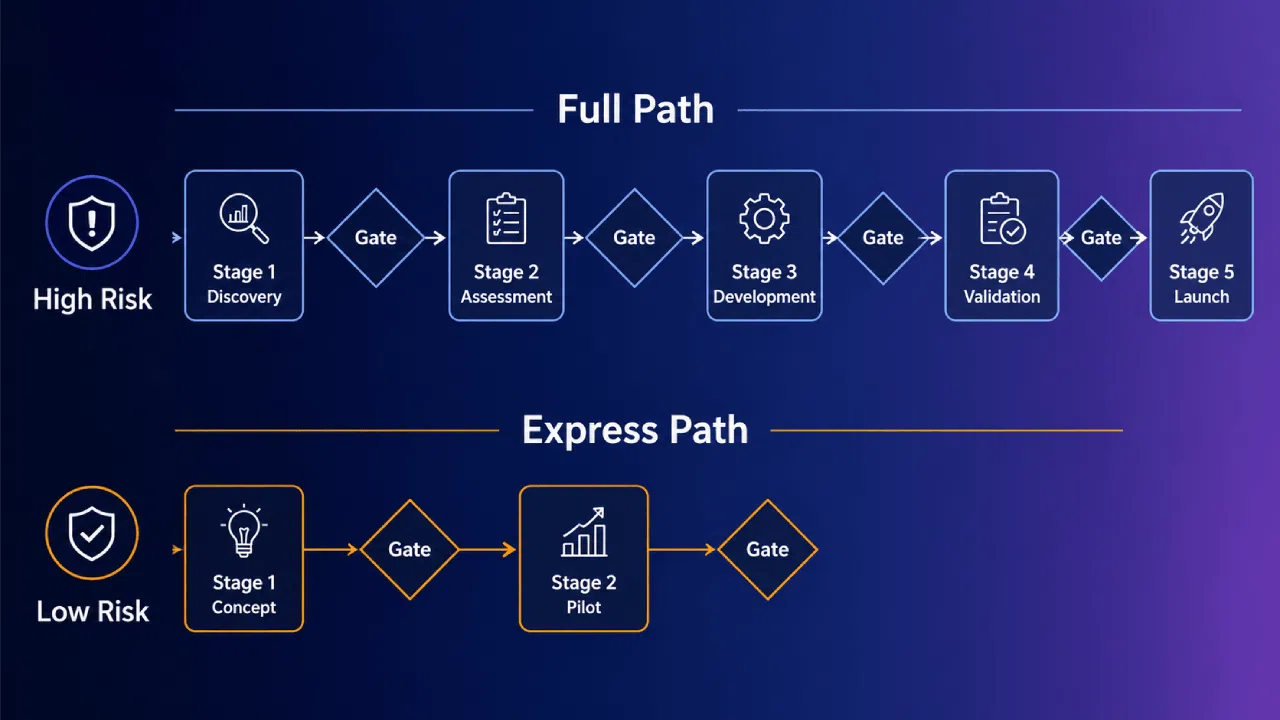
The failure mode is easy to spot once you look for it. One firm spent six months approving a low-risk prototype that touched no sensitive data.
That isn’t caution. It’s a routing error, and it teaches teams that governance is something to avoid rather than use.
Fix Decision Rights Before You Fix the Process
Most governance overhauls start in the wrong place. They redesign the process when the real problem is that nobody knows who gets to say yes.
The fix is narrower than a redesign and far more durable. Four moves, in order:
- Map the critical decisions that actually shape the portfolio, typically 20 to 30 of them.
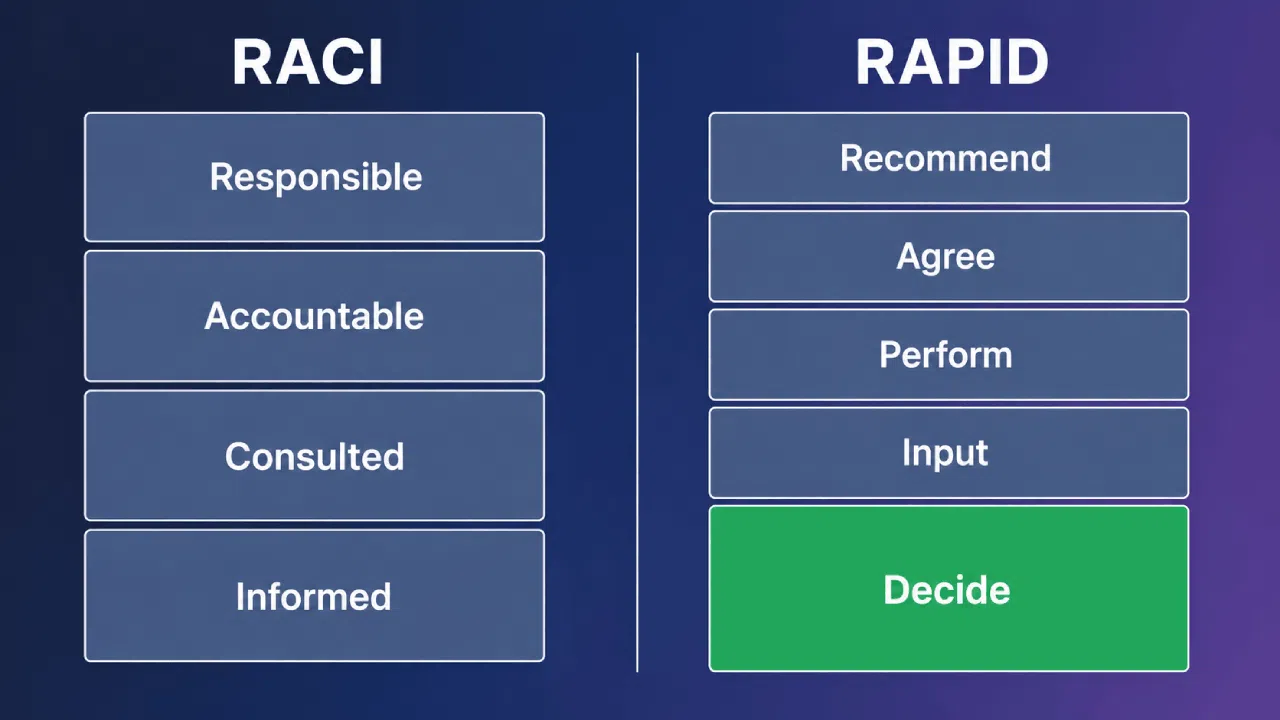
- Assign one accountable decider per gate, using a RAPID-style model over RACI for cross-functional calls.
- Give every governance body a one-page charter stating what it decides and by when.
- Sunset committees annually if they can’t show the value they added.
The theme underneath all four is ownership. Every idea, every stage, every gate has one name attached to the decision.
RAPID beats RACI for a specific reason. RACI blurs who actually decides, while RAPID names the single decider a gate needs.
The one-page charter does quiet, heavy work. It stops mission creep before it starts, because a body that can’t describe its decision on one page is usually deciding nothing.
And the annual sunset matters more than it looks.
Decision effectiveness, which clear decision rights drives, tracks with materially better performance. Retiring bodies that blur that clarity isn’t housekeeping; it’s a performance lever.
Build Kill Discipline Into the Gates
Here’s the asymmetry again, and it’s the expensive one. Most systems have strong entry gates and weak exit discipline.
That imbalance is exactly what breeds zombie projects.
Kill discipline comes down to four moves:
- Make gate decisions live and binding, never tabled and never deferred.
- Give every gate real options: advance, pivot, or stop.
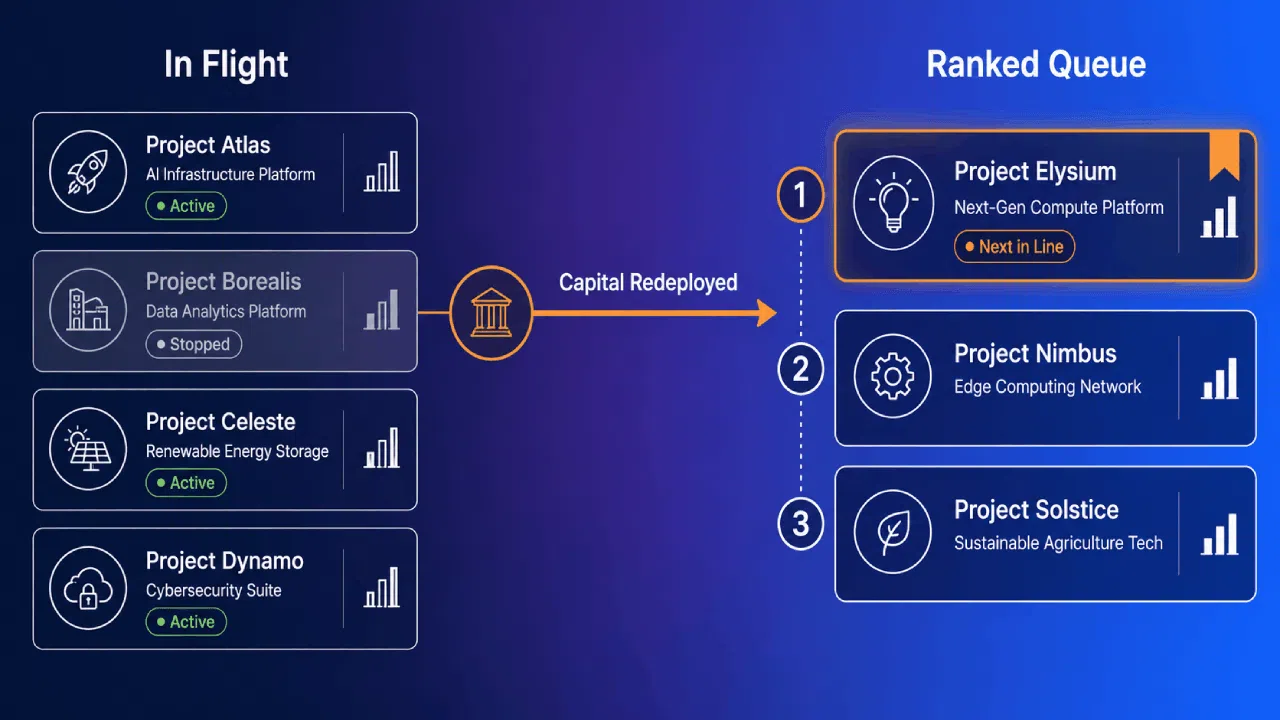
- Keep a ranked queue of funded-ready projects so a kill immediately redeploys capital.
- Empower a single manager who can say both the yes and the no.
A gate that can only advance or postpone isn’t a gate. It’s a turnstile.
A ranked queue is what makes stopping painless. Killing a weak project moves capital to the next contender instead of leaving a hole.
Empowerment matters just as much. Distributed courage is no courage at all.
The evidence for early stopping is blunt. Pharmaceutical research pinned R&D efficiency on cutting late-stage failures, which means killing weak candidates long before they get there.
Killing well is how winning gets funded. That’s what decision quality over idea volume means in practice.
Make Traceability a Byproduct, Not a Chore
The third deliverable is the audit trail, and it’s the one teams dread most.
That dread comes from reconstruction: someone asking, six weeks later, why a project advanced, and nobody quite remembering.
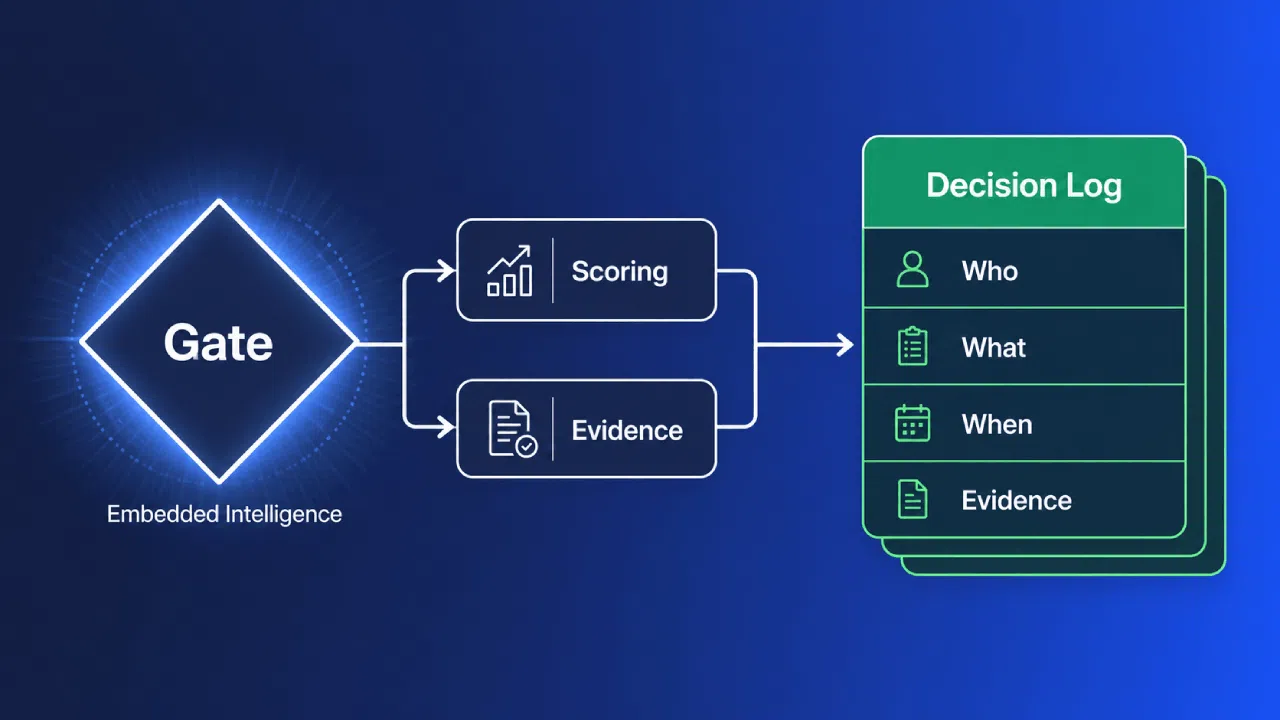
Traceability should be trustworthy by design, logged as the work happens. A decision log captures four things:
- Who made the call
- What they decided
- When the decision was made
- Which evidence supported it
Built that way, the record is a byproduct of deciding, not a separate task. The gate produces its own paper trail.
This is the one place AI belongs in the conversation, and it belongs here without hype.
AI can support scoring and surface the relevant evidence at the gate so the decision record stays consistent across projects.
The call itself stays with the people accountable for it. Tools amplify clarity; they don’t replace discipline.
That consistency compounds. A trustworthy record turns structure and transparency from a compliance cost into a return.
Set a Cadence That Fits the Portfolio
Governance runs on a rhythm, not on demand. Decisions that wait for the next available slot are decisions made late.
A workable portfolio cadence separates the timescales and gives each an owner:
- Annual strategy, owned by leadership, setting the bets and the boundaries.
- Quarterly prioritization, owned by the portfolio lead, reallocating against results.
- Monthly portfolio review, owned by the program owner, catching drift early.
Each layer has a distinct owner because shared ownership of a cadence tends to mean no one convenes it.
Then add the layer most systems skip: the look-back. Once a year, review whether the governance itself still earns its keep, and retire the parts that don’t.
Governance that never audits itself is the thing that calcifies, and the look-back is the only reliable brake on drift.
Start With the Slowest Decision, Not the Framework
Governance is a service. Judge it by the decisions it delivers, not by the elegance of its diagram.
Start where the delay is worst:
- Find the gate where good projects wait longest, and give it one clear owner.
- Make every gate decision live: advance, pivot, or stop, but never table it.
- Let the record write itself as the decision happens, not weeks after.
Don’t roll out a new gate model across every team at once. That’s how lean systems ossify into bureaucracy in the first place.
Fix the slowest decision first, then measure it. Companies organized around empowered product teams ship digital products around 40% faster than legacy incumbents.
As Cooper put it, as go the gates, so goes the process. Start with the gate that hurts, and let the rest follow.
Download our ebook on idea evaluation and governance, and learn how the right structure turns stage-gate reviews into faster, cleaner, and more defensible decisions.
Or book a demo to see how Accept Mission handles automated routing, escalation workflows, and the audit trail that keeps every gate decision traceable.











 English
 Dutch
 Portuguese
 Spanish
 French
 German
 Arabic
