
Governance Without Bottlenecks: Can You Decentralize Decisions Safely?13 min read

Item 3 on this month’s innovation board agenda is a EUR 15k customer test. It’s waited 3 weeks and sits directly above a multi-million platform bet.
Signs the board has become the queue:
- Small, reversible experiments wait as long as major funding calls.
- Teams hold back small asks until the next meeting just to get a slot.
- The board rarely kills anything.
- Nobody can say which decisions the board doesn’t need to see.
The tempting fix is to empower the teams. But without written boundaries that trades a slow queue for inconsistent calls, nobody can audit.
So can you decentralize decisions safely? Yes, if you delegate classes of decisions under a written model and keep a short list of controls at the center.
That list covers the criteria, the thresholds, a decision log, regular sampling and the right to pull authority back (because decision quality is what you’re accountable for).
Why Central Boards Turn Into Queues
Jeff Bezos named the mechanism in Amazon’s 2015 shareholder letter. He split decisions into 2 types by how reversible they are.
His case runs in 4 parts:
- Type 1: calls that are consequential and irreversible or nearly so, the “one-way doors.”
- Type 2: calls that, he wrote, “can and should be made quickly by high judgment individuals or small groups.”
- The drift: as organizations grow, he observed, there’s a tendency to run most decisions, including many Type 2 calls, through the heavy Type 1 process.
- The cost: in his words, “slowness, unthoughtful risk aversion, failure to experiment sufficiently, and consequently diminished invention.”
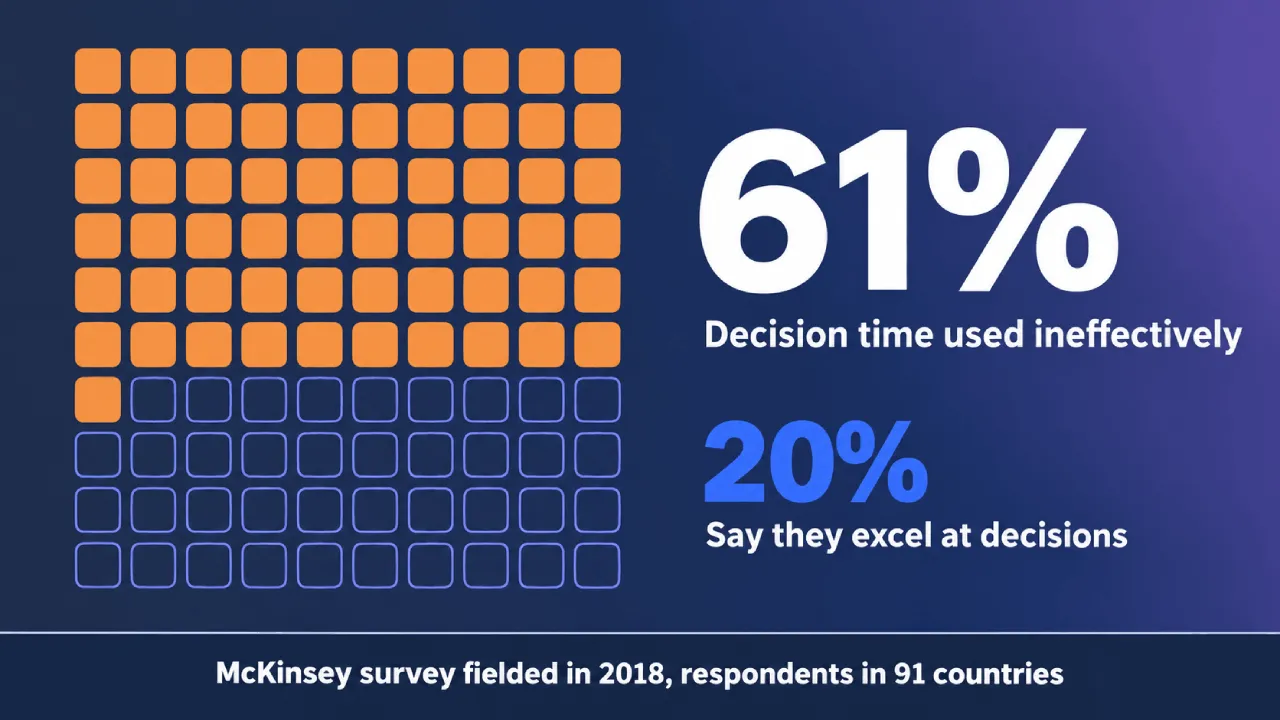
The time cost shows up in a 2018 McKinsey survey across 91 countries. Just over half of respondents reported spending more than 30% of working time on decisions.
Worse, 61% said most of their decision-making time is used ineffectively. Only 20% said their organizations excel at decision making.
Robert Cooper adds the portfolio consequence. A 2024 IRI study he co-authored notes managers “saying ‘yes’ to too many bad projects that should have been killed.”
Our read: a board busy approving small asks has less time to kill. The study points to gates that “fail to cull out the weaker or less valuable projects.”
Cooper’s 2021 paper on accelerating innovation shows the cost at one baby-care manufacturer. Its 16 active projects needed 60.7 FTEs against 26 available, 2.3 times capacity.
Delegate Decision Classes, Not People
The design mistake to fix first is the unit of delegation. Leaders delegate to a trusted person, and the authority walks out when that person does.
McKinsey’s 2017 guide to untangling decision making sorts decisions into types that include big-bet, cross-cutting and delegated ones. Delegated ones are “frequent and low-risk.”
In their words: “Placing the responsibility for these decisions in the hands of those closest to the work typically delivers faster, better, and more efficiently executed decisions.”
| Decision | Reversible? | Default class | Who decides | What the center keeps |
|---|---|---|---|---|
| Approve a small customer test under a set budget line | Yes | Delegated | Idea or project owner | Budget ceiling, test criteria, log entry |
| Move an idea from intake to enrichment | Yes | Delegated | Funnel or campaign owner | Intake criteria, log entry |
| Kill an idea at early screening | Mostly, it can come back | Delegated | Screening panel or stage owner | Screening scorecard, log entry, sampling review |
| Change scoring criteria or weights | Yes, but it ripples | Cross-cutting | Innovation director with unit leads | Final sign-off, version history |
| Fund a project past a major gate | Hard to reverse | Big bet | Innovation board | Everything, it’s the board’s call |
| Cross-unit bet that consumes shared capacity | Rarely | Big bet | Board with affected unit heads | Capacity allocation, portfolio view |
The mapping is ours, so move the lines to fit your mandate. What matters is that each row has a written owner.
The right-hand column has a pattern. Delegating a class never hands over the criteria, and the thresholds still come from the center.
Reversibility does most of the sorting: an idea killed at screening can return next quarter, while a major gate can commit people and budget for months.
But the awkward row is scoring criteria. Changing weights looks small, but it quietly changes every delegated call downstream, so it stays central.
Cross-unit bets stay up for a different reason. They consume capacity that other units are counting on, and no single team can see that trade.
Five Delegation Models and Where Each Breaks
There are 5 delegation models worth knowing, and each one breaks somewhere specific.
| Model | Who decides | Guardrail | Fits when | Breaks when |
|---|---|---|---|---|
| Threshold delegation | Whoever sits under the limit | Written limits on money, risk, reversibility | Decisions are frequent and comparable | Limits go stale, or requests get split to stay under them |
| Stage-based delegation | Stage owners early, the board late | Stage criteria that tighten as stakes rise | The funnel has clear, stable stages | Early gates rubber-stamp and push weak ideas upward |
| Guardrail budgets | Teams, inside a fixed envelope | Envelope size plus an approval threshold | Work is exploratory and hard to predict | The envelope becomes an entitlement nobody reviews |
| Advice process | Anyone, after seeking advice | Duty to consult affected people and experts | Trust is high and issues cross boundaries | Advice turns into a veto, or nobody’s consulted |
| Intent-based delegation | Whoever’s closest, within stated intent | Clear intent and shared context | Conditions change faster than meetings do | Intent is vague, so local calls drift apart |
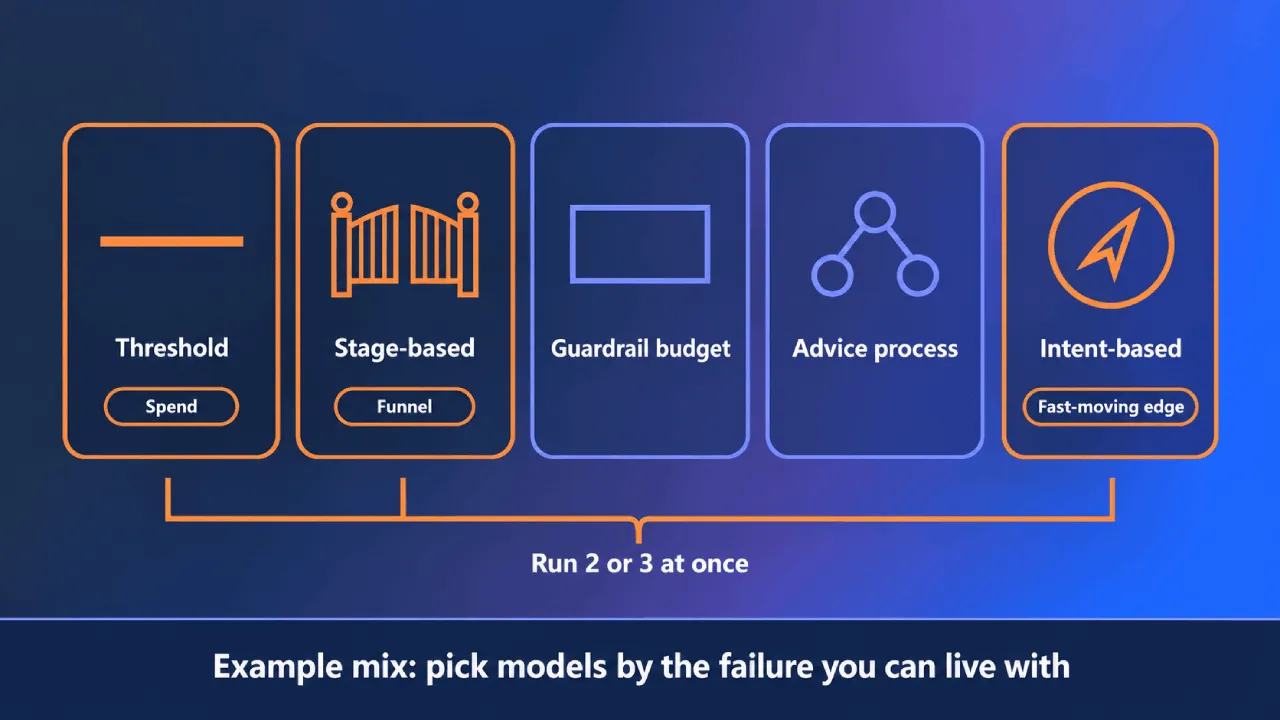
Pick by the failure you can live with, per decision class.
Expect to run 2 or 3 of these models at once: thresholds for spend, stage ownership for the funnel, and intent for the fast-moving edge.
Threshold Delegation
This is the classic delegation-of-authority matrix. Triggers such as budget, risk level and strategic importance decide who signs. Reversibility earns a place on that list too.
It fits frequent, comparable decisions.
The same McKinsey guide advises “thresholds for decisions that require approval (for example, spending above a certain amount),” plus a protocol for the rare call “kicked up the ladder.”
The weak spots are stale limits and gaming. Watch for requests landing just under the line, and sample those first.
Stage-Based Delegation
Stage owners run the early gates and the board keeps the late ones. Rigor scales with the stage, which matches how commitments actually grow.
It fits funnels with stable stages and shared stage criteria.
It breaks when early gates turn into formalities. A weak idea waved through at gate 1 becomes the board’s problem at gate 3.
Guardrail Budgets
Teams get a fixed envelope and choose freely inside it. SAFe’s Lean Portfolio Management uses portfolio guardrails to swap project-by-project approval for boundary-based governance.
The same write-up describes an approval threshold, so larger initiatives still go to formal portfolio review.
It fits exploratory work that’s hard to predict.
The risk is entitlement: an envelope nobody reviews turns into an annual allocation that teams stop giving back.
The Advice Process
Anyone can make a decision after seeking advice from those affected and those with expertise. The bigger the issue, the wider the net.
Dennis Bakke introduced the practice at AES. The same source says “almost all Teal organizations” use it in some form.
It suits high-trust teams facing cross-unit questions where no single owner exists.
In practice, it fails in 2 directions. Advice hardens into a veto, or people skip the advice and call it autonomy.
Intent-Based Delegation
A 2018 Joint Chiefs paper gives the doctrinal definition of mission command: “the conduct of military operations through decentralized execution based upon mission-type orders.”
Netflix’s culture memo applies the same idea to business:
- Context: the memo’s line is “context not control,” with teams “highly aligned and loosely coupled.”
- Ownership: each significant decision gets an “informed captain.”
- Commitment: others can “disagree then commit,” so debate doesn’t stall the call.
Donald Reinertsen explains the logic in his 2009 book on product development flow: “Decentralization is a logical response to unpredictable situations where response time is important.”
He also notes that “in its most advanced form, today’s military combines decentralized control with alignment.” Intent without that alignment drifts.
He’s candid about the fear, too. Product developers, he writes, often avoid decentralized control because they’re afraid it “will lead to chaos.”
Intent-based delegation fits where conditions change faster than meetings do.
The Guardrails That Make Delegation Safe
Whichever model you pick, the same 5 guardrails do the safety work. Each one is small on its own:
- Written thresholds. Money, reversibility, strategic domain and cross-unit capacity each get a line that moves a call upward.
- Shared criteria. Every local decider uses the same scorecard, so a delegated yes means the same thing in every unit.
- A decision log. Every delegated call gets an entry: the decision, the decider, the rationale against the criteria and the date.
- Pull-back triggers set in advance. Everyone knows which conditions pull a whole decision class back a level before any of them fires.
- A sampling review. Each cycle, the board reads a sample of delegated decisions instead of approving each one, which shows whether the other 4 work.
At Dutch home-care provider Buurtzorg, HBS Working Knowledge reported in 2023, nurse teams of no more than 12 decide which patients to accept and how to run their offices.
They adjust care plans without going through levels of clearance. A shared system and a standardized care taxonomy play the criteria-and-log role in another form.
Bayer’s Dynamic Shared Ownership model, in a company-narrated IMD case, embeds compliance experts inside teams.
In a regulated industry, the case says, that speeds up problem-solving and improves quality. It puts it plainly: “autonomy and regulation can work hand in hand.”
Software, and AI in particular, can summarize the decision log and flag calls sitting close to a threshold, so the sampling review reads patterns. People still make the calls.
The Trade-Offs Worth Naming
Decentralization has real costs, and the evidence says so. Treat these as design inputs.
| Trade-off | Source | What it found |
|---|---|---|
| R&D output vs. growth | A 2011 NBER working paper by Arora, Belenzon and Rios, covering 1,290 US listed firms | Firms with decentralized R&D invested less in R&D and generated fewer patents per R&D dollar, but also showed greater sales growth and higher market value. Centralized R&D looked more scientific and broader in scope. |
| Creative vs. routine work | An HBR piece in which Lee, Willis and Tian report their meta-analysis of 105 studies | Empowering leadership influenced creativity and citizenship behavior much more than routine task performance. |
| Divergence | ING’s agile transformation, which moved work to squads (McKinsey interview, 2017) | CIO Peter Jacobs still warned they risk going “in different directions” without alignment roughly “every quarter or six months.” |
| Drift in single records | The HBS piece on Buurtzorg | Nurses backdating a family meeting, tolerated because trust runs high there. |
The NBER result is a correlation. One fair reading is that local control buys commercial focus at some cost to research breadth.
For sequencing, the practical reading of the meta-analysis: delegate exploratory calls first, like which experiments to run. Keep routine, compliance-type calls on tighter rails for longer.
A board can keep the alignment rhythm Jacobs describes by setting a review cadence that includes a sampling review.
On its own, a backdated meeting is minor. But small drift compounds, and the sampling review exists to catch it before it becomes normal.
Is Your Organization Ready to Decentralize Yet?
Before you move a single class, check whether your organization can carry it. It isn’t ready yet if any of these is true:
- No shared scorecard exists, so a delegated yes would mean something different in each unit.
- The board can’t agree on written thresholds for money, reversibility or cross-unit capacity.
- Nobody owns a decision log, so delegated calls would leave no trail to sample.
- The board won’t commit to reading a sample of delegated calls each cycle.
- Pull-back triggers aren’t written down, so any retreat could land as a verdict on people.
Each gap closes with something written down. Start with one decision class, since the model doesn’t have to cover every class at once.
Once none of these holds for that class, the answer for your organization is yes. Delegate it, and let the sampling review show you when to widen the scope.
How to Pull Authority Back Without Breaking Trust
Delegation should be reversible by design. Write down when a decision class moves back up before you ever need to move one.
Typical triggers look like this:
- Repeated threshold breaches in one class or unit.
- Sampled decisions that ignore the shared criteria.
- A strategic shift that changes what counts as low-risk.
Give each class a starting level on Management 3.0’s 7 delegation levels, which run from Tell, Sell and Consult through Agree and Advise to Inquire and Delegate.
When a trigger fires, move the class back 1 level and record why in the log.
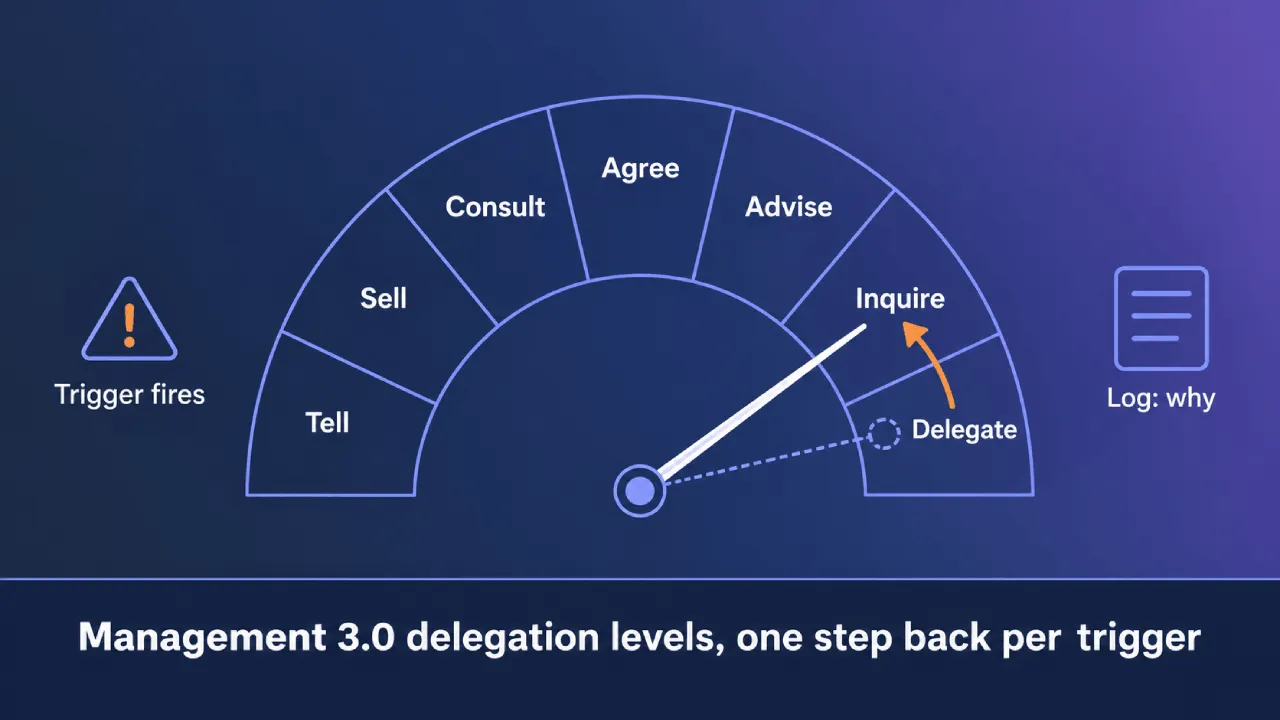
Treat the levels as a dial. A team at Delegate that slips can drop to Inquire, where it still decides and the board asks about it afterward.
Written triggers make a pull-back read as the system working. Without them, the same move can look like a verdict on people.
Restoring authority follows the same rule. The dial turns both ways, so after 2 clean review cycles, return the class to its earlier level.
Delegate the Class, Keep the Criteria
A board that approves everything ends up deciding nothing well. So yes, you can decentralize decisions safely with a model short enough to read in 5 minutes.
Start with these moves this quarter:
- Go through the last 2 quarters of board agendas and mark every small, reversible item.
- Pick 1 decision class and name its owner.
- Write that class’s threshold, criteria and pull-back triggers on one page.
- Get board sign-off, open the log and book the first sampling review before you hand the class over.
Plan for the first cycle to run slower, because writing criteria takes time. The payoff shows up once the class runs without board review.
Structure is what lets a board let go, so keep the criteria and hand out the class.
Download our ebook on idea evaluation and governance. It covers structured pipelines, scoring, governance frameworks, and the handoff from approved ideas into portfolio management.
Or book a demo to see how Accept Mission handles automated routing, escalation workflows, and audit trails, so delegated decisions stay visible to the board.








 English
 Dutch
 Portuguese
 Spanish
 French
 German
 Arabic
