
How to Run a Live Brainstorming Session That Produces Pipeline-Ready Inputs11 min read

Most live brainstorming sessions end the same way. A room full of energy, a wall of sticky notes, a photo someone takes for the shared drive, and then nothing.
Running one that actually delivers means addressing three specific points:
- How the session is designed before it starts
- How participants contribute during it
- How outputs are synthesized before anyone leaves the room
Most ideas from those sessions never reach a reviewer. There’s no structure before, during, or after to convert raw input into something evaluable.
Get those three phases right, and a one-hour session can produce 10 to 15 pipeline-ready inputs. Get them wrong, and you get a Miro board no one opens again.
Why Live Brainstorming Keeps Producing Noise
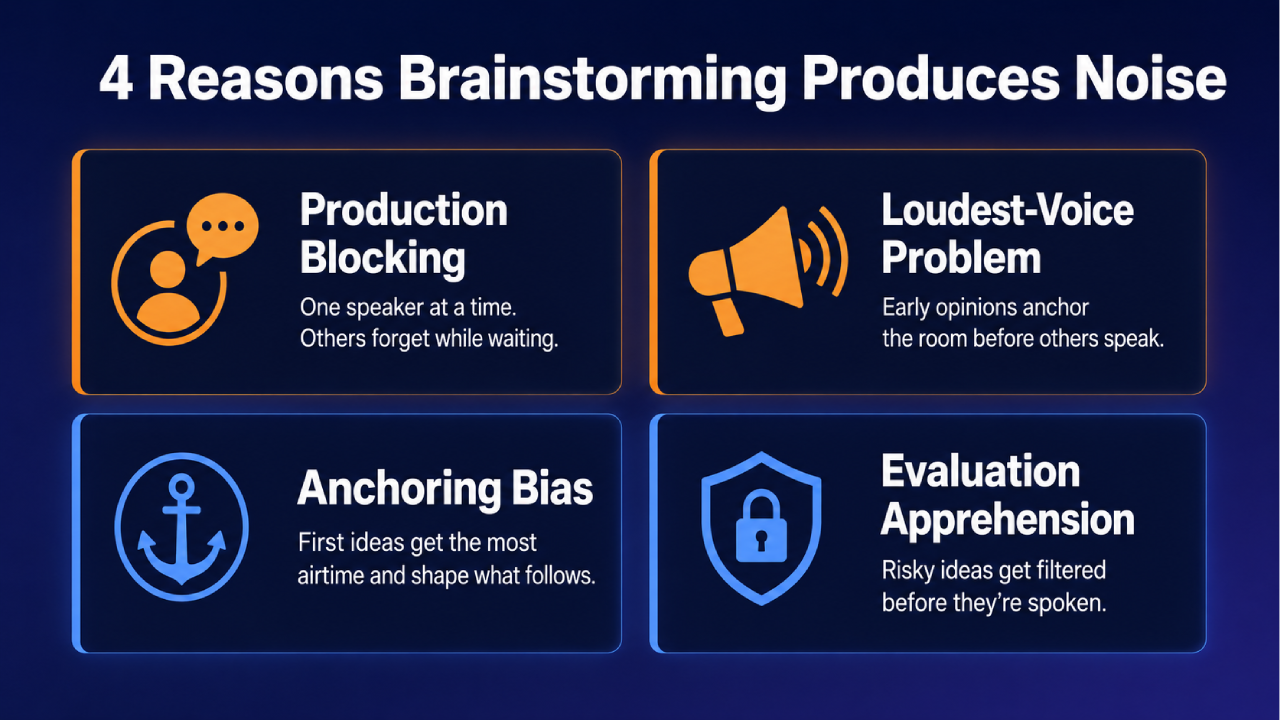
The problems with unstructured group ideation are well-documented and structural, not personal. Four failure modes show up in nearly every session.
- Production blocking. Only one person speaks at a time. While waiting, participants forget, abandon, or self-censor ideas they were ready to share.
- The loudest-voice problem. When a senior leader or vocal participant frames the discussion early, the rest of the room unconsciously shapes their contributions toward that framing.
- Anchoring bias. Early ideas get the most discussion time. Later contributions, often from quieter or more analytical participants, get less consideration.
- Evaluation apprehension. Even with explicit norms against criticism, people feel judged. Unconventional ideas get filtered out before they’re spoken.
The evidence is consistent. A meta-analysis of 241 studies involving 24,000 subjects found that group settings actively impair complex tasks like creative thought.
A 2005 Emory University experiment showed group conformity error rates jumping from 13.8% to 41% when peers gave unanimously wrong answers.
Even when a session generates good raw material, the synthesis step is usually absent: no clustering, no scoring, no standardized format, and no defined route into the pipeline.
The ideas decay as artifacts. The solution is adding structure at the three points where it’s currently missing.
Phase 1: Design the Session Before You Enter the Room
Pre-session design is the highest-impact intervention in the entire process. It determines whether the inputs you collect can be routed at all.
Start with the challenge scope. A session aimed at “improving customer experience” will produce a wall of vague suggestions.
A session aimed at “reducing onboarding time for enterprise customers from 14 days to under 7” will produce specific, evaluable ideas.
The standard framing tool here is How Might We. It reframes problems as opportunities and keeps the room from jumping to solutions before the problem is defined.
Next, consider who’s in the room. Group size matters more than people think.
Six to nine participants is the working range. Smaller groups lose diversity of perspective, and larger groups amplify every structural failure mode at once.
The participant mix should be deliberate.
You want a blend of people close to the problem, people downstream of it, and one or two people far enough outside the domain to ask basic questions that experts skip.
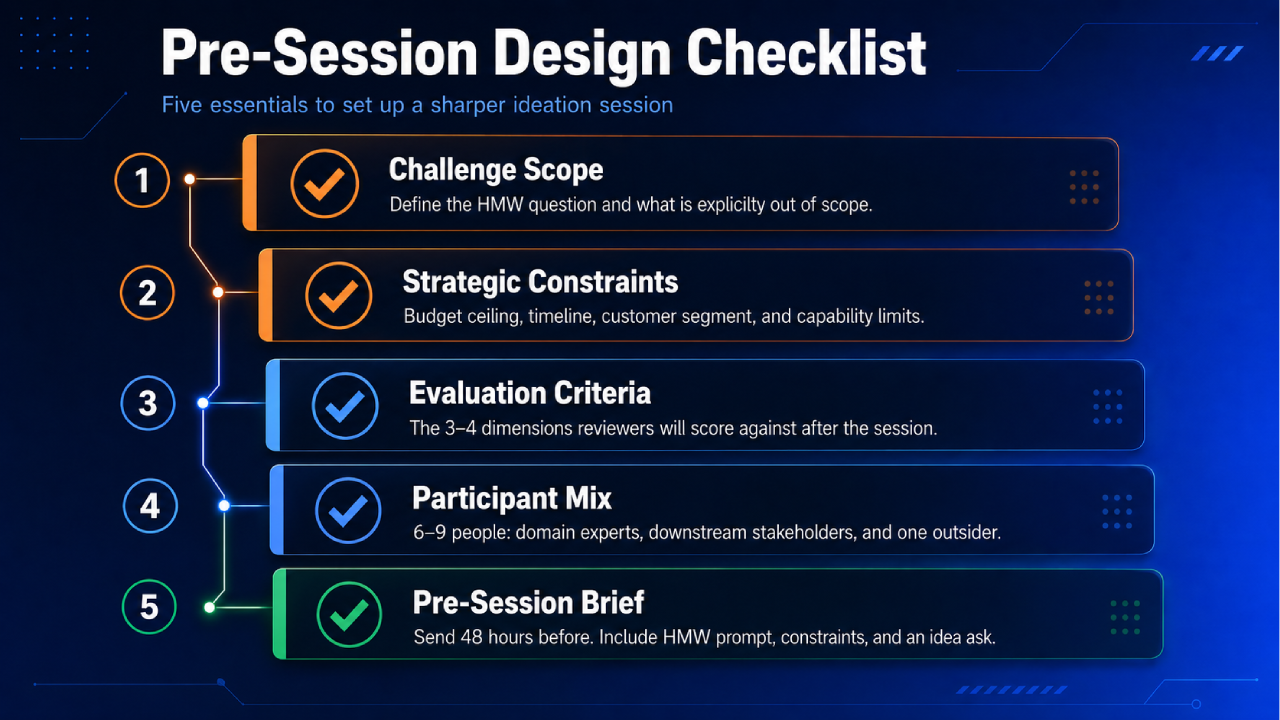
Send a pre-session brief 48 hours before the session. It should contain the HMW prompt, the strategic constraints, and the evaluation criteria you’ll use afterward.
Include an explicit ask for participants to come with two or three initial ideas already written down. This single step eliminates most of the warm-up phase.
| Element | What to Define | Why It Matters |
|---|---|---|
| Challenge scope | The HMW question and what’s explicitly out of scope | Vague scope produces vague inputs that can’t be evaluated |
| Strategic constraints | Budget ceiling, timeline, customer segment, capability boundaries | Prevents the session from generating ideas the organization can’t act on |
| Evaluation criteria | The 3 or 4 dimensions reviewers will score against post-session | Lets participants self-filter and shape inputs toward what matters |
| Participant mix | 6 to 9 people: domain experts, downstream stakeholders, outsiders | Balances depth with the fresh perspective that prevents groupthink |
| Pre-session brief | HMW prompt, constraints, criteria, ask for 2-3 pre-written ideas | Eliminates warm-up time and surfaces individual ideas before group dynamics start |
The point of pre-session design is to constrain the room before the room constrains itself.
As the research puts it, structure actually promotes creativity by keeping participants from “wasting brain power exploring way beyond the creative pasture where you want them to graze.”
Phase 2: Structure the Session So Everyone Contributes
The most consistent finding in brainstorming research is that individual ideation should come before group sharing. This correction addresses production blocking, anchoring, and evaluation apprehension all at once.
Two formats do this well.
- Brainwriting has participants write ideas simultaneously, in silence, for a fixed period. It eliminates production blocking entirely and produces more diverse idea sets than verbal brainstorming.
- Nominal Group Technique is the more rigorous version. It equalizes participation and produces a prioritized output you can use directly.
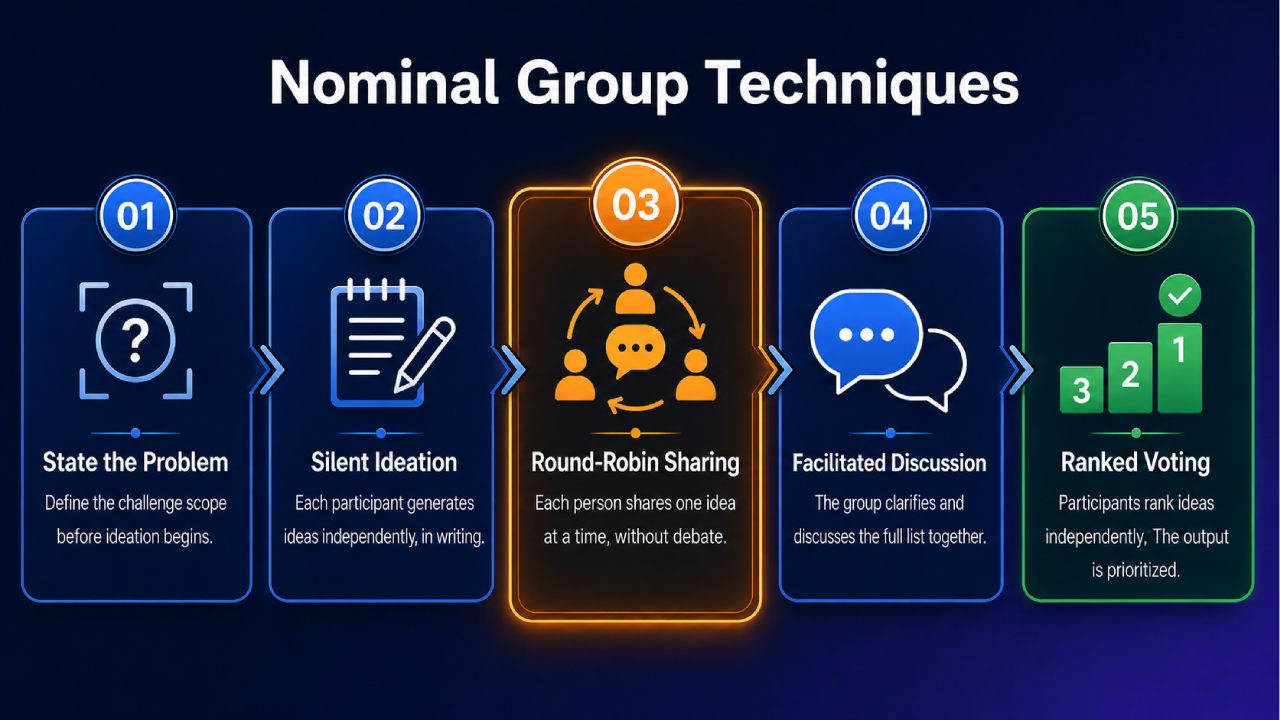
The ASQ definition breaks it into five steps: stating the problem, silent individual ideation, round-robin sharing without debate, facilitated discussion, then ranked voting.
Timebox every phase. A typical 90-minute session might allocate 15 minutes for silent ideation, 25 for round-robin sharing, 25 for clustering, 15 for voting, and 10 for synthesis.
Without timeboxes, discussion expands to fill the slot and synthesis gets cut. Research reviews consistently show that structured methods outperform unstructured ones on both volume and quality of ideas.
Writing Prompts That Get Specific Ideas
The prompt determines the quality of the input. Most facilitators write prompts that invite solutions before the problem is framed.
The result is a wall of suggestions with no underlying problem statement attached. Problem-first framing forces specificity.
Instead of asking “what should we do about X,” ask “what specific behavior or constraint is causing X, and where does it show up most clearly?”
| Vague Prompt | Specific Prompt |
|---|---|
| How can we improve customer onboarding? | Where in the first 14 days do new enterprise customers get stuck, and what removes that friction? |
| How can we use AI in our product? | Which manual workflow inside our product costs customers the most time, and what would replace it? |
| How can we reduce churn? | What signal in the first 30 days predicts churn most reliably, and what action would change that trajectory? |
| How can we innovate our services? | Which service moment generates the most negative feedback, and what would a fundamentally different version look like? |
| How can we grow revenue? | Which customer segment has the highest unmet willingness to pay, and what offer would capture it? |
The pattern is consistent. Anchor the prompt in observable behavior, name a specific constraint, and ask for a targeted intervention.
Vague prompts produce vague ideas. Specific prompts produce ideas a reviewer can evaluate without having to guess at intent.
AI tools extend this precision into the session itself, clustering incoming ideas in real time, surfacing duplicates, and flagging inputs that match earlier submissions from elsewhere in the organization.
Used as a signal amplifier, this shortens the synthesis phase substantially.
Phase 3: Synthesize Before Anyone Leaves the Room
This is where most sessions lose their output. The room ends, people leave, the sticky notes get photographed, and the synthesis step never happens.
The fix is simple: build synthesis into the session itself by reserving the last 20 minutes for it. No exceptions.
The standard tool is the KJ method, also called affinity mapping. Raw ideas cluster into thematic groups, each getting a short label that names the underlying pattern.
This converts 40 individual inputs into 6 to 8 themes. Each cluster still needs at least one pipeline-ready idea: a structured submission a reviewer can evaluate without interpretation.
What a Pipeline-Ready Idea Actually Looks Like
Kaizen Institute’s Idea Card is the minimum viable format. It contains five elements:
- Brief problem statement
- Proposed solution
- Estimated benefit
- Effort or investment required
- Named owner
This standardization does two things: it forces the submitter to think through the idea before passing it on, and it lets reviewers compare ideas fairly across a portfolio.
| Raw Input | Pipeline-Ready Input |
|---|---|
| “AI chatbot for onboarding” | Problem: Enterprise customers wait 4-6 hours for first-response support during onboarding. Solution: AI assistant trained on onboarding documentation, available 24/7. Benefit: Cut time-to-first-value by 30%. Effort: 8 weeks, 2 engineers. Owner: Maria, Product |
| “Better dashboards” | Problem: Customer success managers spend 6+ hours per week building manual reports. Solution: Templated executive dashboards with auto-refresh. Benefit: Reclaim 240 CSM hours per quarter. Effort: 4 weeks, 1 engineer. Owner: James, CS Ops |
| “Faster onboarding” | Problem: Average enterprise activation takes 14 days; target is 7. Solution: Pre-configured account templates by industry vertical. Benefit: Reduce activation time by 40%, increase Q1 conversion. Effort: 6 weeks, cross-functional. Owner: Priya, Implementation |
Pipeline-ready inputs let reviewers score directly. Raw inputs force interpretation first.
Assign ownership before the session ends. Every pipeline-ready idea gets a named person responsible for moving it to the next gate.
Without ownership, even good ideas stall in the gap between “submitted” and “reviewed.”
Building synthesis into the session itself is the highest-impact change most organizations can make. It’s also the one most often skipped.
Closing the Gap Between Session and Funnel
A pipeline-ready idea is only useful if there’s a defined route from the session output to the next evaluation gate. Most organizations don’t have one.
The handoff problem is straightforward. Ideas die because nobody knows where to send them, who reviews them, or what happens after review.
The session output sits in a shared folder, and the energy from the room dissipates within a week. A stage-gate idea funnel solves this.
The five core stages (collection, concept definition, business case development, MVP or testing, and implementation) each have defined evaluation criteria and named gatekeepers.
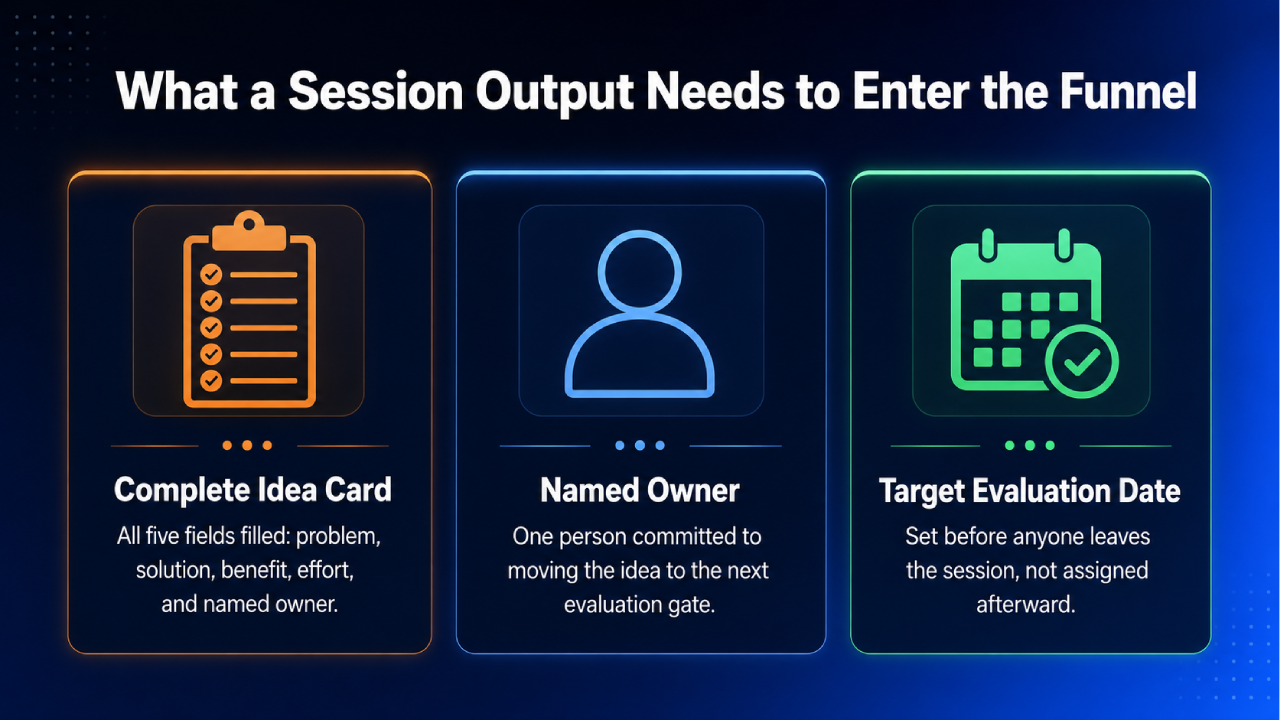
For a structured session output to enter the funnel cleanly, it needs three things:
- A complete idea card with all five fields populated
- A named owner who has committed to moving the idea forward
- A target evaluation date, set during the session itself
A digital platform changes this operating tempo. Once idea cards are entered into a system with scoring, routing, comments, and gate progression, the manual overhead drops sharply.
Reviewers score against pre-defined criteria, owners can see exactly where each idea sits, and executives see the full portfolio at a glance.
Organizations moving to structured digital funnels report real efficiency gains through data-driven scoring. The savings come from killing weak ideas earlier and routing strong ones faster.
The session structure makes the ideas good. The platform keeps that structure from collapsing the moment people leave the room.
Make Synthesis the Step You Never Skip
Structured live brainstorming is what makes creativity evaluable, comparable, and ready to fund.
Three elements determine whether a session produces pipeline-ready inputs:
- Individual ideation before any group sharing
- Prompts anchored in observable behavior
- Synthesis built into the session before anyone leaves the room
Pre-session design and prompt structure both matter. But the single highest-impact step, the one most organizations skip, is in-room synthesis.
The 20 minutes at the end of a session, where raw inputs become Idea Cards with owners and target review dates, is what determines whether the session produces anything at all.
Build all three in. Run them consistently and you walk out with pipeline-ready inputs, every time.
Download the free guide Idea Collecting: From Organizational Signals to Ideas and learn how to design sessions that feed your pipeline with structured, evaluable inputs.
Request a demo to see how Accept Mission gives you full visibility into submission quality, stage progression, and campaign engagement across every active innovation funnel.







 English
 Dutch
 Portuguese
 Spanish
 French
 German
 Arabic
