
Live Brainstorming Prompts: 50 Questions to Ask in Your Next Session16 min read

A brainstorming session runs on the question you put in front of the room. What comes back depends on how you worded it.
Here’s what a loose prompt leaves unsaid:
- who acts on the answer
- which constraint the answer can’t break
- what counts as evidence in this room, and what’s just opinion
- how much detail makes an answer finished
None of that registers as a problem on the day. A vague question is easy to answer, so the hour feels productive right up until it ends.
The cost lands at the review gate weeks later, when nobody can score what came back.
The 50 questions below are grouped by the job each one does inside your session. They’re worded to be read out loud, exactly as written.
Why Most Session Prompts Fail Before Anyone Answers
Innovation managers rarely have an idea-volume problem. What you have instead is a pile of session output nobody can evaluate.
That gap has a shape.
Researchers studying how people judge ideas split idea quality into 4 dimensions. The last one is what open prompts skip.
None of this argues for asking fewer questions. Designers handed a structured list of scenario questions generated more ideas for shifting needs, and higher-quality ones.
The 4 Things a Reviewer Needs From an Idea
Each dimension answers a different question – each has to be requested explicitly. A prompt that skips one gets output that skips it too.
| Dimension | What a reviewer is asking | What the prompt has to name |
|---|---|---|
| Novelty | Is this original, or a repeat of something we’ve already seen? | The approaches already tried, so people can step past them |
| Workability | Can we implement this without breaking a known constraint? | The constraint itself: budget, headcount, system, regulation, timeline |
| Relevance | Does this address the problem we actually stated? | The problem, narrowed to one specific process or moment |
| Specificity | Is it worked out in enough detail to act on? | The unit of a complete answer, and who has to act on it |
Specificity is the dimension that quietly sinks a session. The definition in that framework is blunt: an idea is specific if it’s “clear (worked out in detail).”
Nothing about a wall of sticky notes forces that. Someone can contribute for 90 minutes and never write down who does the work.
So your prompt has to carry it. If the question doesn’t ask for an owner, a constraint and a first action, the answer won’t have them.
More Ideas Won’t Fix a Selection Problem
The obvious response is to generate more. That’s been tested, and it doesn’t hold.
The order the room works in matters more than the number of ideas in it. Run the session in 3 moves:
- Everyone generates ideas alone, before the group talks
- Everyone rates the pooled ideas alone
- The group discusses only after both are done
Groups whose members generated ideas alone before comparing them produced roughly twice as many ideas as groups working together throughout, and more good ones.
Then the same research checked what those groups actually picked. Selection was barely better than random.
In a separate study, that same sequence produced a better best idea than working as a team throughout.
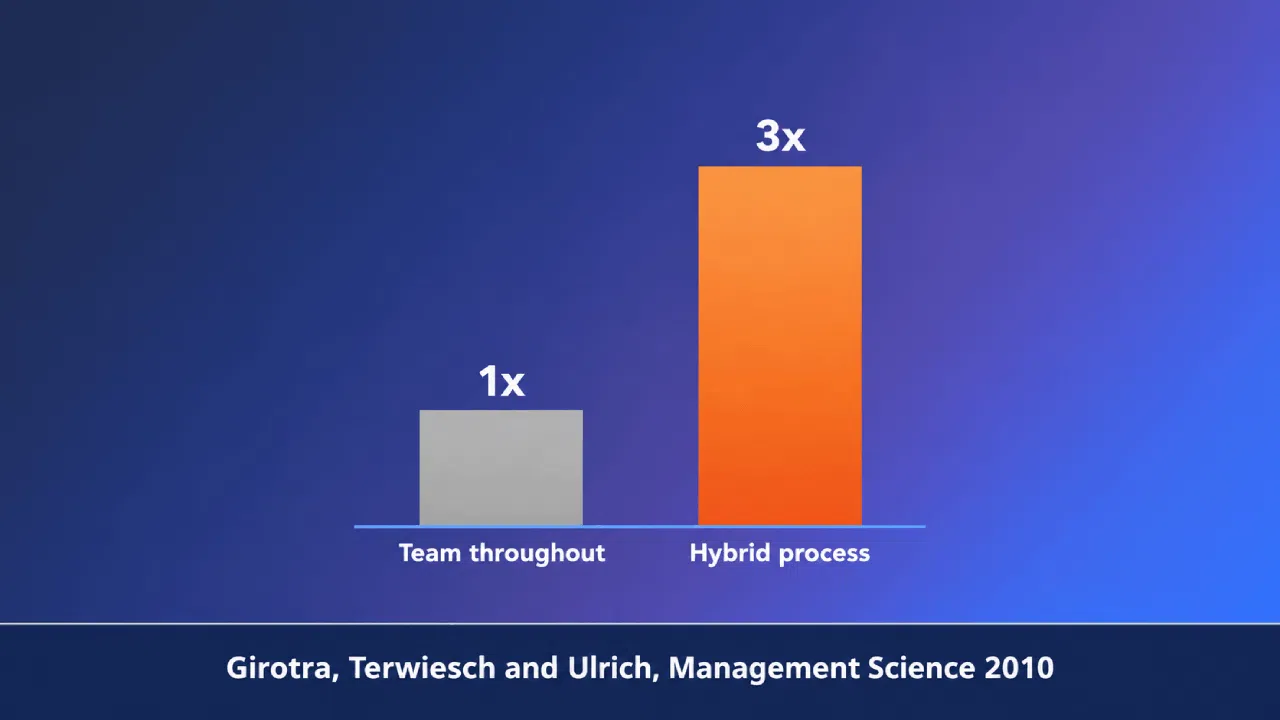
That came from volume and average quality. The hybrid produced about 3 times as many ideas per unit of time.
Handing a group more good ideas didn’t make it choose better ones. That’s why your prompt library needs convergence questions, as scripted as the divergence ones.
What a Well-Scoped Prompt Actually Contains
A scoped prompt names 5 things. Drop one and the answers drift toward whatever’s missing.
Here’s what each element settles:
| Element | The question it answers | What happens when it’s missing |
|---|---|---|
| Actor | Who does the work once this ships? | Ideas arrive with no owner and stall at intake |
| Constraint | What does the answer have to respect? | Proposals ignore budget, headcount or system limits |
| Evidence | What makes this claim credible? | Opinion and observation compete on equal footing |
| Horizon | By when does this have to be true? | Quick fixes get scored against multi-year bets |
| Unit | What does a finished answer look like? | One person writes a sentence, another writes a page |
The 5 elements don’t all need to appear in every question. They need to appear across the set you use in one session.
Framing questions carry the constraint and the evidence. Capture questions carry the actor and the unit.
That division matters more than the wording of any single prompt. A session with 20 well-scoped questions and no capture step still ends with nothing a reviewer can score.
The Constraint Is the Part That Does the Work
Constraints have a reputation for narrowing thinking. The experimental evidence points the other way.
A constraint worth naming is a boundary the answer has to respect. 4 kinds do most of the work in a session prompt:
- Budget: what the answer is allowed to cost
- Timeline: how soon it has to be running
- System: what it has to work inside
- Team: who’s available to do the work
In one study, people writing a short rhyme with an assigned noun produced work judged more creative than their own unconstrained rhymes. It replicated with self-chosen nouns.
That’s a 2-line rhyme, so read it as a signal about how the mind handles a boundary. It isn’t proof that any constraint improves any prompt.
The relationship isn’t linear either. A 2019 cross-disciplinary review argues for an inverted U-shape between constraints and creative output.
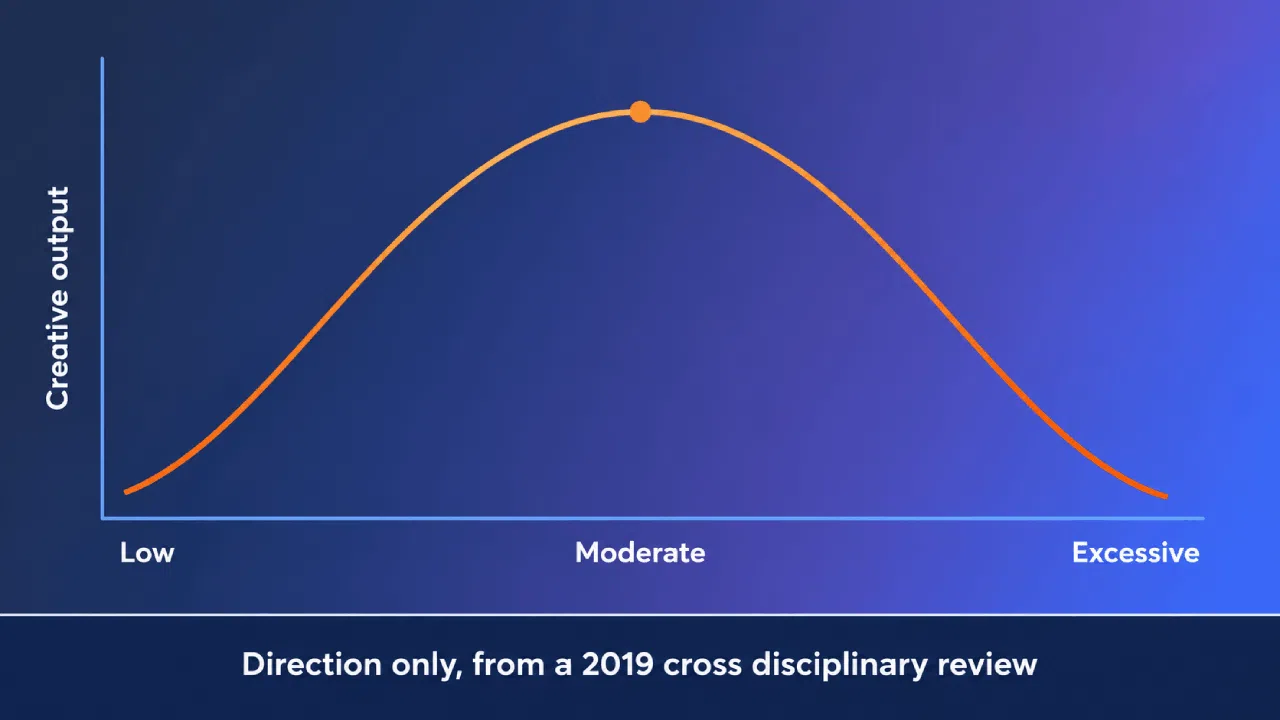
Moderate constraint motivates experimentation and risk-taking. Excessive constraint discourages the very risk-taking you called the session to get.
In practice that means 1 or 2 real limits per prompt. Name all 4 kinds at once and you’ve described the status quo back at people.
How to Sequence 50 Prompts Across One Session
Prompts have an order. Ask a stress-test question during divergence and the room stops proposing anything.
Here’s the sequence and roughly where each block belongs:
| Block | Job it does | When it runs | Prompts |
|---|---|---|---|
| Framing | Agree what we’re solving and for whom | Before anyone proposes | 1 to 8 |
| Divergence | Open the space without losing the scope | First working half | 9 to 20 |
| Specificity | Turn a suggestion into a proposal | Immediately after divergence | 21 to 30 |
| Stress-test | Find the failure before the funnel does | Once shortlisting starts | 31 to 38 |
| Convergence | Choose without running a popularity contest | Final third | 39 to 45 |
| Capture | Write down what a reviewer will need | Last 20 minutes | 46 to 50 |
2 structural choices matter more than which questions you pick. The 1st is that people answer in writing, alone, before the group talks.
When researchers manipulated turn-taking directly, people produced about twice as many ideas with no wait for the floor. Their own recommendation: generate individually first, discuss second.
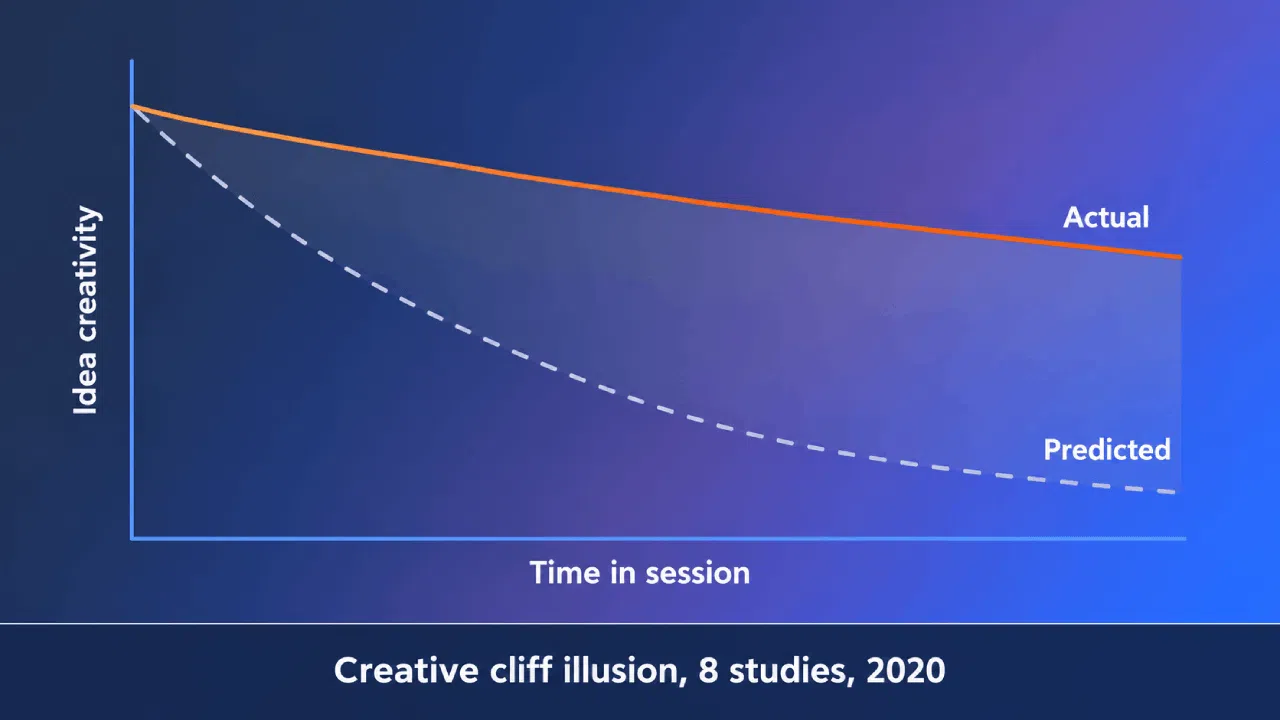
The second is that you don’t stop early. Output per minute drops as a session runs, and people expect their creativity to drop with it.
Across 8 studies, it fell far slower than predicted. Rooms quit right where the answers get interesting, so keep prompting.
Facilitation is the other variable worth spending on. Face-to-face groups with a trained facilitator matched the pooled output of people generating separately.
Framing Prompts: Questions 1 to 8
Framing questions run before anyone is allowed to propose a solution. They take 15 minutes and they decide whether anything after them is worth scoring.
The failure they prevent is subtle. People with stronger problem construction ability tend to produce higher-quality, more original solutions.
That’s a measured ability, not a technique. The framing block forces that work into a room that wouldn’t do it unprompted.
Read these out one at a time and have everyone answer in writing:
- What decision will this session’s output feed, and who makes it?
- Which specific process, moment or handoff are we talking about, and where does it start and stop?
- What have we already tried here, and what happened?
- Who feels this problem most, and how would they describe it in their own words?
- What evidence tells us this is a problem, and how old is that evidence?
- What’s currently working that we shouldn’t break?
- What’s out of scope today, and who decided that?
- If we solve this well, which number moves, and by when?
Questions 5 and 6 are the easiest to skip, and they save time later. Question 5 catches a problem that’s 2 years stale.
Question 6 is cheap insurance. Expect sessions that never ask it to produce proposals that quietly break something another team depends on.
There’s a longer tradition behind this. Art students given an open-ended task divided themselves by behavior.
The ones who explored the objects before committing produced work critics rated as more original, and were far more successful 5 years after graduation.
Nobody assigned them, and the sample was small, so read it as correlation. Time spent on the problem isn’t time lost from the solution.
Divergence Prompts: Questions 9 to 20
Divergence is where the scope usually escapes. The fix is a question with a boundary already inside it.
Each of these moves one variable and holds the rest still:
- What would we build if the budget were a tenth of what it is?
- What would we build if the budget were 10 times what it is?
- Which step in this process would a customer delete if they could?
- What does another industry already do about this, and what would that look like here?
- Where are people already working around this problem without telling us?
- What would we do if the person who owns this constraint left tomorrow?
- If we had to fix this in 2 weeks using only the people in this room, what would we do?
- What are we doing here only because we’ve always done it?
- Which part of this would we never rebuild if it broke tomorrow?
- What would a competitor with no legacy systems do here first?
- What would make this problem irrelevant instead of solved?
- Which of our current constraints is a policy rather than a physical limit?
Questions 9 and 10 work as a pair, so ask them back to back.
The cheap version exposes what’s essential. The expensive one exposes what people have privately given up on.
Question 13 is the highest-yield question on this list. Workarounds are evidence a process is broken, and the people running them know the fix.
Question 20 tends to produce an uncomfortable silence. Often that’s a constraint everyone assumed was permanent turning out to be an old decision.
Anonymous electronic groups produced more nonredundant ideas than non-anonymous ones. A separate study found no effect on output.
How Far to Reach for an Analogy
Question 12 borrows from another domain, and how far you reach changes what comes back.
Across 1,651 design concepts, near-domain examples improved the feasibility and usefulness of what people produced, while far-domain examples improved novelty but not feasibility.
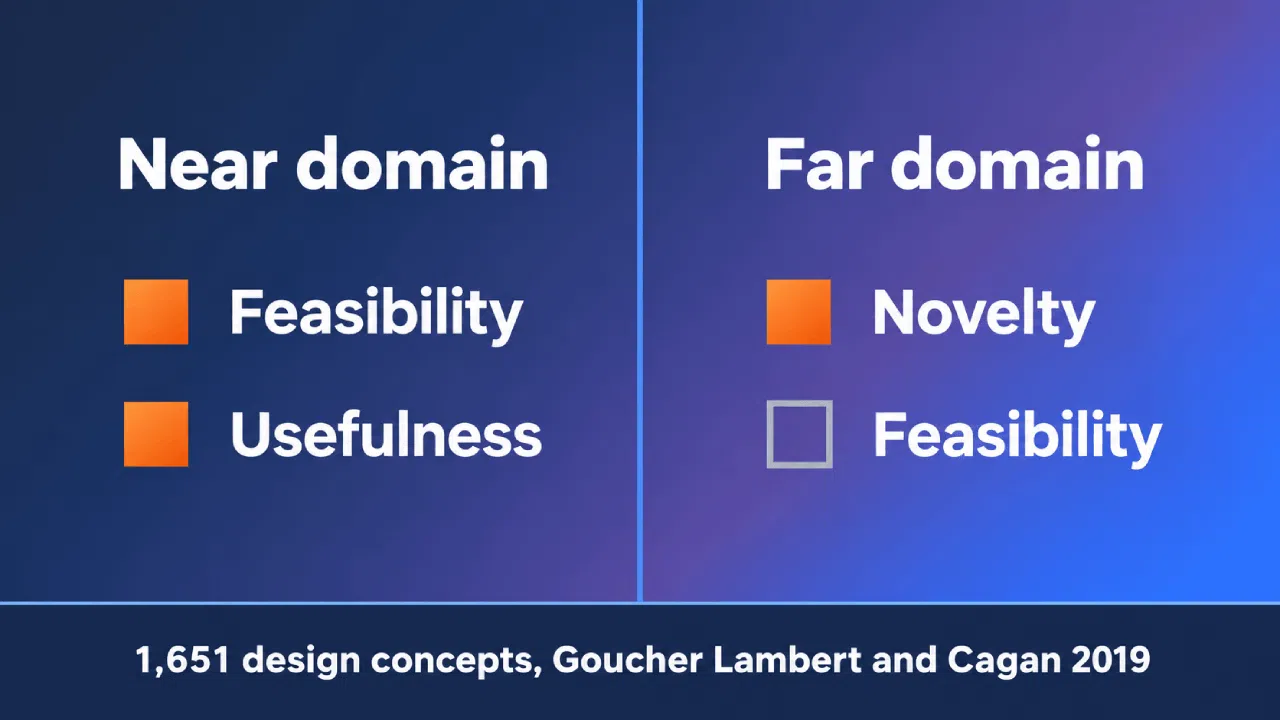
So pick the distance on purpose. Reach into an adjacent sector for something shippable this year, and further when the approach has plateaued.
Specificity Prompts: Questions 21 to 30
Sessions skip this block. That’s why review boards send things back.
Take 5 minutes at the end of divergence to cut to the 6 or 8 ideas worth developing. Run this block on those. Do it while each idea’s author is still in the room.
Work through them per idea, not per person:
- Who exactly does this, and how does their week change once it’s live?
- What’s the smallest version we could run in one team next quarter?
- What has to be true for this to work, and which of those do we already know?
- What would we build, buy, or stop doing to make this happen?
- Which team owns the part of this we can’t do ourselves?
- What does this cost in people, not currency, for the first 3 months?
- What would we measure in week one to know it’s working?
- Which existing system does this touch, and who administers it?
- If we showed this to the person who approves it, what’s the first thing they’d ask?
- What’s the one-sentence version, written so a stranger could repeat it?
Question 22 does more work than the rest of this block. It converts an ambition into something with a scope, a team and a date.
Question 29 is a cheap gate to run. Rework at review turns on questions the author could have answered in the room.
Question 30 exists because ideas travel without their authors. An idea that can’t survive one sentence won’t survive a handoff.
Expect this block to feel slower than the rest.
That’s the trade: work that would otherwise happen at a review meeting moves into a room where the author can still answer.
Stress-Test Prompts: Questions 31 to 38
Stress-testing before convergence sounds premature. It works because a shortlist built without it converges on whatever was argued most confidently.
The bias is well documented. People seek and accept evidence that supports a hypothesis they hold, and resist information that cuts against it.
Run these on the shortlist, not on every idea:
- It’s a year from now and this failed. What killed it?
- What would have to be true for this to be a bad idea?
- Who inside the organization loses something if this works?
- What evidence would change our minds, and can we get it cheaply?
- Where has this been attempted before, inside or outside, and how did it end?
- What’s the most expensive assumption here, and what does testing it cost?
- If the pilot works, what breaks at 10 times the volume?
- Which part of this depends on people behaving differently than they do now?
Question 31 is a premortem – the framing is doing the work. Assuming failure has already happened gives people with reservations a safe way to raise them.
Question 33 is the one facilitators tend to leave out. Its answer explains a lot of stalled projects. An idea that’s technically sound and politically homeless will sit at a gate indefinitely.
Question 34 borrows from a decision checklist for executives reviewing a recommendation. Its authors ask what information you’d want if you were deciding again in a year.
Keep this block short and timeboxed. Stress-testing has no natural stopping point, and a room left in it too long stops proposing anything.
Convergence Prompts: Questions 39 to 45
Convergence is where sessions revert to a show of hands. That’s the step the selection research says is close to blind.
Have people answer 39 privately, in writing, before anyone speaks:
- Which 3 would you fund, in what order, and why that order?
- Which of these solve the same underlying problem, and which is the better route to it?
- If only one starts this quarter, which one, and what does that delay?
- Which of these is cheapest to kill if we’re wrong?
- Which are we drawn to because they’re interesting rather than because they matter?
- What would have to be true for the bottom-ranked idea to be the best one?
- Which of these needs a decision from someone not in this room, and by when?
The private-first instruction on question 39 isn’t a formality. Individual rating before group discussion is the structural difference in the research above.
Question 42 changes what gets funded. Cheap-to-kill options let a portfolio run more bets, and expected value alone doesn’t capture that.
Question 43 works better asked out loud than inferred from the ranking. It’s a fast way to separate a promising bet from an interesting one.
Question 45 prevents a common post-session stall.
An idea awaiting a decision from someone not in the room isn’t approved, and treating it as approved is how a funnel fills with stalled work.
Capture Prompts: Questions 46 to 50
Capture is the difference between a session and a photograph of a wall. Reserve the last 20 minutes for it and don’t let the agenda eat them.
Every idea that made the shortlist gets these 5 answered in writing:
- In one sentence, what problem does this solve, and for whom?
- Who’s the named owner taking this to the next gate, and did they agree out loud?
- What’s the single next action, and what date is on it?
- What did we decide not to pursue today, and for what reason?
- What did we learn here that changes how we’d frame the next session?
Question 47 is the one people negotiate around, and “did they agree out loud” is deliberate. A name assigned in absence is a note, and notes don’t move.
Question 49 is the most undervalued line here. A record of what you rejected, and why, stops it returning next quarter as a fresh proposal.
Volume becomes an asset only once this step is reliable.
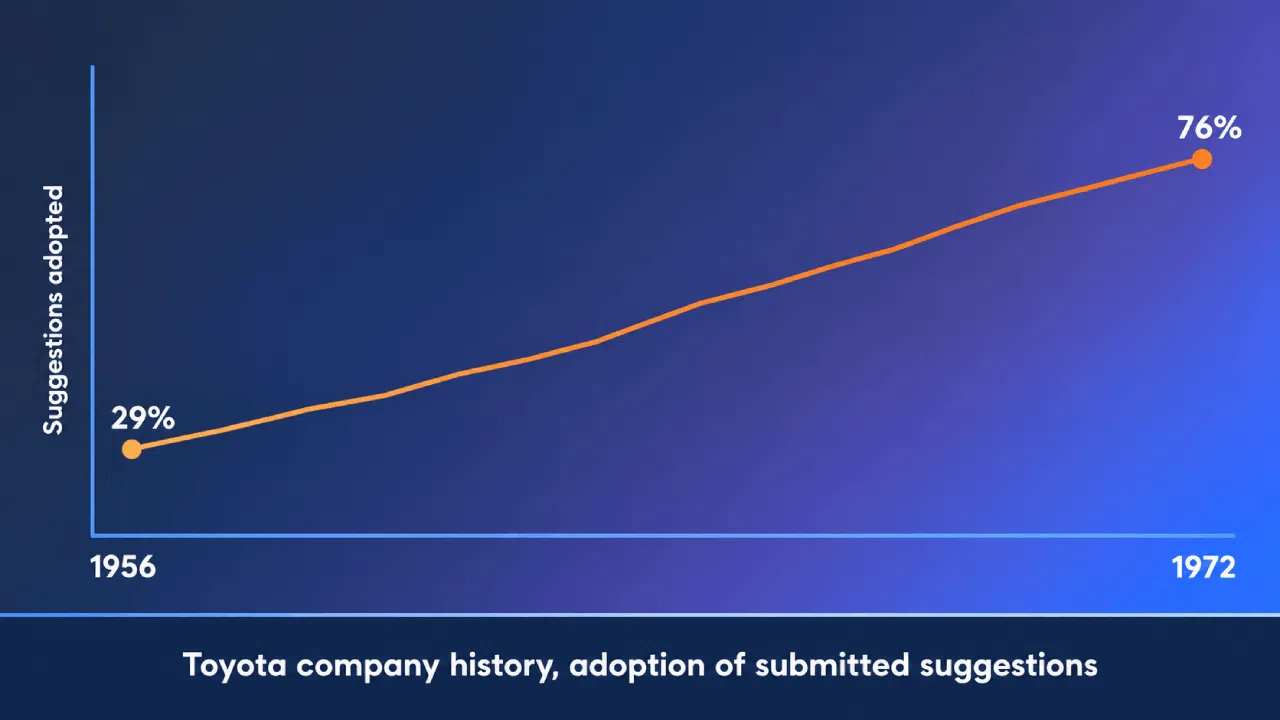
Toyota’s own history reports suggestion adoption rising from 29% to 76% between 1956 and 1972. The same page notes the submission procedure was carefully devised.
Question 50 closes the loop back to framing. The wording that produced thin answers this time is the wording to fix before the next one.
Write the Question, Then Write the Answer You’d Accept
Prompt design has one reliable test, and it takes a minute. Before the session, write the answer you’d be happy to receive.
Check that draft answer for 3 things:
- it names an owner
- it respects a constraint you actually stated
- it’s specific enough for a reviewer to score without asking what you meant
If your own model answer can’t clear that bar, the question won’t produce one that can.
Rewrite the prompt until it does. The sequence is what carries a raw thought to a scored proposal.
Download the free guide Idea Collecting: From Organizational Signals to Ideas and learn how to build a collection process with a clear path to decision.
Or request a demo to see how Accept Mission gives you real-time visibility into submission quality, stage progression, and campaign engagement across the funnel.








 English
 Dutch
 Portuguese
 Spanish
 French
 German
 Arabic
