
From Idea to Execution: The Power of AI Assistants (Agents) in Driving Innovation11 min read

Innovation isn’t what it used to be, and I dare say that that’s a good thing.
With 78% of companies now using AI to boost performance, it’s clear that automation is becoming part of everyday work.
But what about innovation work?
That’s where AI assistants come in. These tools are helping teams think smarter, act faster, and actually enjoy the process of turning ideas into action.
In this article, let’s break down what AI assistants do and how they’re changing the innovation game.
Not Familiar with AI Assistants? Here’s What You Need to Know
Not everyone has worked with AI assistants yet, and that’s okay. These tools are fairly new in the innovation space, but they’re quickly making a big impact.
Here’s a quick list of what AI assistants are all about:
- They automate tasks
- They guide decision-making
- They support creative thinking
- They provide structure
AI assistants are designed to be easy to use and helpful across many roles.
You don’t need to be a tech expert to work with them. In innovation projects, they often act like a smart teammate, ready with suggestions, reminders, or extra context.
And since they run on real-time data or trained inputs, they offer fast, reliable input when your team needs to move quickly.
Meet the AI Innovation Agents from Accept Mission
Accept Mission has built a reputation for making innovation more practical and results-driven.
It’s not just about generating ideas, it’s about creating a full system that helps teams move from insight to impact.
That’s where their AI Innovation Agents come in:
1. Problem Discovery
Problem Discovery is one of the first and most important steps in innovation. Well, you can’t solve what you don’t fully understand. 😅
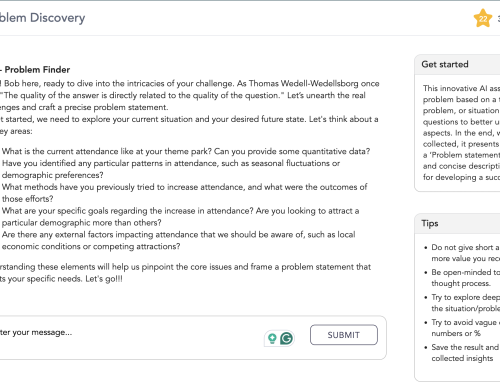
Accept Mission’s AI assistant for problem discovery helps you define the actual problem, not just what appears on the surface.
It guides users with smart prompts to clarify vague ideas, uncover root causes, and build a complete picture of the situation.

Basically, it works like this:
- You begin by entering a short topic, whether it’s an idea, challenge, or situation.
- The assistant asks follow-up questions to help unpack the real issue.
- The more details you provide, the better the assistant understands your situation.
When it gathers enough context, it writes a clear “problem statement” that sums up everything.
This kind of support is especially helpful when teams are dealing with fuzzy ideas or conflicting viewpoints.
Instead of spending hours in meetings trying to align on what the problem is, the AI keeps things structured and objective.
It asks the same sharp questions a business analyst would, but faster and without bias, so teams can move forward with confidence, knowing they’re solving the right thing from the start.
2. Campaign Builder
Once you’ve defined the problem, it’s time to take action, and that’s where the campaign builder comes in.
Accept Mission’s AI assistant for campaign building helps you create a full-blown innovation campaign, step by step.
No more blank screens or guessing what goes where. This assistant asks all the right questions to help you shape your campaign.
It covers everything from the:
- Topic
- Target audience
- Goals
- Planning and timeline
When you’re done, you get a structured campaign plan that’s ready to go.

Here’s how it works:
- You begin by entering the topic of your campaign.
- The assistant asks you about your goals, audience, and key steps.
- You answer each prompt, building your campaign as you go.
- At the end, it creates a highlight plan with everything mapped out.
You get a clear, organized campaign plan without having to start from scratch, which is a great way to keep innovation campaigns focused and aligned.
Here’s the kicker: you can then use Accept Mission’s campaign creator and enter the details that you got from the builder earlier:

Whether you’re planning a new idea challenge, product concept round, or internal improvement mission, the assistant makes sure no key details are missed.
It’s like having your own innovation planner, on demand. 😉
Ready to launch smarter innovation campaigns? Book a demo with Accept Mission and see the AI assistant in action! 🚀
3. Trend Researcher
Good innovation doesn’t happen in a vacuum. You need to know what’s happening around you, and that’s trend researcher is all about.
Accept Mission’s AI assistant for trend research helps you gather trends related to a company, its sector, and the broader industry landscape.
It does the heavy lifting by scanning across different layers:
- Company
- Industry
- Tech
To bring you a clear picture of what’s current.

All you have to do is share the company name, and the assistant guides the rest. No guesswork, no endless Google searches.
Basically, it works like this:
- You start by entering the name of a company.
- The assistant identifies the company’s sector and industry.
- It then pulls in the latest business, market, and tech trends.
- You get a structured report showing trends by layer: sector, industry, and company level.
It’s a fast way to get ahead of what’s coming and what your competitors might already be acting on.
This tool is especially useful for kickstarting idea sessions or building a strategy around real-world changes.
Whether you’re planning a product, setting up a campaign, or just doing some research, the assistant helps your team start from a smarter place.
You get sharper ideas, grounded in what’s actually happening out there.
4. Idea Enricher
Sometimes a good idea just needs a little boost. 💡
The idea enricher assistant helps turn half-formed thoughts into clear, structured, and compelling ideas, ready to pitch or move forward.
Whether you’re working solo or in a team, this AI assistant guides you through defining your idea’s purpose, background, and potential.
It asks helpful questions that bring clarity and direction, and by the end, you get a polished idea summary that feels more like a mini business case.

Here’s how:
- You start by entering your idea in a sentence or two.
- The assistant asks for more details: the background, the problem it solves, and why it matters.
- You fill in each part, shaping the idea as you go.
- It wraps up with a refined summary and even a pitch-ready version.
The goal is to help you present ideas that are easy to understand and hard to ignore.
This is especially helpful when ideas are still rough or hard to explain. It brings structure without killing creativity.
By helping you explore the “why” and “how” behind the concept, the assistant makes sure your idea has the depth it needs to stand out.
5. Maturity Quick Scan
How ready is your organization to innovate, really? 🤔
The maturity quick scan helps you find out by measuring your innovation capability across five key areas:
- Process
- Goals
- People
- Management
- Tools
This AI assistant walks you through a short assessment that reveals your strengths, gaps, and opportunities.
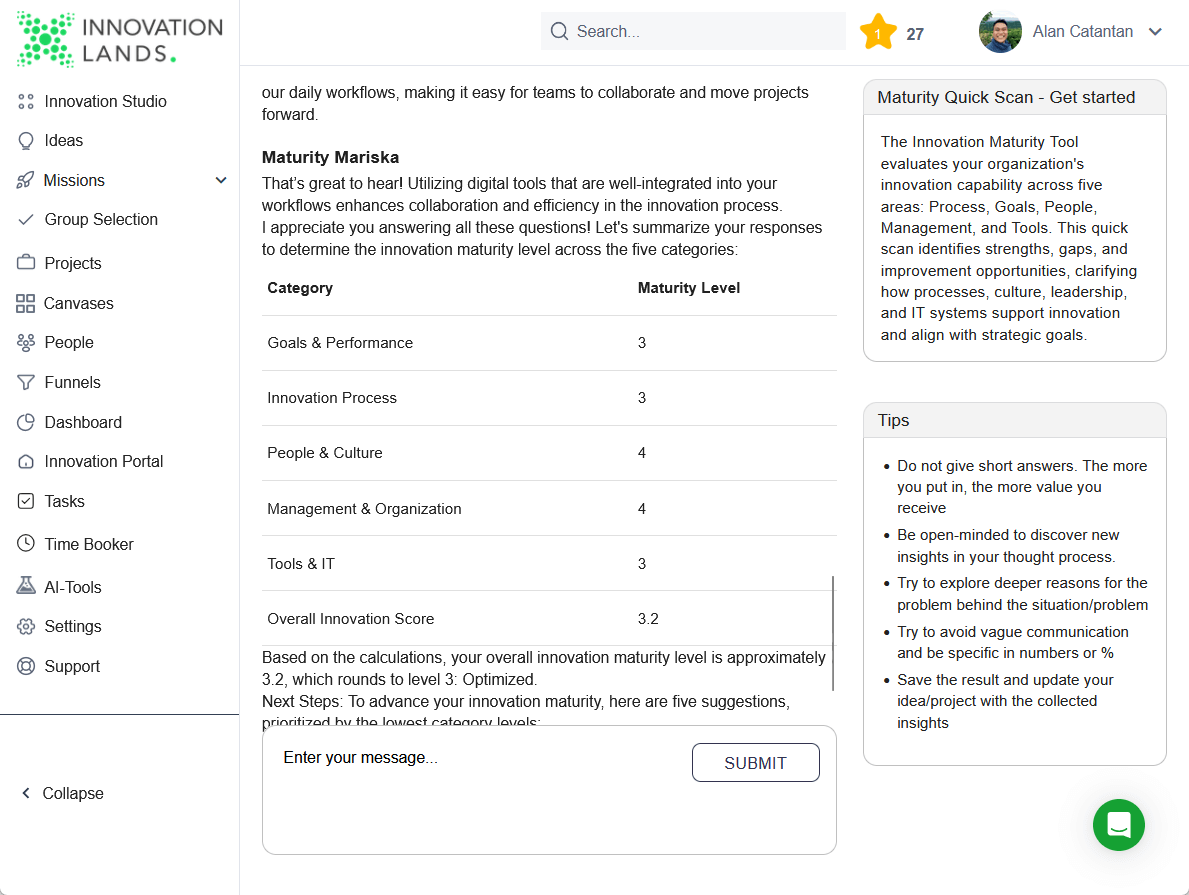
Instead of relying on gut feelings, you get a structured overview that helps you plan smarter next steps, whether you’re just starting or already deep in your innovation journey.
It works like this:
- You start by answering a few questions about your team or organization.
- The assistant evaluates your answers across five maturity categories.
- It highlights where you’re strong and where there’s room to grow.
- You get a summary that outlines your overall innovation readiness.
It’s quick, simple, and surprisingly eye-opening.
This tool is especially useful for team leaders and innovation managers as it helps align leadership on where things stand and what needs attention.
Instead of vague talk about “being innovative,” you get data that helps drive real improvement, one focused area at a time.
6. Idea Generator & Evaluator
Coming up with ideas is one thing, but knowing which ones are worth pursuing is another. ✨
That’s where the idea generator and evaluator assistant (aka Genie) comes in. It’s designed to help you generate and assess innovative ideas that align with your company’s actual goals.
This AI assistant takes both creative thinking and business logic into account.

It doesn’t just throw random ideas at you, it helps you shape ideas that are feasible, valuable, and tied to your context.
Here’s how it works:
- You start by sharing your company’s goals or challenges.
- The assistant helps generate ideas based on that input.
- Each idea is evaluated with a structured framework.
- You get a list of ideas scored by value, feasibility, and fit.
It turns idea generation into something far more strategic.
This tool is especially useful during early-stage innovation or when you need to filter a long list of options.
It brings objectivity to idea selection without killing creativity. And since it’s tied to your goals, the ideas you walk away with are actually worth building.
7. Score Card Generator & Evaluator
Making the right decision starts with having the right scorecard. 🎯
The scorecard generator and evaluator assistant, also known as Scarlett, helps you create structured, optimized scorecards for more consistent and objective decision-making.
Whether you’re comparing ideas, solutions, or vendors, this tool walks you through the scoring process step by step.
It helps you define the right criteria, weigh them properly, and ensure a clear and balanced evaluation. No Excel sheets, no chaos. 🙂

It works like this:
- You start by choosing a predefined scorecard or building one from scratch.
- The assistant asks you to define your evaluation criteria.
- It guides you in setting scoring scales and weights.
- You get a polished scorecard, ready to use in your decision process.
It’s clear, visual, and easy for teams to align around. This is especially helpful when decisions involve multiple stakeholders or competing priorities.
It takes the emotion out of decision-making and adds a layer of structure that builds trust in the outcome. Scarlett makes sure you’re not just choosing fast, but choosing smart.
How Businesses Can Benefit from Using These Agents
You likely thought of this already, but AI assistants don’t just make innovation easier; they make it work better.
By giving teams support in the right moments, these agents help businesses move faster, think clearer, and stay organized from start to finish.
Here are just a few of the benefits companies can expect:
- Less time spent on setup and structure
- More consistent results
- Smarter decision-making
- Greater alignment across teams
- Faster iteration and progress
For example, let’s say Innovation Lands is planning to launch a new exhibit aimed at boosting repeat visits from families.

They start with the problem discovery agent to make sure they’re solving the right challenge.
After entering a short prompt, the assistant guides them through a series of questions to uncover the full context:
- Who the attraction is for
- What’s currently missing
- Why it matters
In the end, it delivers a clear problem statement: families struggle to find attractions that balance fun and education for both kids and adults, which leads to shorter visits and lower satisfaction.
With this solid foundation, the team can move forward with more confidence, knowing exactly what problem they’re solving.
Instead of weeks of meetings and spreadsheets, they moved quickly, with more confidence and way less chaos.
That’s the real value of these agents. They support the entire innovation cycle, from that first vague idea to the final decision.
Well, they don’t replace teams; they help them think sharply and work smarter, all while making the process more enjoyable.
Curious how it all works in real time? Book a demo and see how AI assistants can transform your innovation process from day one! 🚀







 English
 Dutch
 Portuguese
 Spanish
 French
 German
 Arabic
