Establish innovation governance and transparent decision making
Structured governance across the innovation lifecycle
Innovation at enterprise scale requires more than creativity. It requires governance that defines stages, criteria, ownership, and documented decisions. This use case helps organizations implement a transparent, audit-ready innovation process where every initiative moves forward based on clear logic and agreed rules. By embedding governance into daily workflows, teams reduce friction, strengthen trust, and ensure innovation is managed as structured change rather than informal activity.
Guided tour and save time













Why innovation governance matters
Innovation at enterprise scale requires clarity, accountability and documented decisions. Governance ensures initiatives move forward based on defined rules rather than informal judgment.
Without clear governance
- Decisions are inconsistent and difficult to justify
- Ownership is unclear across stages
- Initiatives move forward without transparent criteria
- Leaders lack a documented decision trail
With structured innovation governance
- Stage gates define when and how decisions are made
- Roles and accountability are clearly assigned
- Evaluation criteria are consistent and transparent
- Every decision is documented and audit ready
What you get
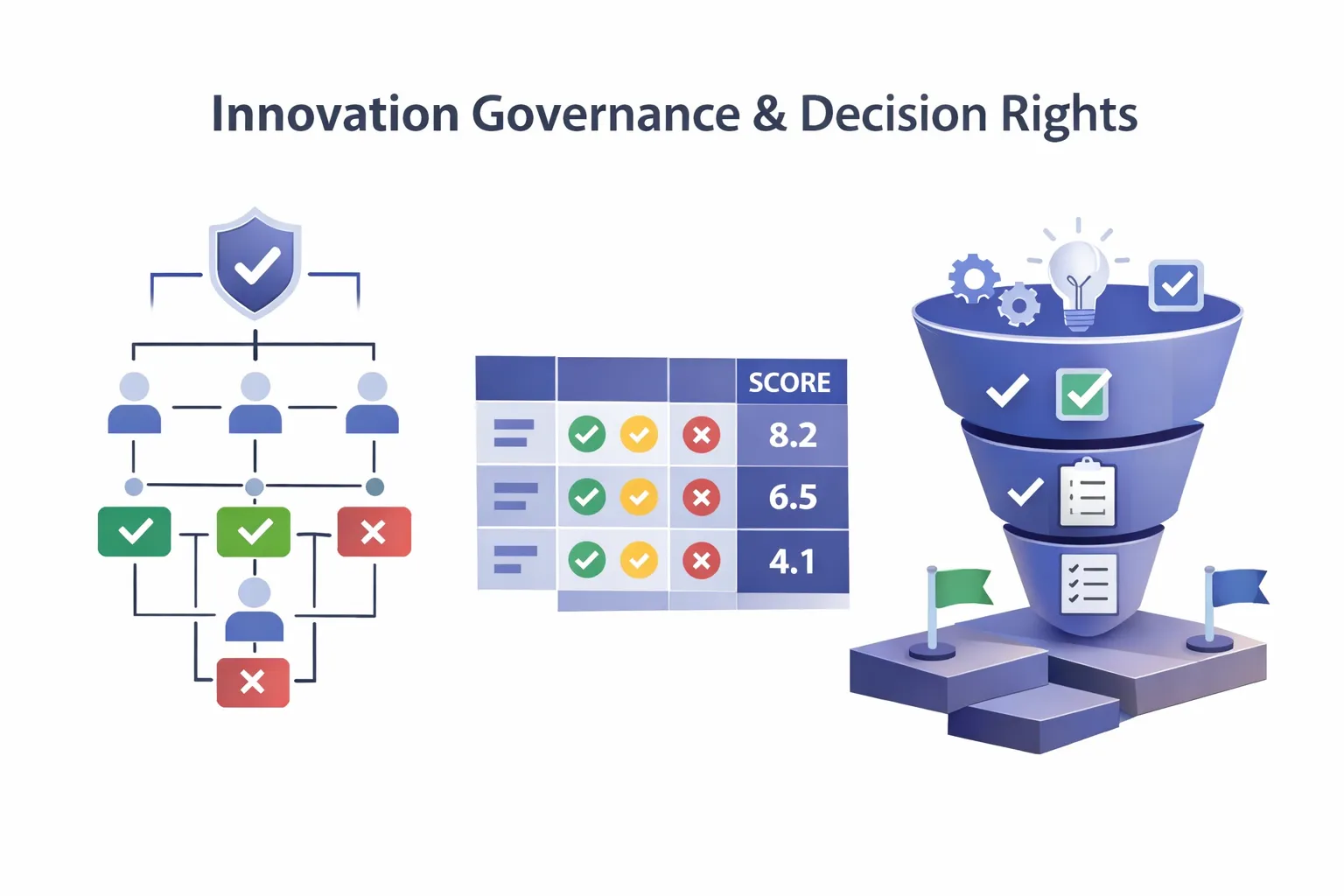
Innovation Governance & Decision Rights gives you structured oversight, transparent evaluation logic, and clear accountability across the full innovation lifecycle.
- Defined stage gates with formal approval logic
- Clear decision rights across roles and governance bodies
- Structured scorecards aligned to enterprise criteria
- Documented approval and rejection rationale
- Full visibility into decision consistency across portfolios
- Audit ready reporting and traceable decision trails
- Reduced friction between innovation teams and leadership
Who it’s for
Primarily designed for innovation teams responsible for structure, decisions, and measurable progress. Secondarily for organizational stakeholders who guide strategy, allocate resources, and evaluate results.
Innovation Managers
Own the innovation process and require full visibility across funnels, governance, decisions, and portfolio impact.
Innovation Leaders
Align innovation with strategy and need clear portfolio steering based on value, risk, and evidence.
Innovation Specialists
Execute initiatives and need structured workflows for intake, validation, evaluation, and next-step clarity.
Strategy & Transformation Teams
Ensure innovation supports strategic priorities and require transparency into progress and expected outcomes.
Portfolio, PMO & Governance
Oversee decision frameworks and resource allocation, requiring structured criteria and stage visibility.
Business & Product Leaders
Make implementation decisions and need clarity on ownership, business cases, risks, and expected impact.
AI enhances innovation governance
AI strengthens governance by making decision logic measurable and consistent. Instead of relying on manual oversight, teams receive signals when criteria are incomplete, approvals are inconsistent, or governance standards are not being applied evenly.
AI Capabilities
- Detect missing inputs at stage gates before review
- Flag inconsistent scoring and approval patterns
- Summarize decision rationale across portfolios
- Identify initiatives with elevated governance risk
- Recommend next actions to complete approvals
- Compare criteria application across teams and stages
- Support audit preparation with structured decision trails
Impact
- More consistent and defensible decisions
- Reduced bias and variability across reviewers
- Higher transparency for leadership and stakeholders
- Faster reviews with fewer governance gaps
- Improved accountability across the lifecycle
- Audit ready reporting with less manual effort
Key features for establish innovation governance and transparent decision making
Governance frameworks
Structure your innovation process around clear ownership and decision authority.
Define governance models that reflect how your organization allocates responsibility across teams, committees, and leadership levels. Ensure decisions are made by the right stakeholders at the right time.
- Clearly defined decision rights per stage
- Governance roles aligned to organizational structure
- Configurable approval workflows
- Separation of evaluation and final decision authority
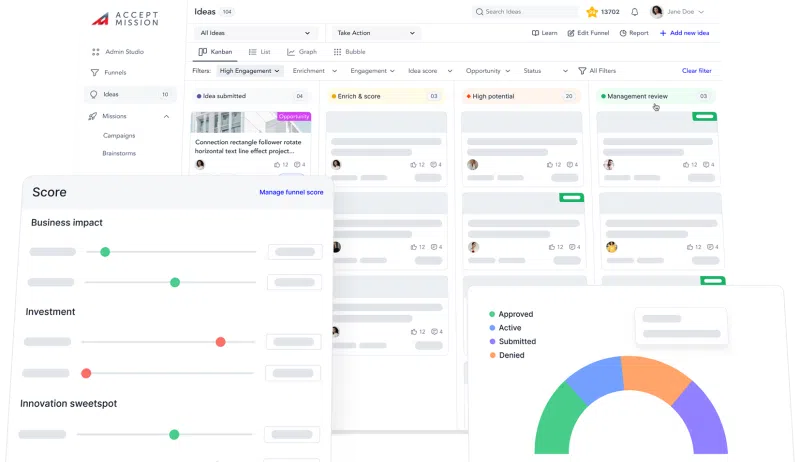
Structured stage gates
Standardize how initiatives move from exploration to execution.
Design formal decision gates with defined criteria, documentation requirements, and approval logic. Make every transition measurable and transparent.
- Configurable stage definitions and transitions
- Mandatory criteria before gate progression
- Automated approval checkpoints
- Transparent gate history and traceability
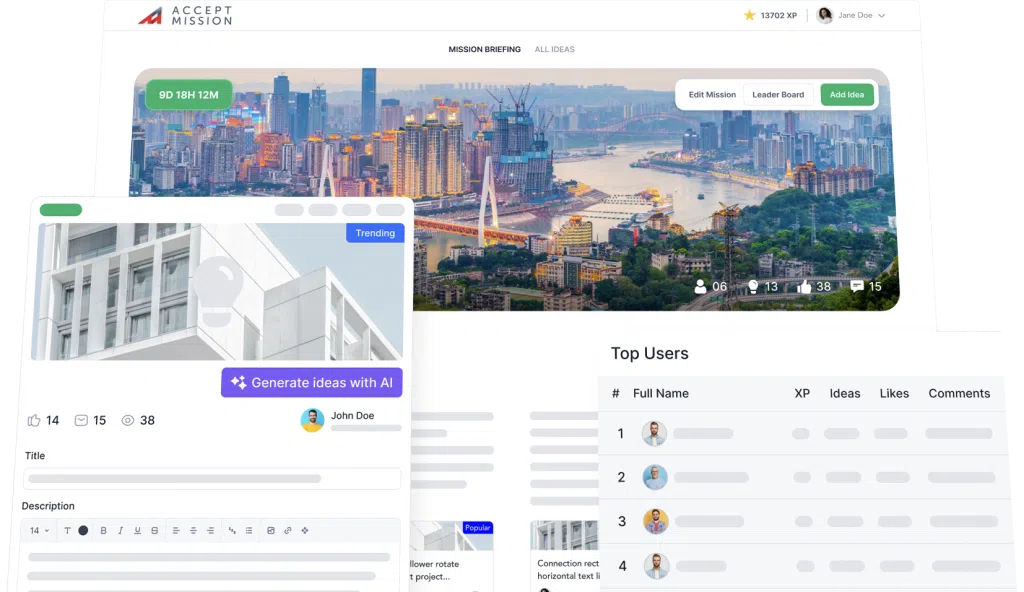
Scorecards and evaluation logic
Make decision making consistent and evidence based
Apply structured scorecards aligned to strategic priorities, risk tolerance, and investment logic. Ensure evaluations are comparable across portfolios.
- Custom weighted evaluation criteria
- Multi reviewer scoring models
- Consolidated decision dashboards
- Documented rationale behind every score
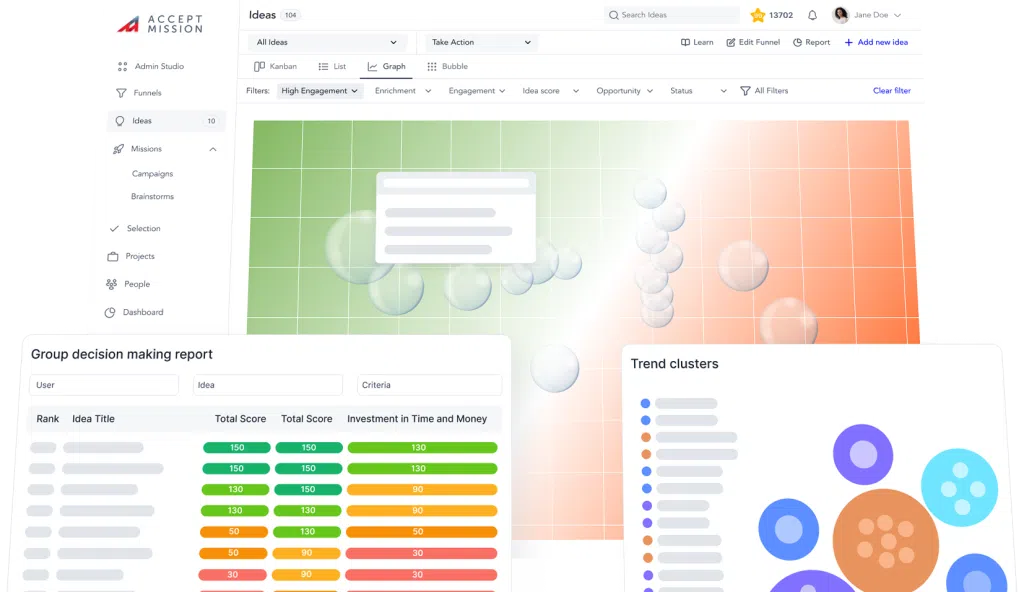
Audit ready decision trails
Create full transparency across the innovation lifecycle
Maintain a traceable record of every evaluation, comment, approval, and rejection. Enable governance reviews without manual reconstruction.
- Complete decision history per initiative
- Time stamped approvals and reviewer inputs
- Centralized documentation storage
- Exportable reports for audit and compliance
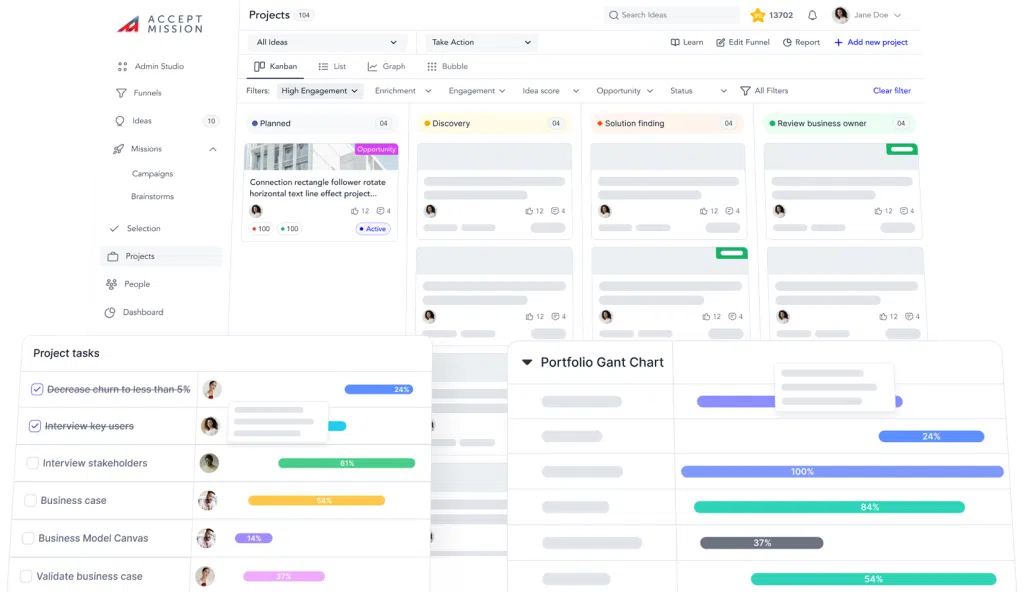
Key steps to success
Turn governance into measurable impact with clear decision rights, structured stage gates, and consistent evaluation logic across the innovation lifecycle.
Define decision rights
Clarify who evaluates, approves, and owns each stage. Make accountability explicit.
Establish stage gates
Create formal transition points with clear criteria and required documentation.
Apply consistent scoring
Use standardized scorecards aligned to strategy and risk tolerance.
Document every decision
Maintain a traceable record of approvals, rejections, and rationale.
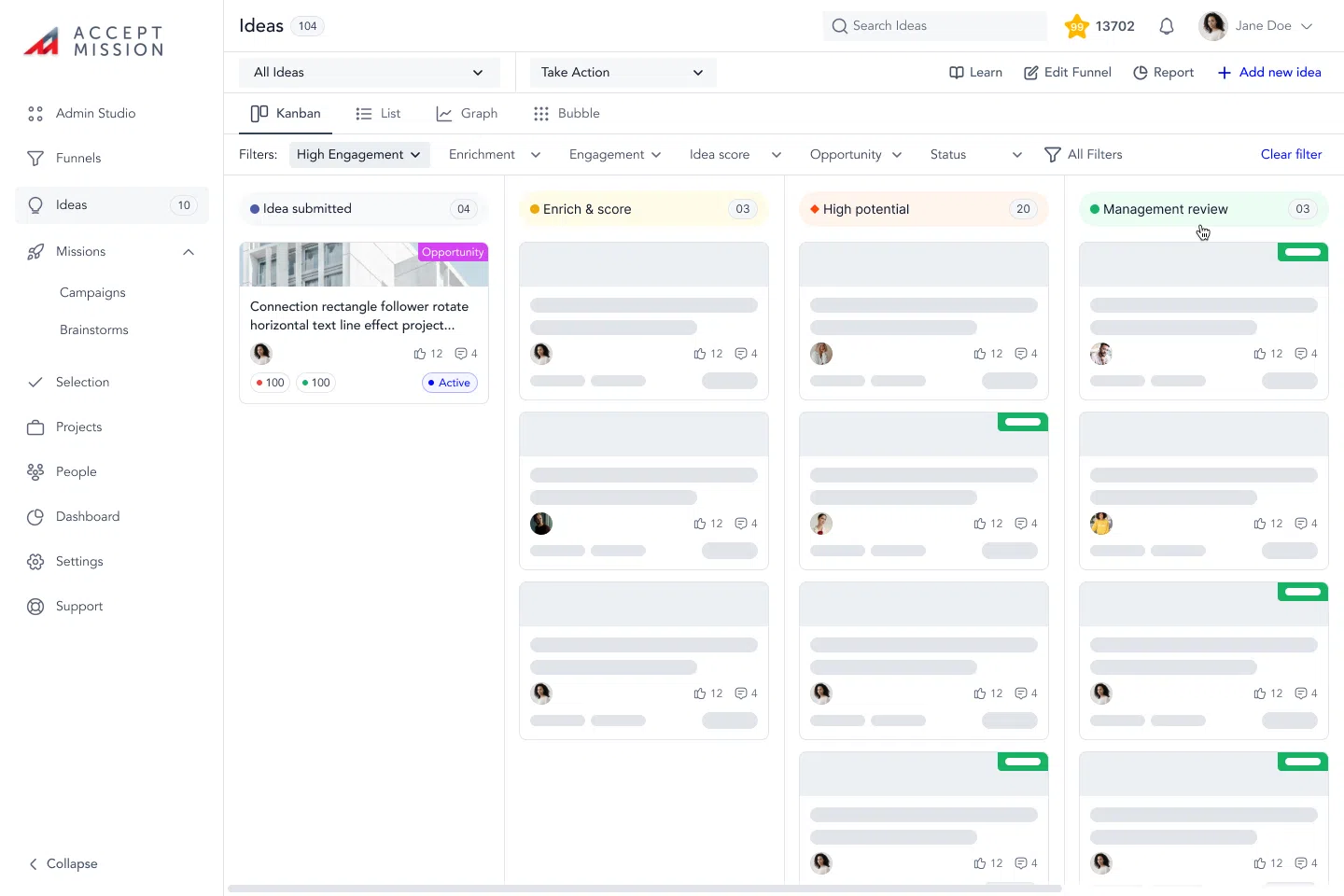
View use cases
Explore practical examples of how teams structure innovation, evaluate initiatives, and align execution with strategic priorities.
Pipeline & Funnel Management
Structure ideas and initiatives into clear stages with governance, visibility, and measurable progress.
Score and Prioritize Innovation
Evaluate initiatives with structured criteria and create transparent portfolio priorities.
Align People With Strategic Goals
Connect initiatives to strategic themes so teams focus on what matters most for long term direction.
Explore all use cases
See how different teams use the platform to structure innovation and drive measurable results.
Ready to see it live?
A short walkthrough that shows how structure, transparency, and dashboards make progress visible and decisions easier.

See Accept Mission in action
Run your innovations with structure and transparency. In a short demo, see how idea management, project portfolio management, and idea collecting connect to funnels, scorecards, and dashboards so progress stays visible and decisions get easier.
- Structured funnels
- Transparent scoring
- Dashboards for progress
What you will see
- Idea collecting that feeds a structured funnel
- Transparent evaluation with scorecards and clear decisions
- Portfolio views and dashboards for leadership reporting
Learn more about Funnel Management
An innovation funnel is a type of funnel that will screen innovative ideas for viability and profitability so that only the best products, processes, propositions, or business models are realized.
A term often interchanged with innovation pipeline, both these tools are useful in managing ideas.
However, as written in this article, an innovation pipeline focuses only on the exterior step-by-step progression of an idea, while an innovation funnel is more specific. It considers whether an idea is approved or not to determine the progress of the innovation process.
You can compare the differences between these tools by comparing them to a sales funnel and a sales pipeline.
Just as how a sales pipeline simply illustrates the stages that your leads go through to become a customer, an innovation pipeline also shows the stages through which an idea becomes an innovation project.
Meanwhile, as your sales funnel represents the entire customer journey, an innovation funnel demonstrates the entire innovation process, specifically in terms of handling and managing ideas.
In addition, this mechanism also shows what happens to every idea if they ever get approved or discarded along the way. So while you can say that your sales funnel is client-based, your innovation funnel, on the other hand, is status-based.
An innovation funnel pragmatically guides the statuses of your innovation initiatives. To use it effectively, you need to define it in a manner that matches your needs. You can do this in four simple ways:
1. Define what your innovation goals and strategies are
Your innovation goals and strategies generally direct the nature of your innovation efforts. This is why you should take adequate time to evaluate and define your innovation goals and objectives prior to any innovation process.
2. Determine whether you’re focusing on a pull or push approach
A pull approach is customer-centric. It first recognizes a genuine issue that a customer faces or identifies any unmet need before looking for a solution. Hence, with a pull approach, companies study the problem first and then develop a solution after.
Push innovation, on the other hand, is solution-centric. With this method, businesses create the product or technology first, and then identify the problem it solves.
Remember that these perspectives are different, so whichever you choose may cause a change in your innovation funnel.
3. Establish what success in innovation means to you.
Some companies define innovation success as simply being able to implement their innovation project rather than being able to scale it. On the other hand, some businesses also see scaling as part of their success.
As you can see, success in innovation can be relative. It really depends on what you want to achieve with your innovation projects and how you define it.
Some companies may see success as commercializing a product, while others may find success in simply completing the project or generating new knowledge. There are also those who view success as launching a minimum viable product (MVP) to see if it works in the market.
Knowing how you will measure the success of your innovation projects helps you understand where you should focus your efforts. It also allows you to set thresholds and limits as to how much risk you’re willing to take. These measures eventually help shape your innovation funnel.
4. Create relevant statuses or stages of your innovation ideas from start to end
Always think about what you want to measure. For instance, in terms of sales, if you want to know the conversion status of a potential lead, you need to set up systematic stages that would specifically direct your lead’s progress until he or she ends up purchasing your product.
The same goes true for your ideas. In your innovation funnel, you need to create specific stages and statuses of every idea until it becomes an approved or implemented project. Just remember to create each stage with a specific purpose.
Here are some of the most popular innovation models you can use as a basis for your innovation funnel:
Stage-Gate Method
The stage-gate method is a popular innovation model used by many companies.

It is a process that helps organizations control and manage the risks associated with their innovation projects by separating the project into different stages, where each stage has specific requirements that need to be met before the project can move on to the next stage.
This framework helps ensure that companies can only move forward with high-quality projects that are likely to succeed.
- Stage 0: Discovery – The discovery stage is all about generating new ideas. This is where you allow your team to come up with as many ideas as possible without any filters or limitations. The goal here is to generate as many ideas as possible, no matter how crazy they may seem.
- Stage 1: Scoping – In this stage, you narrow down your ideas and focus on those that have the most potential. This is where you start to evaluate each idea and identify which ones are worth pursuing.
- Stage 2: Business Plan Concept – This is where you start to develop your chosen idea or ideas further. You will need to create a business plan and conduct market research to see if there is a demand for your product or service.
- Stage 3: Development – As the name suggests, this stage is where you start to develop your product or service. You will need to create prototypes and test them to see if they work as intended.
- Stage 4: Testing and validation – Now, you will need to test your product or service in the real world to see if it works as intended. You would also have to gather your users’ feedback or insights to see if there are any improvements you have to make.
- Stage 5: Launch and implementation – Finally, you can now launch your product or service to the public. Make sure that everything is in place before you distribute your product or service for commercialization, like your marketing, sales, and customer support.
Design Thinking Method
The design thinking method is used to come up with creative solutions to problems. It is a problem-solving process that encourages creativity and collaboration.

This framework is most useful for product designers. However, businesses can also use this process to come up with innovative solutions to problems. The design thinking process typically follows these five steps:
- Empathize: Try to understand the problem from the user’s perspective. Collect relevant data via interviews, surveys, and observations.
- Define: Know what problems you need to solve Analyze the information you have taken in the previous step.
- Ideate: Come up with as many creative solutions to the problem as possible. Brainstorm with your team and come up with ideas that are outside the box.
- Prototype: Create a prototype of your chosen solution and test it to see if it works as intended. If it does not work, go back to the ideation step and come up with another solution.
- Test: Test your prototype in the real world and gather feedback from users. Use this feedback to improve your prototype.
Lean Startup
The lean startup method is a framework that helps organizations reduce waste and increase efficiency. It is often used by startups as it helps them save time and money by launching their product or service faster.

This process contains three steps:
- Build: Build your product or service quickly and efficiently. Create a minimum viable product (MVP) that you can test in the market.
- Measure: Measure the results of your MVP and gather feedback from users. This step is important as it will help you determine whether your product or service is something that people will genuinely want or need.
- Learn: Use the feedback you have gathered to improve your product or service. Apply what you have learned to make your product or service better and to avoid costly mistakes in the future.
PACE
PACE is a five-phase iterative method that combines design thinking, lean startup, and agile scrum. It’s a systematic innovation process that continually validates ideas with clients to make sure that it ends up as something that the customer actually wants.
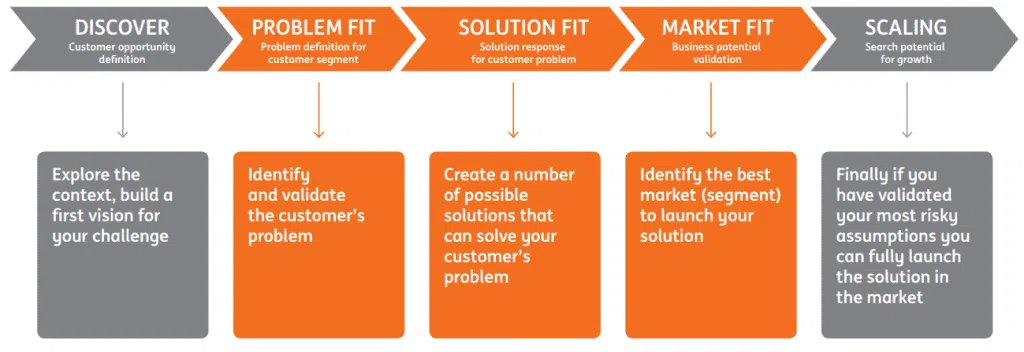
Source: The ING Direct way of working — Part 2 : The stages of PACE | by Leandro Pinter | Medium
This approach promotes the quick release of innovative goods and services created by nimble, independent, and multidisciplinary teams.
- Discovery: Consider the structure of the problem you’ve chosen to solve. Check at trends in consumer behaviour and market trends, technological advancements, regulatory changes, rival businesses, and internal improvements.
- Problem fit: Evaluate and validate the issue of your customers. Identify the problem that merits fixing and the people for whom you are solving it for. Assess the importance of the problem to your selected market to confirm whether or not your idea genuinely provides a commercial opportunity.
- Solution fit: Make a variety of potential solutions to your client’s problems. Develop and evaluate various parts of your solution through experimentation, refining it iteratively until it meets your customers’ preferences.
- Market fit: Create an MVP of the product and its related services, then launch them. This aids in testing your idea in the real world and determining its financial viability in your target market.
Scaling: Now that your riskiest hypotheses have been proven correct, you may completely introduce the solution to your target audience. Commercialize your product or service. Choose the quickest, most effective strategy to enter your intended market.
Innovation software is a type of software that helps businesses and organizations come up with new ideas. However, you can also use it for a variety of purposes, such as developing products, improving workflow, creating new marketing strategies, and even funnel management.
One of the best innovation software today is called Accept Mission, a next generation idea & innovation management software for organizations who want to accelerate their innovation success.
Here’s how you can utilize Accept Mission’s features to get started with your innovation funnel:
Configure funnels with stages and gates
Set numerous, specific stages with corresponding actions for every idea that passes through your innovation funnel— all in accordance with your needs.
Run innovation campaigns
This software’s main purpose may be idea generation, idea management, and innovation campaigns or missions.
However, aside from gathering ideas and seamless collaboration, you can also use Accept Mission to create successful innovation campaigns that:
- Solve specific problems
- Collect potential business challenges
- Collect ideas based on trends/technologies
Engage employees and other participants in process of innovation
Make your innovation campaign fun, rewarding, and exciting with the platform’s gamification features. Plus, everyone can submit their ideas via undercover mode for anonymity purposes.
Score ideas based on predetermined criteria organized by the company’s innovation manager and other relevant parties
Consider what innovation success is for you and convert them into criteria that you can use to score every submitted idea. You may also allow expert scoring with defined categories.
Select the best concepts according to the scores and insights gathered from various participants
Make your decision-making process an all-inclusive activity by allowing your employees and other participants to contribute their feedback, insights, and other comments on all the concepts gathered by the organization.
Keep track of selected concepts’ progress until implementation
Track and monitor the progress of every idea until it gets implemented.
Define a reusable list of selection criteria
Automate the scoring process if necessary by defining a reusable list of selection criteria.
Obtain insights into trends and gain better analysis of ideas through the platform’s powerful tag system
Stay in-tune with everything you need to know about your market. Study current trends and assess your ideas better with Accept Mission’s powerful tag system.
Access and configure innovation dashboards with KPI’s and graphs
Examine and understand your data further with relevant graphs and KPIs.
Secure live data connection with BI software like Power BI
With Accept Mission, you won’t have to worry about integration. This software allows a secure live data connection with other efficient software like power BI.
Use kanban boards, bubble charts, Gantt charts, graphs, and other visuals in reports
Present information with visual graphical representations and make your data more understandable with Accept Mission’s kanban boards, bubble charts, Gantt charts, graphs, and other visuals.


 English
 Dutch
 Portuguese
 Spanish
 French
 German
 Arabic