
IdeaBox Rewards: un reconocimiento que no hará que tu equipo se sienta incómodo13 lectura mínima

The all-hands slide says “Top Contributor,” and a gift card goes to someone who logged 40 ideas. The applause is polite, and nobody can name un that shipped.
You’ve probably seen the rest of the kit:
- Points for every submission, redeemable for a mug
- An “idea of the month” pick with no stated reason
- Leaderboards ranking people by how much they typed
- Percent-of-savings payouts that turn every review into a negotiation
These schemes pay for submissions or savings claims while ideas sit in a queue. That’s why everyone involved cringes, from contributors to the reviewers and owners answering them.
And the recognition contributors en realidad register is quieter: a fast, explained answer, and later their name on the idea in use.
That leaves a simple position: answer first, then reward the decision, size it to the outcome, keep money private, and thank whoever closes the loop.
Where the Cringe Comes From
Steven Kerr named the pattern in 1975: rewarding A while hoping for B. Organizations, he wrote, install reward systems that pay off for behavior other than what they seek.
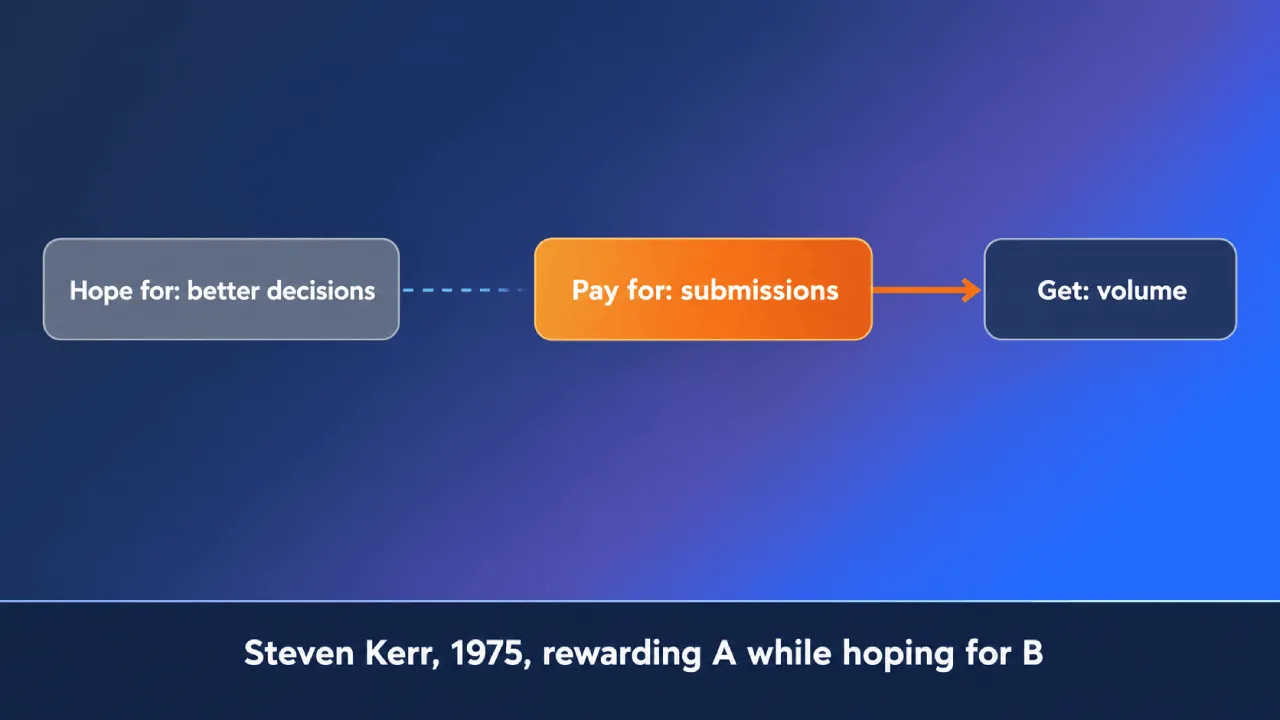
An IdeaBox that rewards submissions is a clean example. You hope for better decisions, pay for volume, and get volume.
And paying for volume carries three costs:
- Crowding: Piezunka and Dahlander’s 2015 study found that crowding narrows an organization’s attention, leaving ideas that depart from its status quo at a disadvantage
- An unpaid queue: someone has to read those 40 ideas, and the reviewer who does it often gets no credit for the work
- Weaker motivation: a 1999 meta-analysis by Deci, Koestner, and Ryan found that expected tangible rewards for doing or completing a task lowered free-choice intrinsic motivation
Crowding alone settles one design choice: give no extra points for submissions, and keep rewards for ideas someone has reviewed.
The third cost rests mostly on lab studies of task interest, so treat it as a warning. Still, a submission bonus pays for a completed form, whatever its quality.
Put the three costs together and the cringe has a precise source. It’s the gap between celebrating volume in public and doing nada with the ideas in private.
And the gap is visible from where contributors sit. The gift card arrived within a week, and the answer never did.
What Contributors Actually Count as Recognition
Recognition starts with an answer. Piezunka and Dahlander’s 2019 study found three things about rejection and newcomers:
- A rejection made newcomers more willing to submit again
- The effect grew when the rejection came with an explanation
- Fue más fuerte still when the explanation matched the linguistic style of the idea itself
The study tracked crowdsourcing platforms and didn’t test employees. We’d still apply it inside a company, since a rejection signals, in the authors’ words, that an organization is interested.
Inside companies, Toyota’s suggestion system is the classic case. According to the Lean Enterprise Institute, most rewards were under $10, and the emphasis was on very quick feedback.
The same piece says what Toyota sought was the compromiso of workers, with cost savings secondary. Those figures are historic and describe Toyota in Japan.
Read that as a design brief. Small and fast was the point, and the reward amount was almost incidental.
Words matter too. The same Deci meta-analysis found that positive verbal feedback raised free-choice behavior, with an effect size of d = 0.33.
What a Useful Answer Looks Like
Personas rara vez get asked what lands for them. A 2024 Gallup report with Workhuman found only 11% of U.S. employees had been asked how they like to be recognized.
In an IdeaBox, the safest guess is the obvious one. Submitters want to know what happened to their idea, and why.
Entonces a useful answer names the decision, gives the reason in a line or two, and says what would change the outcome. Contributors can act on that.
Then budget review time for the explanation as well as the decision. In practice, AI can draft one from your criteria while a llamado person signs it.
Move the Reward to the Decision
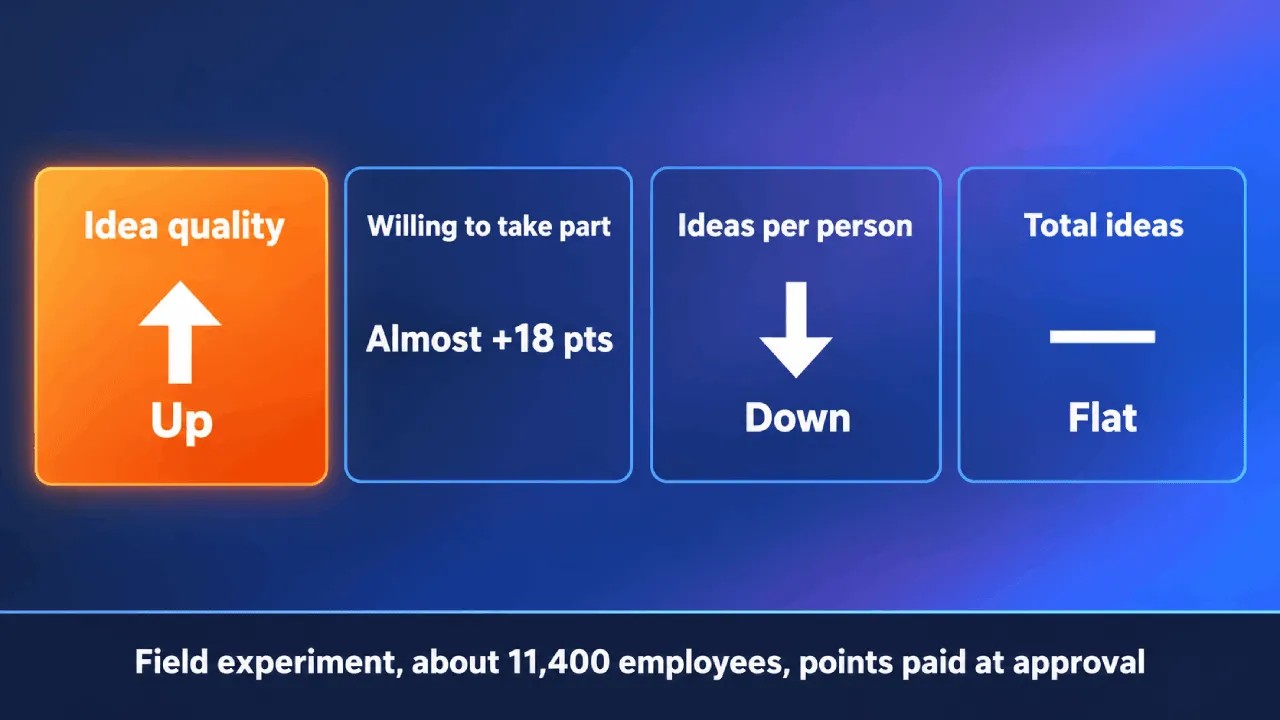
In a field experiment published in 2017, Gibbs, Neckermann, and Siemroth randomized teams covering about 11,400 employees at a technology company. Treatment teams earned points sólo for approved ideas:
- Idea quality went up
- The share of employees willing to take part rose by almost 18 percentage points
- Ideas per participant fell, so total volume stayed flat
- The authors found no evidence of motivational crowding out
- After the reward ended, the quality effect disappeared, while the broader participation base persisted, which the authors read as habituation
For scale, approval earned each team member 2,000 points, about 2.2% of monthly after-tax salary for lower-level staff. Implemented ideas could earn more, depending on the client’s rating.
Those points were redeemable for consumer goods or shopping vouchers, which makes this a meaningful reward, paid for a decision.
So tie your rewards to decisions. Plan for the fade, though, and let the answer habit carry what remains once the reward ends.
How Recognition Maps to the Funnel
Each funnel moment earns a different kind of recognition:
| Funnel Moment | What to Recognize | Form That Fits | Watch Out For |
|---|---|---|---|
| Enviado | A clear, complete submission | Instant acknowledgment with a next step and a date | Points or prizes for volume |
| Reviewed and answered | The contributor’s effort | An explained decision from a named reviewer | Form letters that don’t explain anything |
| Aprobado | The idea’s merit | Specific thanks, plus modest points if you use them | Rewards that dwarf the decision |
| Implemented | The outcome, with the contributor’s name | Public credit where the idea is used, plus any private cash band | Cash promises you can’t audit |
| Loop closed by a reviewer or owner | Response time and explained decisions | Leadership thanks, visible in reviews | Rewarding speed over judgment |
Notice that the submission row carries no reward at all. It gets an acknowledgment and a date, which is the minimum a contributor is owed.
The answer row, meanwhile, carries the most weight. If your stage names leave ideas sitting in a status like “Pending”, the answer row never happens.
Approval is where points belong, if you use them, and cash waits for implementation. Gibbs and colleagues paid at this stage, after a reviewer had judged quality.
At implementation, put the contributor’s name on the change, in its release note or process document. Name the decision-maker too, so credit shows who stands behind it.
Then make it specific. “Thanks for your idea” makes people cringe, while “your change to the returns form is live in all three regions” is reconocimiento they can repeat.
Choosing the Currency: Thanks, Points, or Cash
Cada reward scheme picks a currency, whether anyone decided it or not. Here’s the trade-off before the evidence:
| Currency | Where It Fits | What the Evidence Suggests | Main Risk |
|---|---|---|---|
| Specific thanks | Every answered idea | Verbal feedback raised motivation, mostly in lab studies | Sounds generic if it isn’t specific |
| Symbolic awards | Approved and implemented ideas | Raised retention early; gap no longer significant by quarter 5 | Turns into theater when it’s routine |
| Puntos | Approved ideas only | Raised quality, with no evidence of crowding out | Gaming if tied to submissions |
| Dinero en efectivo | Implemented outcomes, kept private | Contingent bonuses raised creative output in a lab experiment | Disputes, and it’s hard to withdraw |
Read the table as a ladder. The further down it you go, the more a reward needs a llamado decision behind it.
So the cheapest rungs belong on every idea, and the expensive ones only on signed-off outcomes. Thanks and points came up above, so what follows covers symbols and cash.
Symbolic Awards Work, but One Isn’t Enough
Symbolic awards have field evidence. In Kosfeld and Neckermann’s field experiment, published in 2011, offering a congratulatory card for the best performance lifted hired students’ output by about 12%.
Gallus (2017) found a similar pattern with German Wikipedia newcomers. A symbolic award lifted first-quarter retention from 47% to 52%, a gap that stayed significant through quarter 4.
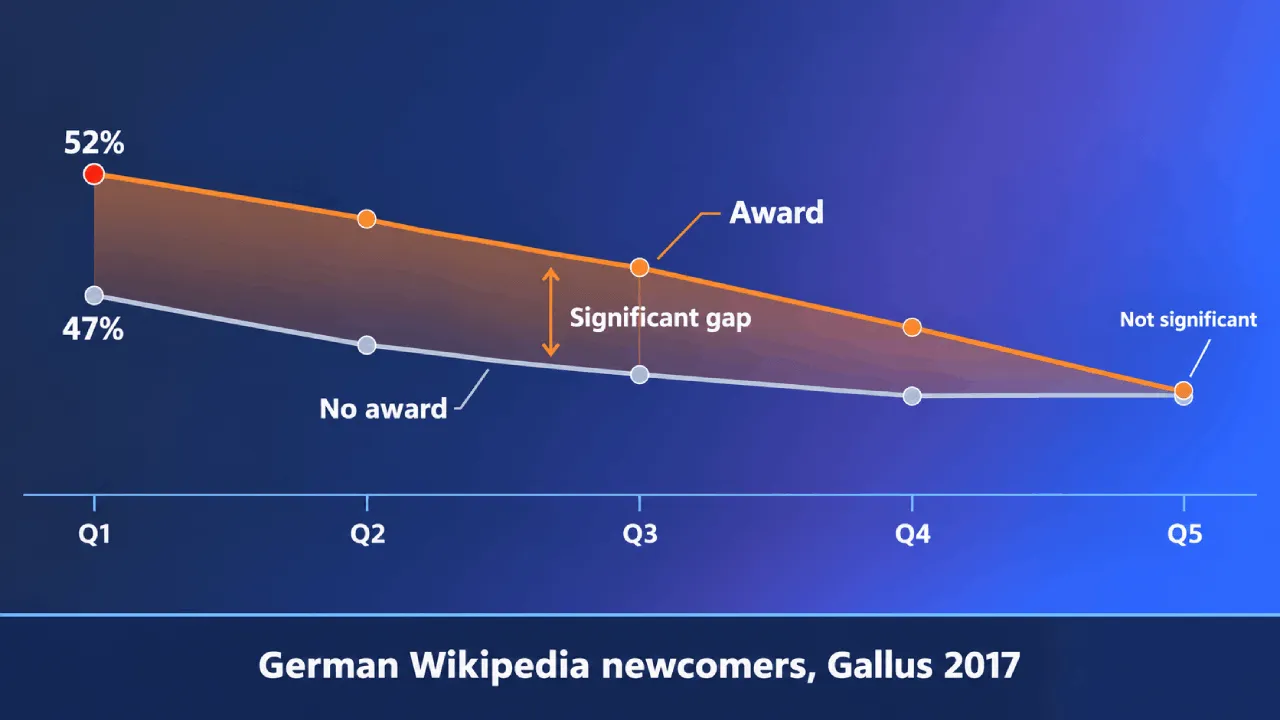
By quarter 5, though, it was no longer statistically significant. So make symbolic awards a habit, and don’t expect a one-off ceremony to carry a program.
Cash Works When It’s Contingent
Cash has a real case, with a condition attached. In Bradler, Neckermann, and Warnke’s 2019 study, a performance bonus substantially increased output on a creative task.
Wage gifts, by comparison, didn’t raise output on the creative task. It was a lab experiment, so treat it as a pointer for workplace schemes.
The study’s bonus paid for measured task output, so the IdeaBox lesson is an analogy. Money tied to a decided outcome fits it, and goodwill money doesn’t.
Concretely, that means private payouts on implemented outcomes, set in bands and decided by a named owner. Keep the formula simple enough to explain in a sentence.
Percentage Payouts Invite Disputes
The trouble starts when cash scales with claimed gains. A 2004 Workforce Management article describes an airline where two workers’ idea added $3 million in yearly profit.
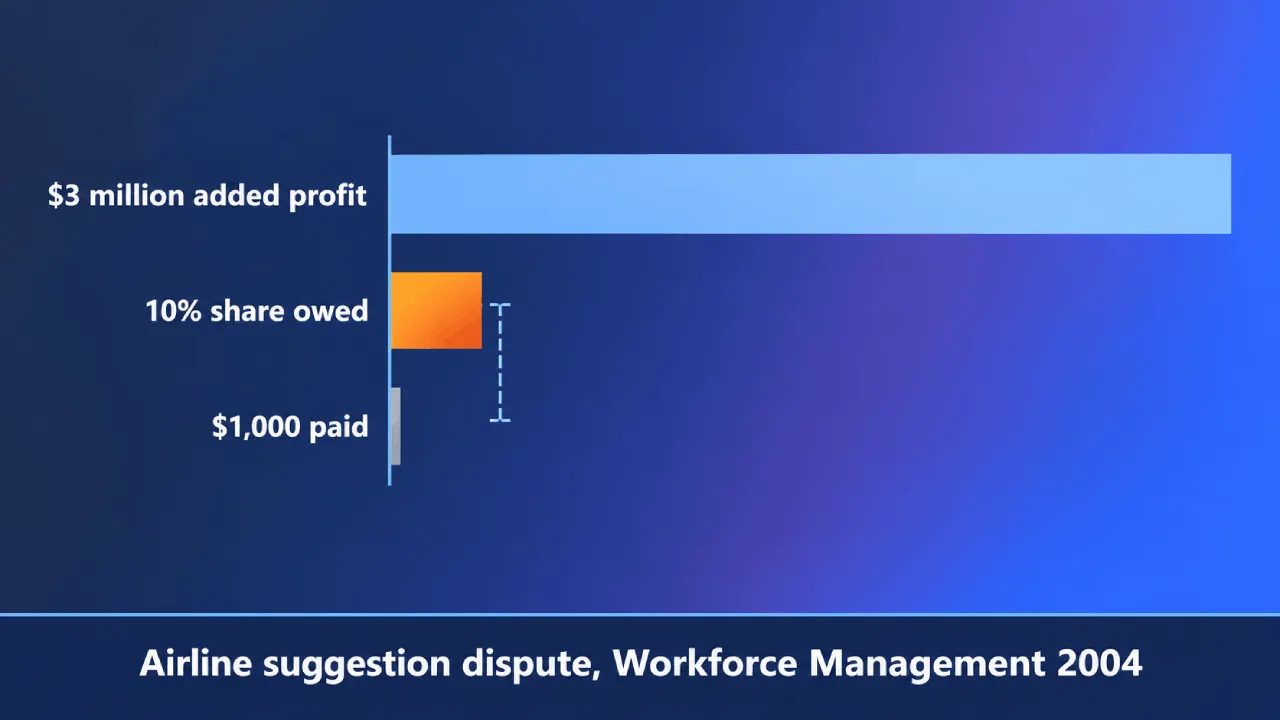
They were owed 10% and got $1,000, so they sued. The company ultimately abolished its suggestion program over disputes about rewards.
At an electronics company in the same article, winners got 10% of savings. The committee chair secretly took half of each award, nearly $250,000 in total.
Both schemes paid a percentage share, of extra profit at the airline and of savings at the electronics firm. At the second, nobody caught the committee chair until later.
Alan G. Robinson, quoted in the article, warns cash rewards can lead to greed and fraud. So keep an audit trail for every payout decision, including who made it.
Changing the Scheme Has a Cost
Taking a reward away carries its own cost. When IBM ended its invention award plan at the end of 2023, employees reacted badly.
That plan paid for patents and publications, and we think the lesson carries to idea schemes. Once people esperar cash, withdrawing it reads as a broken deal.
In Germany, the stakes are formal. The works council has a legal co-determination right over a suggestion scheme, so check local rules before changing anything.
Even outside Germany, announce any change with reasons and a date, as you’d answer an idea. Better still, choose the currency a propósito and plan for changing it.
Leaderboards and the Public-Versus-Private Question
Leaderboards look like transparency. In a crowdsourcing experiment, Barankay found that workers who got rank feedback were menos likely to return and less productive.
His furniture sales experiment points the same way, even though the rankings there were private. In a Wharton interview, he explained who drove the drop.
It was people who fell short of expectations, while those who did better showed no change. On a leaderboard, expect that group to include anyone hoping to rank higher.
Exclusive Awards and the People Who Miss Out
Exclusivity cuts both ways. In a field experiment published in 2016 by Bradler, Dur, and colleagues, recognizing only the top 3 of 8 workers produced the largest lift.
The lift came mainly from workers who no get a card. But it was a 3-hour data entry job, and an IdeaBox runs for years.
Inside a company, the people who missed out are your next round of contributors. A scheme that motivates them through exclusion can end up borrowing against their goodwill.
The same Gallup and Workhuman report counts equitable recognition as a pillar, given fairly “without playing favorites.” A public ranking of contributors tests that pillar every week.
Where to Draw the Line
So draw the line in three places:
- No rank contributors at all
- Make outcomes and named credit public, with team credit where a team did the work
- Keep money private, point balances included, between contributor and manager
Team credit matters because an idea that ships has passed through several hands. Naming only the submitter erases the reviewers, owners, and builders who made it real.
And money stays private because a public cash award invites comparison. Then the popularity logic that fails in prioritization creeps back in.
If you’re weighing gamificación more broadly, apply the same test. Points and badges belong on decisions and outcomes, never on en bruto activity.
Recognize the People Who Close the Loop
Closing the loop does double duty: it’s recognition submitters value, and it’s work your reviewers and owners rarely get thanked for.
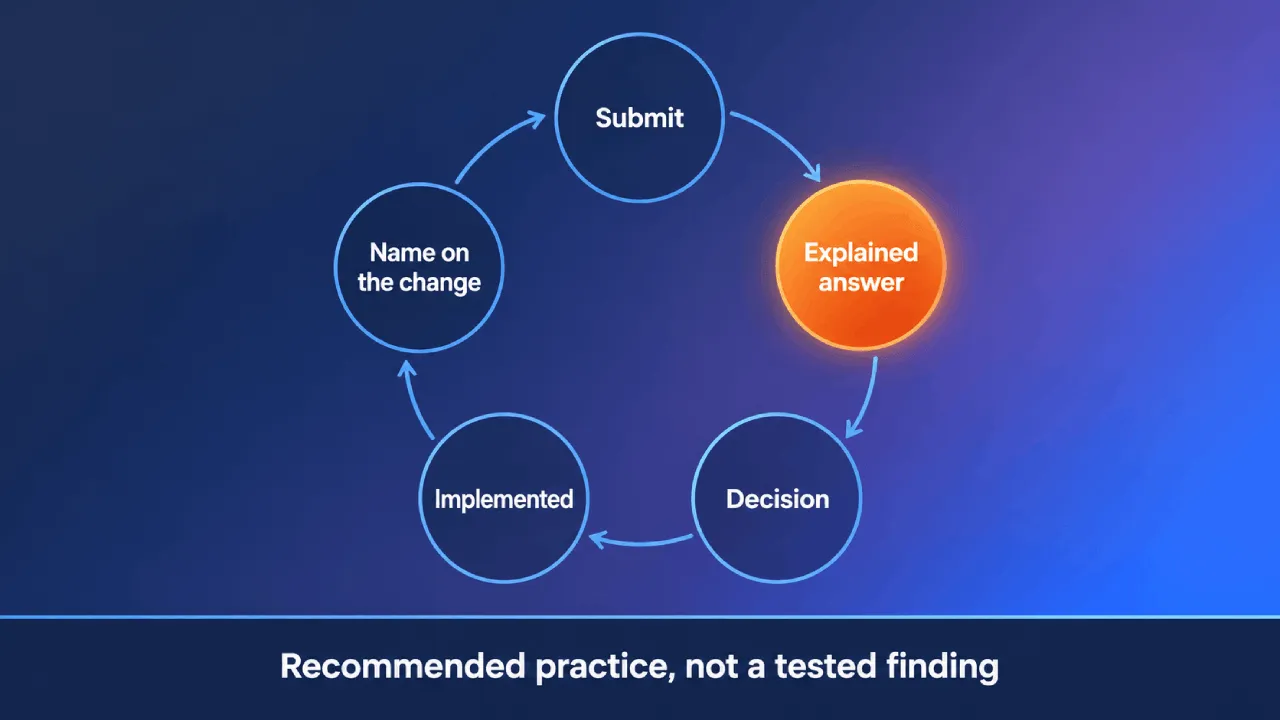
That second half is our own position, and no study we found tests it. It’s an inference: answers keep contributors coming back, and someone has to write them.
Those writers are reviewers or idea owners, and good reviewing shows up as an ausencia: the complaint that never arrived. So recognize it on purpose:
- Track response time and the share of decisions sent with an explanation
- Thank reviewers by name for both
- Credit the owner who gets an idea implemented and tells the contributor, since that’s the moment the loop closes
Owners carry the implementation stretch of the loop. If they’re recognized sólo for successes, expect the ideas that won’t succeed to go quiet without ever being closed.
Whatever you track, keep those numbers off any public ranking, or the cringe comes back. Have the innovation director send a quarterly note naming fast, clear reviewers.
Quién says thanks matters too. In Gallup’s research on recognition, managers (28%) and senior leaders or CEOs (24%) topped the list of most memorable sources.
So have the person who made the decision send the thanks. Senior thanks sits near the top of what people remember.
To track any of this, timestamp every submission and answer so response time is medible. A weekly triage session then gives each idea an owner and a response clock.
Answer First, Then Reward
Desde your people’s side, the payoff is simple: an answer, a reason, and their name on what ships, with reviewers and owners thanked by name.
Before you launch, run these tests:
- Can every submitter get an explained answer by a date you’d publish?
- Does any reward fire before a decision?
- Does any leaderboard rank contributors against each other?
- Who thanks the reviewers and owners who close the loop, and how often?
If the 2nd or 3rd test comes back yes, fix that first, because a reward that fires before a decision-ready review pays for volume again.
And rewards for an always-on IdeaBox sit on top of an answer habit and no puedo replace one. A clearer front door helps: clear submissions are easier to answer specifically.
Descargar la guía gratuita Recopilación de ideas: De las señales organizativas a las ideas and learn how to close the loop with contributors and deliver decision-ready input.
Solicite una demostración to see how Accept Mission gives you visible decisions, contributor feedback, and stage progression for every submission in your always-on IdeaBox.









 English
 Dutch
Dutch Portuguese
 Spanish
 French
 German
 Arabic