
Running an Innovation Portal: One Front Door for Submissions11 min read

Most organizations treat the innovation portal like a solved problem. Set up an intake form, broadcast it, and wait for ideas to arrive.
The result across countless teams is the same:
- Low submission volume
- Inconsistent quality
- A growing backlog of ideas nobody seems to prioritize
Most portals are built backward. They demand too much upfront, use confusing category labels, offer no signal after submission, and then go quiet.
The portal’s architecture shapes what you get out of it: the questions you ask, how submissions route to reviewers, and what the post-submission experience signals.
Get that right and you unlock consistent volume and quality. Get it wrong and you’re managing a system nobody wants to use.
Why Most Portals Underperform
Three failure modes show up in almost every underperforming portal:
- Portals ask for too much upfront. A submitter sees a seven-field intake demanding ROI estimates and implementation timelines, and closes the browser. They don’t have those answers yet.
- There’s no feedback loop. An idea goes in and nothing comes back: no acknowledgment, no timeline, no sign it was read. After a few of those, people stop submitting.
- Category labels don’t match how employees think. Terms like “process optimization” and “revenue acceleration” confuse more than they guide. Ideas end up in the wrong queue and never reach the right reviewer.
The result is a portal that erodes trust quietly, long before submission volume collapses.
| Failure Mode | Root Cause | Fix |
|---|---|---|
| Low submission volume | Intake form too long; high barrier to entry | Require only 3 fields: idea, problem, audience. Offer optional sections for detail. |
| High noise ratio; poor quality submissions | No quality curation at intake; no feedback loop to educate submitters | Seed participation with high-performers; provide short qualitative feedback explaining decision reasoning. |
| Submissions languish unreviewed | No defined review timeline; no designated reviewers; no routing logic | Establish 2-week feedback window; assign reviewers per category; publish routing logic so submitters know where ideas go. |
Choosing Your Intake Model
Two models stand out for innovation intake: always-on and campaign-driven. Most mature systems use both, but they serve different purposes.
- Always-on intake (IdeaBox). Runs continuously; anyone can submit at any time. Good for building habit, but prone to volume problems: without a focused frame, the queue fills with unrelated submissions.
- Campaign-driven intake. Opens around specific challenges (“How might we improve customer onboarding?”). Higher-quality submissions because the frame is tight, but momentum gaps open between campaigns.
The stronger approach uses both. Run an always-on IdeaBox for ongoing contribution, seeded with a few high-performers to set baseline quality.
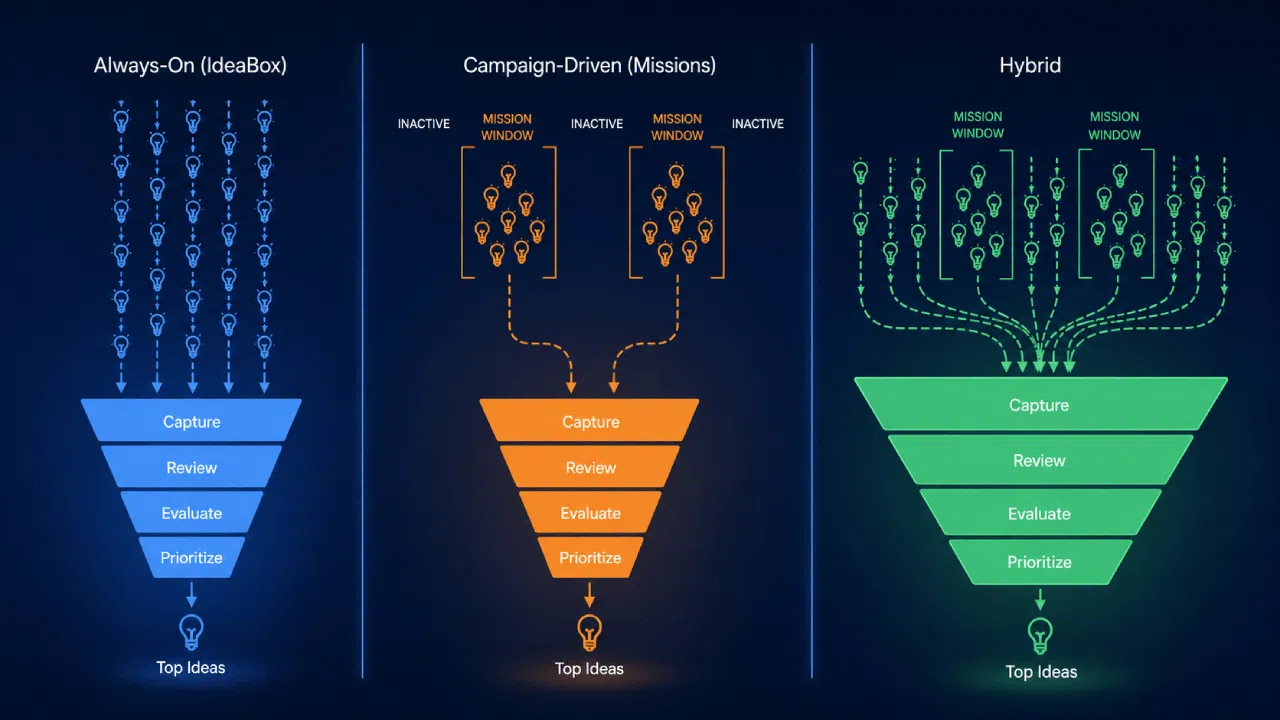
Layer targeted campaigns on top when you need focused input on a specific problem. This gives you continuous signal plus periodic intensity.
| Model | Best For | Submission Volume Expectation | Review Demands | Best Fit |
|---|---|---|---|---|
| Always-on (IdeaBox) | Constant engagement; capturing emergent ideas; building innovation habit | Steady but often lower quality | Lower intensity; distributed review | Mature teams; strong innovation culture already in place |
| Campaign-driven (Missions) | Focused problem-solving; driving urgency; increasing quality | Higher volume during campaign window; creates gaps between cycles | Concentrated review effort during active window | Teams starting out; need to demonstrate quick wins; strategic alignment critical |
| Both (hybrid) | Continuous participation + focused problem-solving | Steady baseline + campaign spikes | Balanced; baseline reviewers + campaign-specific teams | Most scaling organizations |
Building the Portal’s Information Architecture
The portal has three moving parts that shape what you get out of it: the intake form, the category structure, and the post-submission experience.
What Fields Actually Matter
Treat the intake form as a commitment to listening.
Most teams overcomplicate this. They request:
- Idea title
- Detailed description
- Problem statement
- Target audience
- Business impact estimate
- Implementation timeline
- Resource requirements
- Risk assessment
- Sign-off language
What you’ve just built is a stage-gate review checklist dressed up as a submission form.
Three fields matter at intake: What is the idea? What problem does it solve? Who would benefit?
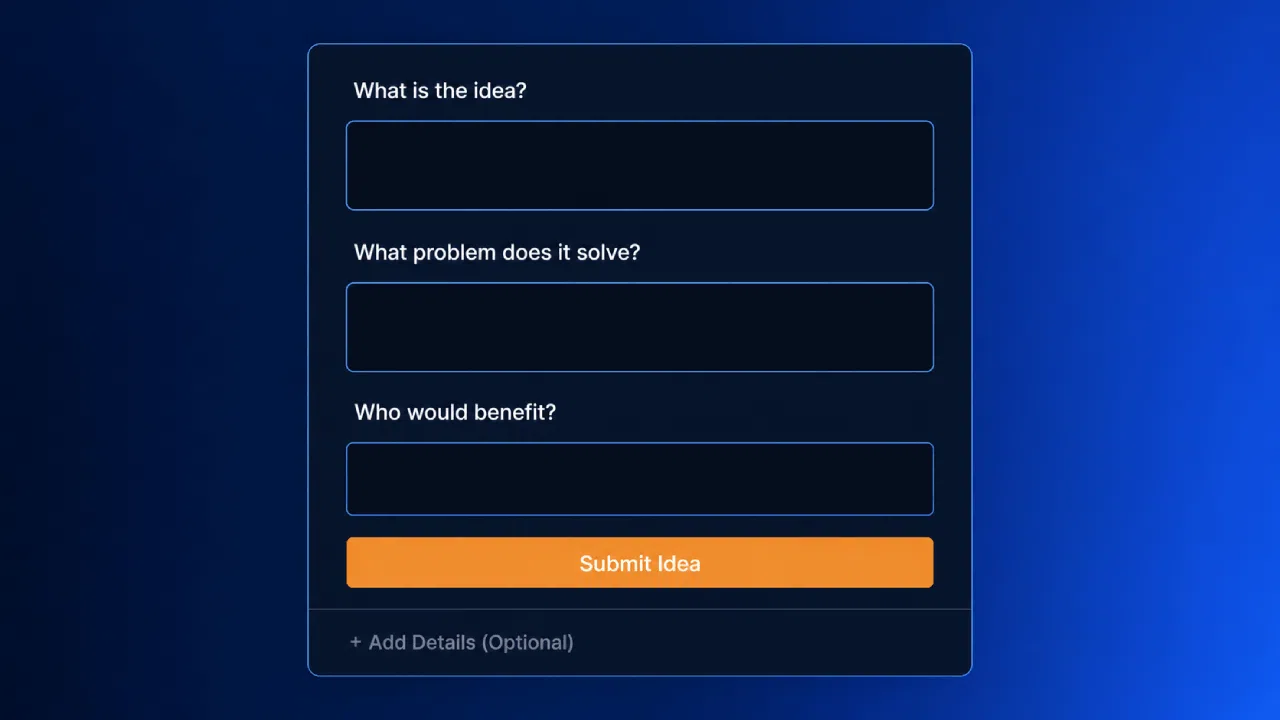
A submitter can answer those in under two minutes. Everything else is optional or belongs in a later conversation.
Optional fields invite elaboration: submitters add detail when they want to. A required field they can’t answer sends them away without submitting.
Avoid requesting ROI projections, full business cases, or resource estimates at intake. Ideas don’t need to be pre-qualified before they’re heard.
How to Structure Categories
Your category taxonomy should map to your funnel, not your org chart.
If your organization is structured by department (Sales, Operations, Product, Finance), that’s useful for internal email routing. It’s not useful for submitters deciding where their idea belongs.
Instead, use problem categories that match how employees think:
- Customer experience
- Cost reduction
- Speed to market
- Employee capability
- Market expansion
These are familiar concepts. An operations person with an idea about faster shipping doesn’t wonder whether it’s a “product” idea or an “operations” idea.
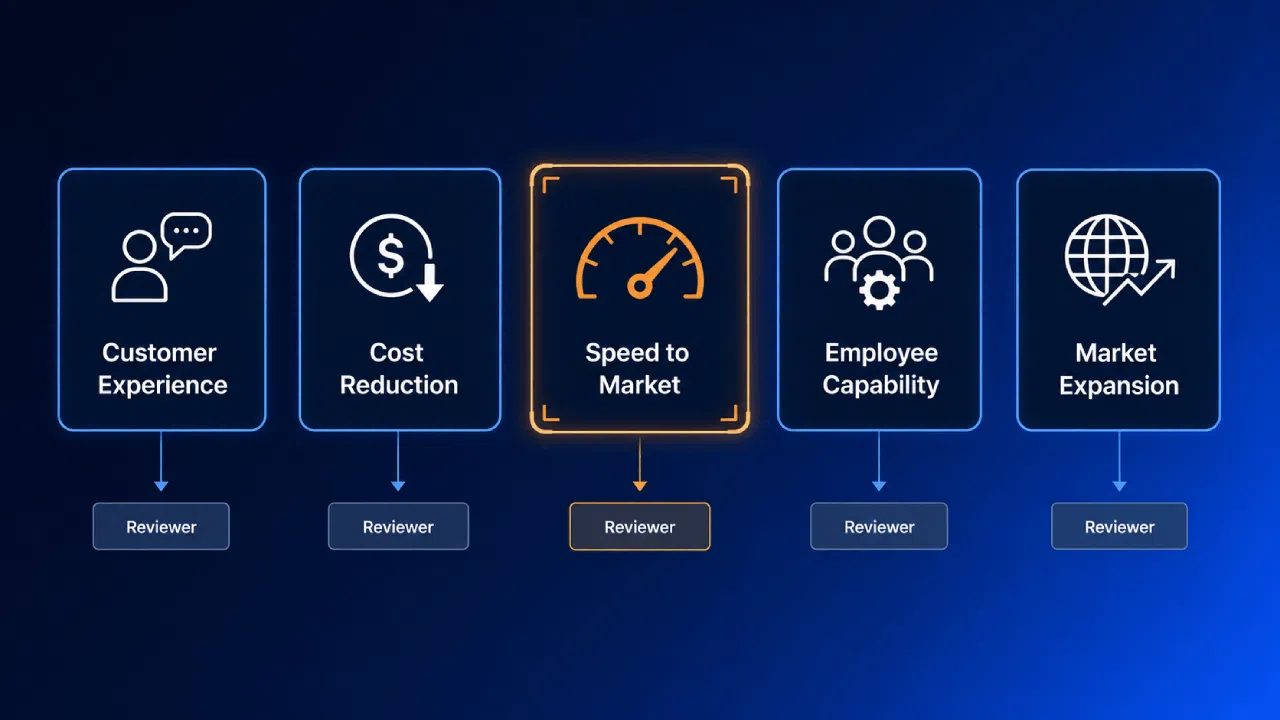
It’s clearly a speed-to-market idea.
A few taxonomy principles to keep in mind:
- Use language your submitters use, not internal jargon.
- Keep the list short (five to seven categories). Too many choices paralyze decision-making.
- Ensure each category routes to a known reviewer or review team. Submissions shouldn’t disappear into routing purgatory.
- Publish the routing logic so submitters understand where their idea goes and who will see it.
A well-structured taxonomy doesn’t just organize submissions. It signals to employees that the system was designed with them in mind.
The Post-Submission Experience
Acknowledgment is the first signal about whether this portal actually matters. Three elements make the post-submission experience work.
- Send an immediate, specific confirmation. Not “we’ve received your submission.” That’s passive. Something like: “Thanks for your idea. We’re reviewing it against our Q2 priorities and you’ll hear from us by 2026.” This tells them someone will read it, there’s a timeline, and there’s a framework for decision-making.
- Set and keep a feedback window. Two weeks is a reasonable benchmark for an initial response. An innovation manager might say, “We think this has real potential. We’re connecting you with the operations team to explore feasibility. You’ll hear from them by 2026.” The submitter can see their idea moving forward.
- Build visibility into the portal itself. Move beyond email. Let submitters log in and see where their idea stands: received, under review, selected for development, in progress, implemented.
When employees can track their submissions through visible stages, trust in the system climbs measurably. The portal stops feeling like a black box and starts feeling like a working funnel.
Driving Adoption After Launch
A portal’s success lives or dies in the first 30 days. Adoption requires rhythm, recognition, and visible proof that the system works.
Seeding Early Participation
Don’t launch with a company-wide announcement. Start with early adopters.
- Identify three to five high-performers or cross-functional leaders who are naturally curious about problems and solutions. Personally invite them to submit ideas before you tell anyone else.
- Make it a conversation, not a broadcast. Ask them specifically: “Here’s a challenge we’re working on. What would you submit?” Their first submissions set the tone: thoughtful, specific, clearly stated ideas become the baseline that new submitters pattern-match.
- Expand the circle after feedback lands. Once those early submissions are in and you’ve responded with solid feedback, announce the portal to a broader team. Point to the examples already in the system. Now people see what good looks like.
You’re not just seeding participation. You’re curating the culture that shapes every submission that follows.
Keeping Engagement Alive
Launch momentum decays without deliberate rhythm. Three mechanisms keep it alive.
- Introduce new challenges regularly. If your always-on box exists but nothing new is happening, engagement flattens. Layer in fresh campaigns every four to six weeks. Even a new problem frame signals that leadership is paying attention and the system is active.
- Communicate results. Send a monthly digest: “Here’s what came in last month. Here’s which ideas are moving to development. Here’s who we’re crediting.” This closes the loop: submitters see what happened to their ideas, and non-submitters see what’s possible.
- Tie campaigns to actual strategic priorities. If the challenge is “How might we improve our supply chain?” connect it explicitly to quarterly business goals. Contribution should feel relevant, not arbitrary or divorced from real business needs.
Each mechanism reinforces the others. Challenges create submissions, results show impact, and strategic framing ensures that impact matters to the organization.
Recognition That Works
Gamification gets a lot of play in innovation circles: points, badges, leaderboards. The evidence for sustained behavior change is thin.
Visibility and credit are what actually drive participation long-term.
Name the person who submitted the idea. Show it moving through the funnel. Celebrate wins publicly.
An email from the CEO saying “This innovation came from Jane in Product, and we’re implementing it next quarter” is worth more than a thousand badges.
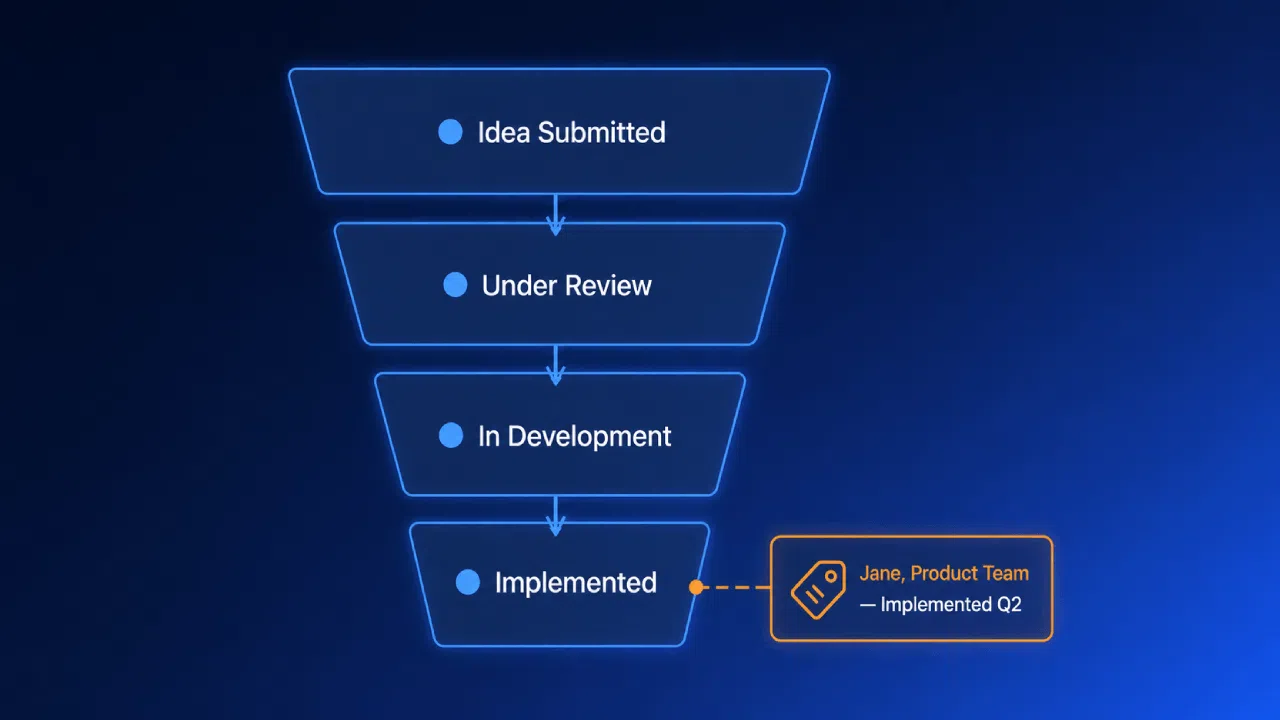
Also: let submitters see their ideas being developed. Even ideas that don’t move to implementation should get a reason why.
A qualitative note explaining the decision teaches submitters what the organization values.
They either reframe their next submission accordingly, or they don’t submit again knowing their thinking isn’t aligned. Either way, you’re building signal, not noise.
What the Reviewer Side Gets Wrong
Portal design is only half the equation. Reviewers are the other half, and most organizations leave that side to chance.
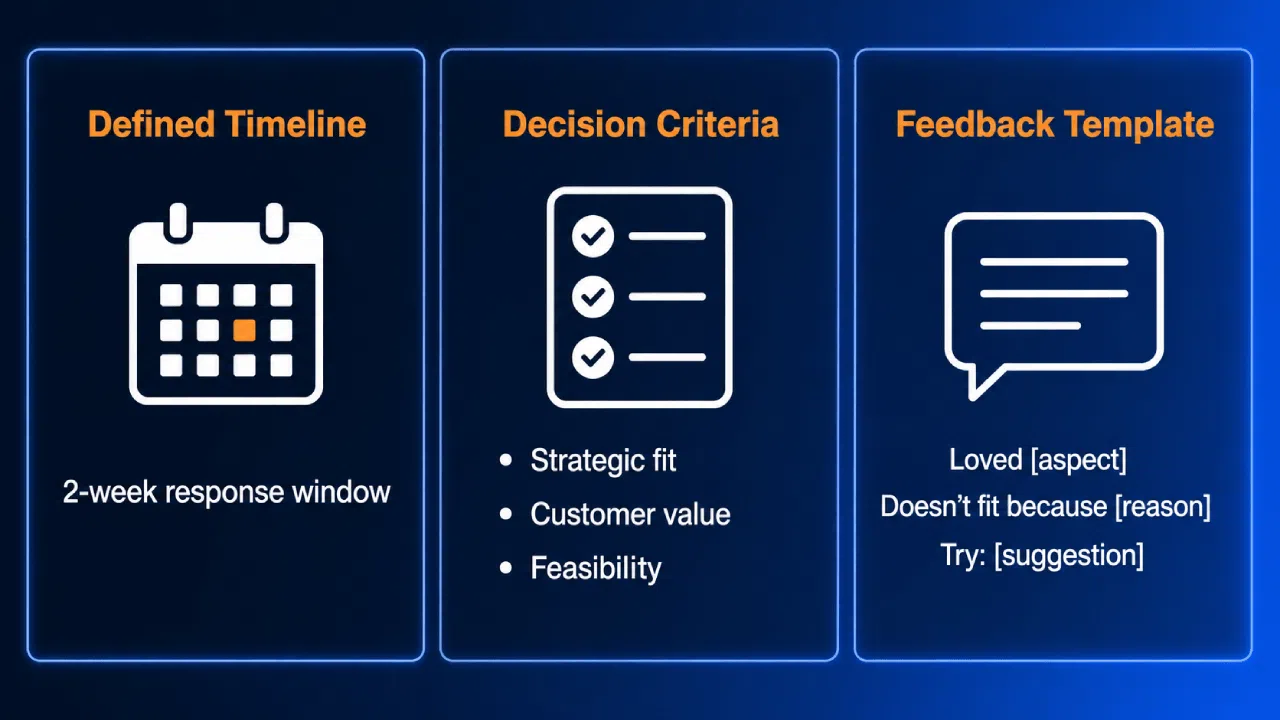
Reviewers need three things to function well.
- Defined timelines. Timelines prevent submissions from languishing. “We’ll respond within two weeks” is concrete.
- Clear decision criteria. Decision-making becomes faster and more consistent when reviewers share a frame. Does the idea need to align with the current roadmap, or can it be future-looking? Can it span departments, or is it contained? Where submission volume is high, AI-assisted scoring helps reviewers apply those criteria at scale, cutting manual triage time without sacrificing decision quality.
- A feedback template. Instead of “This doesn’t fit our strategy,” a template prompts: “We loved the thinking on [aspect]. It doesn’t align with our current roadmap because [reason]. Here’s how you could evolve it: [suggestion].”
This teaches the submitter what matters. They know they were heard, and next time, quality improves.
Without reviewer discipline, portal quality degrades regardless of how well you design the intake form. The form is the door.
Reviewer feedback is the conversation that happens after someone walks through. Both matter.
Make the Portal Part of Your Innovation System
A portal is where ideas enter your organization’s structured funnel.
Without clarity about what happens next (how reviewers prioritize, which ideas move to development, how you measure impact), a portal becomes a collection mechanism with no real purpose.
Design backward from the funnel. Two questions come first:
- What do reviewers need to make fast, consistent decisions?
- What information does the next stage require?
Only then design the intake form to gather exactly what you need, nothing more.
A working portal has two sides in sync: submitters who know exactly what to contribute and how their idea will be treated.
Reviewers understand their timeline, their criteria, and what quality feedback looks like.
When both sides know what’s expected, the system works. Organizations that implement structured intake with disciplined review protocols report 25-30% faster implementation of the projects they select to develop.
Accept Mission’s Idea Collecting module supports both always-on IdeaBox intake and targeted campaign-driven submissions from a single structured environment.
This flexibility means you’re not choosing between continuous engagement and strategic focus: you can run both, with consistent routing, defined review timelines, and transparent feedback loops across all submissions.
Download the free guide Idea Collecting: From Organizational Signals to Ideas and learn how to structure your first intake experience for maximum clarity and participation.
Request a demo to see how Accept Mission gives you one structured environment for every intake channel, from always-on IdeaBox to targeted innovation campaigns.








 English
 Dutch
Dutch Portuguese
 Spanish
 French
 German
 Arabic