
Mission Campaigns That Don’t Flop: How to Get 5× More Submissions14 min read

Most campaigns fail because of bad structure, not low motivation.
Vague prompts, no visible evaluation process, and no follow-through on what was submitted are the real issues. Three patterns account for most failures:
- The black hole: Submissions pour in, then silence. No triage, no outcome, no feedback. The organization can’t metabolize what it collects.
- Strategic drift: “Share your best ideas” produces unfocused input with no internal buyer. Without a clear decision context, nobody owns the pile.
- Innovation theater: Campaigns that look like hackathons but produce zero implementation erode trust fast, and participation collapses in the next one.
A campaign works when it delivers decision-ready submissions: entries a reviewer can evaluate, score, and route without guesswork.
The 5× multiplier in this article is quality-adjusted. More volume only helps if reviewers can process it.
Pillar 1: Campaign Design That Creates Decision Flow
Define the decision you need before you design the campaign. What will you do with the best submissions? If you can’t answer that, the campaign isn’t ready.
Start with Commander’s Intent
Military and emergency teams use a principle called Commander’s Intent: every mission is defined by its outcome, not just its method.
A strong mission has three elements: a target problem (specific and bounded), clear constraints (timeline, budget, technical boundaries), and explicit authority to act (what happens to winning submissions).
This signals that the organization is in active response mode and that contributions will enter a process that leads somewhere.
Build a challenge statement with four elements
A high-quality challenge statement contains four parts:
- Context: Why this matters now. (“Our energy costs rose 20% due to regulatory shifts.”)
- User: Whose problem are we solving? (“Frontline maintenance staff using legacy reporting tools.”)
- Constraint: What are the non-negotiables? (“Must integrate with SAP. No new hardware.”)
- Desired outcome: What does success look like? (“Reduce reporting time by 15% or save $50k annually.”)
Specific framing produces focused, evaluable input. The submission constraints are what determine quality at triage.
Most teams skip the constraint because it feels restrictive.
It isn’t. It tells contributors what a useful submission actually looks like, which reduces the gap between what gets submitted and what reviewers can act on.
Design the funnel before you launch
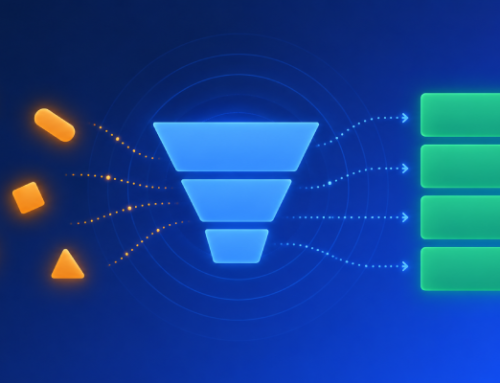
Every mission needs a stage-gate funnel in place before it goes live. Here’s a five-stage structure that works:
| Stage | Purpose | Action |
|---|---|---|
| Submission | Capture input | Automated check for completeness |
| Triage | Rapid keep/kill | Apply knockout criteria. Remove 50–70% of non-viable entries immediately |
| Enrichment | Strengthen promising entries | Send back to submitters for additional evidence or data |
| Selection | Formal evaluation | Review by decision committee using weighted scoring |
| Pilot | Test and validate | Funded experimentation on selected submissions |
The goal is a decision-ready standard.
By the time a submission reaches a human reviewer, it should contain a problem statement, a rough cost or impact estimate, and strategic alignment.
Use AI to multiply evaluation capacity
Five times more submissions without expanded evaluation capacity creates a bottleneck. In comparable document-heavy workflows, AI increases processing capacity by up to 5×.
Four mechanisms make this work:
- Clustering: Group duplicate or related submissions into a single “master idea.” Fifty people suggesting “digital receipts” becomes one entry, not fifty reviews.
- Automated scoring: Pre-score submissions based on alignment with the challenge statement.
- Completeness checks: Reject incomplete submissions automatically and prompt the submitter to fix them before human review.
- Expert routing: Analyze submission content and route it to the relevant subject matter expert.
Together, these mechanisms shift the bottleneck. The limiting factor stops being reviewer bandwidth and becomes the quality of the challenge design itself.
This also changes how managers run campaigns.
When triage is automated, it becomes practical to run more targeted campaigns with narrower scope rather than one broad annual collection that produces an unmanageable pile.
Pillar 2: Prompt Design That Extracts Decision-Ready Submissions
Most submission forms fail because they’re either too brief (“What’s your idea?”) or too bureaucratic (a 40-field business case).
The middle ground is a structured prompt that breaks complex thinking into smaller, manageable steps.
Why open-ended prompts produce low-quality output
An empty text box creates blank-page syndrome. The cognitive load is too high. People freeze or write shallow, unfocused responses.
Structured prompts act as cognitive scaffolds that tell the submitter what to think about, in what order, and at what depth. A high-quality prompt has three components:
- Instruction: What should the submitter do? (“Describe one process that takes more than 30 minutes but adds no value.”)
- Context: What background matters? (“We’re targeting cost savings in logistics this quarter.”)
- Constraint: What format and evidence are required? (“Limit to 100 words per field. Include a time or cost estimate.”)
The constraint is the most commonly skipped component. Without it, submissions vary too much in format and depth to evaluate consistently across a large intake.
Adding context does something less obvious: it signals to the submitter that the campaign has a real decision behind it.
That signal alone tends to raise the quality of input, because contributors understand their response will be read by someone with a specific problem to solve.
Five mission prompt templates by strategic goal
Each template uses structured questions designed to produce evaluable, decision-ready submissions.
1. Quick Win (Cost Efficiency) Mission: “Identify one process that takes more than 30 minutes but adds no value.”
- Q1, The Friction: Name the specific process or task.
- Q2, The Root Cause: Why does this inefficiency exist?
- Q3, The Fix: What’s your specific proposal?
- Q4, The Impact: Estimate hours or dollars saved per month.
- Q5, Feasibility: Can your team implement this alone, or does it require IT or capital?
2. Customer Radar (CX) Mission: “What is the number one thing customers keep asking for that we don’t have?”
- Q1, The Request: Describe the need in the customer’s words.
- Q2, The Frequency: How often do you hear this? (Daily, weekly, monthly.)
- Q3, The Competitor: Who currently provides this?
- Q4, The Solution: Should we build, buy, or partner?
- Q5, The Metric: Which KPI will this improve? (NPS, CSAT, churn rate.)
3. Shield (Risk and Compliance) Mission: “Identify a vulnerability before it becomes an incident.”
- Q1, The Threat: What specific risk are we exposed to?
- Q2, The Root Cause: Why does this vulnerability exist?
- Q3, The Mitigation: What control or process do you propose?
- Q4, Compliance Check: Does this align with specific regulations?
- Q5, Urgency: What happens if we do nothing for six months?
4. Hunter (Growth) Mission: “Where is the new revenue hiding?”
- Q1, The Opportunity: Who is the target customer we’re currently missing?
- Q2, The Value Prop: Why would they pay for this offering?
- Q3, The Advantage: Why are we the right company to build this?
- Q4, The Horizon: Is this an improvement to an existing product or a new business model?
5. Future Proof (Sustainability) Mission: “How can we reduce our footprint while saving costs?”
- Q1, Impact Area: Which sustainability target does this address?
- Q2, The Shift: How does this change our current practice?
- Q3, Double Bottom Line: How does this save money while reducing environmental impact?
- Q4, Scalability: Can this roll out to other sites or locations?
Killer questions and behavioral nudges
Every submission form should include one or two disqualifier questions. If the answer is “no” or “unknown,” the submission gets flagged for enrichment or auto-rejected.
Examples: “Is this feasible with our existing stack?” and “Does this violate any known compliance requirement?”
Three nudges also improve quality:
- Save progress: Let people draft and return. Remove the pressure of a perfect first attempt.
- Similar idea display: Show related past submissions as the user types. Prevent duplicates and encourage building on what exists.
- Champion prompt: Ask “Who would be the best executive sponsor?” Force submitters to think about feasibility before they hit submit.
Pillar 3: Incentive Design That Rewards Signal, Not Noise
Getting the prompt right improves input quality. Getting the incentive right shapes participation behavior. Most incentive structures are designed around the wrong goal.
Why do cash incentives backfire for knowledge workers?
When an organization places a cash bounty on an idea, it converts a social norm into a market norm. “I want to improve this company” becomes “I’m doing this for $50.”
Research confirms that monetary incentives crowd out intrinsic motivation for complex, creative tasks. Cash also encourages gaming: submitting many low-quality entries to maximize the odds of winning.
The career signal strategy
The most effective incentive for ambitious employees is professional visibility. Winning a mission should signal high potential to leadership.
| Tier | Reward type | Mechanism | Best for |
|---|---|---|---|
| Tier 1, Entry | Social recognition | Digital badges, peer recognition, “thanks” points | Driving initial participation, reinforcing culture |
| Tier 2, Quality | Access and exposure | Leadership roundtable, town hall presentation, Innovator of the Month | High-quality validated submissions, ambitious employees |
| Tier 3, Impact | Professional growth | Training budget, conference tickets, “Innovation Fellow” title | Consistent top contributors, retaining talent |
| Tier 4, Success | Resource allocation | Seed funding ($5k–$50k) to build the pilot, dedicated project time | Winning teams selected for implementation |
Giving the winning team dedicated time and budget to build the pilot ties the reward directly to the outcome.
Anti-gaming rules that protect quality
Gamification works. Platforms with well-designed game mechanics generate up to 1.7× more submissions. But without safeguards, it invites noise.
Four rules keep the system honest:
- Weighted scoring: Award 10 points for submission, 100 for passing triage, 500 for pilot selection. Points accumulate through stage progression, which reduces incentive to flood the system with low-effort entries.
- Skin in the Game: Give participants virtual currency to invest in peers’ ideas. If a backed idea succeeds, the backer earns status.
- Algorithmic fairness: Ensure new submissions get equal visibility. Early entries shouldn’t dominate simply because they arrived first.
- Quality filters: No points until a submission passes an AI quality check for length, uniqueness, and completeness.
Define “5×”: The Metrics That Actually Matter
The 5× claim is specific and measurable. It’s the compounded result of three levers.
Where the 5× multiplier comes from
| Lever | Multiplier | Mechanism |
|---|---|---|
| Gamification lift | 1.7× | Well-designed game mechanics increase submission rates |
| Mobile and UX friction reduction | 1.3× | Mobile-first design enables in-the-moment capture |
| AI capacity expansion | 2.5× | AI-augmented triage lets managers solicit input more aggressively because they can process higher volumes |
Combined, these three levers compound to roughly 5×. The multiplier is meaningful because it applies to decision-ready submissions, not raw volume.
Four metrics every campaign owner should track
Four specific metrics determine whether a campaign is functioning as intended:
- Decision-ready rate: Percentage of submissions that meet the decision-ready standard at triage. With structured prompts, aim for 40–60%.
- Review time per submission: Time from submission to first review decision. Benchmark: under two weeks. Best practice with AI triage: under 48 hours.
- Conversion rate (submission to pilot): 5–10% of submissions should reach the pilot stage. Below 1% means criteria are too strict or quality is too low. Above 50% means criteria are too loose.
- Trust signals: Are outcomes communicated back to submitters? Are status updates visible? Trust is the leading indicator of participation in your next campaign.
These metrics sit inside a broader dashboard that tracks:
- Pipeline health (submissions per stage)
- Engagement pulse (active users vs. submission volume)
- Portfolio balance (distribution across Horizon 1, 2, and 3)
- Speed to value (cycle time from submission to implementation decision)
Together they give campaign owners a complete picture of whether the intake is working, where it is stalling, and whether the organization is building or losing credibility with contributors.
Templates You Can Use This Week
Mission brief template
Use this template to frame every mission before launch:
| Field | What to include |
|---|---|
| Mission title | Clear, specific, action-oriented |
| Strategic context | Why this matters now. One paragraph maximum |
| Target audience | Who should submit? Be specific about roles and departments |
| Challenge statement | The four elements: context, user, constraint, desired outcome |
| Constraints and disqualifiers | Non-negotiable boundaries and knockout criteria |
| Timeline and milestones | Submission deadline, triage window, selection date, pilot kickoff |
| Evaluation criteria | Weighted scoring dimensions (impact, feasibility, alignment, evidence) |
| Incentive structure | What happens to winning submissions. Be explicit |
Submission prompt library
| Mission type | Core question | Required evidence | Disqualifier |
|---|---|---|---|
| Quick Win | “What process takes 30+ mins but adds no value?” | Hours/dollars saved per month | Not feasible with existing stack |
| Customer Radar | “What do customers keep asking for?” | Frequency, competitor landscape, target KPI | No customer evidence provided |
| Shield | “What vulnerability exists before it becomes an incident?” | Root cause, proposed mitigation, urgency | Violates known compliance rules |
| Hunter | “Where is new revenue hiding?” | Target customer, value prop, horizon classification | No identifiable internal buyer |
| Future Proof | “How do we cut footprint and save costs?” | Impact area, cost savings estimate, scalability | Cannot be rolled out beyond one site |
Incentive menu with anti-gaming safeguards
| Tier | Reward | Anti-gaming safeguard |
|---|---|---|
| Tier 1, Entry | Badges, peer recognition | No points until AI quality check passes |
| Tier 2, Quality | Leadership access, Innovator of the Month | Points awarded only after triage stage |
| Tier 3, Impact | Training budget, conference tickets | Consistent contribution over time required |
| Tier 4, Success | Seed funding, dedicated project time | Selection committee review with weighted scoring |
Action Checklist: Launch a Better Campaign This Week
- Define the decision. Write the specific decision this campaign must inform. Use the four-element challenge statement.
- Set up the funnel. Configure five stages: Submission, Triage, Enrichment, Selection, Pilot. Define knockout criteria for triage.
- Choose a prompt template. Match it to your strategic goal. Add one or two disqualifier questions.
- Configure AI triage. Set up clustering, completeness checks, and automated scoring against your challenge criteria.
- Select incentives. Pick from the career signal menu. Set weighted scoring rules that reward stage progression over volume.
- Communicate the mission brief. Share the timeline, evaluation criteria, and what happens after submission with your target audience.
- Close the loop. Publish outcomes within 48 hours of each stage gate. Communicate what was selected, what wasn’t, and why.
Campaigns that generate more decision-ready submissions are tighter in scope and clearer about what happens after submission. Participation follows when the process is credible.
Download the free guide Idea Collecting: From Organizational Signals to Ideas and learn how to build a collection process with the right intent, ownership, and a clear path from input to decision.
Request a demo to see how Accept Mission gives you real-time visibility into submission quality, stage progression, and campaign engagement with dashboards built for structured idea intake.







 English
 Dutch
Dutch Portuguese
 Spanish
 French
 German
 Arabic