
How to Turn Employee Resistance Into Innovation Success (Complete Guide)11 min read

About 70% of all change initiatives fail. Not because the strategy is flawed. Not because the technology isn’t ready. They fail because of people.
Companies like Kodak, Nokia, and Blockbuster saw the future coming. Yet all three collapsed because they couldn’t get their organizations to embrace change. The real challenge isn’t creating new strategies or buying new technologies. It’s getting employees to accept them.
This guide shows you how to shift from fighting resistance to building resilience. You’ll learn why employees push back, how to spot it early, and proven strategies to turn skeptics into advocates.
Why Employees Resist Change
Employee resistance isn’t irrational defiance. It’s a predictable human response to disruption.
The Psychology Driving Pushback
Most resistance starts with fear.
Innovation dismantles what’s familiar and introduces uncertainty. The human brain treats uncertainty as a threat, and when people lack clear information, they imagine the worst.
Two cognitive biases make this fear worse:
- Loss aversion: People feel the pain of losing something twice as strongly as gaining something equal. Employees focus on what they’re losing—familiar processes, proven workflows, established relationships—rather than potential benefits.
- Status quo bias: People prefer their current state, even when shown better alternatives. “The way we’ve always done it” creates powerful inertia that makes any change feel threatening.
Innovation also challenges fundamental needs.
Top-down changes make employees feel powerless, while new systems requiring new skills make existing expertise less valuable. This hits long-tenured staff hardest because their professional identity is tied to mastering current systems.
Then there are concrete worries: job security and increased workload, with the fear that automation will eliminate jobs driving strong opposition.
How Companies Make Resistance Worse
Companies often create the conditions that guarantee resistance. Past failures and disconnected leadership breed skepticism about any new initiative.
Organizations fuel their own fires through:
- Poor communication: Silence fills with fear and rumor instead of facts
- Top-down mandates: Excluding employees from the process breeds resentment
- Change fatigue: Repeated transformations exhaust people, making each new initiative feel like another burden
- Broken trust: When previous changes failed, employees doubt the next one will succeed
This creates a vicious cycle. Poor communication triggers fear. Fear activates loss aversion.
If this follows a failed initiative, mistrust deepens. Each poorly managed change erodes trust, which amplifies resistance to the next initiative.
Leaders often misdiagnose this problem. They see someone resisting new software and try to “sell” the features. The real issue isn’t the software. It’s a lack of trust.
The solution isn’t a better demo. It’s a transparent conversation about the employee’s future and the support they’ll receive.
Recognizing Resistance in Real Time
Resistance doesn’t always announce itself loudly.
Active resistance is visible: someone argues in a meeting or refuses training. Passive resistance is more dangerous. People agree in meetings but ignore the change afterward.
Here are warning signs you would see:
| Behavior | Active Signs | Passive Signs | First Action |
|---|---|---|---|
| Communication | Vocal criticism, spreading negativity | Silence in meetings, withholding feedback | Host open Q&A sessions |
| Participation | Refusing to join teams or training | Chronic absence, minimal engagement | Provide one-on-one coaching |
| Adherence | Openly continuing old processes | Quietly reverting to old methods | Offer hands-on training, create quick wins |
| Attitude | Sarcasm, challenging leadership | Apathy, “just do enough” mindset | Acknowledge challenges, reinforce value |
Watch for these red flags:
- Disengagement: Employees stop sharing ideas and contribute minimum effort
- Information hoarding: People withhold critical data or concerns
- Negative peer influence: Respected employees signal doubt in informal settings
- Productivity dips: Decreased performance or increased absenteeism
What silent compliance really means: Passive resistance indicates low psychological safety. In safe environments, concerns emerge as active resistance, like tough questions in town halls.
But where dissent has been punished, resistance goes underground. Don’t be alarmed by active resistance. Be alarmed by its absence.
Six Strategies to Navigate Resistance (The Leader’s Playbook)
You don’t overcome resistance by pushing harder. You address root causes through vision, communication, involvement, and support.
Strategy 1 – Lead by Example
Employees watch their leaders for behavioral cues. You must be the first and most visible champion of any innovation.
To lead effectively:
- Model the change: Actively use new tools and adopt new behaviors yourself
- Take calculated risks: Show willingness to experiment and learn from failures
- Build a coalition: Assemble influential leaders from various functions who can remove obstacles
- Stay visible: Demonstrate resilience when setbacks occur and communicate consistently
Your actions matter more than your words. When employees see leaders embracing new tools, adopting new mindsets, and learning from mistakes, they’re far more likely to follow.
Strategy 2 – Create a Compelling Vision
Your vision must answer four questions:
- Where are we going? Clear, concise, aspirational
- Why are we going there? The market shifts or opportunities that make change necessary
- Can we get there? A credible plan addressing concerns about skills and resources
- What’s in it for me? How it benefits employees personally
The last question is the most important. Employees need to see how the change benefits them directly through growth opportunities, skill development, or improved work experience.
Connect the innovation to your organization’s mission and values to make it meaningful and inspire genuine commitment.
Strategy 3 – Master Communication
Create a formal plan that identifies key audiences, core messages, effective channels, and a clear timeline. Start early. It’s better to communicate that not all answers are known than to remain silent.
Your communication must answer three critical questions:
- What is changing: The specific systems, processes, or behaviors being introduced
- Why this change is necessary now: The business reasons and urgency behind the decision
- How it impacts individuals: The personal benefits and day-to-day implications for each employee
Create two-way dialogue through town halls, pulse surveys, and listening tours.
The messenger matters: senior executives deliver strategic vision, while direct managers explain personal impact and answer specific questions their teams have.
Strategy 4 – Involve Employees as Co-Creators
Include employees early through diagnostic workshops, co-designing workflows, and pilot testing. This generates better solutions and transforms employees into stakeholders.
Effective involvement means:
- Start early: Bring employees in during problem identification, not just implementation
- Empower champions: Identify change-friendly employees and give them formal roles to advocate
- Recognize participation: Celebrate the act of contributing, not just winning ideas
- Create feedback loops: Make it easy for employees to share concerns and suggestions
People support what they help create. When employees co-design the solution, they’re invested in making it work.
Identify naturally change-friendly employees and empower them as “change champions” who can advocate within their peer groups and provide valuable feedback from the front lines.
Strategy 5 – Build Competence Through Training
Commit to comprehensive learning programs tailored to specific roles. Training should cover technical skills and soft skills like adaptability and resilience.
Effective training programs include:
- Role-specific content: Customize training to address the actual tasks each role performs
- Technical and soft skills: Cover both the “how” and the mindset shifts needed
- Ongoing support: Provide clear documentation, dedicated help channels, and coaching
- Realistic expectations: Acknowledge the learning curve and adjust performance metrics initially
Provide accessible support through multiple channels, so employees can get help when they need it. Recognize that adaptation takes time, and adjust expectations during initial implementation to reduce pressure and give people space to learn.
Strategy 6 – Create Psychological Safety
Create an environment where people feel safe to speak up, ask questions, share ideas, and fail without fear of punishment. This is the foundation of a learning culture and a requirement for innovation.
Psychological safety looks like:
- Questions are welcomed: No question is considered stupid or annoying
- Mistakes are learning opportunities: Failures are analyzed, not punished
- Dissent is valued: Different opinions strengthen decisions rather than threaten authority
- Vulnerability is acceptable: People can admit when they don’t know something
Without psychological safety, training becomes useless because employees won’t risk applying what they’ve learned. When people feel safe to experiment and be vulnerable, innovation thrives and adaptation accelerates.
Proven Frameworks to Structure Your Approach
Research-backed frameworks help you navigate complexity. Don’t view these as competing theories—they’re complementary tools operating at different levels.
Think of change management frameworks as operating at different altitudes:
- 30,000 feet: Conceptual philosophy (Lewin)
- 10,000 feet: Organizational project plan (Kotter)
- Ground level: Individual coaching guide (ADKAR)
Using all three creates a holistic approach addressing change from macro-organizational to micro-individual levels. Each framework serves a distinct purpose in your overall strategy.
Lewin’s 3-Stage Model (30,000 feet)
This model provides a simple yet powerful framework for conceptualizing transformation. It breaks the entire change journey into three distinct phases that everyone can understand.
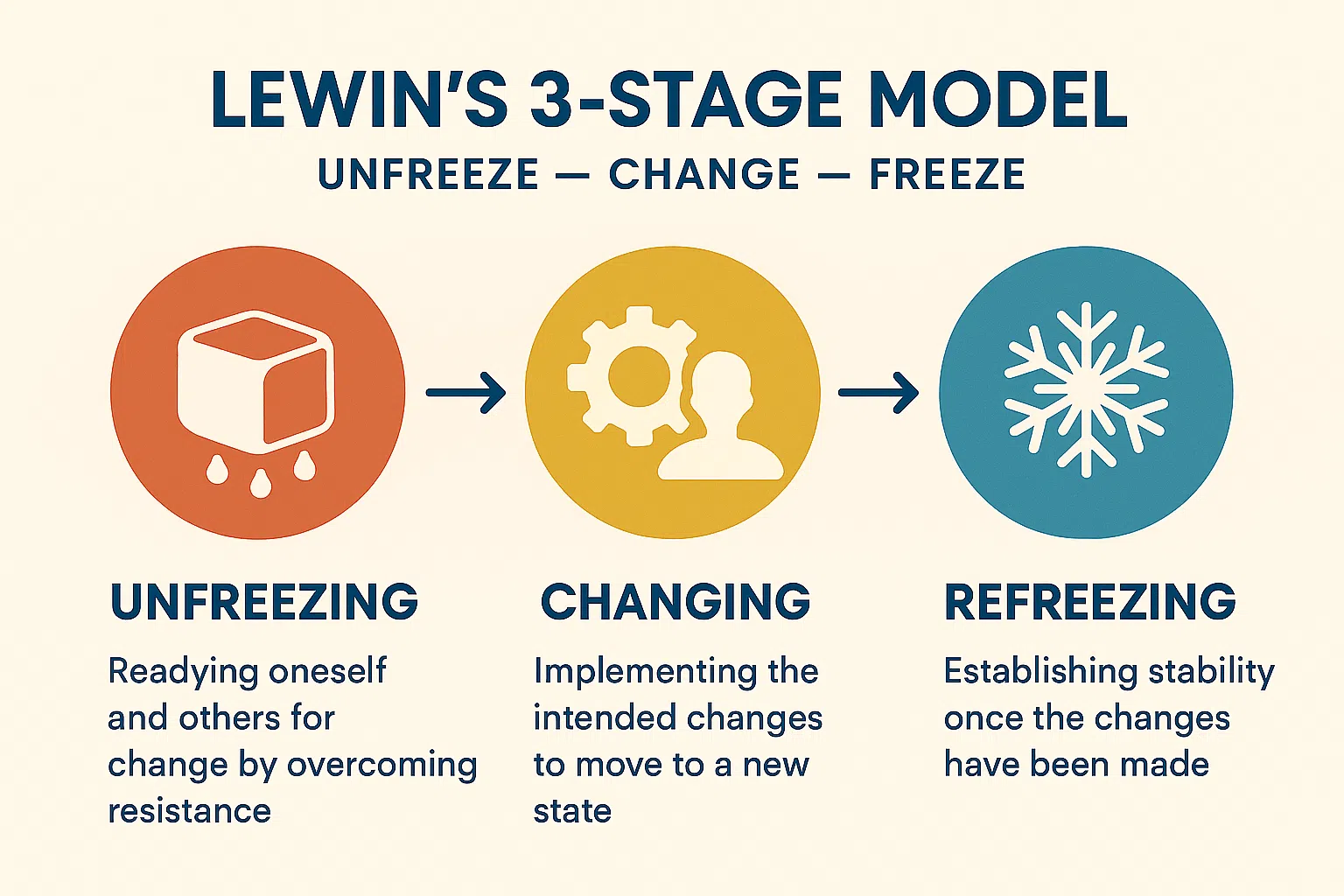
The three stages are:
- Unfreeze: Prepare the organization by communicating rationale, creating urgency, and gathering support
- Change: Implement new processes with clear communication, training, and support while expecting mistakes
- Refreeze: Stabilize after implementation by reinforcing new behaviors through updated policies, rewards, and celebrating success
This model works best when explaining the overall change journey to leadership and the broader organization. It provides a clear mental model that helps everyone understand where they are in the process and what comes next.
Kotter’s 8 Steps (10,000 feet)
This framework provides a detailed roadmap for large-scale transformation. It translates Lewin’s philosophy into specific, sequential actions your leadership team can follow.
The eight steps include:
- Create urgency: Build compelling reasons for action by identifying crises and opportunities
- Build a coalition: Assemble a group with power, credibility, and expertise to lead
- Form a vision: Create a clear, simple, inspiring picture of the future state
- Enlist volunteers: Communicate broadly to get employees to buy in and contribute
- Remove barriers: Identify and eliminate obstacles while empowering employees to act
- Generate quick wins: Create visible successes early to build momentum and credibility
- Sustain acceleration: Use early wins to drive even more significant change
- Institute change: Anchor new approaches in culture by linking them to success
Use this framework as your master project plan for major transformations. It gives your change management team and senior leadership a clear sequence of actions to execute, ensuring nothing critical gets overlooked.
ADKAR (Ground level)
This model addresses change at the individual employee level. It provides a diagnostic tool to identify exactly where someone is stuck in their change journey.
The five sequential outcomes are:
- Awareness: Understanding the need for change and why it’s necessary
- Desire: Personal motivation to participate and support the change
- Knowledge: Understanding how to change, including new processes and required skills
- Ability: Demonstrated capability to implement the change in practice
- Reinforcement: Sustained change through recognition, rewards, and positive feedback
Use ADKAR when an employee struggles with change.
Stuck at Awareness? Improve communication about the “why.” Stuck at Desire? Address personal concerns and show benefits. Stuck at Knowledge? Provide training. Stuck at Ability?
Offer coaching and practice opportunities. This precision lets managers provide exactly the right support at the right time.
Leading the Resilient Organization
Managing change effectively has become a continuous competitive advantage. Mastering it requires shifting from reactively managing resistance to proactively building resilience.
The goal isn’t just surviving the next software rollout. It’s building a resilient organization where employees embrace continuous innovation and act as engines of transformation.
Accept Mission helps turn this vision into reality through its AI-driven innovation management platform.
The software manages the full innovation lifecycle while addressing the human side of change through gamification, transparent workflows, and collaborative features.
Getting started with building your resilient organization doesn’t require overhauling everything at once:
- Create psychological safety in your team where people feel comfortable experimenting and sharing concerns
- Improve your communication plan by answering the “what,” “why,” and “WIIFM” questions clearly
- Identify and empower change champions who can advocate within their peer groups
- Measure what matters with a simple dashboard tracking both adoption and sentiment
- Involve employees early in co-designing solutions rather than imposing changes
Start small with one or two strategies. Build momentum. Learn what works in your specific context. Adjust what doesn’t. The key is taking that first step toward creating a culture where innovation isn’t an event to endure, but an ongoing process to embrace.
Ready to transform how your organization handles innovation? Book a demo with Accept Mission to engage employees, manage ideas, and build a change-ready culture.








 English
 Dutch
Dutch Portuguese
 Spanish
 French
 German
 Arabic