
How to Structure Your Innovation Funnel for Maximum Impact11 min read
Many companies want to innovate, but their efforts are often chaotic and disconnected from business goals.
This leads to “innovation theater” — a lot of activity with no real results. A well-structured innovation funnel brings order, strategy, and focus to the process.
What Is an Innovation Funnel (and Why You Need One)
An innovation funnel is a system that brings order to the creative process.
It helps you capture, filter, and develop new ideas, providing a clear path to turn many raw concepts into a few high-impact projects.
Instead of a random approach, it gives you a structured way to guide ideas from their first spark to a final, market-ready solution.

But a funnel does more than just filter ideas.
It’s a strategic tool that helps you manage risk by testing concepts with small investments before committing significant resources.
It also drives growth by aligning innovation efforts with your company’s goals. The need for a better system is clear:
While 96% of executives see innovation as vital for growth, only 21% report meeting their innovation goals.
A funnel helps close that gap by making the process deliberate and manageable.
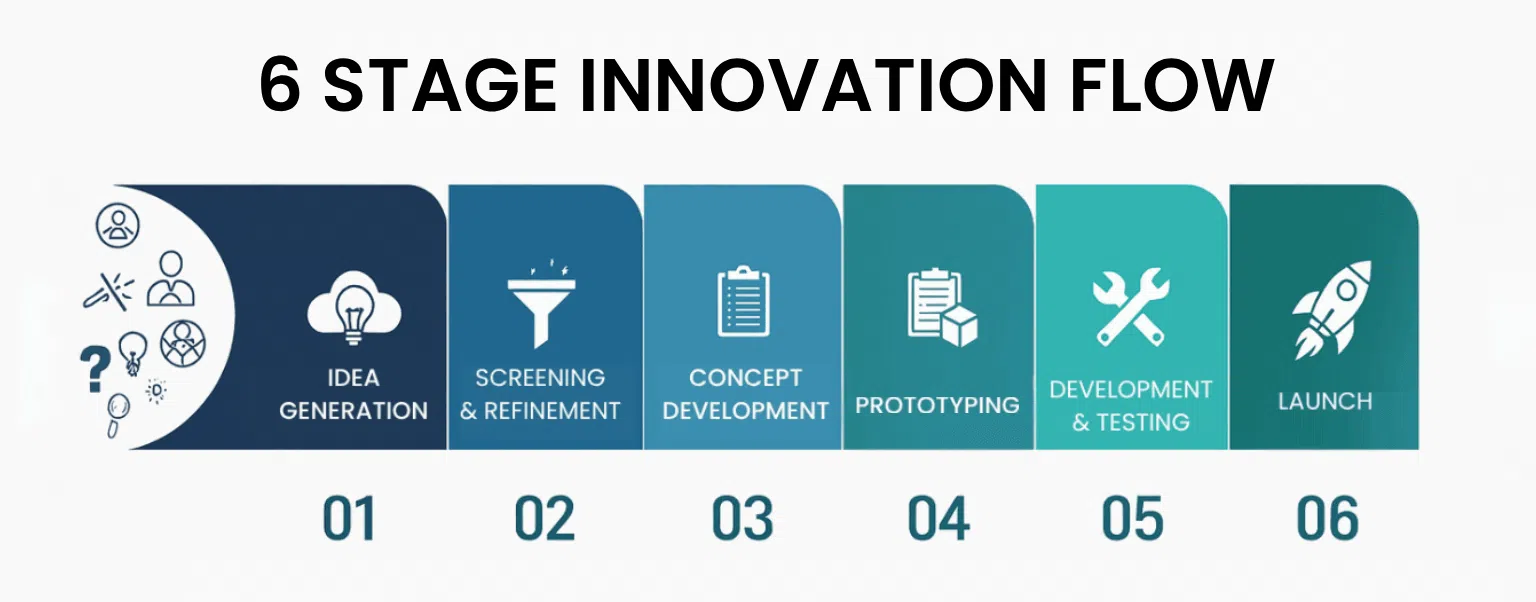
The 6 Essential Stages of a Modern Innovation Funnel
While the details can be customized, a successful funnel generally follows a clear, six-stage process.
Each stage serves a specific purpose, moving ideas from a raw concept to a market-ready reality.
Stage 1: Idea Generation (The Wide Mouth)
The first step is to gather a large quantity and variety of ideas. To do this well, you need to look beyond a simple internal suggestion box.
Key sources for ideas include:
- Internal employees
- Customer feedback
- Partner ecosystems
- Market research
Actively sourcing ideas from these different channels is crucial. Running focused innovation campaigns on specific topics is a great way to generate relevant concepts.
The main goal at this stage is to maximize the quantity and diversity of inputs. This ensures you have a rich pool of concepts to draw from for the rest of the process.
Stage 2: Idea Screening & Refinement
Next, you need to perform a quick screening of the ideas based on their strategic fit and basic feasibility.
This isn’t a deep dive, but a rapid assessment to filter out concepts that are clearly misaligned.
During this stage, you should:
- Assess strategic fit
- Check basic feasibility
- Involve cross-functional experts
- Refine promising concepts
Involving experts from different departments like marketing and engineering is key. They can help enrich promising but incomplete ideas and spot major flaws early on.
This collaborative approach is far more effective than simply voting on ideas. This helps the concepts move forward stronger and be viewed from multiple perspectives.
Stage 3: Concept Development & Business Case
Ideas that pass the initial screening are then developed into a more detailed plan. At this point, you build a robust business case to justify further investment.
A strong business case includes:
- A detailed value proposition
- Target market analysis
- Competitive landscape review
- Initial financial projections
This step moves the idea from a high-level concept to a concrete proposal. The goal is to provide a clear, evidence-based rationale for the project’s potential.
A well-defined business case is important for securing the resources needed for the next stages. It turns an idea into a clear investment plan.
Stage 4: Prototyping & Market Validation
This stage is all about testing your core assumptions with real users before committing to full-scale development.
The goal is to get tangible feedback and validate that you are solving a real problem.
Common validation methods include:
- Building a Minimum Viable Product (MVP)
- Conducting customer interviews
- Running surveys and pilot tests
- Observing user interactions
An MVP is a simplified version of your product that allows you to learn with minimal effort. The feedback gathered from these tests is invaluable for refining your concept.
This process helps you avoid the costly mistake of building a product that nobody wants. It ensures that your innovation is grounded in real customer needs and desires.
Stage 5: Development & Testing
Once the concept has been validated with real users, it moves into the full-scale development and testing phase.
This is where the validated prototype is transformed into a market-ready product or service.
Key activities in this stage are:
- Complete product engineering and design
- Rigorous quality assurance (QA) testing
- Fixing bugs and stability issues
- Running a beta test with external users
Close collaboration between R&D, engineering, and design teams is critical here. The beta test provides crucial feedback on real-world performance and user experience.
This feedback is used to make final adjustments and refinements before the official launch to ensure the final product is robust, scalable, and meets customer expectations.
Stage 6: Implementation & Launch
The final stage of the funnel is the market launch and commercialization of the innovation.
This involves a coordinated effort across marketing, sales, and operations to ensure a successful introduction.
The launch process involves:
- Executing the go-to-market strategy
- Running marketing and promotional campaigns
- Scaling up production and distribution
- Monitoring post-launch performance
The work doesn’t end once the product is launched. It’s important to continuously monitor key metrics like adoption rates, user engagement, and revenue.
This data creates a vital feedback loop for the business as they inform future product iterations and improvements, starting the innovation cycle all over again.
Make innovation decisions clearer and faster
Use practical stage gates, scorecards, roles and governance routines to move the right opportunities forward with confidence.
Choosing Your Approach: 3 Models for Managing Your Funnel
Managing the flow of ideas through your funnel is as important as the stages themselves. There are three main models to consider.
The Disciplined Model: Stage-Gate
The Stage-Gate model is a linear process with formal review meetings, or “gates,” between each stage.
At each gate, a team decides if a project should continue (“Go”) or be stopped (“Kill”).
This structured approach is best for large, complex projects in industries like manufacturing, where managing risk is critical.
Its main weakness is that it can be slow and rigid, sometimes stifling creativity.
The Agile Model: Lean Startup
The Lean Startup model uses a fast, iterative cycle of “Build-Measure-Learn.”

You build an MVP, measure customer reactions, and learn whether to change direction (pivot) or continue (persevere).
It’s great for software development and tech startups dealing with high uncertainty. However, it can sometimes lead to endless tweaks without a decisive launch.
The Collaborative Model: Open Innovation
Open Innovation involves actively using external ideas, technologies, and partners.
Instead of relying only on internal R&D, you collaborate with universities, startups, or customers.
This can accelerate progress and broaden your access to new ideas, but it requires careful management of intellectual property (IP) and relationships.
The Best Approach? A Hybrid Model
You don’t have to pick just one. The best strategy is often a hybrid.
You can use the Stage-Gate structure for overall governance, the Lean Startup method for validation, and Open Innovation principles for sourcing new ideas.
| Feature | Stage-Gate Model | Lean Startup Model | Open Innovation Model |
|---|---|---|---|
| Core Idea | Structured, linear progression | Rapid, iterative cycles | Leveraging external knowledge |
| Pace | Slower, more predictable | Fast and adaptive | Can accelerate development |
| Best For | Large, complex projects | High-uncertainty projects | Augmenting internal skills |
| Weakness | Can be rigid and slow | Can lack a clear endpoint | IP risks and management |
How to Measure Your Funnel’s Success (and Avoid “Innovation Theater”)
“Innovation theater” is when a company looks busy with innovation but produces no tangible results. Good measurement prevents this.
Key Performance Indicators (KPIs) to Track
A balanced set of metrics gives you a complete picture of your funnel’s health:
| KPI Category | KPI Name | Description |
|---|---|---|
| Input Metrics | Number of Ideas Submitted | Measures engagement at the start of the funnel. |
| Process Metrics | Idea-to-Project Conversion Rate | Shows how effectively you filter and select ideas. |
| Process Metrics | Time-to-Market | Measures the speed of your innovation process. |
| Output Metrics | Revenue from New Products | A key metric showing the financial impact of innovation. |
| Cultural Metrics | Employee Engagement | Tracks how many employees are active in innovation. |
These metrics provide a holistic view of the innovation process from beginning to end.
They help you identify bottlenecks, measure efficiency, and demonstrate value to stakeholders.
It’s important to track a mix of input, process, and output metrics to get a complete and accurate picture.
Regularly reviewing these KPIs allows you to make data-driven decisions to optimize your funnel’s performance over time.
A Smarter Way to Think About ROI
Applying the same ROI rules to every idea can kill breakthroughs. It’s better to differentiate your approach based on the type of innovation.
Here is how to approach ROI for different types of projects:
- Incremental Projects: Calculate ROI at the project level
- Transformational Projects: Measure ROI at the portfolio level
For incremental innovations, a traditional project-level calculation works well because costs and returns are easier to predict.
However, for high-risk transformational bets, success must be measured across the entire portfolio.
You should expect most of these projects to fail, but the few that succeed can deliver huge returns that cover all other costs.
In the early stages, focus on “validated learning” as a key metric for these projects, not immediate financial return.
Using Technology to Power Your Funnel
Managing a modern innovation funnel with spreadsheets and email is inefficient.
These tools create information silos and make tracking progress hard. An integrated software platform is a better solution because it centralizes the entire process.
How a Platform like Accept Mission Can Help
A dedicated platform acts as the backbone for your innovation process. For example, a tool like Accept Mission helps you:
- Generate ideas: Run focused innovation “Missions” with gamification features like points and leaderboards to boost employee engagement and get higher-quality ideas.
- Evaluate ideas: Use custom scoring criteria and automated workflows to make the decision-making process more objective and efficient.
- Collaborate effectively: Provide teams with digital tools like brainstorming boards and business model canvases to help them develop ideas together.
- Measure success: Track all your KPIs and ROI in one place with built-in dashboards that connect to business intelligence (BI) tools for deeper analysis.
By bringing all these activities into one place, such a platform breaks down information silos that often slow down innovation.
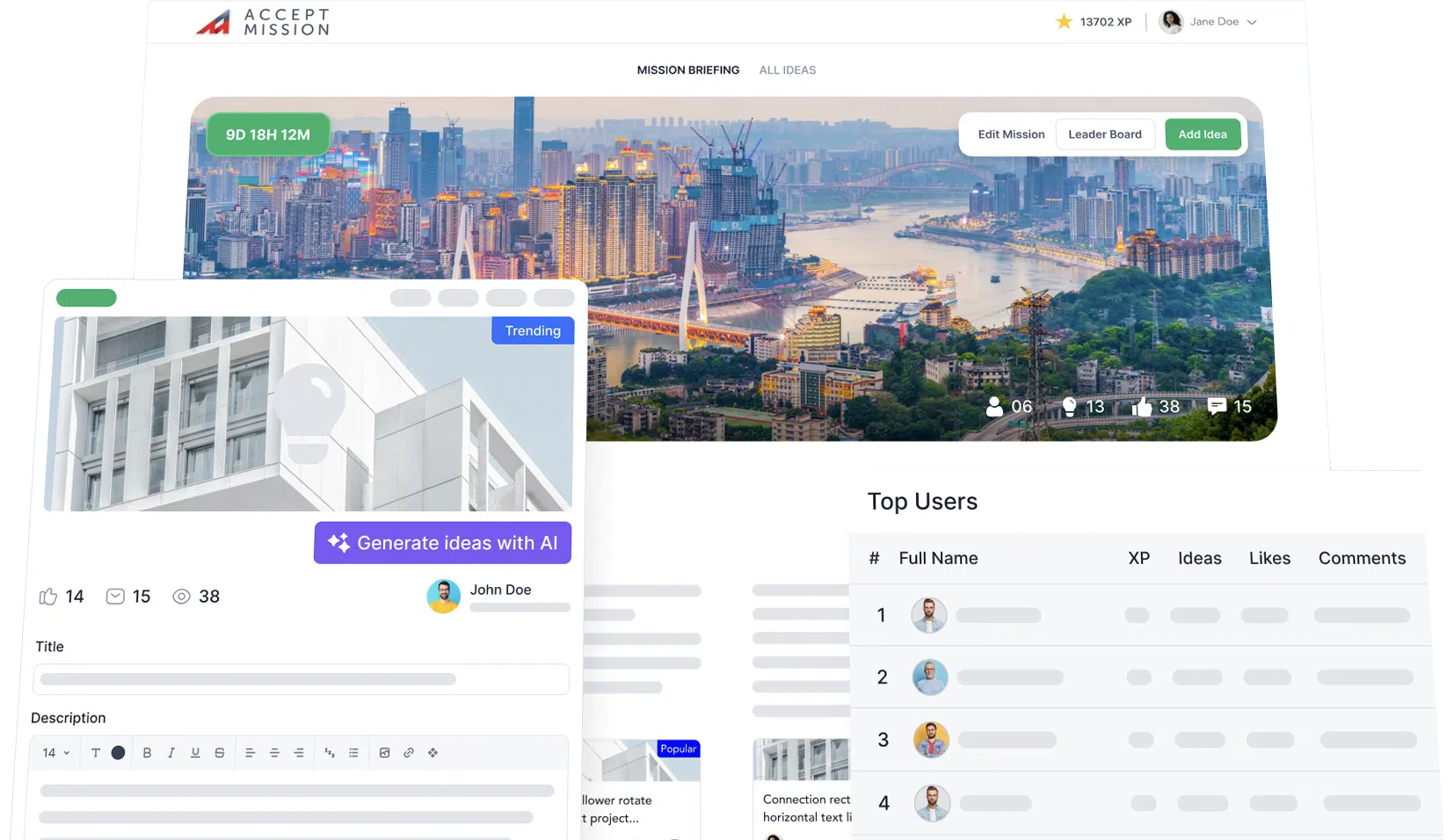
It creates a single source of truth for the entire innovation lifecycle, from the first idea to the final project.
This integration makes the process more transparent and easier to manage for everyone involved.
Ultimately, it provides the structure needed to turn a complex process into a repeatable and scalable business capability.
From Funnel to Flywheel: Your Next Steps
A modern innovation funnel is not a rigid, one-size-fits-all process. It should be a hybrid system that is data-driven, collaborative, and supported by technology.
To get started, first audit your current process to find gaps. Then, define clear metrics for success and use a dedicated platform to automate and streamline your funnel.
By doing this, you can turn innovation from a gamble into a reliable engine for business growth.
Build an innovation funnel that improves every decision
A strong funnel connects opportunity discovery, idea evaluation, governance and execution. See how Accept Mission supports the complete innovation lifecycle and adapts structured workflows to your organization.






 English
 Dutch
Dutch Portuguese
 Spanish
 French
 German
 Arabic