
How to Run a Prioritization Workshop That Ends With a Ranked List10 min read
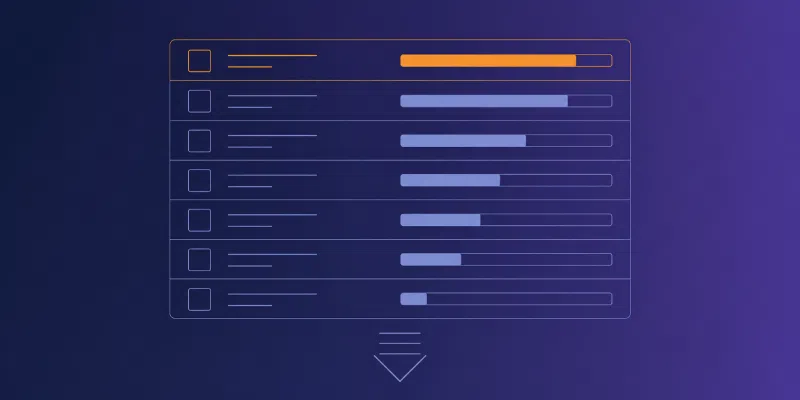
Most prioritization meetings produce the same output: a calendar invite.
It usually goes the same way:
- The most senior person in the room signals a preference early. Discussion follows the signal.
- No scoring happens. The group leaves with a sense of priority, not a ranked list.
- A follow-up gets scheduled to finalize what was never actually decided.
The fault is in the session design, and the fix is structural.
When scoring becomes the activity in the room, the meeting produces a numbered list that everyone helped generate and nobody can quietly disown.
Why Most Prioritization Meetings End Without a List
The failure pattern is consistent. A team gathers to rank twenty initiatives, and the most senior person signals a preference in the first ten minutes.
Group decision methods that default to consensus lock in this dynamic before the real conversation starts.
The next forty become ratification, and the meeting ends with a sense of priority instead of a ranked list. Four structural forces produce this outcome predictably.
| Failure Mode | What Happens in the Room | Why It Prevents a Ranked List |
|---|---|---|
| HiPPO effect | Senior person signals a preference early; group gravitates toward it | Subsequent “discussion” is performative; no independent signal to rank against |
| Groupthink | Participants conform to perceived group consensus once votes go public | Scores cluster artificially; real disagreement stays hidden |
| Analysis paralysis | Each idea gets re-debated; criteria shift mid-conversation | No idea ever scores out; the list never closes |
| The “strategic” override | An initiative without a strong rationale gets labeled “strategic” | Functions as a veto on the scoring process and breaks the ranking |
These failure modes share one cause: open discussion as the primary ranking mechanism. Change the mechanism and most of them stop firing.
Three Things That Must Be True Before You Start
A well-designed session cannot rescue a poorly prepared one. Three preconditions decide whether the workshop has any chance of producing a real list.
Understanding how to evaluate and prioritize ideas in your innovation funnel is what separates teams that leave with a list from those that schedule a follow-up.
- A short list of 8 to 15 candidates. Pre-filter ruthlessly: groups facing 24 options are significantly less likely to decide than groups facing six.
- Pre-agreed scoring criteria and weights. Setting weights inside the session opens the door to bias, which is exactly what scoring is supposed to neutralise.
- Decision-makers in the room, not just influencers. A list requiring sign-off from someone not present is still just a recommendation, not a decision.
Get the inputs right first, then design the session around them.
When all three preconditions are met, the session has a chance. Any one of them missing, and the structure below will not save you.
The Three-Phase Session Structure
A good prioritization workshop has a direction. Each phase produces a defined output that feeds directly into the next, so the session never stalls or loops back.
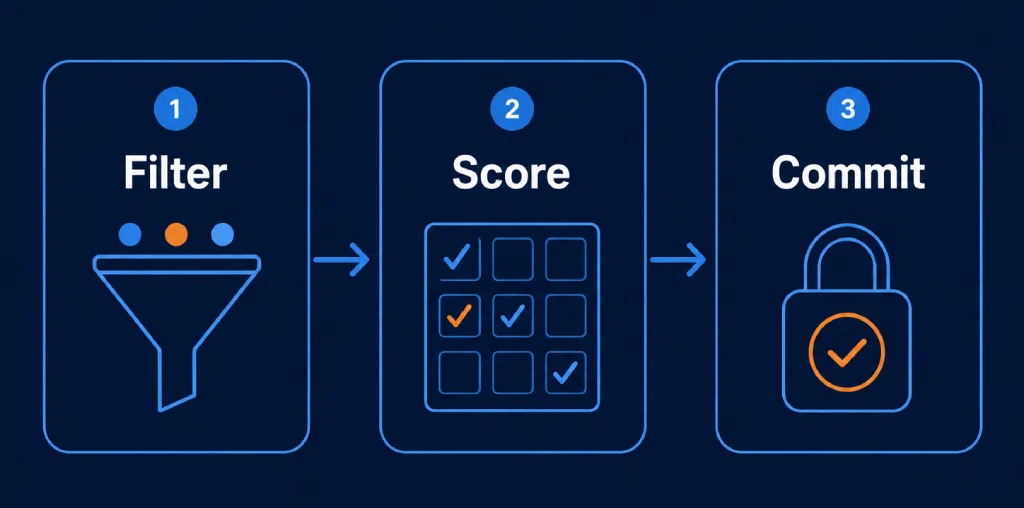
Running a decision-ready idea review follows the same principle: every gate produces a usable artifact, not another meeting invitation.
Three phases, around 60 to 75 minutes total.
| Phase | Time | Method | Output |
|---|---|---|---|
| 1. Filter | 15–20 min | Dot voting or impact/effort map | Shortlist of 8–15 |
| 2. Score | 25–35 min | Anonymous individual scoring against pre-agreed criteria | Aggregated score per idea |
| 3. Commit | 15–20 min | Reveal sorted list, discuss outliers, lock the top N | Ranked, committed list |
Phase 1: Filter
This is a convergence step. Dot voting works well here because the goal is to remove obvious non-starters quickly, not to rank what remains.
Impact/effort mapping does the same job visually. Either gets you from a long list to a workable shortlist in twenty minutes.
Digital and physical brainstorming can be combined to run the filter step effectively even when participants are distributed across locations.
Phase 2: Score
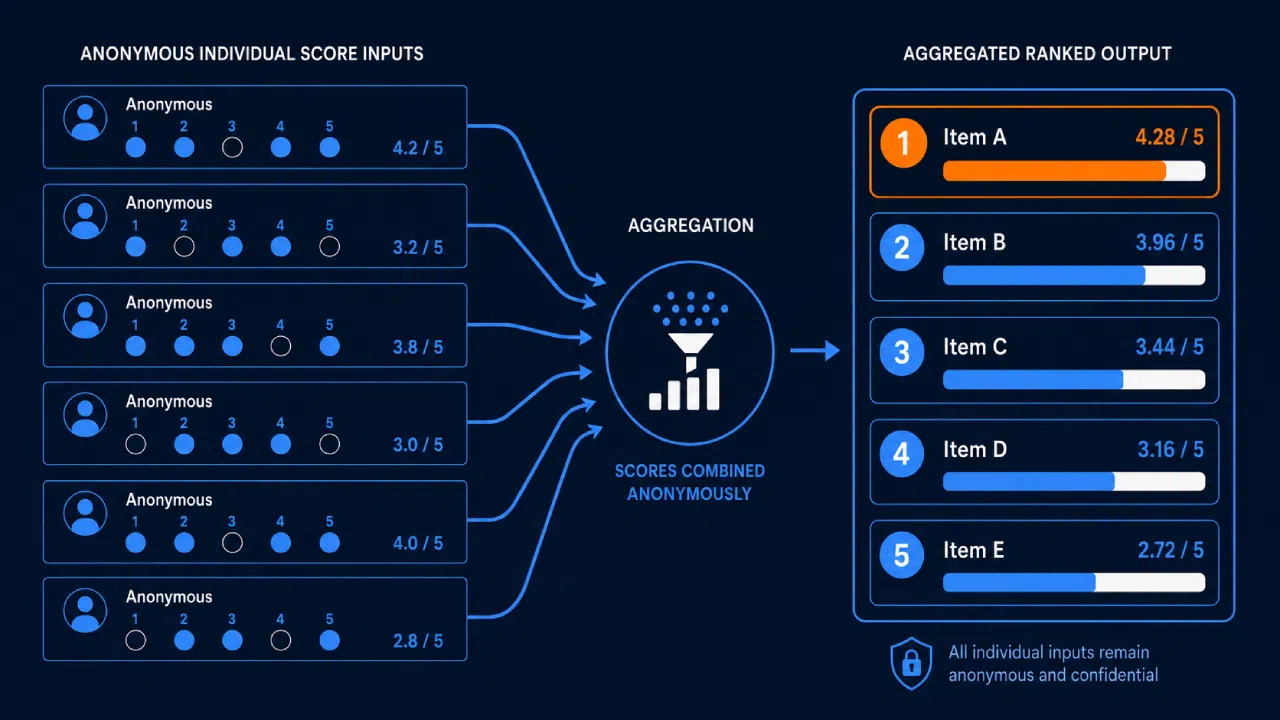
Each participant scores every shortlisted idea individually, anonymously, against the criteria locked in advance. No discussion during scoring.
This is the phase that breaks the HiPPO and groupthink failure modes. Nobody sees anyone else’s score until the aggregation is complete.
Phase 3: Commit
The aggregated, sorted list goes on screen. The group discusses only the items where scores diverged sharply, then calls out the top N explicitly.
This is the moment the meeting produces an actual ranked list.
The discipline is in the handoffs. Each phase ends with a defined artifact, and that artifact feeds the next conversation.
Choosing Your In-Session Scoring Framework
Three frameworks cover almost every prioritization context. The right choice depends on time, group experience, and how much the underlying decision merits.
The go/no-go scoring model addresses the same challenge from a gate-decision angle, useful context before selecting a framework.
| Framework | Best For | Time Required | Complexity |
|---|---|---|---|
| ICE | First-time groups, time-constrained sessions | 20–25 min | Low |
| RICE | Product-style decisions where reach varies widely | 30–40 min | Medium |
| Weighted Matrix | Strategic portfolios with multiple stakeholder concerns | 35–45 min | Medium-High |
Whatever framework you choose, one rule applies: individual scoring before any reveal. Scoring publicly reintroduces the HiPPO effect inside the structured exercise.
Confidence-adjusted scoring adds another layer of honesty when data is uncertain. Participants flag not just their score but how confident they are in it.
Grundfos and Cambridge University found anchoring matters.
Scoring with explicit descriptions of what a high vs. low score looks like produced “much more concrete discussions” than open numerical ratings.
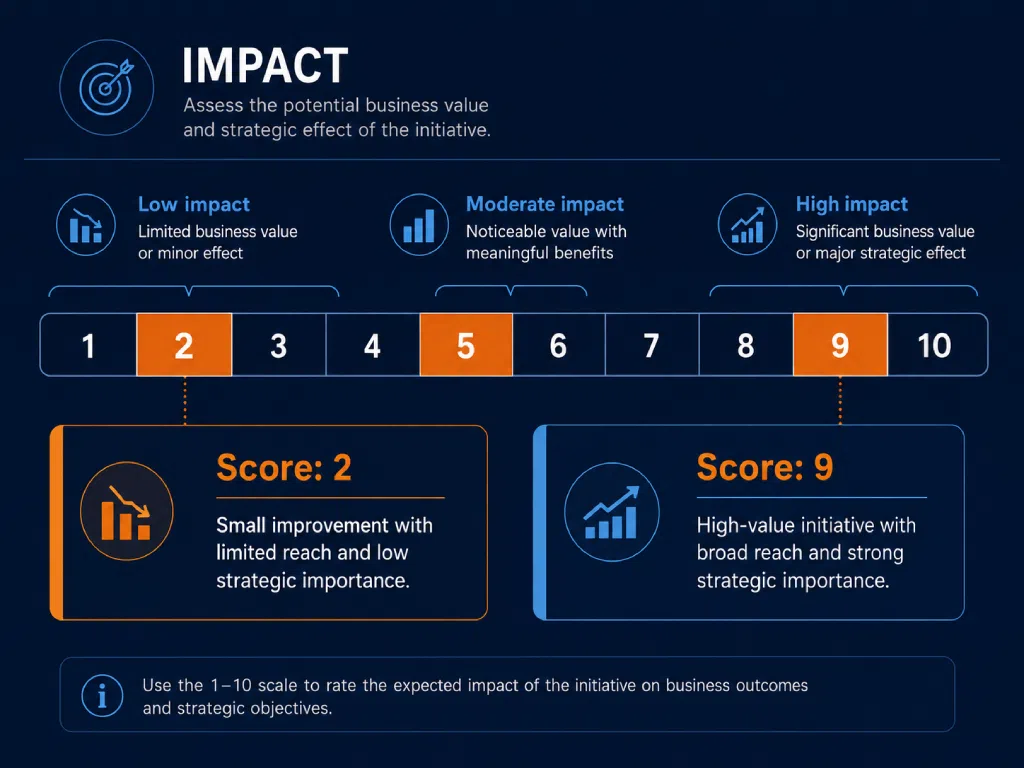
A “7 out of 10 on Impact” means very little until the room agrees on what a 7 looks like. Write the anchors before the session.
The best framework is the one your team will use consistently.
A sophisticated model that gets abandoned after one use is worth less than a simple one that becomes the planning rhythm.
Running the Score Without Losing the Room
The scoring phase runs like this in practice:
- Five to seven minutes of silent, simultaneous, anonymous individual scoring.
- Every participant scores every shortlisted idea against every criterion, with no discussion or glances.
- Aggregate the results: sum or average individual scores per idea, sort the list, display it.
- Apply the outlier rule before opening any discussion.
The Outlier Rule
Discuss only the ideas where individual scores diverged significantly, because that is where the real disagreement lives.
Two people scoring Impact 9 and 2 on the same idea is a focused conversation worth having. Eight people scoring Impact 7 is not.
Idea selection for smart decision-making explains how to use aggregated scores to surface outliers without reopening the entire debate.
Handling the “Strategic” Override
The “strategic” override needs its own handling. When a decision-maker wants to elevate a poorly scored idea, ask which criterion the score got wrong.
Innovation governance and decision rights frame the broader question: who can override a scored outcome, and what the process must look like when they do.
If the answer is “none, but it’s strategic,” the criteria are incomplete. Add a strategic-fit factor explicitly and re-score.
That converts a veto into a structured recalibration, keeping the scoring process intact.
How Long This Actually Takes
Time matters here. Grundfos reported that their scored review took roughly two hours per idea.
Christian Rasmussen described that as “not a lot compared to the time we used to take, debating round and round”.
The structured method is faster once you count the follow-up meetings the unstructured approach generates.
A well-run scoring phase ends with a sorted list, a small number of flagged outliers, and a room ready to commit.
From a Scored List to a Committed Ranked List
The reveal is a moment, and it should feel like one. Everyone sees the sorted list at the same time, on the same screen.
Before the list appears, three things must not happen: no leak, no early summary from the facilitator, no “well, before we look, let me set this up.”
The list appears, and the room reacts.
The Commitment Step
Most workshops skip this part. Digital group decision-making strengthens commitment because every participant’s score is on record.
Walking away from a list you helped generate is hard. The facilitator runs three explicit moves at the reveal:
- Name the top N out loud: “Based on the scoring, the top five are these.”
- Ask the room directly: “Are we aligned to commit resources here?”
- Require yes or no. Anyone who wants to move an item up or down must point to a criterion and propose a re-score.
This is why in-session scoring beats async scoring for commitment, even when async would produce cleaner numbers.
PMI research is clear: people support what they helped create. A list generated in the room is harder to walk away from than one emailed in advance.
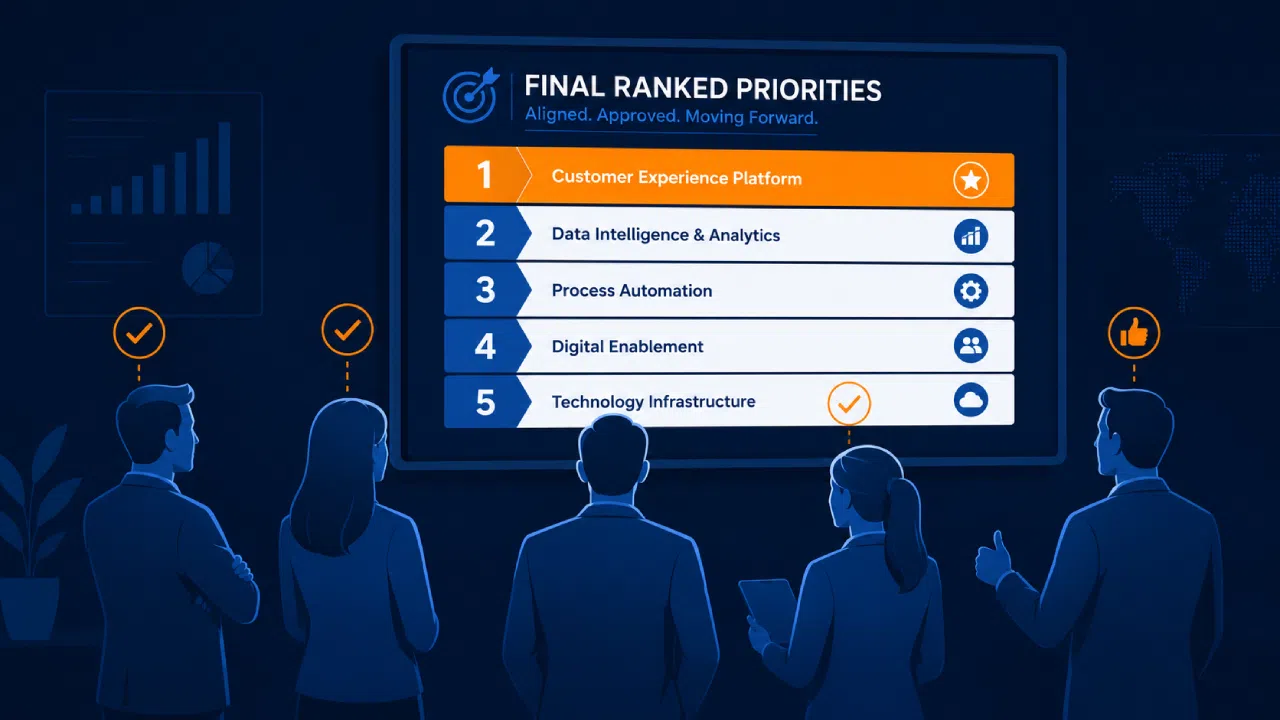
This is also where digital tooling earns its place. AI-assisted platforms collect scores in real time and project the ranked list the moment the last score lands.
The session moves from score to commitment without a manual tally in between.
Organisations report measurable reductions in resource waste because the scoring process makes it visible when budget flows to initiatives that were never honestly prioritised.
Allocating innovation budget across a diverse project portfolio becomes a structured conversation when a scored ranked list is the starting point.
Run the Next Session Around the Score
Scoring is the meeting. Everything else (filtering, revealing, committing) exists to make the scoring honest and the result usable.
When teams leave a workshop with a real ranked list, three things change:
- Resource reallocation becomes a defensible conversation, because the ranking is on paper and everyone helped produce it.
- The top initiatives get clearer mandates, because the people who scored them are the same people who will sponsor them.
- The next meeting is a kickoff, with real decisions to implement.
McKinsey documented a specialty-chemicals company that cut its development project count by 40%, freeing resources that materially increased the success probability of the remaining projects.
Stopping zombie projects in your innovation portfolio follows the same logic: a ranked list makes it defensible to close what was never honestly prioritised.
The ranking is what made the reallocation possible. So design the next session around the score.
Pre-filter to a short list, lock the criteria and weights, score anonymously in the room, reveal once, commit explicitly. The meeting will end with a list.
Download our ebook on prioritization workflows for innovation teams, or book a demo to see how Accept Mission handles scoring, routing, and audit trails.









 English
 Dutch
Dutch Portuguese
 Spanish
 French
 German
 Arabic