
Funnel Hygiene: How to Prevent Backlogs, Zombie Ideas, and Stale Stages10 min read

Most organizations invest heavily in filling their innovation funnel. They run campaigns, host hackathons, and track intake velocity like it’s the only metric that matters.
Then they do almost nothing to maintain what they’ve collected:
- Ideas enter the funnel and stop moving.
- Reviewers get buried under screening workloads.
- Stages fill with ideas nobody has the authority to kill.
- Innovation managers stop trusting the data.
Funnel degradation is a design problem. Funnel hygiene is what separates a working innovation system from an abandoned one.
Without it, your funnel becomes a liability.
Why Funnels Degrade (And It Has Nothing to Do With Idea Quality)
The default mode is passive accumulation: ideas enter, nobody decides, and stages fill. Two data points explain why:
- Projects with two or more blockers are 3.5x more likely to stall. Blockers aren’t always technical.
- 54% of innovation leaders struggle to bridge the gap between innovation strategy and business strategy. Ideas without visible sponsorship rarely survive initial screening.
No organizational force pushes ideas through the funnel on a predictable timeline. They sit indefinitely, waiting for a decision that never comes.
When decision rights are unclear and dwell time is uncapped, the funnel’s design guarantees stagnation.
Nobody owns the stage. Nobody has accountability for moving ideas through within a defined timeframe.
What Zombie Ideas Actually Are (And How to Spot Them)
A zombie idea is formally submitted and never resolved.
It sits in a stage without progressing or being killed, stuck in an indefinite state of limbo while consuming reviewer attention and organizational credibility.
They simply entered the system and stopped. You spot them by looking for three signals: no reviewer activity in 30+ days, unclear ownership, and no decision scheduled.
| Stage | Warning Signal | Dwell Time Trigger |
|---|---|---|
| Screening | No score assigned; multiple reviewers skipped | 14 days |
| Evaluation | Feedback incomplete; decision date not set | 21 days |
| Concept Development | Status unchanged; no milestone progress | 30 days |
| Gate Decision | Leadership hasn’t convened; no decision communicated | 14 days |
Zombie projects can persist for 10+ years without passing a single gate. They’re not always bad ideas; they’re just ideas that nobody has claimed ownership over.
No decision was made to kill them. No resources were committed to move them forward.
When any of these conditions exist, the idea has transformed from a potential opportunity into bureaucratic debt.

Each stage has a natural dwell time. When ideas cross that threshold, they shift from “in progress” to “at risk.”
That distinction matters. It’s the difference between a review queue and a zombie farm.
Stage SLAs: The Structural Fix Most Funnels Are Missing
A stage SLA is a maximum dwell time before an escalation is triggered. Not before an idea is automatically killed; before a conversation happens.
SLAs work because they turn passive stages into time-boxed commitments. Instead of ideas drifting indefinitely, each stage has a deadline.
When an idea approaches that deadline without progress, the system surfaces it and forces a decision.
The decision might be “keep going,” “pause and reassess,” or “kill it.” But a decision gets made.
| Stage | Recommended Max Dwell Time | Escalation Action |
|---|---|---|
| Intake | 7 days | Route to screening owner; assign reviewer |
| Screening | 14 days | Escalate to evaluation lead; request score or kill |
| Evaluation | 21 days | Escalate to gate owner; request go/no-go decision |
| Concept Development | 30 days | Escalate to sponsor; assess blocker or cancel |
| Gate Decision | 14 days | Escalate to executive sponsor; force decision |
These are starting points, not absolutes. Define the maximum dwell time per stage, then enforce it with escalation.
SLAs work best when paired with clear escalation paths.
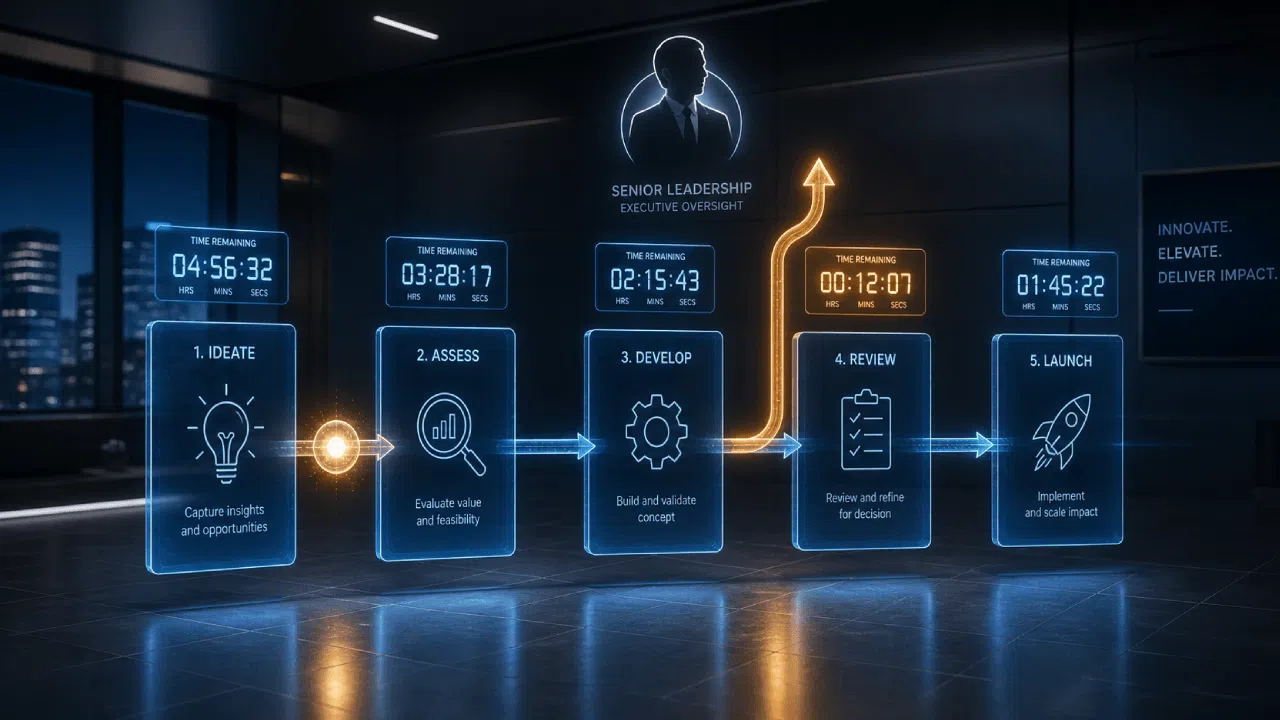
An idea approaching its dwell time limit gets escalated to someone with authority to decide. Urgent ideas jump the queue.
Use SLAs as triggers for conversations, not automatic kills: when an idea hits its limit, somebody talks to the reviewer, unblocks the blocker, and makes a call.
The result is measurable. Organizations using structured workflows and centralized reporting move ideas through the funnel faster, with clearer accountability and better data at every stage.
The Cleanup Cadence: Making Hygiene a Habit, Not an Emergency
SLAs define the rules. The cadence is the recurring act of enforcing them.
A cleanup cadence means a weekly or bi-weekly funnel sweep at the operational level, paired with a monthly portfolio review at the leadership level.
| Frequency | Who Does It | What They Review | Output |
|---|---|---|---|
| Weekly | Innovation manager | Items approaching dwell time limits; zombie signals; reviewer workload | Escalation list; assignment adjustments |
| Monthly | Innovation leadership | Portfolio composition; kill rate by stage; blockers and risks | Go/no-go decisions; priority resets |
| Quarterly | Executive steering | Strategic alignment of active portfolio; resource allocation; pipeline health | Portfolio reset; roadmap adjustments |
During each sweep, three things happen:
- Dead ideas get archived with an explicit decision rather than silent neglect.
- Stalled ideas get escalated.
- Reviewer assignments get reset for overdue items.
The funnel moves. The system stays alive.
Killing ideas is harder than launching them. It requires explicit permission and leadership courage.
Without a formal cadence, zombie projects persist indefinitely. With one, they don’t.
The goal is a funnel that innovation managers trust. Every idea in it has a current status and an accountable owner.
How to Handle the Backlog You Already Have
Most organizations have a version of this problem: 300 ideas in Stage 2, 150 in evaluation, 50 stuck in gate decisions. How do you clear it?
Triage first. Sort by age, apply kill criteria, and run a one-time cleanup session where you explicitly decide on every stalled idea:
- Kill the ones with no sponsor.
- Pause the ones waiting for external information.
- Move the ones that are ready.
- Restart the ones where conditions have changed.
Here’s the friction point: if your kill rate at Gates 1 and 2 falls below 20–30%, your funnel is too permissive.
You’re advancing ideas that should have been killed earlier. A healthy funnel kills ideas early and often, moving survivors fast.
Your triage process needs teeth. Not every idea gets a second chance.
Without weekly sweeps and monthly reviews, you’ll return to the default mode. Hygiene is a habit, not a project.
Kill vs. Pause: A Framework for the Hardest Decision in the Funnel
The kill/pause decision is where most innovation managers hesitate. Both options feel permanent when they’re not.
The distinction comes down to whether conditions can realistically change. That answer determines whether an idea should be paused or killed.
| Signal | Kill | Pause |
|---|---|---|
| No owner or sponsor | ✓ | |
| Strategic misalignment | ✓ | |
| Waiting for external event or data | ✓ | |
| Resource unavailable this cycle | ✓ | |
| Similar idea already in active pipeline | ✓ | |
| Conditions likely to change within 90 days | ✓ |
The key constraint on pausing: every paused idea needs a scheduled review date. An idea without one is a zombie in waiting.
Pauses also need an expiry. If conditions haven’t changed by the review date, that’s your signal to kill.
Not every paused idea comes back. But a formal close means the decision was made, not just deferred.
Closing Ideas Without Killing Engagement
Most organizations underestimate the psychological cost of a poor rejection process. When submitters don’t hear back, or hear back with no explanation, they stop submitting.
A good close has three components:
- Decision: Clear and explicit. “This idea has been closed” beats “we’ll keep it in mind.”
- Reason: Brief and specific. “This doesn’t align with our current focus areas” is better than silence.
- Invitation: Forward-looking. “We’d welcome a revised submission if conditions change” signals the door isn’t permanently closed.
High submission rates over time come from organizations with strong closing protocols. Closing well is what keeps contributors engaged long after an idea gets killed.
Closing an idea well is an act of respect for the person who submitted it. That respect compounds over time.
Every Stage Needs an Owner
SLAs and cadences only work when ownership is defined per stage.
Not “the innovation team.” A named person accountable for items moving through that stage within the time limit.
The stage owner is accountable for three things:
- Following up when a reviewer misses a deadline.
- Unblocking or escalating ideas that are stuck.
- Making or routing decisions when a call is needed.
Stage ownership creates accountability without creating bureaucracy.

One owner per stage. One person to escalate to. One person who knows the status.
This structure scales. As your portfolio grows, stage owners don’t become bottlenecks: they become the invisible scaffolding that keeps the system from collapsing.
How to Know Your Funnel Hygiene Is Actually Working
SLAs and cadences are inputs. Metrics are how you know they’re producing results.
A healthy funnel has four signals worth tracking:
- Average dwell time per stage. If ideas are spending less time per stage over time, hygiene is working. Rising dwell times signal a breakdown worth investigating.
- Kill rate by stage. A healthy funnel kills 20–30% of ideas at Gates 1 and 2. Below that threshold, the funnel is too permissive.
- Reviewer response time. Tracks how quickly assigned reviewers complete their evaluations. A rising average signals workload problems or unclear accountability.
- Zombie rate. The percentage of active ideas that have exceeded their stage SLA. Even a rate of 5–10% indicates a systemic issue worth addressing.
Run these monthly. Share them with leadership quarterly.
A single bad month is noise; three in a row is a signal worth acting on. The value is in spotting degradation early, before it rebuilds into a backlog.
Keep the Funnel Alive
Funnel hygiene is the operating layer that turns idea collection into an accountable system.
The three-part operating model is straightforward:
- Stage SLAs that define maximum dwell times
- Cleanup cadences that enforce them
- Named stage owners who drive accountability
Organizations that manage their funnel like a living process (not a passive container) make better decisions and waste less effort on ideas that were never going anywhere.

The funnel becomes an asset. Decisions happen. Innovation accelerates.
Pattern analysis can surface hidden bottlenecks: which reviewers consistently miss deadlines, which stages accumulate backlogs, which decision types get stuck.
AI-backed dashboards flag ideas approaching dwell time limits automatically, surfacing bottlenecks that pattern analysis alone would miss. The system itself is simple.
Let the data tell you what’s working and what isn’t.
Download our ebook on innovation funnel governance, or book a demo to see how Accept Mission handles automated routing, escalation workflows, and audit trails.







 English
 Dutch
Dutch Portuguese
 Spanish
 French
 German
 Arabic