
The 10-Question Idea Scorecard That Replaces Opinion with Evidence14 min read

Nobody is talking about why idea evaluation quietly fails inside organizations.
Not because people lack experience or intent, but because belief keeps getting mistaken for evidence. Without shared evaluation criteria, decisions default to the HiPPO effect.
Ideas advance on conviction (“I’m confident”) instead of confidence (“Here’s the proof”). Portfolios accumulate zombie projects, and governance turns into negotiation rather than judgment.
The fix isn’t removing judgment, but more on separating what you hope is true from what you know is true.
That’s what this 10-question idea scorecard does across four different dimensions:
- Desirability
- Viability
- Feasibility
- Calibration
Here’s how it works.
The Rules of Engagement: How to Score Without Creating New Wars
The scorecard only works if the scoring process neutralizes the social dynamics that cause opinion wars. Three non-negotiable rules make this happen:
Rule 1: No Data = Low Score
If you can’t point to specific evidence, you can’t score above a “3” on most questions. This is the foundation of the entire system.
The following don’t count as evidence under this framework:
- “I have 20 years of experience”
- “Our CEO loves it”
- “The market is trending this way”
- “Everyone knows customers want this”
This single rule eliminates opinion inflation. When someone argues for a high score, the facilitator simply asks: “What evidence supports that?” No evidence? The score stays low.
The burden of proof shifts from persuasion to documentation. Teams quickly learn that conviction without validation earns you a research budget, not an execution budget.
Rule 2: Use Blind Voting
Each team member scores independently, then everyone reveals their scores simultaneously. Don’t let the first speaker (usually the senior leader) anchor the room.
Here’s what happens when scores diverge:
- One person scores “5” while another scores “1”
- Stop. Don’t average them to “3”
- Ask both to explain their reasoning
- Information gaps surface immediately
The engineer knows about technical debt the CEO doesn’t see. The CEO knows about strategic direction the engineer hasn’t heard. This isn’t disagreement. It’s asymmetric information.
After the information exchange, re-vote. Convergence happens naturally when everyone operates from the same facts. The process then transforms scoring from a political exercise into a learning mechanism.
Rule 3: Treat Scores as Tiers, Not Rankings
A final score of “37” versus “38” is meaningless noise. The inputs were estimates based on incomplete information.
Instead, use results to create decision tiers:
- Fund now (high score, high confidence)
- Needs validation (high score, low confidence)
- Kill (low score, any confidence level)
The scorecard tells you what to do next, not which idea is 0.3 points better than another.
If two ideas both land in the “35 to 40” range, they’re in the same tier. Picking between them requires additional strategic context, not fake precision from decimal points.
The 10 Questions (Grouped by What They Reveal)
Desirability (Is this what customers actually need?)
These three questions validate whether you’re solving a real problem and whether your solution is differentiated enough to matter.
Question 1: How acute is the customer pain point?
This reveals whether you’re solving a real problem or building a “nice-to-have” that no one asked for.
If you get a low score here, run customer interviews to validate the problem exists before designing solutions.
| Score | Evidence Level |
|---|---|
| 1–2 | Assumption only, or anecdotal feedback from a few users |
| 3 | Customer interviews confirm this is a top-3 frustration |
| 4 | Survey data shows >50% of target segment struggles with this |
| 5 | Customers are already paying for imperfect workarounds (active pain) |
For evidence cue, look for behavioral proof:
- Are customers building spreadsheet hacks?
- Using three tools to do one job?
- Complaining repeatedly to support?
Remember that active pain is visible.
Question 2: How unique is our value proposition?
This question reveals whether you’re differentiated enough to matter or just adding to the noise.
If you get a low score, revisit the solution design. Check for “me-too” features that rarely drive growth. Find the 10x angle or kill the idea.
| Score | Differentiation Level |
|---|---|
| 1–2 | Worse than or same as competitors (“table stakes”) |
| 3 | Incremental improvement (faster, cheaper, slightly easier) |
| 4 | Distinct benefit competitors cannot easily copy |
| 5 | 10x better, renders competitors obsolete (blue ocean) |
Question 3: Is the customer accessible?
This reveals whether you can actually reach the people who need this solution.
If you get a low score and you have no distribution channel, pause and solve the go-to-market problem before building anything.
| Score | Channel Access |
|---|---|
| 1–2 | Unknown audience or expensive paid acquisition only |
| 3 | Can use existing sales or marketing channels |
| 4 | Viral or referral potential, current users will bring new ones |
| 5 | We already have these customers, rollout is instant |
This matters because a great product for unreachable customers is still a failure. Distribution is half the battle.
Viability (Does this make business sense?)
These three questions ensure the idea aligns strategically and economically with your organization.
Question 4: Strategic fit
This question reveals whether this idea strengthens your core strategy or distracts from it.
If you get a low score and you have off-strategy, kill it no matter how “cool” it is. Shiny objects will just drain focus and confuse your brand.
| Score | Strategic Alignment |
|---|---|
| 1–2 | Off-strategy, confuses the brand or diverts limited resources |
| 3 | Fits within a current strategic pillar |
| 4 | Critical to achieving annual goals |
| 5 | Existential to the company’s future, defines where you’re heading |
Question 5: Revenue or value potential
This reveals the size of the opportunity, like is this a rounding error or a game-changer?
For the low score action, if impact is minimal, deprioritize unless it’s a quick win (check your feasibility scores first).
| Score | Impact Magnitude |
|---|---|
| 1–2 | <$100k impact or minor efficiency gain |
| 3 | Meaningful contribution to business unit goals |
| 4 | Capable of moving company-wide metrics |
| 5 | Could double the size of the business (transformational) |
If you need an evidence cue, base this on TAM/SAM analysis or proxy revenue from similar competitor offerings (not best-case spreadsheets built on optimistic assumptions).
Question 6: Business model scalability
This question reveals whether this grows with leverage or requires linear hiring and costs.
If you get a low score, and scalability is poor (service-heavy model), decide whether strategic value justifies low margins before proceeding.
| Score | Scalability Profile |
|---|---|
| 1–2 | Costs exceed revenue, or revenue grows 1:1 with costs (consulting model) |
| 3 | Some economies of scale |
| 4 | Software or SaaS economics, low marginal cost |
| 5 | Network effects, value increases as more users join |
Feasibility (Can We Actually Build This?)
These two questions ground ambition in execution reality.
Question 7: Technical and operational feasibility
This reveals how complex this is to deliver – and where underestimation risk lives.
If you get a low score and feasibility is unknown (score 1-2), run a technical proof-of-concept before committing to a roadmap.
| Score | Complexity Level |
|---|---|
| 1–2 | Requires R&D breakthrough or significant refactoring (high risk) |
| 3 | Standard development work with some unknowns but solvable |
| 4 | Straightforward, uses existing patterns and tech |
| 5 | Trivial, config change or minor update (<1 week) |
This matters because underestimating complexity is the #1 cause of project delays. Engineering knows this better than anyone else in the room, so listen to them.
Question 8: Resource and capability fit
This reveals whether your team can execute this now, or whether you need new hires and skills.
If you get a low score and you have no internal capability, factor recruitment timelines into your plan…or kill the idea if you can’t afford the wait.
| Score | Team Readiness |
|---|---|
| 1–2 | Must hire or outsource entirely, or backlog is full (no capacity) |
| 3 | Core team available, need some external support |
| 4 | Team is available and skilled |
| 5 | Perfect team is ready and waiting for this exact project |
Calibration (How Much Do We Actually Know?)
These two questions are the “secret weapon.” They assess the quality of evidence behind everything else you just scored. This is where opinion wars die.
Question 9: Confidence level (evidence strength)
This question reveals how much of your evaluation is data versus educated guessing.
If you get a low score and confidence is low (1-2), DO NOT approve of the build. Approve a small budget for experiments to gather evidence instead.
| Score | Evidence Type |
|---|---|
| 1 | Internal opinion only, HiPPO preference or brainstorm |
| 2 | Self-reported data, surveys or focus groups (people say they’ll do it) |
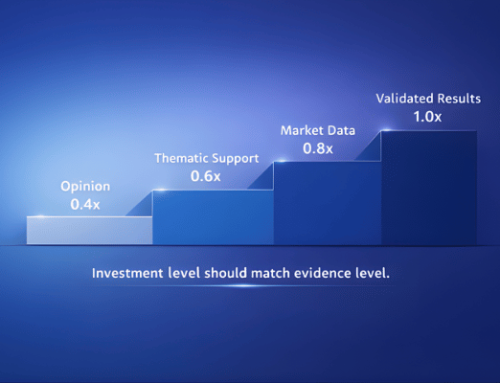
| 3 | Market data, competitor analysis, search trends, proxy indicators |
| 4 | Behavioral evidence, MVP signups, “fake door” click-throughs, waitlist |
| 5 | Transactional proof, real pre-orders, signed contracts, money changed hands |
The HiPPO killer is that you can’t score “5” on confidence just because a senior leader believes strongly. You need any evidence you can point to:
- Receipts
- Transaction logs
- Signed documents
The key insight here is that an idea with high desirability and viability scores but low confidence (score of 1 or 2) isn’t an “approved project”, it’s a hypothesis that needs validation.
Question 10: Risk assessment (kill criteria)
This question reveals whether there are binary blockers: legal, regulatory, ethical, or technical showstoppers.
If you get a low score and there’s a fatal flaw (score 1), kill immediately regardless of other scores. Don’t build illegal or brand-damaging products.
| Score | Risk Profile |
|---|---|
| 1 | Fatal flaw, illegal, unethical, or violates brand safety (KILL) |
| 2–3 | Regulatory hurdles or dependency on unreliable third parties (needs mitigation) |
| 4 | Low risk, standard compliance issues, fully manageable |
| 5 | Fully compliant and de-risked |
Three Ways Teams Misuse Scorecards (And How to Avoid Them)
Even well-designed scorecards fail when teams fall into these traps. Here’s how to avoid the most common pitfalls.
Pitfall 1: Decimal Point Worship
Teams treat a score of “38.2” as scientifically precise when the inputs were rough estimates. They obsess over whether an idea ranks 5th or 6th, forgetting that the error bars are massive.
Signs you’re worshiping decimal points:
- Spending 30 minutes debating whether something is a “3.5” or a “4”
- Rank-ordering ideas by tenths of a point
- Using final scores to create a strict priority queue
- Treating the scorecard output as gospel truth
Use scores to create decision tiers instead: “High Priority,” “Needs Validation,” “Kill.”
If two ideas both score in the “30 to 40” range, they’re in the same tier. Picking between them requires additional strategic context, not fake precision from decimal points.
The scorecard provides signal, not certainty. It helps you make better decisions faster, but it doesn’t absolve you of the need to think.
Pitfall 2: Ignoring the Confidence Score
Approving an idea that scores high on desirability and viability but has a “1” on confidence is the most common failure mode. This confuses a hypothesis with a validated opportunity.
Here’s what actually happens:
- Idea scores 25/30 on Questions 1 through 8
- Confidence (Question 9) scores a 1 (pure opinion)
- Team approves $500k build budget anyway
- Six months later, market proves the assumptions wrong
Use confidence as a gate. Low confidence means fund validation experiments, not full builds. Let teams “earn” higher confidence through evidence before releasing execution budgets.
A $500k project with a confidence score of 1 should become a $5k experiment first:
- Run customer interviews
- Build a landing page
- Test a concierge MVP
- Gather evidence
Then re-score. Only when confidence reaches 3 or higher should you consider committing serious resources.
Pitfall 3: Letting One Person Score Alone
Asking the idea owner to evaluate their own project is asking a parent to objectively rate their child’s talent. They’re the most biased person in the room.
Red flags that scoring is too narrow:
- Only the product manager scores product ideas
- Only the sponsor fills out the scorecard
- Cross-functional input happens after scores are set
- Subject matter experts see results but don’t participate
Always use a cross-functional panel. Include skeptics and subject matter experts:
- Engineers score feasibility
- Sales scores customer access
- Finance scores scalability
- Legal reviews risk
The best scorecards surface disagreement early, when it’s cheap to resolve.
If marketing thinks the customer is accessible (score 5) but sales thinks acquisition will be expensive (score 2), you need to know that before you build anything.
Where This Fits in Your Workflow
Use the scorecard at three decision points:
- Triage — Quick initial screening to filter obvious misalignments (off-strategy ideas, fatal flaws)
- Validation gate — For ideas with high scores but low confidence, allocate small budgets for experiments, then re-score with new evidence
- Portfolio review — Visualize all ideas on a score vs. confidence matrix to identify “moonshots” (high score, low confidence, which needs research) versus “zombies” (low on both – kill now)
This creates a rhythm: triage fast, validate cheaply, scale confidently.
Start Small, Shift the Conversation
The shift from opinion to evidence doesn’t happen overnight. Start small: score 3-5 ideas in your current pipeline, run one blind voting session, and watch the conversation change.
You’ll spend less time arguing about who’s right and more time discussing what the data shows. Less “I think customers want this” and more “Here’s what 50 customers told us in interviews last week.”
That’s not the end of judgment, but the beginning of accountable, transparent innovation. The best ideas still require vision and intuition. But now, those ideas earn their funding through evidence, not eloquence.
And the opinion wars? They end the moment everyone agrees to let the data speak first.
Ready to move from opinion to evidence?
Download our free ebook on building an idea management operating system, or book a demo to see how Accept Mission helps teams score ideas and track evidence in one platform.









 English
 Dutch
Dutch Portuguese
 Spanish
 French
 German
 Arabic