
How to Translate Your 3-Year Strategy into 30-Day Learning Sprints12 min read

Your company spent months crafting an ambitious 3-year innovation strategy.
But then teams revert to what they know: building features, hitting deadlines, and checking boxes instead of pursuing the plan.
The truth is that organizations don’t fail because they lack strategy.
They fail because they adopt the ceremonies of agility (standups, sprints, retrospectives) without changing the underlying mindset, a trap called “agile theater.”
The solution is a “translation engine” that bridges the chasm between your 3-year vision and your teams’ monthly work.
Architecting Your 3-Year Innovation Strategy (The “True North”)
Before any sprint can run, you need a clear 3-year direction.
This isn’t a detailed project plan. It’s a strategic framework that tells teams where to explore, where to defend, and where to experiment.
Most companies treat innovation as a binary choice: maintain the core business or chase moonshots. That’s inefficient. You need both and everything in between.
The Three Horizons Framework
McKinsey’s Three Horizons of Growth is the proven model for this. It splits your innovation portfolio across three time horizons, each with different goals and risks.
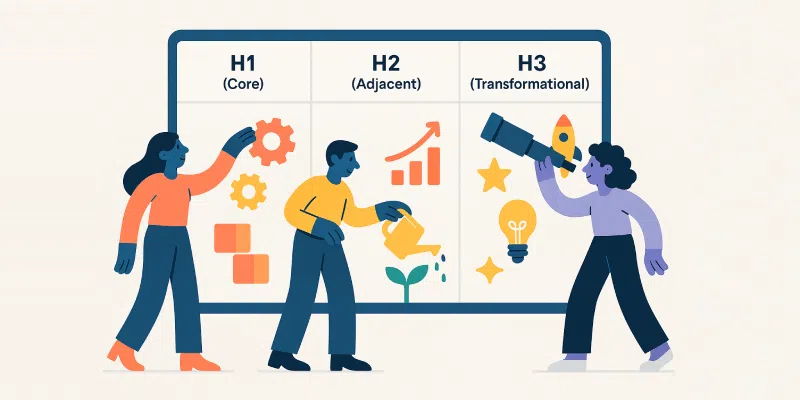
Here’s how it works:
Horizon 1: Defend the Core (70% of effort) focuses on your existing business.
You’re improving margins, enhancing efficiency, and serving current customers better. This is how you fund everything else. Without it, there’s no money for innovation.
Horizon 2: Nurture Emerging Business (20% of effort) takes what you already have and extends it into new areas. A new market. An adjacent product.
These deliver value in 6-24 months.
Horizon 3: Create New Business (10% of effort) is pure exploration. R&D. New business models. High-risk, high-reward bets.
These are the moonshots. They take 2-4 years, but they’re essential for long-term survival.
This 70/20/10 split prevents innovation from feeling like a one-time event.
It becomes a permanent portfolio approach. You’re executing today, building for tomorrow, and exploring for the future all at the same time.
Here’s what each horizon looks like in practice:
| Horizon | Timeframe | Strategic Goal | Key Metrics | Example 30-Day Sprint Goal |
|---|---|---|---|---|
| 1 | 0–12 months | Defend core business | Margin, churn, efficiency | “Validate if new dashboard feature reduces support tickets by 5%” |
| 2 | 6–24 months | Nurture emerging business | New market penetration, revenue from new products | “Test if German small business segment responds with 10% demo sign-up rate” |
| 3 | 2–4 years | Create new business | Discovery of new models, R&D milestones | “Invalidate assumption that smart home users need physical hardware” |
Defining Your Opportunity Spaces and Innovation Ecosystem
A 3-year strategy that says “innovate everywhere” isn’t a strategy. It’s a waste of resources.
You need boundary conditions: clear definitions of where you’ll innovate and, just as importantly, where you won’t.
RELX Group runs 10-15 experiments per customer segment annually but funds only one or two. The rest get killed. This works because they’ve already decided which segments matter.
Your boundaries might look like this:
- We explore in the “remote work” opportunity space for the next 2 years
- We don’t explore blockchain applications
- We’re testing new pricing models in Europe first
- We’re defending our core product in North America
These boundaries prevent diffusion, focus effort, and make sprint planning faster because teams stop constantly asking, “Should we work on this?”
Your 3-year strategy is actually three interlocking systems working together:
- The explore portfolio: Your three horizons split across defined opportunity spaces. It’s your allocation of people, time, and money.
- Innovation programs: The specific initiatives running right now, including campaigns, features, and experiments that create value or shift culture.
- Exploration culture: The environment that discovers, validates, and accelerates ideas. It’s how your organization actually thinks and behaves.
The strategy isn’t “Build Project X.”
It’s “We’ll run 15 Horizon 3 experiments in the ‘Future of Work’ space to find one new business model while protecting our core.”
That’s the strategy. Everything else flows from it.
The Translation Engine (With the Use of OKRs)
Now you have your 3-year direction. But teams still don’t know what to work on next month. That’s where OKRs (Objectives and Key Results) come in.
OKRs are the bridge between strategy and execution. They translate abstract vision into concrete, measurable goals that teams can actually execute.
The Strategic Cascade
OKRs work like a cascade, with each level becoming more specific and actionable. The connection flows downward from vision to execution without losing strategic alignment.
The cascade has three distinct levels:
- 3-Year Vision: “Become the leader in personalized AI-driven education”
- Annual Objectives: “Establish a foothold in the K-12 market” (your big chapter in the story)
- Quarterly OKRs: Team-level Key Results specific enough to guide sprints but flexible enough to allow discovery
Each level translates the one above it into something your teams can actually execute. The 3-year vision stays constant, but annual objectives break it into manageable chapters.
Then quarterly OKRs break those chapters into team-level goals that feel both strategic and achievable.
The magic happens at the quarterly level, where teams have enough clarity to move fast but enough autonomy to discover the best path forward.
The Critical Pitfall: Outcome OKRs vs. Output OKRs
This is where most organizations fail. They adopt the syntax of OKRs but not the substance. They create output OKRs instead of outcome OKRs.
An output OKR describes a task. It locks in a solution before you’ve tested whether that solution is right.
Bad example:
- Objective: Digitize patient journey.
- Key Result: Choose and implement a new EMR system.
This sounds like an OKR.
But it’s not. It’s a project plan. It tells the team exactly what to build. It kills discovery. Likewise, it reduces teams to feature factories.
An outcome OKR describes a change in behavior. It defines a problem without dictating the solution.
Good example:
- Objective: Create a seamless patient journey.
- Key Result: Reduce new patient intake time from 45 minutes to 10 minutes.
Now the team owns the outcome. They can discover the best solution.
Maybe it’s a new EMR. Maybe it’s a simplified paper form. Maybe it’s a change in process. The OKR doesn’t care. It just cares about the result.
Here’s why this matters: Output OKRs prevent innovation. Outcome OKRs enable it.
| Strategic Theme | Annual Objective | Output OKR (Bad) | Outcome OKR (Good) |
|---|---|---|---|
| Become the leader in AI-driven education | Establish K-12 market foothold | KR: Launch K-12 marketing campaign by Feb 1 | KR: Increase qualified K-12 demo signups from 50 to 500 |
| Achieve operational excellence | Improve R&D cycle time | KR: Roll out new project management software to all teams | KR: Reduce average “idea-to-first-customer-test” time by 40% |
| Innovate business model | Explore new revenue streams | KR: Deliver research report on subscription models | KR: Achieve 1,000 signups for new subscription-based experiment |
When you write outcome-based OKRs, you force the conversation back to the customer.
You stop asking “What should we build?” and start asking “What change do we want to see?” That one shift prevents most “agile theater” before it starts.
The 30-Day Learning Sprint: Redefining “Done”
With an outcome-based OKR in hand, your team needs a vehicle to execute it. Enter the 30-day innovation sprint.
This isn’t a software sprint. It’s not a design sprint. It’s something different.
What Is an Innovation Sprint?
A software sprint (Scrum) has one goal: deliver a working increment of product. Success means shipping features on time.
A design sprint has one goal: produce a validated prototype. Success means getting user feedback.

An innovation sprint has one goal: generate validated learning. Success means testing a critical assumption and getting clear evidence about whether it’s true or false.
This is the key difference. The “product” of an innovation sprint isn’t code or a prototype. It’s knowledge.
Think about this:
If a sprint proves an idea is bad, it’s a 100% successful sprint. You’ve saved the company from months or years of wasted investment. You’ve generated high-value learning.
That’s a win.
Building Your Hypothesis Backlog
Here’s how to translate an Outcome OKR into sprintable work.
Start with your key result: “Increase user activation by 15%.”
Now ask: Why isn’t it already 15%? What do we believe about the user, the market, or our product that’s holding us back?
Brainstorm hypotheses:
- Users drop off because the signup form is too complex
- Users don’t see the value of the “Projects” feature
- Users need better onboarding to understand our core functionality
- Users are price-sensitive and need tiered plans
Each hypothesis becomes one or more backlog items. Each backlog item is an experiment you can run in a single sprint.
Hypothesis: “Users drop off because the signup form is too complex.”
Backlog item: “Run a 5-day A/B test comparing a 3-field vs. 5-field signup form. Measure impact on activation rate.”
Hypothesis: “Users don’t understand the ‘Projects’ feature.”
Backlog item: “Build low-fidelity prototype of new onboarding flow. Test with 5 new users.”
Now your backlog is a registry of risk. The top item isn’t the easiest task.
It’s the riskiest assumption, which is the one that, if proven false, kills the entire idea. This forces teams to tackle the most critical unknown first.
You de-risk projects faster. You learn quicker.
Redefining “Done” as Validated Learning
In traditional software sprints, “Done” means the code is written, tested, and releasable.
As I explained earlier, in innovation sprints, “Done” means something different.
Done is when a hypothesis is validated or invalidated. That’s the whole definition.
Examples of “Done” for an innovation sprint:
- A high-fidelity prototype has been created and tested
- Usability test completed with 5 target users; findings are documented
- A/B test has run to statistical significance; a clear winner or loser is identified
- Critical business model assumption is documented, tested, and marked validated or invalidated
When your team agrees on this definition upfront, everything changes.
They’re not rushing to code. They’re designing tight experiments. They’re collecting good data and focusing on learning instead of delivery.
Prioritization and Execution: From Backlog to Sprint
You have a hypothesis backlog. Now you need to prioritize it. Then execute it with the right ceremonies.
Choosing a Prioritization Framework
Traditional prioritization (ROI, effort, impact) doesn’t work for innovation because you don’t have data yet. You need a framework built for uncertainty.
RICE Scoring (Reach, Impact, Confidence, Effort) is built exactly for this.
Score = (Reach × Impact × Confidence) / Effort
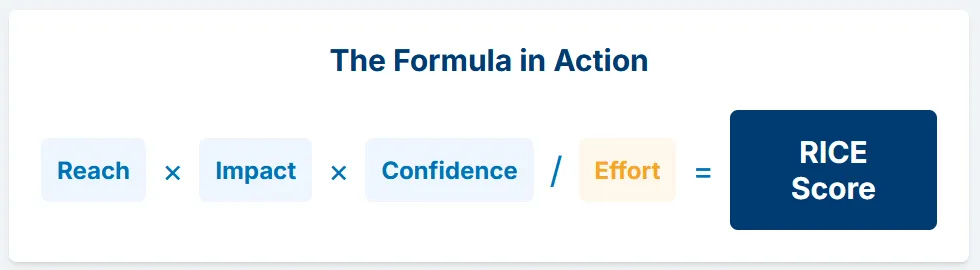
For innovation, “Reach” and “Impact” are educated guesses. The genius of RICE is the “Confidence” variable. It explicitly tracks uncertainty.
You might have a huge-impact idea but low confidence (25%).
The goal of your sprint isn’t to build it. It’s to run an experiment that increases confidence to 80% or 90%. RICE makes this visible.
Impact-Effort Matrix works too.

Plot each hypothesis on a 2×2:
- High impact/Low effort (do now)
- High impact/High effort (plan carefully)
- Low impact/Low effort (if you have time)
- Low impact/High effort (avoid)
It’s visual. It facilitates discussion. But it’s less precise than RICE if you have many “Quick Wins.”
MoSCoW (Must Have, Should Have, Could Have, Won’t Have) works for core business (Horizon 1) where requirements are well understood.
For exploration (Horizon 3), it’s dangerous. It prematurely locks in unvalidated assumptions.
For innovation teams, RICE is the winner. It forces you to track uncertainty. It makes learning the priority.
Adapting Agile Ceremonies for Learning
Your ceremonies need to change. They’re not optimized for learning. They’re optimized for delivery.
Here’s how each ceremony shifts:
- Sprint planning: Commit to a Learning Goal, not a feature list
- Daily standup: Track learning blockers, not code blockers
- Sprint review: Present evidence and make “pivot, persevere, or kill” decisions based on data
- Retrospective: Use “Starfish” or “4 Ls” format to improve your experimental process
When you make these shifts, everything changes. Teams stop rushing to code and start designing tight experiments.
They collect good data instead of shipping fast. They focus on learning instead of delivery. This isn’t just a process tweak. It’s a fundamental reframe of what success means in a sprint.
Your Translation Engine Starts Here
You now have a system linking your 3-year vision to 30-day learning sprints through three horizons, OKRs, and feedback loops.
But it only works with psychological safety, celebration of failure, and leaders who reward outcomes over outputs.
Accept Mission is an AI-powered innovation management platform that manages the full innovation lifecycle, from idea collection to project success.
It’s built to operationalize exactly what you’ve just learned: connecting strategy to execution through structured, outcome-focused work.
Here’s what Accept Mission provides to make your translation engine real:
- Campaign Builder AI to launch dynamic missions and collect ideas from your entire organization
- Smart idea funnels with stage gates that automatically follow up ideas based on quality and strategic alignment
- AI-powered scoring to evaluate ideas against your strategic themes and business goals
- Real-time dashboards that show portfolio status, progress, and ROI across all three horizons
- Gamification features with leaderboards and points that keep teams engaged and motivated
- Portfolio management tools that ensure every innovation project stays on time, on budget, and aligned to strategic objectives
Instead of managing OKRs and sprints across spreadsheets and emails, Accept Mission combines idea campaigns, scoring, funnels, and project portfolio management in one platform.
Teams see exactly how their work connects to strategic outcomes. Leadership gets real-time visibility into portfolio health across all three horizons.
Ready to stop managing strategy and execution separately?
Book a demo with our team today to see how Accept Mission can operationalize your translation engine and turn your innovation strategy into measurable business results.





 English
 Dutch
Dutch Portuguese
 Spanish
 French
 German
 Arabic