
How to Assess and Accelerate Your Innovation Maturity: The Innovator’s Self-Scan Guide11 min read

Are you confident that your team’s approach to innovation is truly working, or could there be untapped potential and hidden gaps?
Whether you are leading a startup or guiding a large organization, it’s easy to overlook weak spots or miss out on areas of hidden strength.
Understanding your true innovation maturity enables you to spot opportunities more quickly, address risks earlier, and achieve better results for your team and business.
Why bother measuring innovation maturity first?
Building stronger innovation always begins with honest measurement.
Before making improvements, you need a clear understanding of your current position and the obstacles that could hinder your progress.
The Hidden Costs of Low Maturity
When you don’t measure your innovation maturity, it’s easy to miss the subtle weaknesses holding your organization back. Weak spots go unnoticed.
Teams may feel busy but accomplish less. Projects tend to slow down, and creative energy can fade as people hit repeated barriers.
- It impacts your ability to compete effectively in your market.
- It makes it harder to attract top talent who want to work in innovative environments.
- It challenges your efforts to retain ambitious team members looking for growth.
In many cases, the most creative people leave to find workplaces where ideas actually get the green light.
Over time, you may also notice higher risks in project launches, as there are fewer learning loops or feedback cycles.
Problems grow quietly until they are too big to ignore, sometimes resulting in missed opportunities or expensive mistakes. These issues ripple through your entire business.
For instance, if innovation gets stuck in one department or lacks sponsorship from leadership, you will see competitors copying or outpacing you.
If projects keep failing to launch or scale, your organization’s reputation may suffer both internally and in the market.
Worse still, without honest feedback or structured measurement, it’s almost impossible to fix the root causes. You end up stuck in “innovation theater” — lots of talk, but little progress.
The Value Proof in Real Companies
The good news is that these problems are avoidable, and the positive impact of measuring maturity is very real.
Once organizations begin tracking their innovation maturity, they quickly notice several benefits:
- Teams identify and address barriers sooner, leading to faster cycles from idea to launch.
- Decision-making improves, since leaders can focus resources where they make the biggest difference.
- Employees feel more engaged and are inspired to contribute, knowing their ideas matter.
- The business adapts more quickly to change and is better positioned to seize new opportunities.
- Reputation grows, both internally and externally, as results become more consistent and visible.
Ultimately, measuring innovation maturity helps turn innovation from a source of frustration and unpredictability into a reliable engine for growth and learning.
Organizations that build this discipline consistently see improvements in their ability to create, adapt, and deliver value.
Which maturity model fits your context?
Choosing a maturity model shapes how you assess your current state and plan your progress.
Since not every framework fits every team, it helps to know your options and what each can reveal.
Comparing the Leading Frameworks
There is no shortage of maturity models. Here are the ones most organizations start with:
- CMMI-style five-level ladders focus on process depth and rigor, making them ideal for teams that want structure and detailed assessment at every stage.
- Viima’s 2×2 matrix of scale and maturity brings in a cultural dimension, revealing where “innovation theater” might be hiding, where activity is high, but results are missing.
- Strategyzer’s three-pillar assessment looks at portfolio results (is your innovation portfolio actually driving outcomes?), innovation programs (do you have clear structures for nurturing ideas?), and company culture (are people safe to experiment?).
- Accept Mission’s quick scan covers five essential domains and benchmarks your team against similar organizations for fast, relevant feedback.
These models each offer something different.
While CMMI is perfect for those who like to follow a clear path from ad hoc to optimized, the Viima and Strategyzer models add the human and strategic side of innovation.
Accept Mission, meanwhile, offers a practical, time-saving solution for teams with limited bandwidth.
What if none of them feels right?
Every organization has a unique culture, size, and ambition. That is why some teams mix and match, taking the structure from one model and combining it with questions from another.
For example, you might use the detailed stages from CMMI but add culture questions from Viima. What really matters is to keep your assessment focused and short.
Long, detailed surveys are tempting, but they drain energy and often reduce honest participation. Your aim is to uncover the real issues, not just check a box.
If none of the models feels like a perfect fit, consider these steps:
- Pick the model that most closely matches your needs.
- Adapt it over time as you learn about your own gaps and strengths.
- Focus on progress, not perfection.
Remember that starting to measure is the most important step; you can always refine your approach as you go. Each improvement will make future assessments even more effective.
How do you run a reliable self-scan?
A self-scan is most effective when it’s structured, transparent, and repeated regularly. Rather than a box-ticking exercise, it should spark fresh conversations and surface real insights you can act on right away.
Step-by-Step Checklist
Running a self-scan sounds simple, but a little planning makes all the difference.
Here’s a reliable, repeatable process that most innovation leaders recommend:
- Select the right model and set your questions in stone for at least one cycle. Changing questions midstream makes it impossible to compare results over time.
- Invite a broad cross-section of people to participate, including different functions (like marketing, product, HR, and IT) and all levels of seniority. You will get a much clearer picture than if you only ask the “usual suspects.”
- Use a digital tool that gives you instant scoring, saves responses securely, and lets you track trends over time. Paper forms and manual tabulation make things harder than they need to be.
- Once results are in, share the main findings quickly—ideally within a week. This keeps energy high and signals that the survey will lead to action, not just paperwork.
A few tips: Keep the survey short and clear, ideally taking less than 20 minutes. Make sure the purpose is well-explained up front.
And always follow up, even if the results are uncomfortable. Transparency builds trust and drives honest improvement.
Who should own the survey?
Everyone has a stake in innovation, but someone needs to take charge of the process.
In most cases, this is the innovation lead, an internal champion, or a trusted project manager. Sometimes, organizations bring in an external facilitator for objectivity. However, leadership buy-in is crucial.
When senior leaders visibly support the assessment and different business units are involved, participation rates go up, and the process feels more credible.
The most effective way to handle the assessment process is to keep things collaborative and structured. Here’s what to focus on:
- Assign one clear owner to manage logistics, set timelines, and coordinate all communications.
- Make sure leaders actively model openness and transparency.
- Create an environment where team members feel safe to speak honestly about barriers.
When everyone understands their role, the process moves faster and with less confusion. Leaders who show vulnerability encourage teams to be more open and constructive.
Regular communication helps prevent misunderstandings and keeps participants engaged. Ultimately, this organized approach builds trust and leads to a much more accurate assessment.
Using Accept Mission’s AI-Powered Innovation Maturity Quick Scan
Accept Mission’s Innovation Maturity Quick Scan is great for its speed and simplicity.
You will answer adaptive, AI-powered questions focused on these five core domains:
- Process
- Goals
- People
- Management
- Tools
As you answer, your responses are benchmarked in real time against other organizations, so you can see how you stack up.
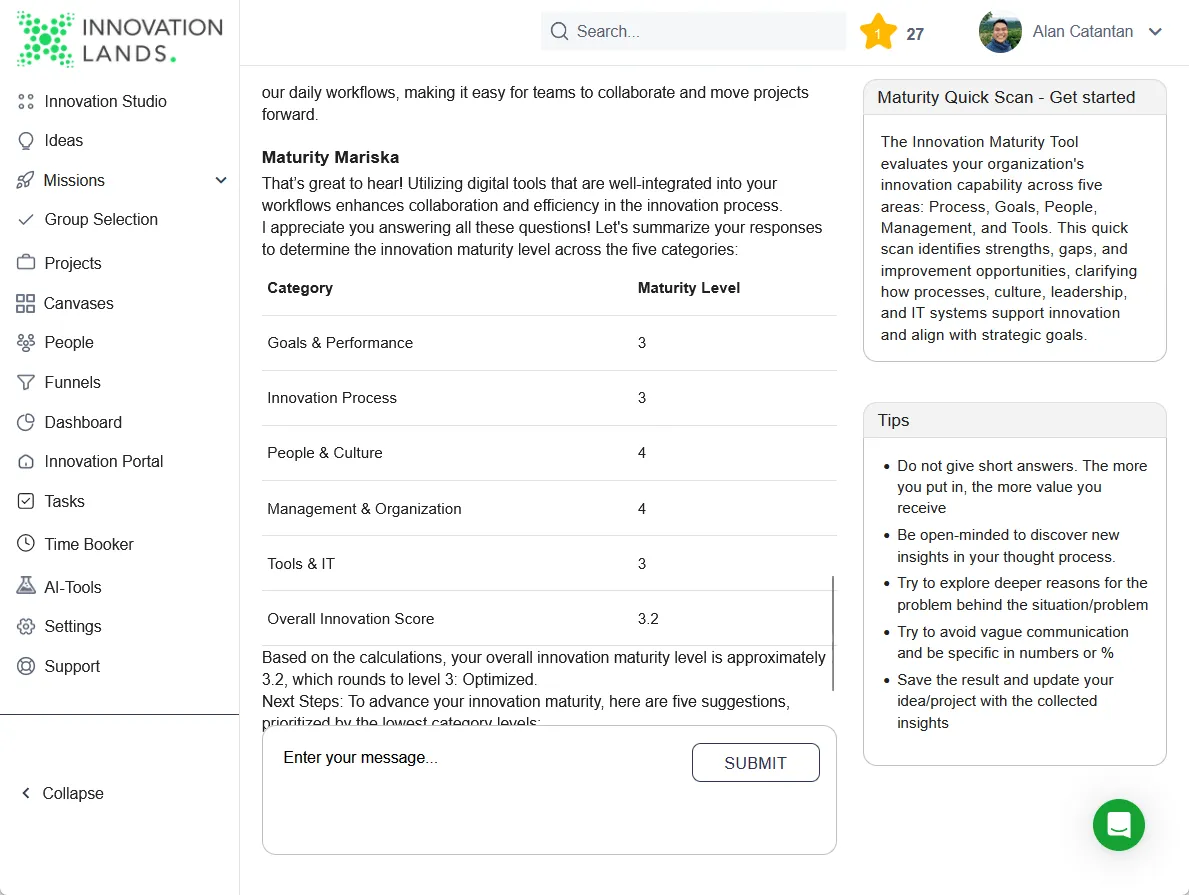
The scan generates a radar chart showing your strongest and weakest domains. But it doesn’t stop there: the AI engine recommends personalized next steps.
These could range from tightening your idea-to-project governance process to running a targeted campaign around experimentation, or even piloting new tools to remove roadblocks.
The quick scan is designed for real business pace. Most teams finish in just 10–15 minutes, making it easy to repeat every quarter or as often as needed.
There’s very little survey fatigue, and you don’t need outside consultants. All results flow directly into Accept Mission dashboards, letting you track improvement, share updates with leadership, and tie your maturity score to business outcomes.
How do you jump to the next maturity level fast?
Once you know your strengths and weaknesses, the real work begins.
Moving up a level does not require a massive overhaul, just a series of targeted actions and visible wins.
Priority Actions Per Pillar
Moving up the maturity ladder is about smart, focused changes. Here are some moves that can deliver results quickly:
| Action | What to Do | Why It Matters |
|---|---|---|
| Strengthen governance | Set a regular (for example, biweekly) decision rhythm for evaluating and advancing new ideas | Creates momentum and ensures nothing lingers in limbo |
| Adjust your funding mix | Follow the 70-20-10 rule: 70 percent on core business, 20 percent on adjacent opportunities, and 10 percent on transformational innovation | Balances stability with risk-taking |
| Launch or formalize an innovation program | Link clear metrics and KPIs to your main business goals; embed metrics in leadership scorecards if possible | Makes innovation measurable and keeps it on the leadership agenda |
| Coach leaders and managers | Help them see failure as part of learning; publicly share stories of lessons learned, not just successes | Builds psychological safety and encourages open experimentation |
What Is a 90-Day Win I Can Show?
Quick wins build belief.
To make your progress visible, create a structured 90-day action plan that breaks goals into manageable steps:
- Identify three specific milestones for each month.
- Assign ownership for each milestone to a responsible team or leader.
- Schedule regular check-ins to monitor progress.
At the end of every month, hold a “show-and-tell” session where teams present what they’ve tried, what worked, and what challenges they encountered.
This routine keeps teams engaged, surfaces challenges before they grow, and helps leaders see real progress. Even small wins add up, and public celebration of progress reinforces your commitment to the process.
How will you keep momentum after the first push?
Momentum often fades after initial excitement, but consistent habits set successful teams apart. Building a routine of measurement, storytelling, and accountability keeps innovation at the center of your culture.
Cadence for Re-Assessments
Innovation maturity is not a one-time checkup; it’s a regular practice.
Most successful organizations conduct a brief self-assessment every six months to track progress, followed by a more in-depth, detailed assessment annually.
This rhythm keeps innovation goals at the forefront and makes it easier to spot patterns or backsliding before they become major setbacks.
Reassessments shouldn’t feel like extra work:
- Keep surveys brief and focused
- Automate as much as possible with your chosen digital tool
- Announce assessment periods in advance and explain how results will be used
When people see positive changes from previous surveys, participation and honesty will go up naturally.
Building Narratives and Dashboards
It’s not enough to measure; you need to make innovation maturity a visible, ongoing part of your culture.
Try these steps:
- Link your most important innovation metrics to executive dashboards and leadership scorecards, so progress is front and center every month.
- Share stories, highlighting both wins and setbacks, across internal channels such as newsletters, all-hands meetings, or digital forums.
- Update dashboards frequently, using visuals like radar charts or heatmaps to help teams stay aligned on what’s improving and where focus is needed.
- Celebrate teams that share lessons learned and keep innovation conversations active throughout the year.
When innovation maturity is consistently visible and openly discussed, you build a culture of trust and continuous improvement.
Over time, these steady, visible moves create a durable foundation for growth, while flashy, one-time efforts tend to fade quickly.
Ready to take the next step and see the Accept Mission innovation maturity tool in action?
Book a free demo with Accept Mission today and get instant access to the AI-powered quick scan, so you can benchmark your team’s innovation maturity.







 English
 Dutch
Dutch Portuguese
 Spanish
 French
 German
 Arabic