
The Most-Voted Idea Is Rarely the Best One: Better Prioritization for Innovation Teams11 min read

Almost every innovation team has a reliable way to decide which ideas move forward: count the votes and send the top finishers to development.
You have seen it in every form:
- A whiteboard covered in dot stickers after a brainstorm
- A platform tallying thumbs-up counts on submitted ideas
- A poll that sends the top vote-getter straight to development
It feels fair. Everyone participates, the count is quick, and the winner looks like a group decision rather than one person’s call.
But voting captures what people liked, and that’s a different measure from what deserves your budget, your engineers, and your next six months.
The idea with the most votes is rarely the idea with the strongest case. Voting is an engagement tool, not a prioritization system.
The Appeal of Voting (and Its Hidden Cost)
The appeal of voting is real. It’s fast, it’s inclusive, and it spreads ownership across the group instead of concentrating it in one person.
Those are genuine benefits. They explain why voting shows up in nearly every innovation process, from sticky notes to enterprise platforms.
What a vote actually records is the problem.
What You’re Really Measuring
A vote captures a preference. Prioritization needs a judgment, and those are not the same input.
When you count votes, you learn what people liked. When you prioritize, you need to know what will pay off, for whom, and at what cost.
| What Voting Measures | What Prioritization Requires |
|---|---|
| Demand: how many people raised a hand | Value: strategic fit, return, and opportunity cost |
| Popularity in the room | Alignment with stated business objectives |
| Who showed up to vote | Who has the expertise to judge the idea |
| Preference for a proposed solution | Clarity on the underlying problem being solved |
| A snapshot of current momentum | A defensible tradeoff between competing options |
Voting boards measure demand, not value, as one product leader puts it.
Demand is a count. Value accounts for who is asking, what it maps to strategically, and whether the solution even fixes the right problem.
The Biases Voting Amplifies
Voting doesn’t just miss value. It actively rewards the wrong signals, because group votes are shaped by who is in the room and what order things happen in.
These are structural failure modes, not occasional accidents. They show up every time, and they push your selection toward safe, familiar, and well-connected ideas.
The HiPPO Effect
When a senior leader speaks first, the group anchors to that position before deliberation even begins. The vote that follows is no longer independent; it’s an echo.
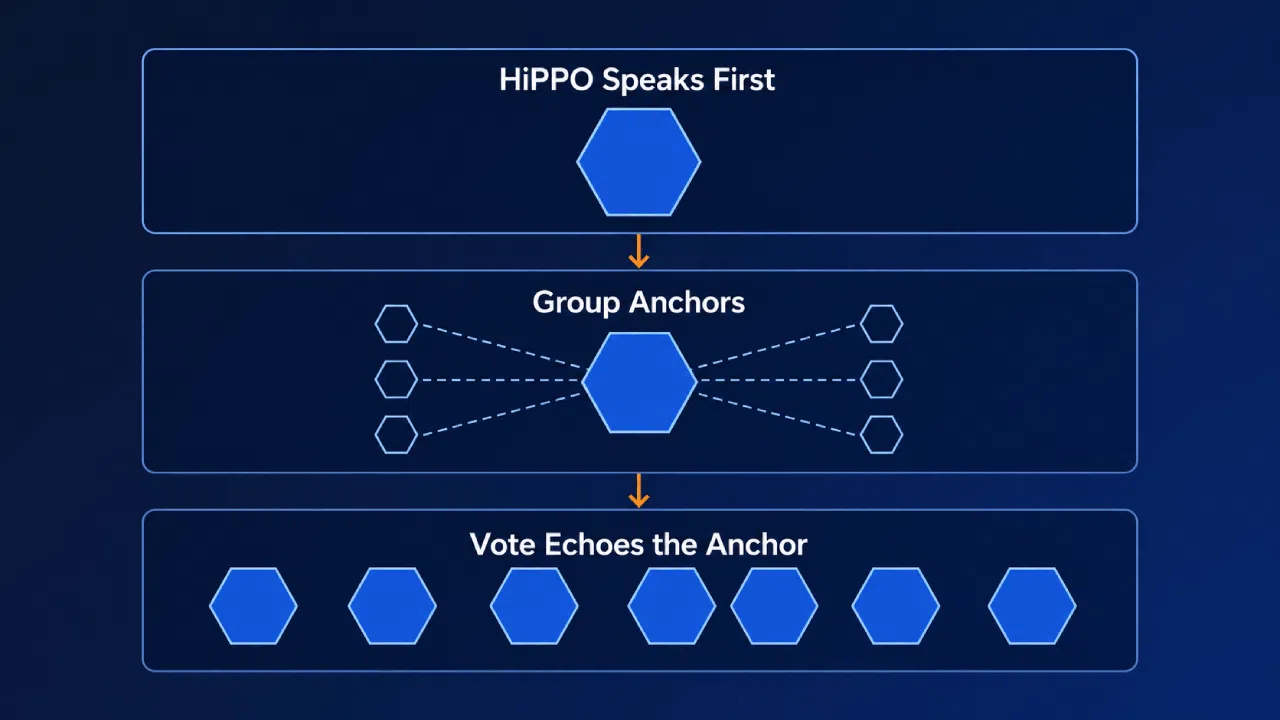
This is costly because seniority and loss aversion travel together. Research shows senior decision-makers tend to favor risk-averse ideas while believing they’re selecting creative ones.
The most disruptive ideas get killed at exactly this stage. They look like threats to the person with the most pattern-matching experience in the room.
One software company uses a simultaneous reveal for quick group reads (thumbs up, down, or sideways shown all at once), so the senior voice cannot anchor everyone before they commit.
Bandwagon and Position Bias
Votes attract votes. An idea with a visible lead collects more support independent of its quality, a rich-get-richer dynamic driven by social proof.
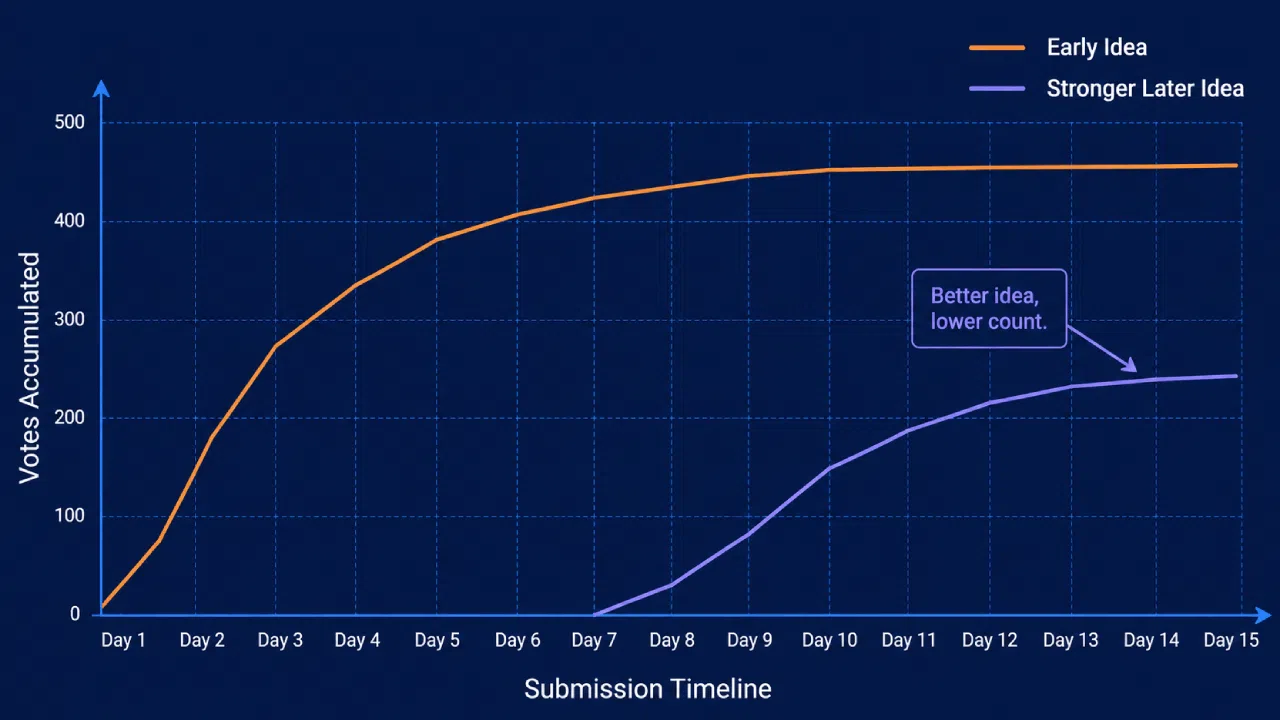
Position compounds the problem. Ideas submitted earliest accumulate structural voting advantages that persist, even when a stronger idea arrives later in the cycle.
So the count you read at the end is not a clean measure of merit. It’s partly a measure of timing and momentum.
Survivorship Bias in Who Votes
Look closely at who actually votes, and the data narrows. Power users and highly engaged employees dominate voting portals, while quieter or less-engaged voices barely register.
Your tally describes your most committed people, which means it says nothing about the broader market, the customers who churned, or the segments you have not won yet.
You can optimize hard for that data and still miss where the real growth was hiding.
When Voting Actually Works
Voting is not the villain here. It earns its place when you use it as a signal, not a verdict.
Early in a cycle, a vote is one of the fastest ways to read the room. It surfaces which ideas have energy behind them, which themes keep resurfacing, and where curiosity is already pooling.
That’s genuinely useful. A submission that excites forty people is worth a second look, and the enthusiasm itself can carry an idea through development.
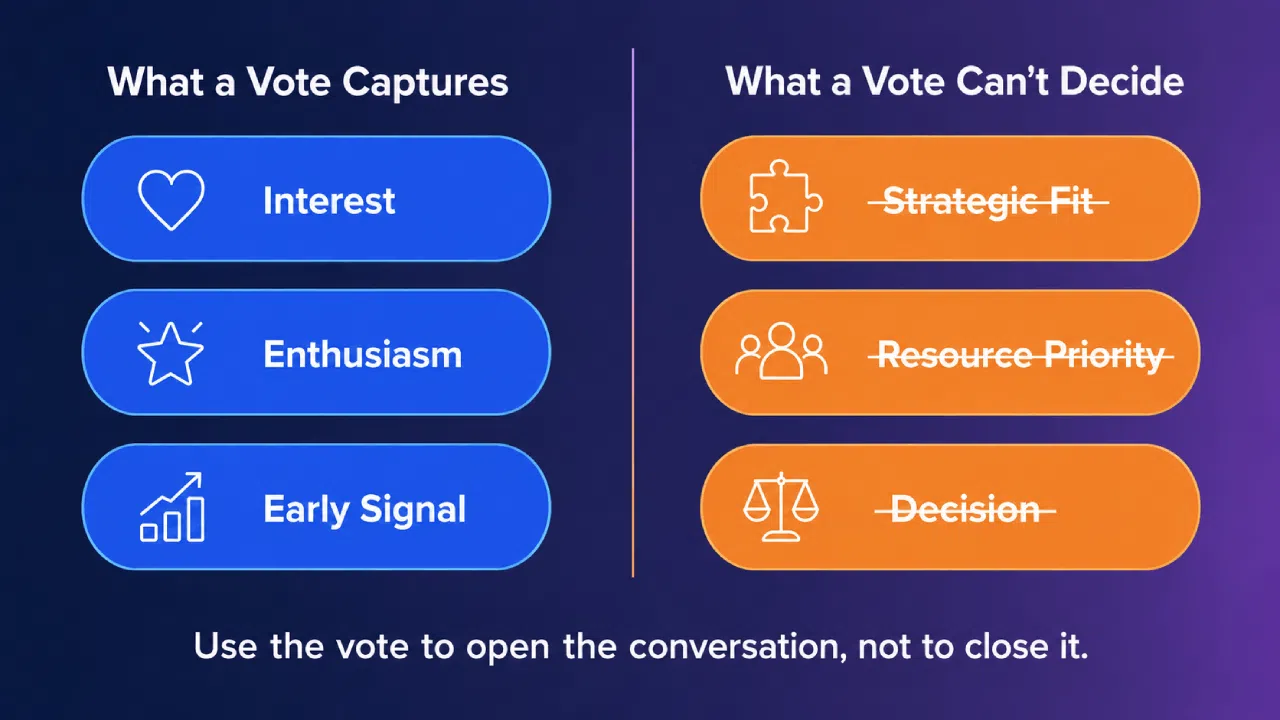
Voting also does real work for engagement. When people see their input register, they stay involved, and participation tends to climb across the next cycle.
Open innovation research has long linked visible participation to stronger contributor commitment.
So keep the polls. Just be honest about what they measure.
A vote tells you what the crowd notices and what it finds appealing. It can’t tell you which idea fits your strategy or clears your constraints.
Treat the count as a filter that narrows the field, then hand the survivors to a process built to actually decide.
What Real Prioritization Requires
Real prioritization requires different infrastructure: agreed criteria, the right evaluators, and structured deliberation instead of a show of hands.
Each piece does a specific job. Together they convert a popularity contest into a defensible decision.
Criteria Agreed Before Any Idea Enters
The single most important move is setting your criteria and weights before a single idea is submitted.
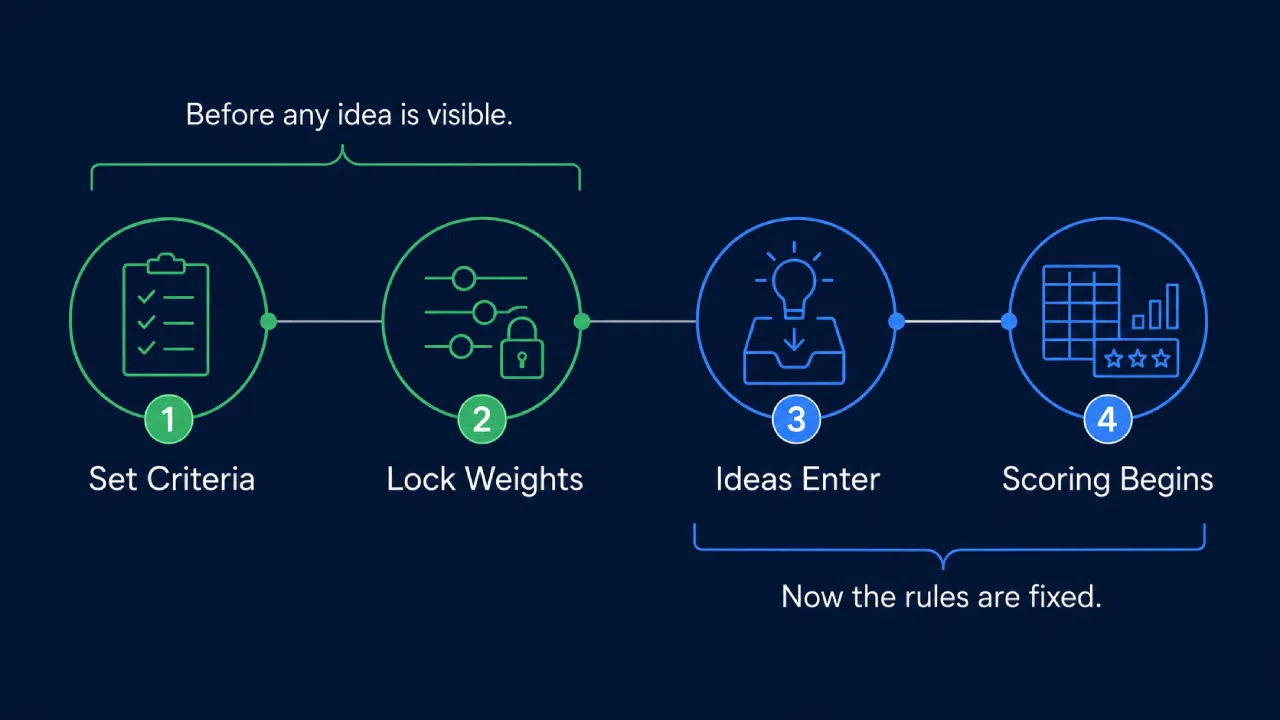
Agreeing on criteria up front keeps opinion-based prioritization from sneaking back in through the back door.
Once ideas are on the table, every weighting choice starts to look like a vote for a favorite. Lock the rules first, and you remove that temptation.
Annotate the scales, too. “Needs external expertise and resources” communicates more precisely than a bare label like “high effort,” which means different things to a senior engineer and a marketing lead.
Expertise-Matched Evaluation
Who scores an idea matters as much as what they score. A vote treats every opinion as equal weight; real prioritization doesn’t.
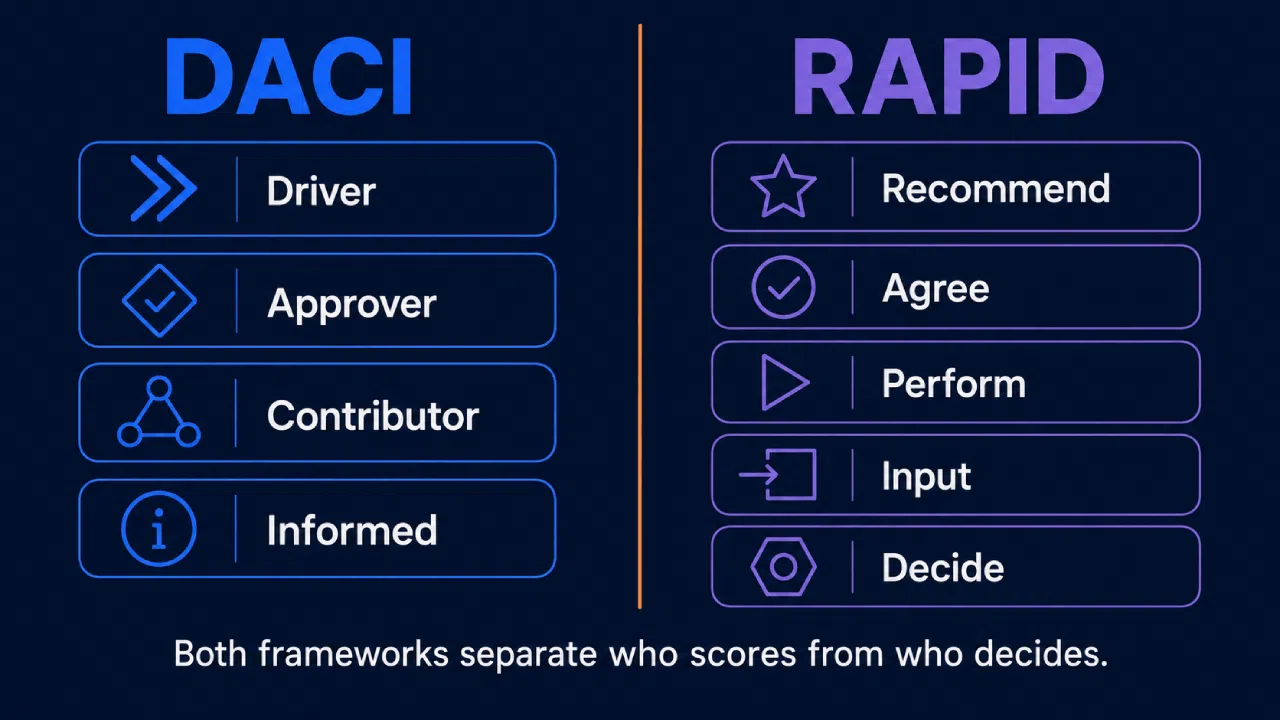
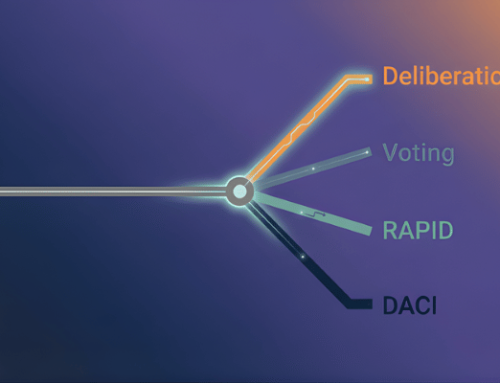
DACI and RAPID are the role-clarity frameworks that handle this. DACI separates the process manager from the decision-maker, while RAPID adds compliance sign-off and execution accountability, closing the gap where good calls get made but never get built.
A 2025 study in Organization Science found that ranking projects outperformed counting their votes, especially when budgets were tight and only a few ideas could advance.
Deliberation, Not Consensus
Consensus feels safe, but it has a known failure mode. Harvard researchers put it bluntly: consensus-based groups are often where innovative ideas go to die.
When people sense the group leaning one way, they suppress the objections that would have sharpened the decision. The room agrees, and the idea gets worse.
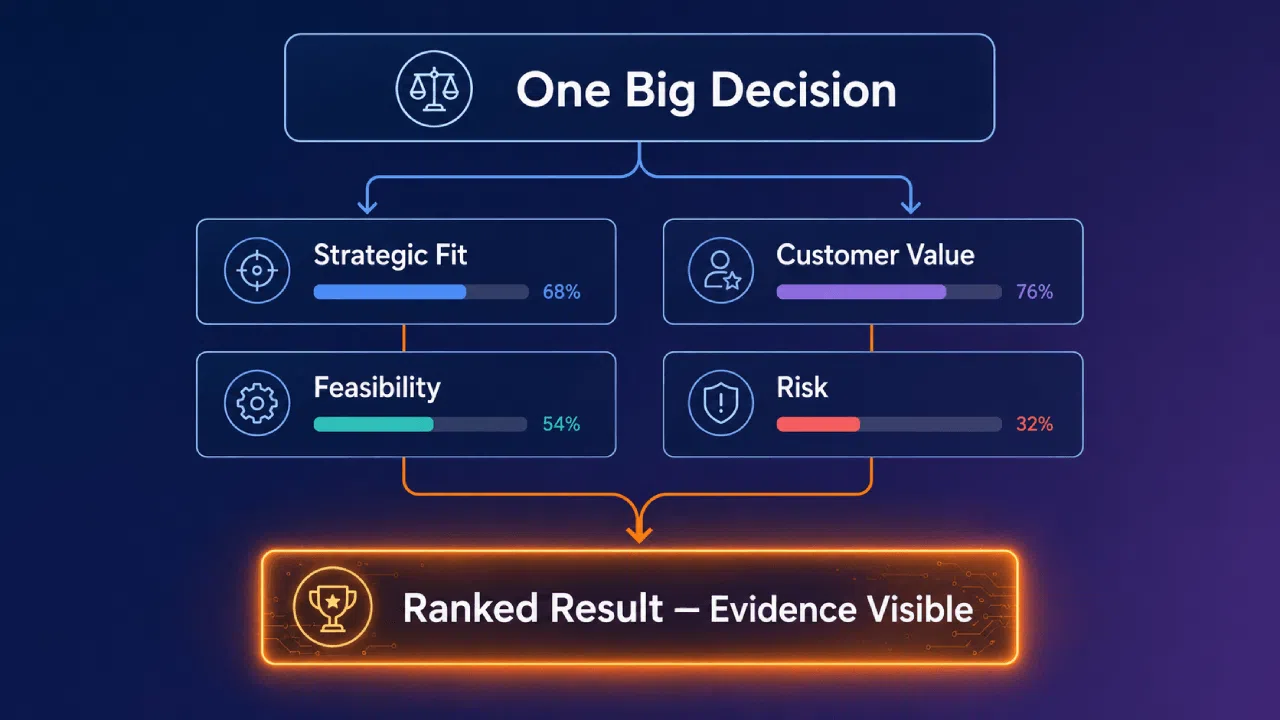
The fix is to build dissent into the process on purpose. The Mediating Assessments Protocol breaks a big choice into smaller, criteria-based sub-evaluations, so intermediate evidence stays visible instead of collapsing into one confident verdict.
Decision Patterns That Replace Voting
You don’t need to abandon group input. You need to structure it so that expertise, not volume, drives the outcome.
Three patterns do most of the work. Use them individually or stack them depending on how high the stakes are.
Weighted Scorecards With Pre-Agreed Criteria
A weighted scorecard scores each idea across shared criteria (customer value, effort, strategic alignment, risk), then multiplies each score by its agreed weight to produce a ranked total.
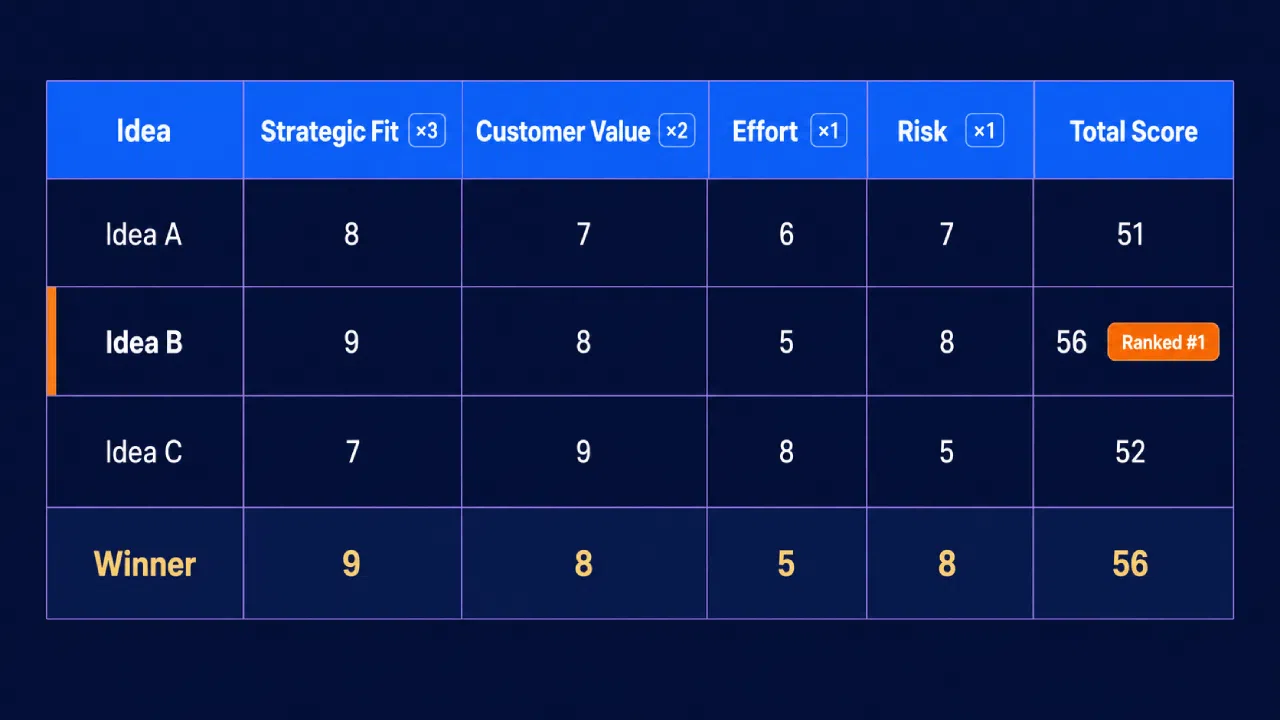
The math is simple. The discipline is in fixing the weights beforehand, so the ranking reflects criteria rather than the room’s mood.
Annotation is what makes it reliable. When every point on the scale has a concrete description, evaluators interpret it the same way, and you spend less time arguing about what a “4” means.
Role-Coded Input (When Group Participation Matters)
Sometimes you genuinely want a group involved. The trick is to weight input by domain rather than treating every voice as identical.
Color-coding input by perspective (customer, financial, technical) forces a winning idea to earn support across dimensions.
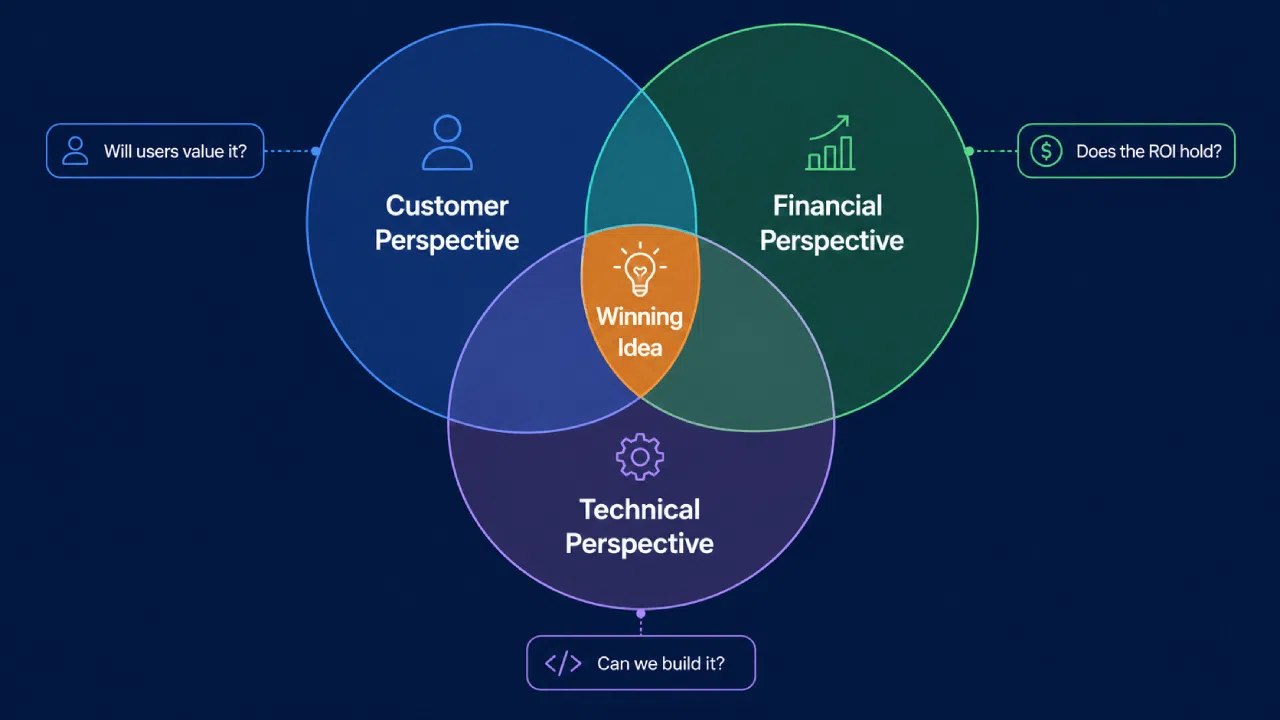
That narrows a field of five to seven contenders down to the two or three that are genuinely strong everywhere.
Here’s a sequence that holds up in practice for a structured group session:
- Align on criteria and weights before anyone sees the ideas.
- Have each evaluator score independently, no discussion yet.
- Reveal all scores simultaneously to prevent anchoring on the most senior view.
- Surface the disagreements deliberately, and ask the outliers to explain their reasoning.
- Rank the finalists and assign a clear decision owner to make the call.
That structure does something a vote never can. It treats disagreement as information instead of noise to be averaged away.
It also leaves a record. Anyone reviewing the decision later can see how each idea scored and why, which makes the outcome far easier to defend.
And the list is transferable. Anyone stepping into the role of session facilitator has a repeatable sequence they can apply, regardless of how politically charged the ideas are.
Structure your input well, and you still need someone accountable for the decision. Use DACI for cleaner, more linear choices, and RAPID when the governance is genuinely complex.
The goal is clear ownership: the right people making the right calls, with accountability for both the decision and its execution.
Make Evaluation Criteria Visible
There’s a useful distinction between transparency of criteria and transparency of votes: showing people the evaluation rules builds trust, while showing them other people’s votes just reintroduces the bandwagon effect.
So make the criteria visible, not the running tally. Publish the scoring weights and what happens to an idea after it is submitted.
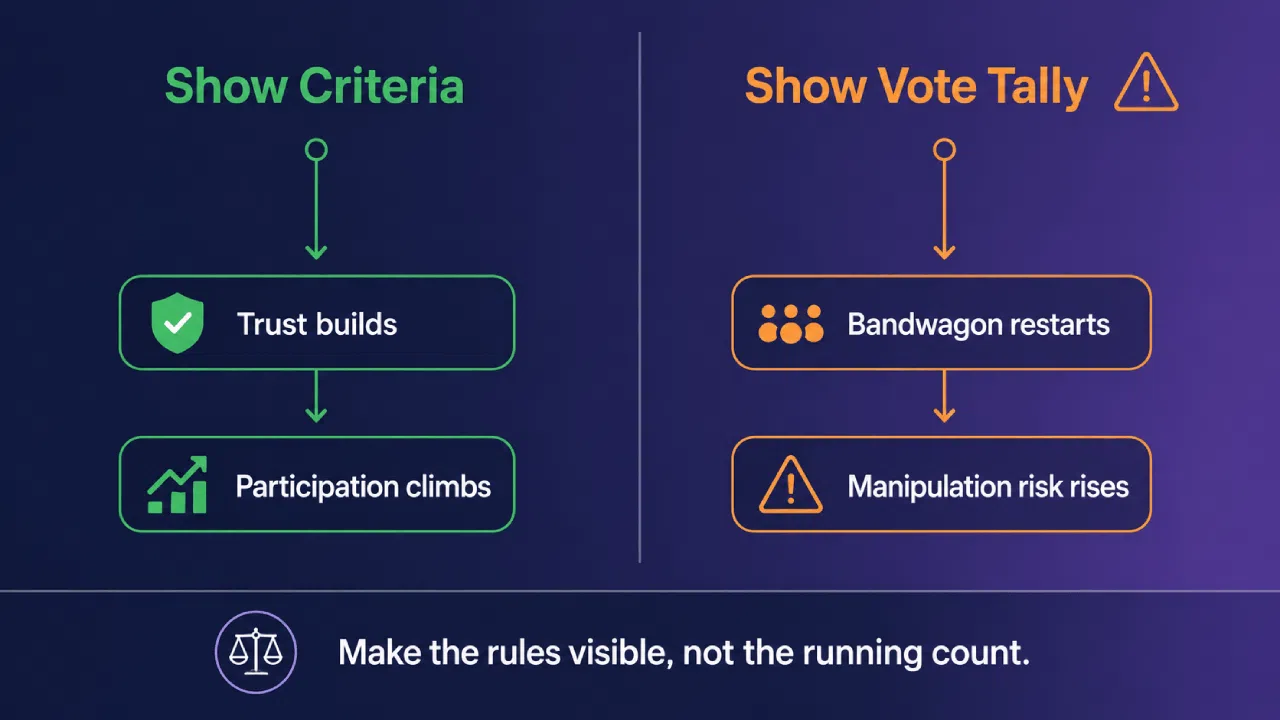
The stakes here are concrete. When employees cannot see what happens to their submitted ideas, trust collapses, participation drops, and the pipeline stalls.
A 2025 study in Scientific Reports confirms the human side of this: when employees experience more structured evaluation, they report higher belonging and stronger perceptions of procedural justice.
Innovation platforms with weighted scorecards, AI-assisted evaluation, and funnel visibility give decision-makers criteria-based rankings instead of click counts.
The Cost of Getting This Wrong
When the wrong idea advances, the bill arrives slowly, and then all at once. It lands in three places, each one harder to recover from than the last:
- Budget: Resources flow toward something that looked popular but never had the strongest case, and they are gone when the right idea arrives.
- Pipeline: A weak project sits in development long after its weakness is obvious, blocking the slots and attention that stronger work needed.
- Trust: The expert who flagged the risk and got outvoted remembers it, and so does the contributor whose reasoned submission lost to something flashier.
According to Harvard Business School professor Clayton Christensen, 95% of new products fail, which means backing the wrong idea compounds a problem you can barely afford.
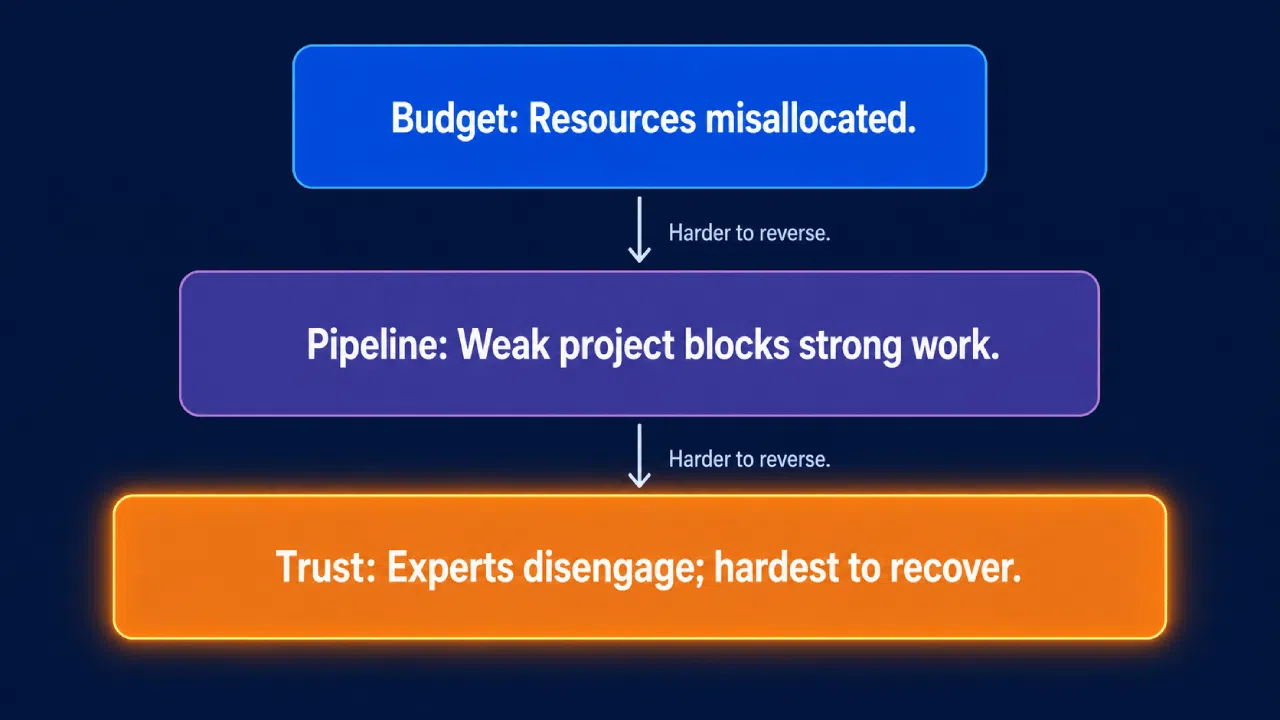
The quietest of those costs is trust, and it’s the one that lingers. Run that pattern a few times and your best people stop bothering.
They learn that reasoning loses to popularity, and they ration their effort accordingly.
That’s the real damage. A process that rewards momentum over merit does not just waste one cycle of spending.
It teaches your sharpest evaluators that their judgment doesn’t count, and that lesson is expensive to unlearn.
Separate the Vote From the Decision
Voting has a real job. Use it to gauge interest, widen participation, and give contributors a stake in what gets built.
For the actual decision, you need three things no vote can provide:
- Criteria and weights agreed before any idea enters the process
- Evaluators matched to the domain they are actually scoring
- The scoring results visible to participants, not the running vote tally
Deciding what advances, what gets funded, and who owns the call requires a scoring process, not another round of votes.
If you’re building a review process, keep the two purposes separate. Use the vote to open the conversation, and the scorecard to close it.
That’s the shift: from counting whose hand went up, to designing how the decision actually gets made.
Download our ebook on structured idea evaluation and group scoring, or book a demo to see how Accept Mission replaces popularity voting with criteria-based decisions.








 English
 Dutch
Dutch Portuguese
 Spanish
 French
 German
 Arabic