
The Always-On Idea Channel: How to Capture Ideas Without Running Campaigns9 min read

Campaigns have a launch date and a sunset. Good ideas don’t.
Most organizations deal with this in one of two ways:
- Run structured campaigns and ignore everything in between
- Deploy an open idea channel that quietly turns into a graveyard
There’s a third option: an always-on channel with enough structure to make triage manageable, designed to run alongside campaigns rather than replace them.
Why Campaigns Miss Most Ideas
Innovation campaigns are purposeful by design. They have a defined scope, a clear deadline, and explicit strategic intent.
That focus comes with a trade-off.
A quarterly or twice-yearly campaign generates submissions tied to that specific mandate, but ideas don’t follow a campaign calendar.
They surface continuously:
- A process improvement noticed by someone on the operations team
- A product gap spotted by a customer success manager
- A market observation from someone in sales
According to McKinsey, 80–90% of executives consider innovation a top priority, yet only 6% are satisfied with their organization’s innovation performance.
Most ideas that surface between campaigns go nowhere because there’s nowhere structured for them to go.
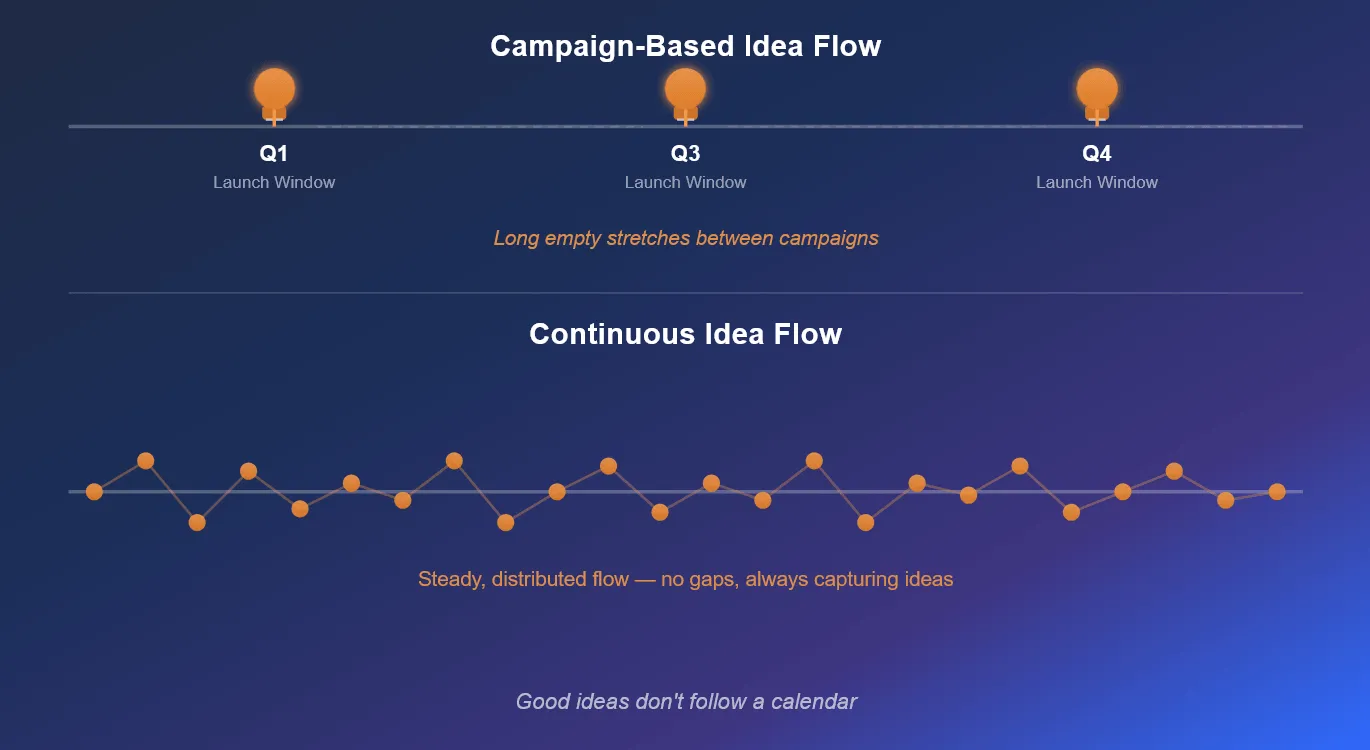
Campaigns deliver focus. Continuous ideas require a separate channel.
Both matter, and running one without the other leaves real value uncaptured.
The Suggestion Box Trap
Most organizations have tried an open-ended idea channel. Most have quietly given up on it.
The real bottleneck is structural. A traditional suggestion box fails for five predictable reasons:
- Manual inefficiency. Collecting, sorting, and logging submissions by hand creates bottlenecks and delays.
- Lack of structured workflow. Ideas arrive unformatted; reviewers spend time just understanding what was submitted.
- No collaborative refinement. Submissions sit static instead of being discussed and improved.
- Strategic misalignment. There’s no way to route ideas toward business priorities or functional ownership.
- Absence of accountability. Ideas disappear without explanation. Submitters hear nothing and lose faith.
The cumulative effect is what innovation leaders call the “black hole problem.” Ideas go in; nothing comes out.
Engagement drops. The channel becomes a ghost town.
The real design challenge is building an open channel with enough structure to actually work, and light structure is where to start.
What “Light Structure” Actually Means
Light structure is a precise concept. It means three specific things: a minimal submission form, a small set of categories, and one clear owner.
The Submission Form
Ask three questions:
- What’s the idea?
- What problem does it solve?
- What area does it relate to?
That’s the form. The goal is to gather enough context for triage, not to evaluate at submission time; heavy upfront criteria kills participation.
A submitter should be able to answer in five sentences or less.
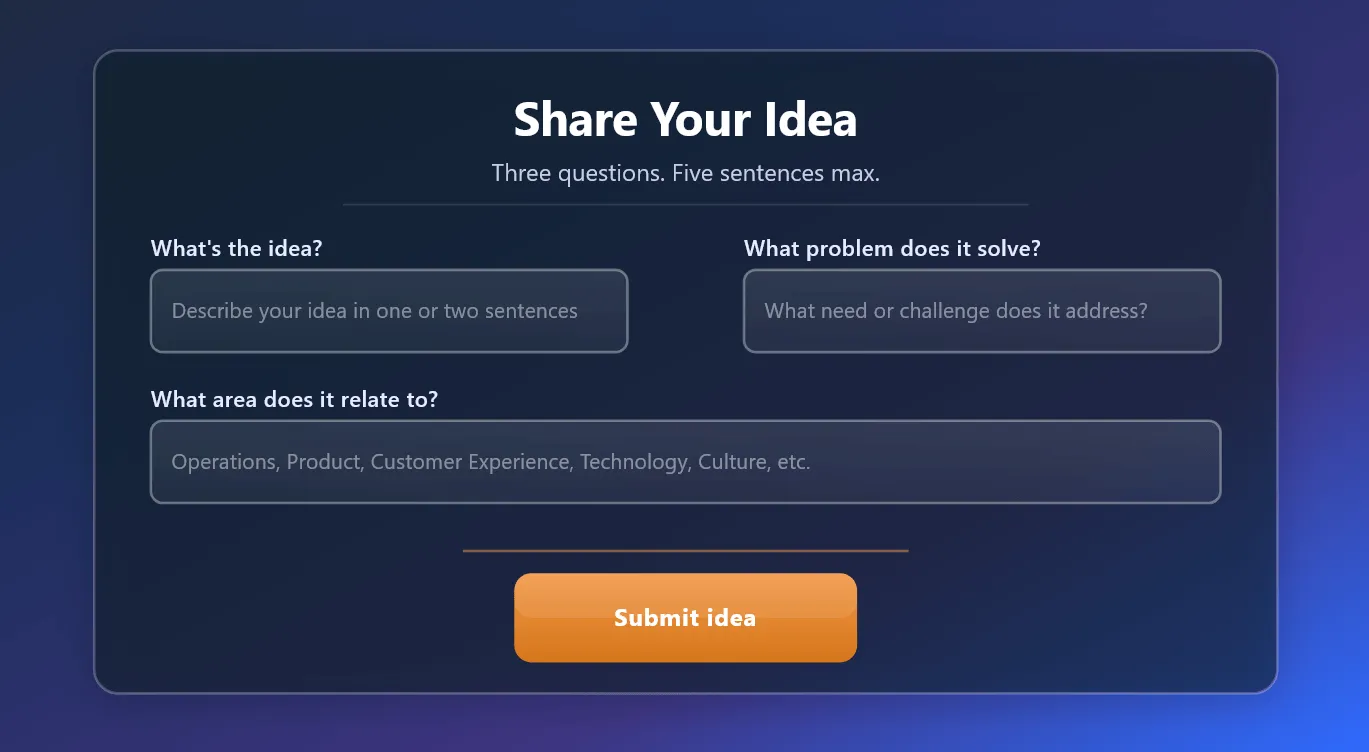
If they can’t, the idea probably isn’t fully formed yet. That’s a useful signal too.
Categories and Tags
Define three to six categories tied to your strategic domains or functional areas. Assign them at triage time, not at submission.
A submitter doesn’t need to guess whether their idea fits “Process Efficiency” or “Customer Experience.” The triage owner makes that call.
| Category | Example Tags | What It Enables for Triage |
|---|---|---|
| Product | Feature, Integration, Roadmap alignment | Route to product leadership; stack with similar submissions |
| Operations | Cost reduction, Process, Automation | Assign to ops owner; flag for quick wins |
| Customer Experience | Support, Onboarding, Retention | Tie to customer feedback; inform customer advisory input |
| Revenue | Pricing, Upsell, Market expansion | Escalate to leadership; link to pipeline opportunities |
| Culture | Workplace, Remote, Learning | Flag for people/ops; assess feasibility |
| Other | Strategic, Exploratory | Park or close with reasoning |
Categories should evolve as your strategic priorities shift. Light structure means they’re not permanent; they follow where the organization is going.
Who Owns It
Ownership is the single most underestimated design choice in idea management. The owner doesn’t need to evaluate every idea themselves.
In practice, the owner’s job is narrower than it sounds. They need to ensure triage happens on cadence and that every submitter gets a response.
The right owner is usually someone with the authority to make go/no-go calls and the credibility to communicate them, someone like:
- Innovation manager
- R&D lead
- Program directory
They don’t need to be a technical expert, but they need skin in the game.
This is where most programs fail. When nobody owns the process, everything stalls. When ownership gets spread across five people, it’s almost as bad.
Ideas slip through the cracks. Submitters never hear back. The channel withers.
The Triage Workflow
Triage is a sorting process. Three moves, applied consistently.
Triage Frequency: Weekly, Not Quarterly
Weekly 30-minute reviews of five to ten new submissions are manageable. Quarterly reviews of 50 or 80 accumulated ideas create a panic and a backlog.
Weekly triage also keeps the feedback loop tight. A submitter hears back within days, not months, and that speed itself signals that someone is paying attention.
The Three Triage Decisions
Every idea gets one of three outcomes:
| Decision | When to Use It | What Happens Next |
|---|---|---|
| Promote | Aligns with strategy; solves a known problem; ownership is clear | Moves to the formal innovation funnel; enters evaluation process |
| Park | Interesting but not actionable now; timing matters; needs more context | Tagged with reason and date; reviewed quarterly; owner is notified if priority shifts |
| Close | Doesn’t fit scope; duplicates existing submission; outside strategic focus | Submitter receives explicit reason; can provide feedback or resubmit refined version |
The close loop is critical. Ideas disappearing without explanation drive disengagement.
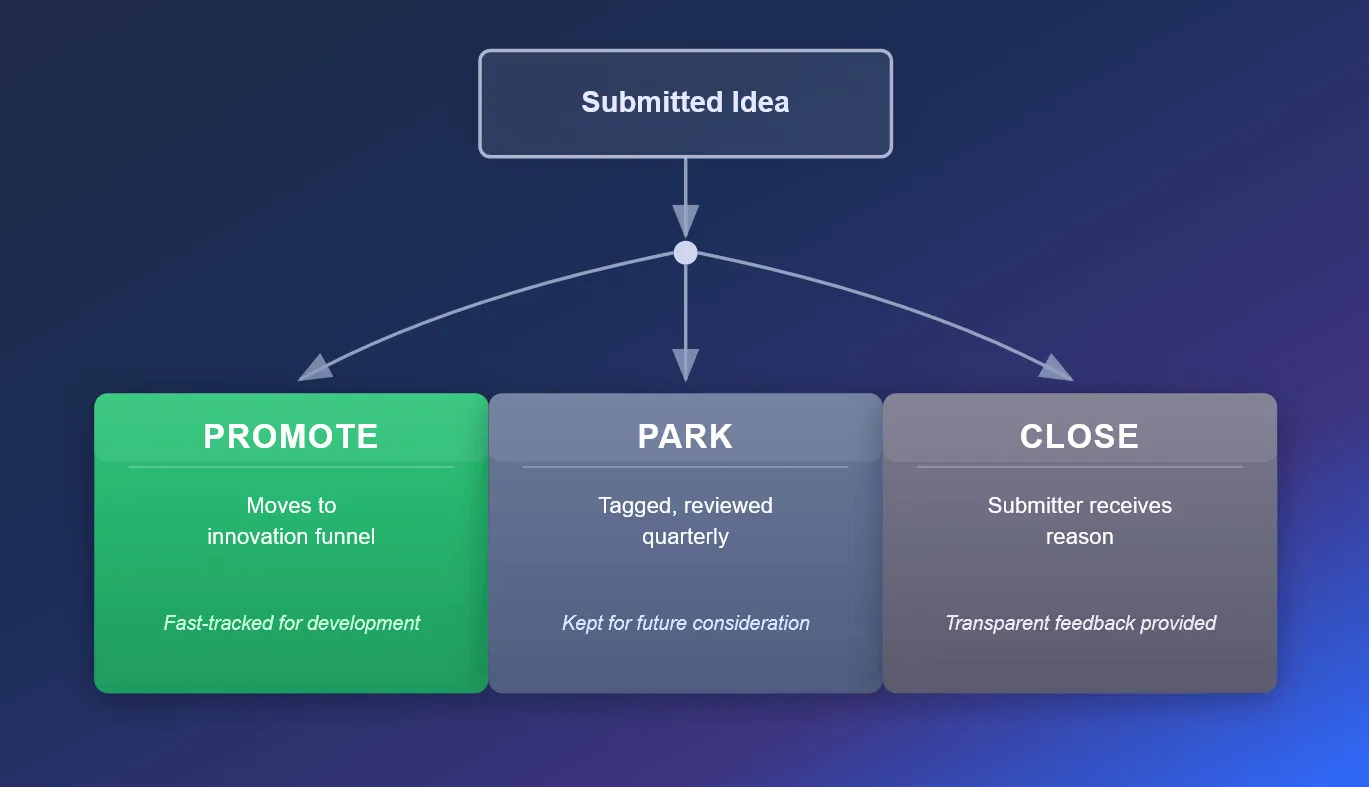
A clear reason (such as “This is great, but it’s outside our current scope”) maintains credibility even when ideas don’t move forward.
Feedback Is Part of the Process
Every triage decision generates a notification to the submitter. That notification includes the decision and the reasoning.
A complete notification covers three things:
- The decision (promoted, parked, or closed)
- The reason behind it, in plain language
- Next steps, if any, or a clear signal that none are needed
Nothing fancy. Just accountability. Transparency, even in rejection, is more powerful than silence.
When submitters get clear feedback, participation rates stay high. When ideas disappear into a void with no response, people stop submitting.
The channel becomes an afterthought instead of a habit.
Connecting the Always-On Channel to the Funnel
An always-on intake channel works best when it feeds directly into your existing innovation funnel, not as a replacement for campaigns, but as a parallel entry point.
Ideas that pass triage should enter the same evaluation and development process as campaign submissions:
- Same gates
- Same workflow
- Same ownership
The difference is the source. Campaigns deliver batches of aligned ideas on a schedule; the always-on channel delivers continuous ideas that meet your triage criteria.
That connection is what prevents the “black hole” feeling. A promoted idea flows directly into the process where decisions get made and work gets assigned.
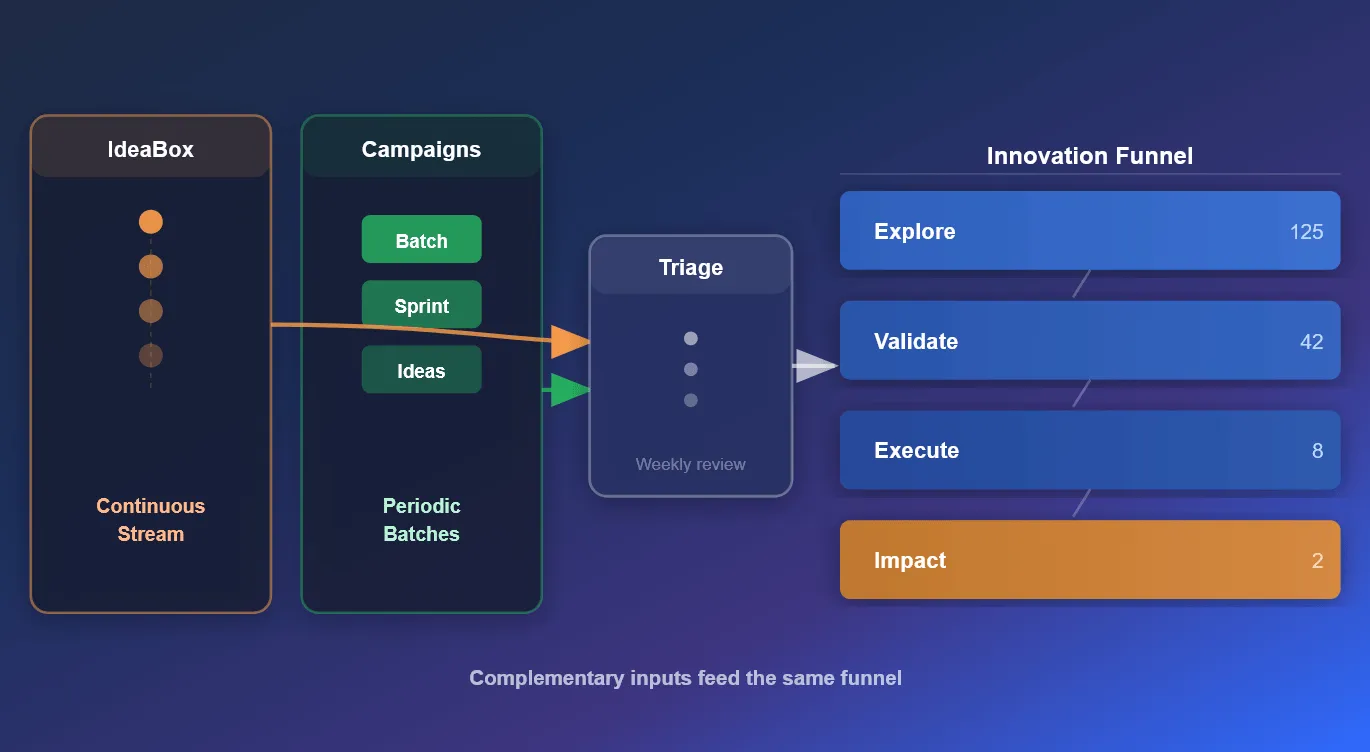
When intake, triage, and funnel management are connected, the efficiency gains are real:
Organizations using structured idea management platforms report significant reductions in administrative overhead through reduced handoffs and centralized context.
Without that connection, ideas land in a spreadsheet and sit. Nobody knows what happens next. The context that came with the submission gets lost between intake and evaluation.
The innovation manager ends up spending half their time tracking down which ideas are where, instead of actually moving them forward.
When to Layer On More Structure
Light structure is a starting point, not a permanent ceiling. As you mature, watch for three signals that more structure might help.
- Triage is taking more than an hour per week, suggesting volume has outgrown your current process.
- Certain categories consistently produce actionable ideas, suggesting a sub-innovation portfolio worth formalizing.
- Leadership starts asking for reporting: idea submission rates, category performance, time-to-decision metrics.
Structure should follow maturity, not precede it. Starting heavy kills participation. Starting light and adding structure as you learn what works is how sustainable programs scale.
If you’re just getting started, a shared spreadsheet can serve as a temporary triage log.
Once weekly triage consistently produces five or more promoted ideas per quarter, that’s a signal to invest in a more structured environment.
Build the Front Door Before the Campaign
Most organizations invest in campaign mechanics without building a persistent intake channel.
They run an annual innovation jam or quarterly challenge and wonder why the ideas don’t become business impact.
To get started, assign an owner, define three to six categories aligned with your strategic priorities, and schedule a weekly 30-minute review.
Commit to responding to every submitter within five business days. Start there.
Download the free guide Idea Collecting: From Organizational Signals to Ideas and learn how to build a collection process with the right intent, ownership, and a clear path to decision.
Request a demo to see how Accept Mission gives you real-time visibility into submission quality, stage progression, and campaign engagement with dashboards built for structured intake.











 English
 Dutch
Dutch Portuguese
 Spanish
 French
 German
 Arabic