
Audit-Ready Innovation: Building Traceability Into Your Workflow13 min read
Leadership asks the question at some point in every innovation program: “Why did we approve this idea?”
If the answer is silence, scattered emails, or a vague reference to last quarter’s meeting, something critical is already missing.
The gap usually looks the same:
- The reasoning behind a gate decision never got documented.
- The evidence that informed a score or ranking isn’t retrievable.
- Accountability at each stage was assumed, not assigned.
- What happened to a specific idea over time can’t be reconstructed.
Innovation programs generate activity constantly. What they often don’t generate is a clear record of why decisions happened.
Traceability is a design choice. Built in from launch, it gives teams better decisions, faster reviews, and a credible story for leadership.
Retrofitted afterward, it creates signal-to-noise problems, incomplete records, and review processes that slow rather than speed.
What “Audit-Ready” Actually Means in Innovation
Audit-ready means you can reconstruct any decision at any stage: who made it, what information they had, what alternatives they considered, and how the idea progressed over time.
Three components matter:
- Decision record: A timestamped log of every significant gate decision, who made it, and what happened next (approved, rejected, paused, escalated).
- Evidence behind it: What was available when the decision was made: scores, reviewer comments, comparative analysis, external data, risk assessments. Not a summary. The actual information the decision-maker saw.
- Change history: When an idea moved stages, changed status, or was deprioritized, that movement gets logged with context. Why did it move? What changed? Who authorized the change?
Here’s how this shapes a workflow:
| Dimension | Activity-Tracked Workflow | Audit-Ready Workflow |
|---|---|---|
| What’s captured | Submissions, scores, stage transitions | Submissions, scores, rationale, evidence, decision-maker, alternatives considered, stage history with reasoning |
| What’s searchable | Idea title, submitter, current stage | All above, plus decision logic and evidence packets linked to each gate |
| Who’s accountable | Unclear; ownership transfers without a record | Clear ownership at each stage; escalation paths documented |
| What a reviewer sees | Current idea description and score | Full evidence packet: historical context, previous feedback, decision criteria, comparable ideas, risk flags |
The difference: one workflow generates data. The other generates intelligence.
Why Most Innovation Workflows Aren’t Traceable
Most slowdowns in innovation come from governance design, not individual negligence. Three structural gaps show up consistently.
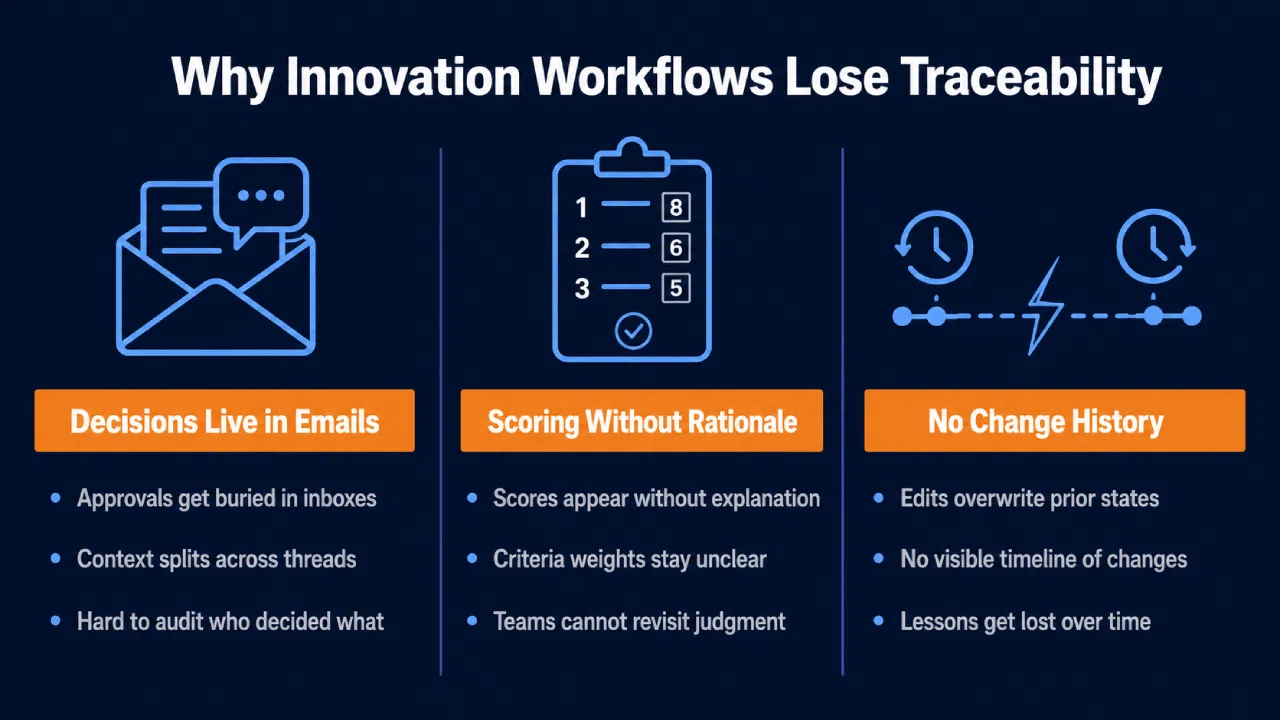
Decisions Live in Emails and Meetings
The actual reasoning behind a gate decision rarely makes it into the system. A steering committee discusses an idea, weighs three options, and approves one.
But the system just records “Approved.” The conversation, the trade-offs, the concerns that were addressed: those stay in email threads and personal notes.
Six months later, when someone asks “why did we fund this over that,” nobody has a clean answer. The decision happened. The reasoning didn’t survive.
Scoring Without Rationale
Ideas get scored on criteria like “strategic fit” or “market potential.”
Scores matter, but scores without reasoning are just numbers. When a reviewer gives an idea a 7/10, does that mean it’s strong but capital-constrained?
Maybe it’s a good concept with weak execution. Or risky but high-upside. Without a comment field that captures actual thinking, the score floats free from the judgment that created it.
No Change History on Ideas
Ideas move through a lot of states: paused when funding dries up, escalated when a sponsor gets excited, deprioritized when priorities shift, resurfaced when new evidence arrives.
Three questions tend to go unanswered when history isn’t logged:
- Why was this idea paused three months ago?
- Who made that call, and under what conditions?
- What would trigger moving it back into active evaluation?
That history vanishes. Reviews take longer because context is missing. Audits fail because documentation is incomplete.
Retrospectives stay shallow because decision reasoning wasn’t captured. And teams repeat mistakes because institutional memory was never built.
The Four Elements of a Traceable Innovation Workflow
Building traceability means embedding four elements into your process. None of them is complex, but all of them are deliberate.
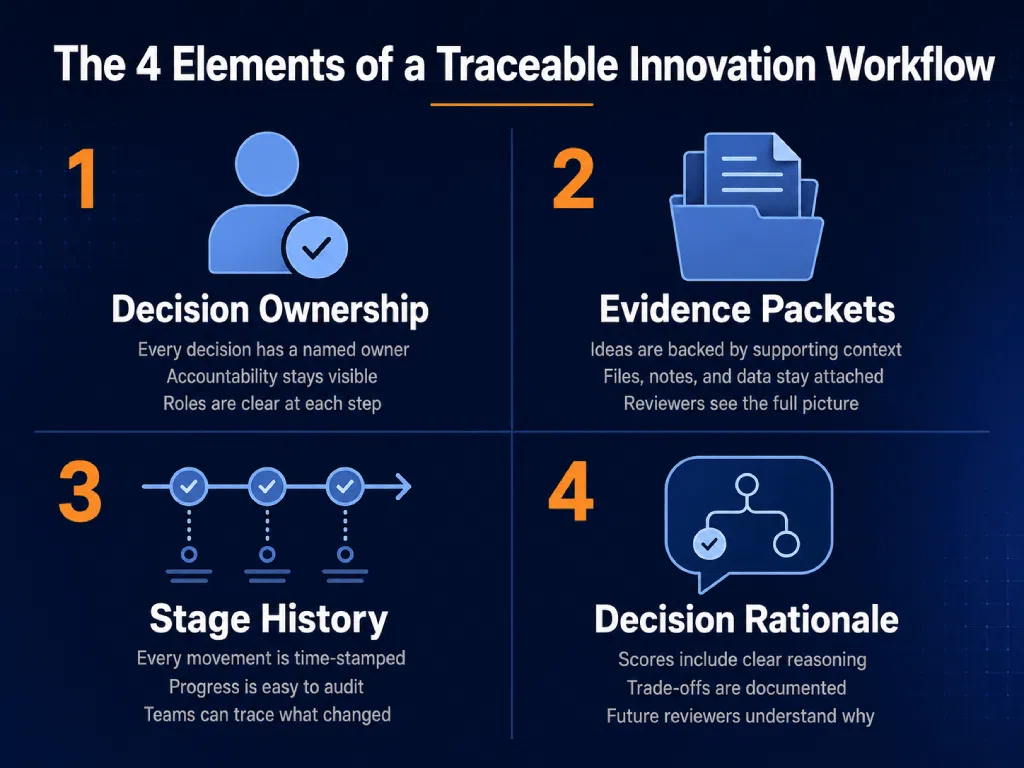
1. Decision Ownership
Every gate has a decision structure.
Someone recommends. Someone approves. Someone escalates if consensus breaks. That structure needs defining before the workflow starts, not improvised in the meeting.
Answer these in advance:
- Who has authority at each stage?
- Which decisions require consensus vs. a single owner?
- When does a recommendation from the technical team carry veto weight?
- What triggers escalation to the steering committee?
These questions have answers in your organization. Most teams just never write them down.
When ownership is documented, automation becomes possible. The platform routes ideas to the right reviewer at the right time.
Escalations happen by rule, not by email. And the audit trail records not just the decision but the path the decision followed.
2. Evidence Packets
An evidence packet is the complete information set available at the moment of a gate decision.
It includes:
- Idea description and submission date
- All reviewer scores and comments (with timestamps)
- Comparative analysis (how this idea ranks against similar submissions)
- Risk and feasibility assessments
- Executive summaries or supporting data the decision-maker requested
- Stage-specific evaluation criteria and how the idea performs against them
- Notes on alternatives discussed or rejected
The evidence packet doesn’t need to be enormous.
It needs to be complete enough that someone reviewing the decision six months later (or an auditor reviewing it two years later) can understand what the decision-maker knew and why they chose what they chose.
Well-designed systems build evidence packets automatically. As reviewers submit scores and comments, the packet gets richer. No one has to manually compile it.
3. Stage History
Every idea follows a progression through stages: submitted in January, moved to stage two in February, paused in March, resurfaced in April, approved in May.
That story matters.
But stage changes aren’t just milestones. They’re decision moments. Why did it pause? Who paused it? What condition would unpause it?
Most systems record the transition but not the reasoning.
The traceable approach is simpler: every stage change includes a note explaining it. The note becomes part of the permanent record.
Over time, stage history becomes a pattern library. That pattern recognition helps you make better decisions in the future.
You start to see which ideas stall for funding reasons, which get paused pending external events, which get escalated because they’re strategic.
4. Decision Rationale
This is the core differentiator. When a gate decision is made, record not just the outcome but the reasoning.
Three examples of what this looks like in practice:
- “Approved because strategic fit is strong and technical feasibility is established” vs. just “Approved.”
- “Rejected: market demand is speculative and we lack in-house expertise. Revisit if customer feedback on similar features becomes available” vs. “Rejected.”
- “Paused: scope is right but we’re at capacity. High priority to unblock when Q2 capacity opens” vs. “Paused.”
Rationale documents tell the story of the decision. They let future reviewers understand not just what was decided but why it made sense at the time.
And they create accountability. It’s harder to make arbitrary decisions when you have to explain them.
What Traceability Looks Like in Practice
In practice, traceability means three types of records accompany every idea through its lifecycle:
- Evidence packet: The original idea submission, every reviewer comment and score from earlier stages, a summary comparing this idea to similar submissions, a risk assessment flagging obstacles, and any additional analysis approvers requested (market validation, technical feasibility study, budget estimate).
- Decision log entry: “Gate 2 Review / 2026-04-15 / Approved / Reviewer: Product Leadership Team / Rationale: Market demand validated through customer interviews. Technical approach is sound and aligns with platform roadmap. Budget approved for Q2 initiation. Dependencies: marketing asset availability (confirm by 2026-04-30). Owner: Sarah Chen.” That entry links back to the evidence packet that informed the decision.
- Stage change note: “Moved from Active Review to Paused / 2026-04-10 / Reason: Strategic value remains high, but prioritization shifted. We’re at capacity through Q2. Unpause trigger: confirm capacity availability by 2026-06-01 or reallocate Q2 workload. Owner: David Park.”
Six months later, when someone asks “why did we shelve that idea,” you pull up the stage history and decision log.
What traceability produces is searchability, transparency, and accountability. You see exactly who made the call and what they were thinking.
Platform-enabled traceability works because the system handles the overhead. Workflows generate timestamps automatically, routing records are captured, and scoring trails stay linked to rationale.
Change histories accumulate without manual effort. What used to require a compliance officer managing spreadsheets becomes a natural byproduct of how work happens.
The payoff: teams that standardize their workflows and build governance rigor into the process see 25–30% faster implementation of innovation projects.
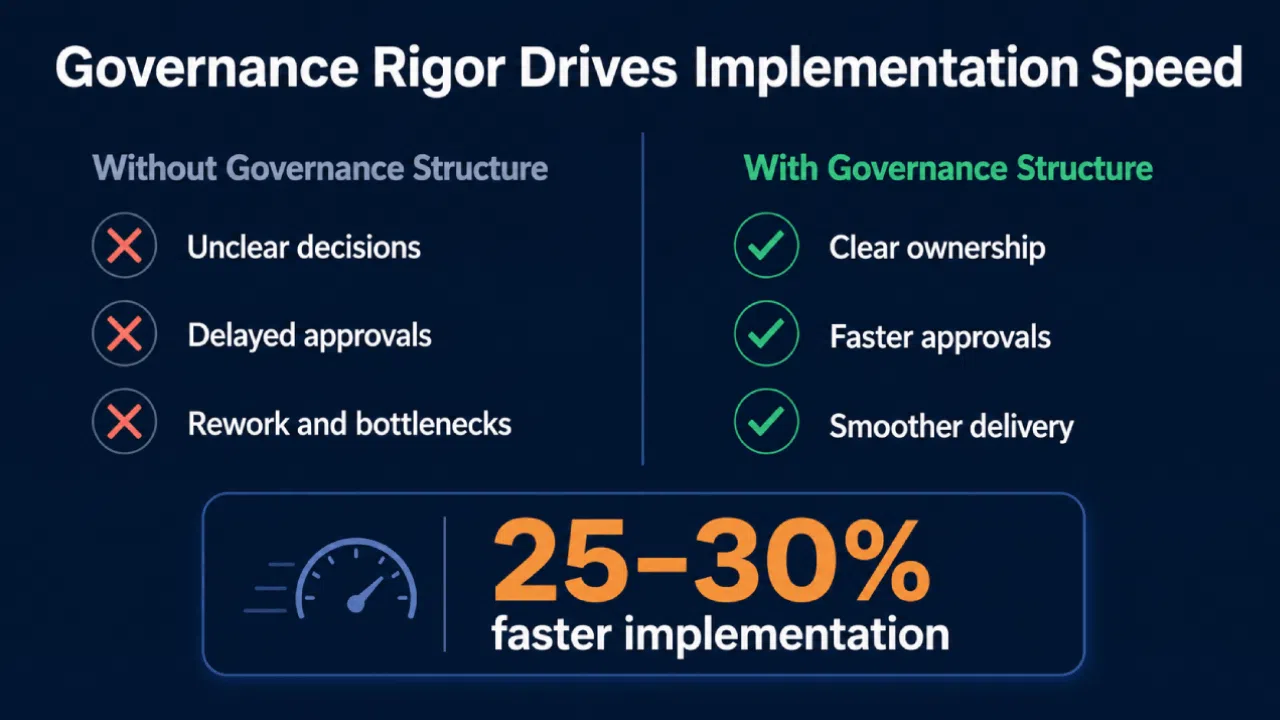
Faster not because traceability speeds anything up directly, but because clarity about decision rights, structured information, and documented rationale eliminate the slowdowns that come from confusion and rework.
Governance Speed vs. Governance Weight
The biggest objection to traceability is always the same: it sounds like we’re slowing down to go slower.
Won’t recording rationale and building evidence packets turn our innovation program into a compliance machine?
The reframe is this: good governance design accelerates decision-making. Bad governance design kills it.
Without structure, gate meetings go sideways in predictable ways:
- Reviewers argue about priorities instead of making calls.
- Questions surface that should have been answered upstream.
- Consensus forms around criteria that should have been defined in advance.
That’s slow.
Research on decision velocity is clear: slowdowns come from design problems, not documentation problems.
Organizations improve decision speed by clarifying governance before decisions are needed, not by removing governance layers.
That said, not every idea needs the same documentation depth. A reversible decision about which features to test might need a quick score and a one-line rationale.
A strategic bet that commits budget and headcount needs a full evidence packet and a detailed decision record. Calibrated rigor means matching the governance weight to the decision impact.
Building Traceability Into the Workflow (Not Onto It)
The difference between building traceability in and bolting it on is the difference between sustainable practice and documentation theater.
Start with Stage-Gate Design
Define your stages before the workflow launches. Most programs move ideas through four to six clear gates: intake, screening, detailed evaluation, decision, and launch.
Each gate is a decision point where certain information must be available and certain people must approve.
When stages are explicit, traceability moments become obvious. Intake is where the idea gets submitted and initial ownership gets assigned.
Screening is where you collect early feedback and surface risks. Detailed evaluation is where evidence packets get built.
Decision is where gate reviews happen and rationale gets recorded. Each stage has a clear job and a clear output.
Define Decision Rights Up Front
Who decides at each gate? Is it a single owner, a consensus group, or a tiered escalation?
What does approval require? Are tie-breaking rules necessary? When does escalation happen automatically?
Write these down before the first idea enters the workflow. Use a RACI matrix if you need to. Never discover your governance structure during a gate meeting.
Use Templates and Structured Inputs
A scorecard isn’t just a rating scale. It’s a template that forces thinking.
Questions like “What is the primary customer need this addresses?” and “What could go wrong in the first six months?” don’t just collect information.
They shape how reviewers think about the idea.
An evidence packet template ensures the same information gets collected every time, in the same format. Reviewers know what to expect and auditors know what to look for.
A decision log template captures rationale in a consistent structure: decision date, decision-maker, outcome, key reasoning, risks acknowledged, success metrics, owner, and next steps.
Automate What You Can
Structured inputs create an opportunity for automation. When reviewers score ideas on defined criteria, the system can aggregate scores, flag outliers, and surface points of disagreement.
When stage changes are triggered by criteria, the system moves ideas automatically. AI-assisted scoring surfaces decision quality issues: ideas with wide variance get flagged for discussion.
Pattern detection can warn when an idea is stuck or when decision criteria aren’t being applied consistently.
Automation doesn’t remove judgment. It amplifies the judgment that matters by handling the logistics.
Checklist: What to Define Before Launch
Before your traceable innovation workflow goes live, confirm:
- Decision rights documented for each stage (who decides, what authority matters, when escalation happens)
- Governance criteria defined (what does “strategic fit” mean in your organization, how do you measure it, who evaluates it)
- Stage gates clearly defined (what moves an idea forward, what information must be available, what constitutes approval)
- Evidence packet template created (what information gets collected, when, who’s responsible)
- Decision log template standardized (consistent fields for outcome, rationale, owner, next steps)
- Roles assigned (who manages the workflow, who owns the system, who’s accountable for gate discipline)
- Escalation rules explicit (what triggers escalation, who’s the escalation owner, what’s the timeline)
Getting these elements in place before launch is what separates a workflow that produces usable records from one that generates noise.
The list is also a diagnostic. Walking through it before launch tends to surface the governance gaps that would otherwise only become obvious after the first contested gate decision.
Build Traceability Into Your Culture, Not Just Your System
Programs that can’t explain their decisions lose institutional memory. Ideas get re-funded because nobody remembers they were tried.
Programs with traceability gain:
- Credibility with finance and leadership
- Faster reviews, because decisions are made with complete information
- A pattern library built from captured reasoning
- Audit readiness without scrambling for documentation
- Institutional memory that survives team turnover
Teams repeat failures because past rejections went undocumented. And leadership learns to distrust innovation cycles when they can’t see the logic behind funding choices.
Leadership trust follows when the logic behind funding choices is visible. “Why did we approve this idea?” should have a crisp, documented answer.
If it doesn’t, your governance design needs work.
Download our ebook on building accountability into your innovation workflow, or book a demo to see how Accept Mission enables audit trails and decision documentation.






 English
 Dutch
Dutch Portuguese
 Spanish
 French
 German
 Arabic