
Stop, Scale, or Continue: The Steering Gate Framework for Innovation Portfolios9 min read

Most organizations have innovation gates. What they rarely have is real decisions at those gates.
The pattern plays out the same way everywhere:
- Calendar holds: gate reviews drift into status meetings with no actual decision made
- Default to continue: no clear threshold for stop vs hold vs go; everything moves forward
- Zombie projects: sunk cost bias keeps underperforming initiatives alive indefinitely
- Winner starvation: resources spread so thin that the best projects never get enough capital
Organizations globally waste $97 million for every billion invested on projects due to poor portfolio governance. That’s money burned because gates became rituals instead of steering mechanisms.
The stop/scale/continue framework rebuilds the gate as an actual decision point. Reviewers face three explicit, mutually exclusive options.
That structural change transforms what happens in the room.
Why Gates Stop Working
Gates fail for three compounding reasons:
- No clear decision threshold: “go,” “hold,” and “kill” look identical, so everything defaults to continue
- Momentum bias: the social cost of stopping a project exceeds the operational cost of running it
- Escalation of commitment: sunk costs create rational-seeming justifications to keep going
Most organizations have no clear threshold for what “go” looks like versus “hold” versus “kill.” Everything defaults to continue.
Momentum bias does the rest. The social cost of stopping a funded project exceeds the operational cost of running it.
Executives rationalize continuation because sunk costs make stopping feel irrational, even as evidence stacks against the project.
Organizations with formal stage-gate governance achieve 78% success rates versus 24% for ad-hoc approaches. Yet gates only work if they enforce decisions.
When 84% of executives say innovation is crucial but only 6% feel satisfied with innovation performance, that number reflects what happens when gates default to rubber stamps.
The Three Options: What Stop, Scale, and Continue Actually Mean
The power of SSC is clarity. Each option comes with trigger criteria, resource implications, and a conversation that follows.
| Option | What It Means | When It Applies |
|---|---|---|
| Stop | Project exits the portfolio. Resources reallocate. Learnings documented. | Pre-committed criteria violated; expected value turns negative; dependencies collapse; market conditions change |
| Scale | Accelerate the project. Increase budget, staffing, or timeline priority. Pull resources from other initiatives. | Performance exceeds targets; market window tightens; competitive advantage clear; business case strengthens |
| Continue | Proceed as planned. Same scope, timeline, resource level. Next gate confirmed. | Project remains on track; no new data challenges assumptions; conditions stable |
Stop: The Least Used Option
Stop means exiting a project, not pausing or deferring it.
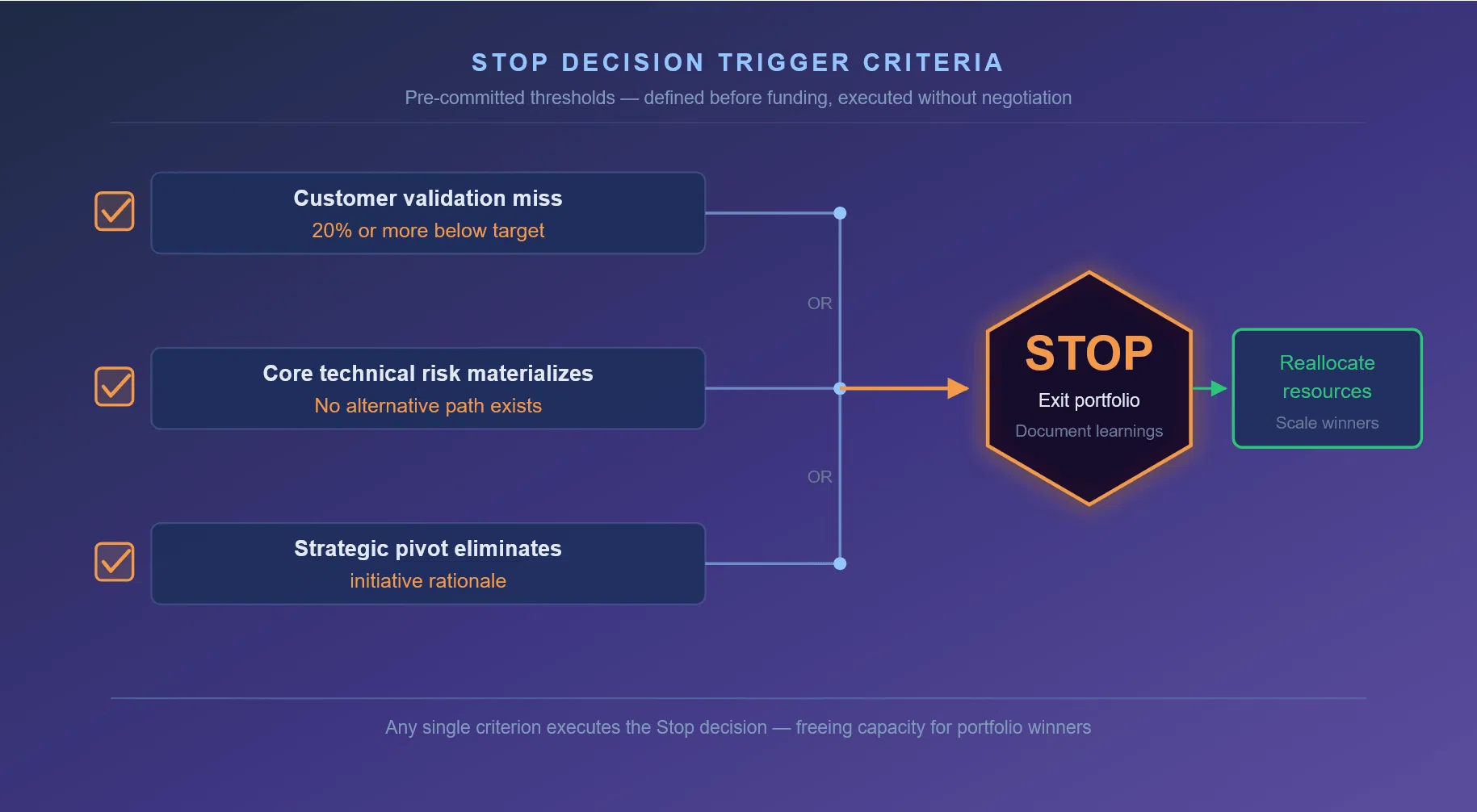
Pre-committed stop criteria make this workable. A project stops when:
- Customer validation misses target by 20% or more
- Key technical risk materializes and no alternative path exists
- A strategic pivot makes the initiative redundant
These are concrete decision points, not conversations waiting to happen, even though the psychological barrier is real for teams and stakeholders who have invested significant time and credibility.
But here’s the thing:
Organizations that stop projects systematically are the ones that scale winners. You cannot concentrate resources on high-potential initiatives if mediocre ones keep consuming budget.
Stop decisions should be celebrated. They represent good governance, document learnings, and free capacity for better bets.
Scale: The Most Underused Option
Scale is the hidden leverage in SSC. Most organizations fail not at identifying what’s not working, but at accelerating what is.
Resources stay evenly distributed even as certain projects deliver outsized value. That’s the peanut butter problem: nothing dies, but nothing takes off.
Scale changes this. A project should Scale when:
- Milestones come in faster than expected
- Key assumptions validate ahead of schedule
- The market opportunity is larger than originally scoped
Reallocate resources from other projects and accelerate this one.
Top-quartile innovators reallocate 6-30% of R&D budgets annually. Bottom-quartile performers see only 37% of firms reach that threshold.
Scale decisions are where that reallocation happens. The gap between top and bottom performers comes down to governance discipline.
Continue: The Default That Should Not Be Default
Continue means “proceed as planned.” Same budget, same timeline, same staffing level.
But here’s the critical shift: Continue requires active justification, just like Stop or Scale.
That means affirmatively confirming the project remains on track, that new data hasn’t changed the risk profile, and that the gate criteria still support moving forward.
When Continue becomes the default, gates stop working. The frame must flip: Continue is one option among three, and it requires evidence just as much as Stop or Scale.
The Default Problem: Why Continue Wins Every Time
Momentum bias is a structural problem. Projects keep going because stopping them is uncomfortable.
At the gate, the conversation usually goes: “Well, it’s not dead. The team is working hard. We’ve already spent six months. Let’s give it one more quarter.”
Organizations spread resources so thin that nothing achieves meaningful traction. The healthy kill rate targets tell the story:
- Ideation stage: 60-70% kill rate
- Validation stage: 40-50% kill rate
- Scale stage: less than 20% kill rate
Most organizations operate well below these rates. A zero percent kill rate for two consecutive quarters is a governance audit trigger.
It means the gates aren’t gates. They’re meetings.
What Pre-Committed Criteria Look Like
The most important structural fix to gates is commitment before pressure.
The gate team defines explicit criteria for each SSC decision before a project receives funding. This ensures concrete, measurable thresholds are defined in advance to trigger a Stop decision.
Stop criteria might include:
- Customer discovery interviews fall short of target by 20% or more
- Technical proof of concept fails on core assumption (e.g., latency requirements unmet)
- Strategic dependencies on another initiative fail to materialize
- Budget overrun exceeds 30% without scope reduction
- Competitive landscape changes eliminating the addressable market
Scale criteria might include:
- Customer validation exceeds projections by 15% or more
- Total addressable market expands beyond original estimate
- Core technical risks resolve faster than expected
- First-mover advantage window tightens; competition entering the space
- Adjacent opportunities emerge with higher ROI than original scope
Stop exits projects when criteria are violated, Scale accelerates winners exceeding targets, and Continue proceeds as planned if the project remains on track across all commitments.
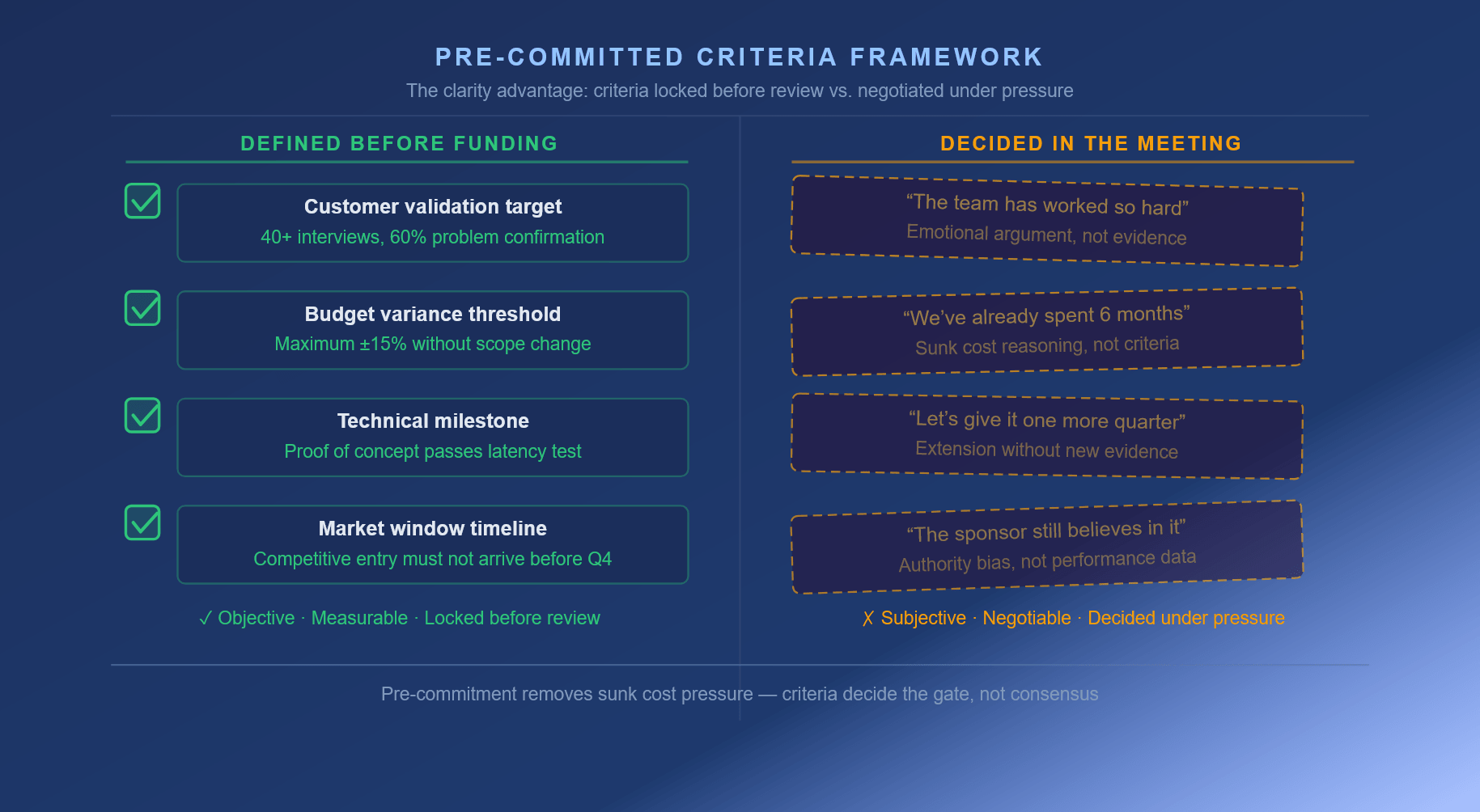
Why does pre-commitment matter? Because sunk costs don’t apply.
Once the gate convenes, the team isn’t negotiating whether the project should continue. They’re checking whether the pre-agreed criteria have been met.
That removes the psychological pressure to rationalize continuation.
Running a Steering Gate: Who, When, and How
Gate reviews fail when gatekeepers lack authority. Without cross-functional decision-making power, the default is always continue.
Real authority means the sponsor can pull budget, the program manager can reallocate capacity, and executive leadership can enforce priorities. Observers don’t change culture.
Cadence and Gate Output
Cadence matters too. Monthly gate cycles create tighter feedback loops, catching problems early and capitalizing on wins quickly.
Quarterly reviews are too slow. Projects that should scale miss their window, and those that should stop burn another 90 days.
What does a steering gate produce?
- An explicit SSC decision
- Documented rationale for that decision
- Confirmation of the next gate date with updated deliverables and criteria
That becomes the decision record. A steering choice with teeth.
Explore vs. Exploit Tracks
One structural shift:
Separate governance tracks for explore versus exploit. Early-stage exploration projects get different criteria and longer runways than scale-stage execution initiatives.
Applying quarterly financial scrutiny to innovation exploration kills discovery prematurely. Apply it to scale initiatives where the bet is already validated. Different tracks, same framework.
AI-powered platforms that centralize gate data, project scoring, and resource allocation reduce gate prep time from 40+ hours to 4-6 hours per review and cut cycle time by 30-50%.
Portfolio-Level Implications: What Happens When SSC Is Applied Consistently
Apply Stop / Scale / Continue at every gate, and the portfolio self-corrects over time. Bad projects exit. Good ones accelerate.
Medium performers either improve or get squeezed out as resources concentrate on winners. The resource distribution naturally shifts toward concentration.
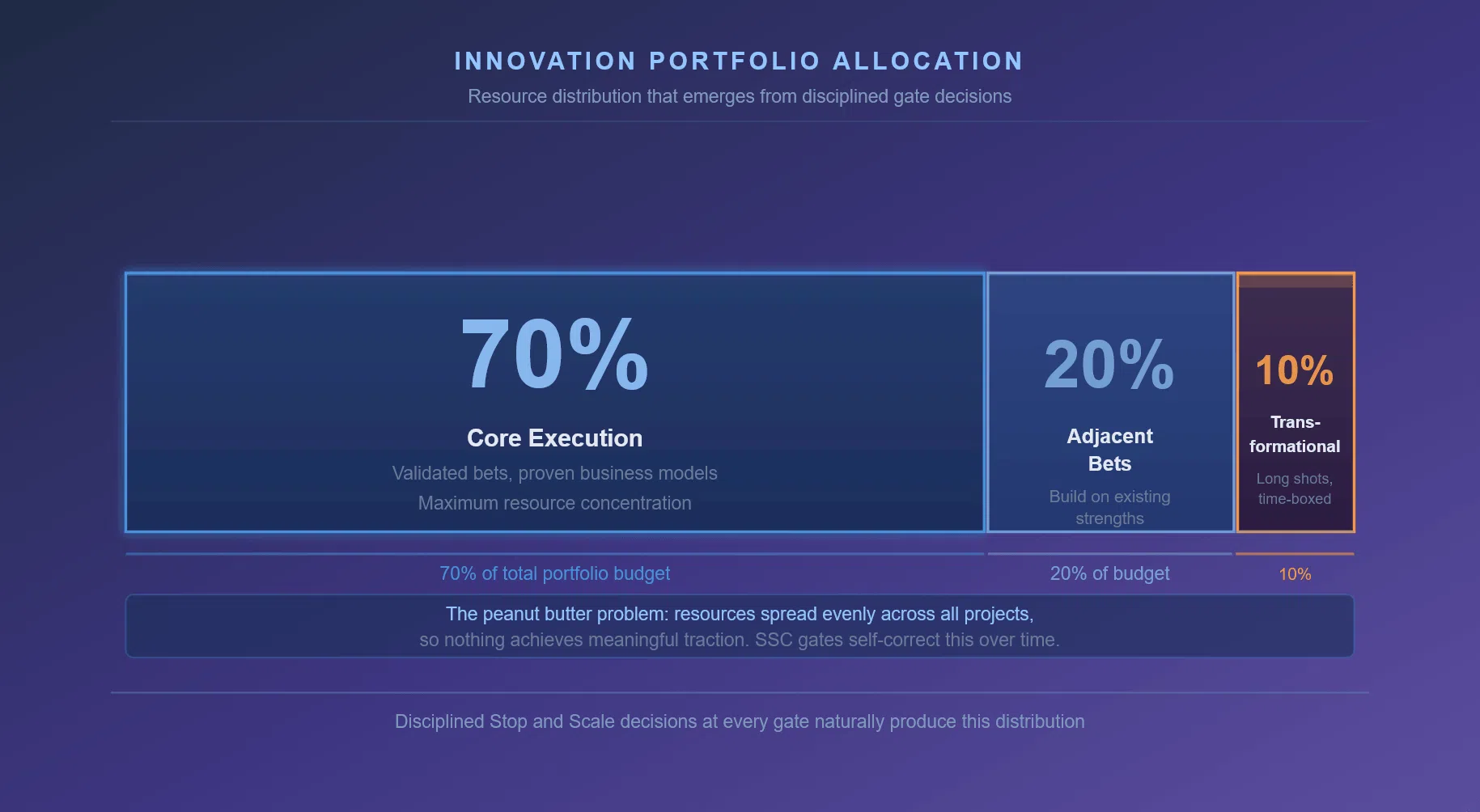
A 70-20-10 balance emerges naturally from disciplined gate decisions:
- 70% on core execution, where the bet is already validated
- 20% on adjacent bets, building on existing strengths
- 10% on transformational long-shots, kept small and time-boxed
The peanut butter problem solves itself. Resources stop spreading evenly and the portfolio consolidates around the ones with highest evidence of success.
Accept Mission customers report measurable reductions in resource waste through data-driven scoring. Gates that actually decides to free up capital and concentrate.
Gates are only as good as the data behind them. Real-time visibility across project health, resources, and budget is table stakes. Without it, gatekeepers are guessing. With it, they’re steering.
Make the Gate a Real Decision
Stop / Scale / Continue doesn’t fix innovation. It fixes the conversation at the gate.
Real steering requires three things:
- Explicit decision options: Stop, Scale, or Continue (not “hold” or “revisit”)
- Pre-committed criteria: thresholds defined before funding, not during the review
- Real authority: gatekeepers with the power to enforce what the criteria say
Gates that default to continue aren’t gates. They’re calendar holds.
Start with one rule: define Stop and Scale criteria before the next review, not in the meeting. That single shift transforms how gates work.
Download our free ebook Project Portfolio: From Opportunities to Value to learn how to establish a single source of truth for your innovation portfolio.
Request a demo to see how Accept Mission gives you real-time visibility, structured gate decisions, and one unified view across your entire innovation portfolio.








 English
 Dutch
Dutch Portuguese
 Spanish
 French
 German
 Arabic