
Stop Annual Planning: Build a Dynamic Portfolio That Responds to Change12 min read

Annual planning cycles. Locked budgets. Unchanged priorities for 12 months. This is how most organizations manage innovation.
And it’s exactly why they struggle to adapt when the market moves faster than their plans.
The solution isn’t better forecasting. It’s a fundamentally different operating model—one that treats innovation as a continuous discipline, not a once-a-year decision.
Why Static Planning is No Longer an Option
Your annual innovation plan was outdated the moment you finished it. Market conditions shifted. A competitor launched something unexpected.
This is the reality of static portfolio management in a world that moves too fast for annual cycles.
Static portfolio management assumes the future will look like the past. But that assumption is dangerous, especially today.
Here’s what’s actually happening in real organizations:
- Market volatility. Geopolitical tensions, supply chain chaos, and unexpected competitive moves reshape your priorities overnight.
- Technology acceleration. Generative AI, new business models, and emerging platforms disrupt market structures faster than your annual plan anticipated.
- Resource misalignment. Companies continue funding projects that no longer matter while starving breakthrough ideas that don’t fit the old plan.
The cost of this misalignment is brutal. Resources stay locked in place while opportunities slip away. By the time leaders realize something needs to change, the window for action has already closed.
The solution isn’t better planning. It’s continuous management. A dynamic innovation portfolio treats innovation as an always-on discipline, not a one-time annual decision.
Resources flow to the highest-strategic-value initiatives. Decisions happen in real-time. And your organization moves at the speed of the market.
From “Buy & Hold” to “Always-On”
Most organizations don’t even realize they’re using an outdated model.
They manage their innovation portfolios the same way investors managed stock portfolios decades ago – set it and forget it.
But the world has changed. And so must the way we think about managing innovation.
The Static Model’s Fatal Assumption
Most organizations manage innovation like a buy-and-hold investment portfolio, setting priorities once per year and leaving them unchanged for 12 months.
This approach assumes historical patterns predict future outcomes. But in a volatile world, historical data is no longer predictive, creating a dangerous incentive trap.
When budgets are approved based on historical averages, only projects with predictable, near-term ROI pass the decision hurdle.
Breakthrough ideas look too risky.
The static model doesn’t just fail to support breakthrough innovation, but it actively strangles it, rigging the system against the exact kinds of bets that drive long-term competitive advantage.
How the “Real-World Pace” Breaks Static Systems
Market conditions are changing faster than annual planning cycles can handle. Three macro forces are accelerating this reality:
The first one is the market and geopolitical volatility.
Supply chains broke during COVID. Inflation spiked unexpectedly. Geopolitical tensions reshape competitive landscapes overnight. Organizations used to evaluate strategy once per year.
Now they must re-evaluate every quarter.
The second force is technology acceleration.
Generative AI didn’t exist two years ago. Now it’s disrupting entire industries. New business models create technology step changes that destroy old market structures.
The pace of innovation is moving exponentially, not linearly.
Lastly, competitive arms races.
When technology shifts, competitors have a strong incentive to invest heavily in R&D.
Companies that invest in innovation “through-cycle” (even during downturns) consistently outperform their peers. Waiting for calm before you invest is a losing strategy.
The central challenge is clear: success now demands organizational agility.
Static models are the opposite of agile. They’re rigid, and they’re slow. They’re built for a stable world that no longer exists.
Here’s how the two approaches compare across key operating dimensions:
| Dimension | Static Portfolio | Dynamic Portfolio |
|---|---|---|
| Planning Cadence | Annual or bi-annual | Continuous, quarterly reviews |
| Data Source | Scattered spreadsheets, historical estimates | Real-time data from integrated systems |
| Decision-Making | Status-oriented reviews, gut feeling | Data-driven, responsive to market changes |
| Risk Management | Risk estimated upfront, avoids risk | Actively manages risk through continuous adjustment |
| Overall Approach | “Buy & hold” fixed snapshot | “Always-on” live dashboard |
The Dynamic Portfolio Framework
So what does the alternative actually look like?
Dynamic portfolio management isn’t just about moving faster.
It’s built on a set of interconnected principles that fundamentally change how organizations think about strategy, data, and decision-making.
Five Core Principles That Enable Real-Time Adaptation
Dynamic portfolio management rests on five interconnected principles that work together as a system:
1. Continuous Strategic Alignment
Your portfolio isn’t aligned once per year. It’s continuously managed to ensure every initiative still aligns with current business strategy.
The innovation strategy guides which problems to solve and how to prioritize investment. This happens on an ongoing basis, not during an annual planning cycle.
2. Data-Driven Decision-Making
Decisions are based on real-time, verifiable information. Not intuition. Not gut feeling.
Organizations that are highly data-driven are three times more likely to report significant improvements in decision-making compared to those relying less on data.
3. Dynamic Resource Allocation
Resource capacity is the primary constraint in most organizations. It means continuously optimizing the allocation of people and budgets.
Resources flow toward the highest-impact initiatives, not toward projects that were funded because of last year’s plan.
4. Active Risk & Balance Management.
The portfolio is actively managed to achieve a healthy mix of risk and reward.
This means balancing projects across multiple dimensions: risk profiles, time horizons, project types, and strategic goals.
5. Continuous Lifecycle Management
The portfolio gets reviewed regularly to sunset underperformers and adapt based on new learnings.
Environmental shifts trigger portfolio adjustments. This ongoing process is what keeps the innovation program agile.
From “Doing Projects Right” to “Doing the Right Projects”
Traditional project management asks: “Are we executing on time and on budget?”
Dynamic portfolio management asks a different question: “Are we working on the right projects?”
When you move to dynamic management, the benefits show up across three critical dimensions:
- Financial gains. R&D budgets optimize for maximum value creation. Resources flow to highest-impact initiatives. Wasted spend on stalled or irrelevant projects disappears.
- Strategic alignment. Every initiative directly supports organizational goals. Leaders gain clear visibility into portfolio health and progress.
- Agility. The portfolio responds quickly to market changes and competitive threats. Time to market shrinks. Your organization moves faster than competitors.
Together, these benefits create a competitive advantage that accelerates over time.
Organizations that master dynamic portfolio management don’t just improve innovation outcomes. They fundamentally change how their organization responds to opportunity and threat.
The difference shows up in faster go-to-market, better ROI, and teams empowered to pursue breakthrough ideas.
The Operational Engine
Understanding the principles is one thing. Actually executing them is another.
The Quarterly Review Cadence
A dynamic portfolio requires a steady, deliberate rhythm operationalized through a regular cadence, typically quarterly, for portfolio review and adjustment.
The portfolio management board convenes to formally assess the portfolio, embedding a mechanism for continuous review, reflection, and adaptation at a pace that matches the market.
The meeting follows a four-step agenda. These steps form an algorithm that forces a collision between internal operations and external reality:
Step 1: Portfolio Health Check
Review progress against KPIs and the strategic balance of the portfolio.
- Are you on track?
- Is your 70/20/10 balance still aligned with strategy?
- Where are you over-invested or under-invested?
Step 2: Project Deep Dives
Assess key projects at critical gates or milestones.
- Has this project met its learning milestones?
- Does the evidence support further funding?
- Is this still a burning problem for customers?
Step 3: Market & Tech Updates
Evaluate what’s changed in the external environment.
- What happened in your market?
- What did competitors do?
- Did a new technology emerge that makes this project obsolete or 10x more valuable?
Step 4: Resource Reallocation
Make actual adjustments to priorities, funding, and resource allocation.
Based on steps 1-3:
- What must you stop funding to free up resources?
- What do you need to start or scale?
This algorithm prevents the “ivory tower” misalignment that plagues static models.
External data gets formally introduced before decisions are made. Internal operations get measured against external reality.
The Three Execution Frameworks
Governance and cadence create the structure. But how do you actually fund and manage projects in a dynamic way?
These three frameworks form the engine of dynamic portfolio management. They only work when deployed together as a system.
1. Strategic Buckets
Here’s the reality:
If you don’t explicitly protect breakthrough innovation, it will get starved. The core business will consume all available resources for near-term improvements.
Strategic buckets solve this problem. They use a top-down approach where business strategy drives portfolio allocation.
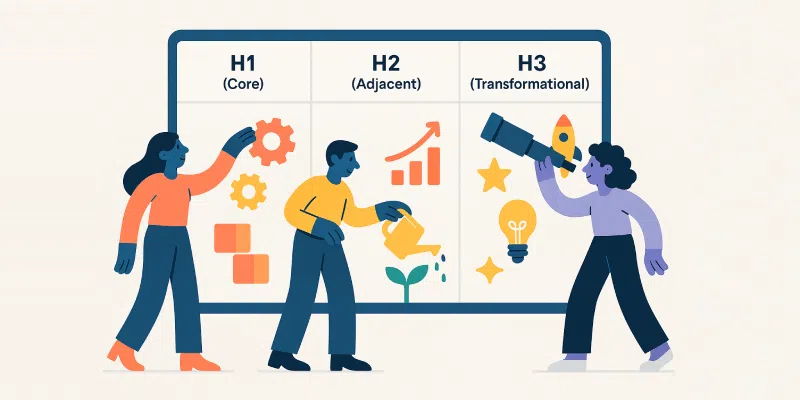
The most common framework is the 70/20/10 rule:
- 70% to core innovation. Incremental improvements to existing products for existing customers. Lower risk, near-term revenue.
- 20% to adjacent innovation. Expand from your core through new markets, customer segments, or adjacent applications. Medium risk, medium-term returns.
- 10% to transformational innovation. Breakthrough bets, new business models, and self-disruption plays. High risk, long-term potential.
The magic is in the dedicated buckets. Transformational projects have a protected pool of funding. They’re not competing with the core business for scraps.
This ensures breakthrough ideas actually get funded instead of systematically starved by short-term pressures.
2. Metered Funding
Once you’ve allocated budget to strategic buckets, how do you actually spend that money? Traditional annual budgets lock organizations into outdated priorities.
Metered funding is the answer.
It applies venture capital discipline to enterprise innovation. Instead of approving a $10M transformational project upfront, you approve a small first tranche (maybe $50,000).
The team’s job isn’t to build a product. It’s to validate key assumptions.
If they return with evidence that validates those assumptions, you release the next tranche (maybe $200,000 for more rigorous validation).
If evidence emerges that invalidates assumptions, you stop. You’ve only lost $50,000, not $10M.
This approach makes the unpredictable more predictable. You manage many small investments instead of a few large ones.
Risk is distributed. Each stage of funding is tied to learning milestones, not just budget cycles.
3. Pivot, Persevere, or Kill
Here’s an uncomfortable truth: innovation portfolios only work when you can kill projects. And most organizations can’t.
The reason is human. Project termination decisions are often driven by emotion, sunk cost fallacy, ego, or internal politics instead of objective data.
A project’s sponsor doesn’t want to admit failure. A team leader fears what it means for their career. So zombie projects get funded indefinitely, consuming resources that could fuel better ideas.
Termination protocols solve this. These are explicit criteria for when projects should be terminated, set before the project even starts.
The decision isn’t based on opinion. It’s based on pre-agreed, objective standards. This removes emotion from the equation.
When a project reaches a decision gate, you have four options:
| Decision | Definition | Evidence Required |
|---|---|---|
| Scale | Shift from experimenting to scaling the business | Strong product-market fit validation. Clear path to profitability. Real traction. |
| Pivot | Change one part of the business model (customer segment, value proposition, channel) | Current approach is failing. User feedback shows an adjacent opportunity. |
| Persevere | Keep going, but continue experimenting | Stuck between success and failure criteria. Learning is still happening. Clear, short-term experiment is defined. |
| Kill | Stop the project entirely | Fail condition has been met. No viable pivot has emerged. Problem isn’t a burning issue for customers. |
These three frameworks form a strategic trinity.
Buckets protect high-risk bets. Metering funds them without betting the farm. Pivot/Kill Protocols decide if a bet deserves the next tranche.
Together, they create the engine of dynamic portfolio management.
How Accept Mission Powers Dynamic Portfolio Management
Building this operating system requires more than good intentions and processes. You need a platform designed from the ground up to support continuous, data-driven innovation management.
Accept Mission is an AI-powered innovation management platform that manages the full innovation lifecycle – from idea collection to project success.
Accept Mission enables the specific capabilities that make dynamic portfolio management actually work:
- Campaign builder AI. Launch themed innovation campaigns to collect ideas continuously, not just annually. Gamification features (leaderboards, badges, points) drive engagement and keep innovation top-of-mind across your organization.
- Idea scoring and selection. Ai-powered scoring validates the potential of ideas based on impact, investment requirements, business goals, strategic fit, and ROI. This removes emotion from prioritization.
- Real-time portfolio dashboards. Visualize your portfolio across risk profiles, strategic alignment, and resource allocation. Track KPIs like pipeline conversion rate, time to market, and revenue from new products.
- Project portfolio management. Convert approved ideas into managed innovation projects. Accept mission enables you to manage the whole innovation process from idea generation to solution delivery in one platform. Track status, progress, and strategic fit in real-time.
- Stage-gate automation. Define and automate your project decision gates. The pivot, persevere, or kill framework becomes embedded in your workflow, not a one-time exercise.
- AI-powered insights. Use the power of AI to gain deep insights into trends, patterns, and opportunities. Make data-driven decisions instead of relying on intuition or historical averages.
Accept Mission clients consistently report impressive outcomes: 58% higher engagement across the organization, with employees actually enjoying participation in innovation.
The platform brings all your innovation work into one place: structured, scalable, and built to turn ideas into real business impact.
Ready to transform your innovation management from static to dynamic? Accept Mission offers a 15-day free trial so you can experience the platform in your own context.
Book a demo with the Accept Mission team today and discover how your organization can make real-time decisions at the pace your market demands.







 English
 Dutch
Dutch Portuguese
 Spanish
 French
 German
 Arabic