
Scorecards for Different Innovation Types: Why One Size Fails All Three Horizons13 min read

Most innovation teams run one scorecard across every idea in the funnel: same criteria, same weights, same thresholds, regardless of horizon.
The result is consistent:
- Core ideas win every review
- Transformational ideas die in committee
- The portfolio drifts toward sustaining work by default
That outcome is not accidental and a one-size scorecard is not a neutral instrument. When its criteria are tuned for predictable returns, anything uncertain looks weak by comparison.
Each horizon carries a different kind of uncertainty. Scoring all three the same way resolves every bet in favor of the most predictable one.
Why One Scorecard Fails All Three Innovation Types
Core (H1) ideas improve what already works while adjacent (H2) ideas stretch existing capabilities into new markets. Transformational (H3) ideas reshape the business model itself.
A single scorecard cannot serve all three. The failure mode is structural, not cosmetic:
- ROI and payback criteria reward short, predictable horizons, which is the definition of Core work
- Transformational ideas, by definition, have no proven market and no defensible revenue forecast at the point of evaluation
- Familiar criteria amplify evaluator familiarity bias, where reviewers rate genuinely novel ideas lower because the ideas feel unfamiliar
The data backs this up:
Gartner reports that around 33% of transformational projects are underfunded because early-stage evaluation methods are mismatched to the work.
[scorecard-portfolio-bias.png]
Academic research is blunter. Unsuitable evaluation procedures, the research finds, are enough to kill promising disruptive innovations before they ever reach the market.
So a single scorecard does not produce a balanced portfolio. It produces the portfolio the scorecard was designed to reward.
How to Think About Innovation Horizons Before You Score
The Three Horizons model is useful as context, not as a calendar. Steve Blank has argued that the original time bands are obsolete because technology has collapsed innovation timelines.
He’s right about the timelines, but not about the taxonomy. The three categories still hold, because they describe three different kinds of uncertainty, not three different waiting periods.
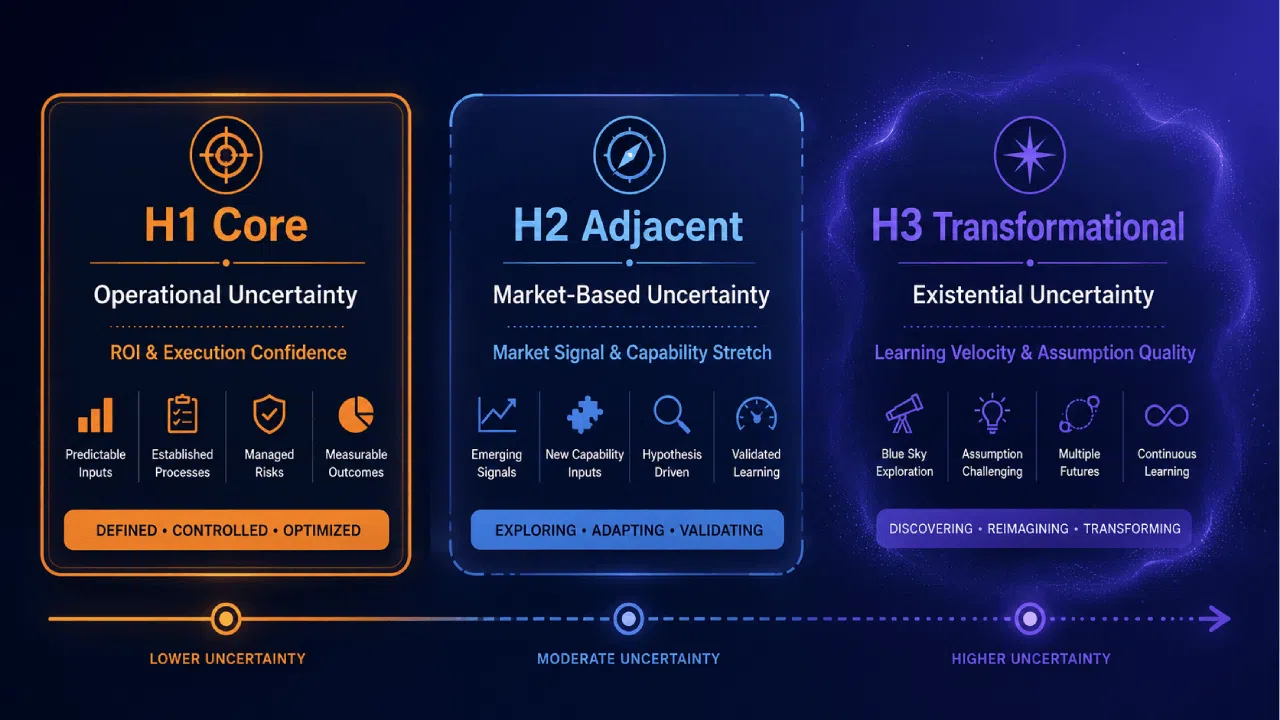
Core uncertainty is operational while adjacent uncertainty is market-based, and transformational uncertainty is existential.
The most neglected of the three is H2. When organizations first map their portfolio, 90 to 95% of investments typically sit in H1.
H2 gets left as an empty middle, too large for Core governance and too near-term for experimental governance. That gap is a scorecard problem before it is a strategy problem.
If H2 ideas are scored as Core, they look like weak Core ideas. If scored as Transformational, they look like over-engineered bets.
The fix starts with admitting that “good” means three different things, and then building three different instruments.
The Core Innovation Scorecard
Core innovation has predictable boundaries: existing customers, known cost structures, established channels, and payback typically inside 12 to 18 months.
The scorecard should reward efficiency, margin, and confidence of execution. This is the one place where traditional financial KPIs are not just allowed but required.
| Criterion | What You’re Testing | Weight Guidance |
|---|---|---|
| ROI potential | Whether projected return clears the company’s hurdle rate within 18 months | High (20–25%) |
| Time to market | Speed from approval to revenue impact, in months | High (20%) |
| Operational fit | How cleanly the idea slots into existing systems, channels, and teams | Medium (15–20%) |
| Customer impact | Measurable lift in satisfaction, retention, or share-of-wallet from current customers | Medium (20%) |
| Resource efficiency | Cost-to-execute relative to expected return, including team load | Medium (15–20%) |
A strong Core score means high confidence, high margin, and fast execution. A weak one signals thin returns or execution risk inside a domain the company should already understand.
The common mistake is treating a strong Core score as the universal definition of a good idea. It is the definition of a good Core idea, nothing more.
When Core scoring becomes the universal benchmark, the portfolio collapses into sustaining work. Every other horizon loses in a contest it was never built to win.
The Adjacent Innovation Scorecard
Adjacent innovation stretches existing capabilities into new markets or new business models. The goal of the scorecard shifts from filtering for return to validating signal.
The core questions are whether the market is real and whether your capabilities actually transfer. Revenue certainty is a secondary concern at this stage.
| Criterion | What You’re Testing | Weight Guidance |
|---|---|---|
| New market potential | Size and accessibility of the target segment, with at least directional sizing | High (20–25%) |
| Customer validation signal | Evidence from interviews, pilots, or pre-orders that the new buyer wants this | High (25%) |
| Capability leverage | How much of the company’s existing IP, talent, or distribution actually applies | High (20%) |
| Strategic fit | Alignment with the company’s stated growth thesis, not just opportunism | Medium (15%) |
| Competitive differentiation | Why the company can win here when generalist players cannot | Medium (15–20%) |
The trap in H2 scoring is demanding H1-level financial certainty for a market that doesn’t yet exist. That pressure forces teams to defend fantasy figures instead of testing the hypothesis.
Score market signal and capability stretch hard. Let financial precision come later, once there’s something real to measure.
The issue is almost never a shortage of H2 ideas. A wrong scorecard simply makes them look uninvestable.
The Transformational Innovation Scorecard
Transformational innovation operates under conditions where revenue forecasts are meaningless.
The market may not exist, the customer may not be defined, and the business model may need to be invented along the way.
A scorecard built on ROI will reject every H3 idea on contact. The instrument has to change.
| Criterion | What You’re Testing | Weight Guidance |
|---|---|---|
| Learning velocity | How fast the team can test and retire the riskiest assumption | High (25%) |
| Disruption potential | The size of the shift if the bet works, measured against current category economics | High (20–25%) |
| Assumption quality | Whether the underlying hypotheses are sharp, testable, and not already disproven | High (20%) |
| Scalability signal | Early evidence that the model could grow non-linearly if validated | Medium (15–20%) |
| Strategic optionality | What this opens up for the company even if the specific bet fails | Medium (15%) |
Gartner specifically recommends building separate scorecards for transformational opportunities, with “transferable lessons” and “disruption potential” replacing revenue-driven criteria at early stages.
Strategos makes the same point: at an H3 gate, asking “what did you learn” is the right metric.
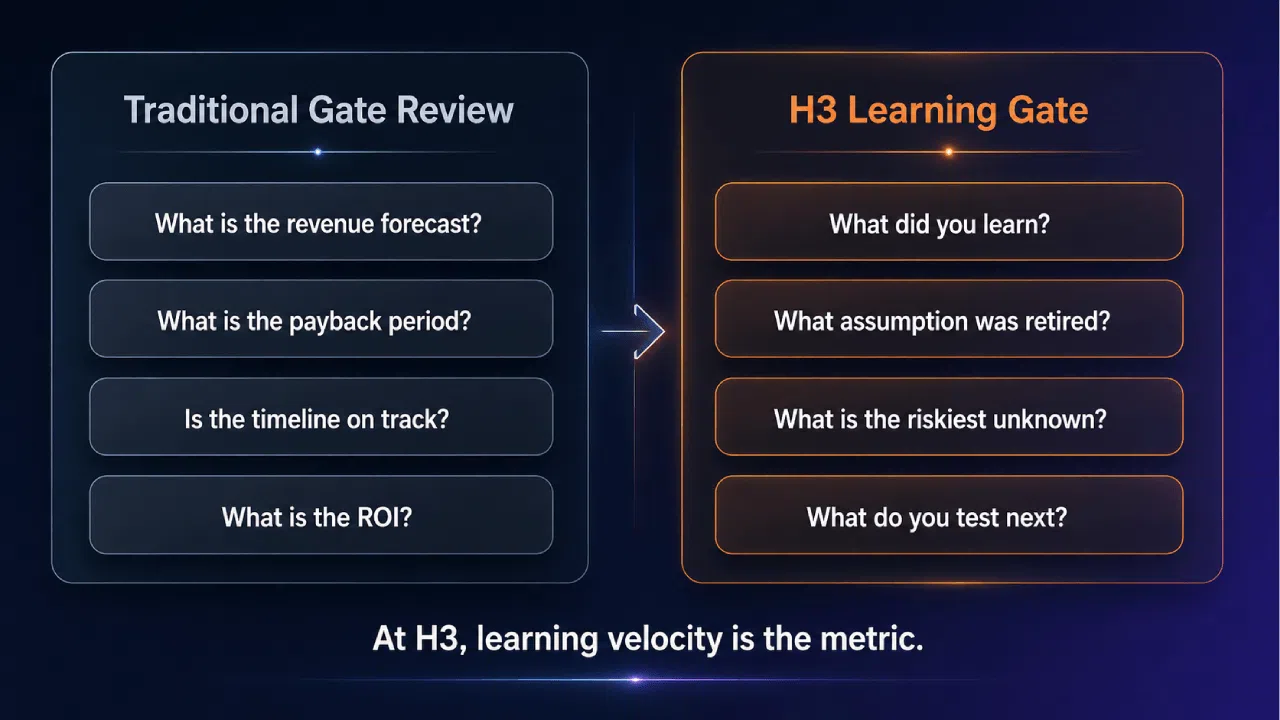
Revenue projections at this stage are numbers that do not exist yet. Asking for them produces fabricated confidence, which is worse than having none at all.
This is also where AI-supported scoring earns its keep. Pattern-matching across early-stage assumptions and surfacing weak hypotheses is more useful at H3 than anywhere else.
Evaluator bias skews ratings here more than at any other horizon, because the human signal is noisiest.
Financial precision returns later, at the commercialization gates. Demanding it at the front end of H3 is how good ideas get killed.
How to Classify an Idea Before You Score It
The three scorecards only work if the classification step is honest. An idea routed to the wrong scorecard gets the wrong verdict, and the error compounds from there.
Each horizon reflects a different type of uncertainty.
| Question | Core (H1) | Adjacent (H2) | Transformational (H3) |
|---|---|---|---|
| Do we know who the customer is? | Yes, existing customer base | Partially, adjacent buyer segment | No, customer not yet defined |
| Can we build this with current capabilities? | Yes, fully in-house | Mostly, with manageable stretch | No, requires significant new capability |
| Can we model the revenue? | Yes, with reasonable confidence | Directionally, with key assumptions | No, market does not exist yet |
| Does this use existing channels? | Yes | Partially | No |
If an idea checks yes across all four questions, it belongs in H1. If it checks no across all four, it belongs in H3.
Mixed answers almost always point to H2. The harder problem is self-classification.
When teams report their own horizon without accountability, ideas drift toward whichever threshold carries the most favorable funding terms.
Build a short classification review into your intake process. Keep it separate from the idea team, and run it before any scorecard is applied.
Who Should Sit on Each Review Panel
The scorecard tells you what to measure. The reviewer tells you whether the measurement is calibrated.
For all three horizons, the calibration problem is different.
Core reviews need operational expertise. Finance and product leadership belong here because they can challenge the cost, margin, and execution assumptions behind any ROI projection.
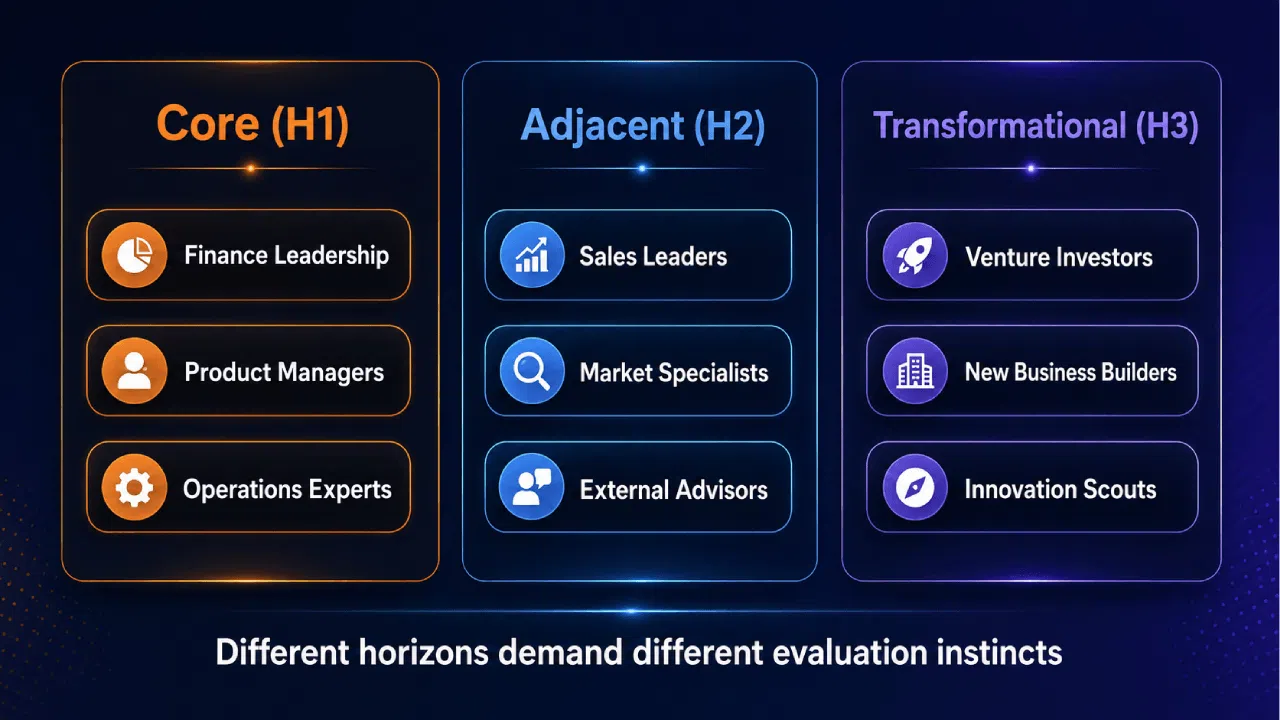
Adjacent reviews need market exposure. The core competency risk is easier for internal reviewers to assess than the market signal risk.
Adjacent panels benefit from external advisors, sales leaders with direct customer contact, and people who have built in the target segment before.
Transformational reviews need a different instinct altogether. The question is whether the team can learn fast enough and whether the disruption potential is real.
Venture experience and new-business building count more here than operational expertise.
The single-panel problem is that operational expertise becomes a liability at H3 gates. It pulls toward the familiar and away from the genuinely uncertain.
What a Passing Score Actually Looks Like
A scorecard without a defined pass threshold is a ranking tool, not a decision tool.
The criteria tell you what matters; the threshold tells you what to do about the score. Thresholds vary by horizon, and they should.
| Horizon | Pass Signal | Kill Signal | Pivot Signal |
|---|---|---|---|
| Core (H1) | Strong ROI, fast time-to-market, clean operational fit | Thin margin or long payback with no compensating factor | Execution risk is high despite strong returns: restructure the delivery plan |
| Adjacent (H2) | Real market signal plus credible capability stretch | No customer validation and no differentiation thesis | Market is real but capability gap is too large: consider partnering or licensing |
| Transformational (H3) | Sharp assumptions, high learning velocity, meaningful disruption potential | Assumptions already disproven, or no testable hypothesis | Disruption potential is real but scalability is weak: narrow the scope first |
The pivot column matters most. Most scoring frameworks produce binary verdicts: advance or kill.
At H2 and H3, a pivot verdict is often the correct call. The core bet is directionally right, but the execution plan needs restructuring before it deserves resources.
Build the pivot path into your gate criteria explicitly. Without it, reviewers default to the binary, and good ideas get killed on a technicality.
How to Retrofit Three Scorecards Into an Existing Stage-Gate
Most organizations do not have the option of building a clean system from scratch. Their existing stage-gate criteria often have not been updated in years.
The retrofit does not require replacing the gate structure. It requires adding a classification step before the gate, then swapping the scorecard template based on that classification.
The sequence looks like this:
- At intake: classify the idea as H1, H2, or H3 using a short classification rubric before any scorecard is applied.
- At each gate: pull the appropriate scorecard template based on the horizon classification. The gate questions change; the gate process does not.
- For reviewer assignment: flag the horizon classification when convening the review panel and adjust composition accordingly.
- For threshold calibration: document pass, kill, and pivot criteria for each horizon. This is typically a one-time setup, refined over the first few gate cycles.
The most common failure in a retrofit is stopping at step one. Organizations classify the idea into a horizon, then evaluate it with the same scorecard anyway.
The classification becomes a label with no downstream consequence, and the portfolio bias problem persists. For classification to do real work, the scorecard must change with it.
Making It Work in Practice
Designing three scorecards is the easy part. Holding the line on how they get used is where most programs fail.
Three pitfalls show up consistently:
- Misclassification. Projects get labeled H3 to qualify for transformational funding, but they are scored on the Core scorecard anyway. The classification changes, the criteria do not.
- Single-panel reviews. The same committee scores all three horizons, importing familiarity bias into every H3 decision. Reviewers default to what feels safe.
- Ambition inflation. Teams relabel Core work as Transformational to appear more innovative, without any change to evaluation criteria or governance. The portfolio looks balanced on paper and is not.
The fix is uncomfortable but clean: standardize the process (who scores, how independently, on what timeline) and differentiate the criteria, meaning what is actually being measured.
Each horizon needs its own scorecard template. It also needs its own reviewer pool with relevant context, and its own definition of a passing score.
Platforms support this directly.
Innovation teams can configure separate scorecards per portfolio stage and route ideas to the appropriate review group, with structured scoring and group decision-making built into the workflow.
The mechanics matter less than the principle. One scorecard means one conversation; three scorecards open three different conversations about what is actually being decided.
Match the Instrument to the Bet
A scorecard signals what the organization values, and when those signals favor only what is easy to measure, the portfolio quietly loses its grip on the bigger picture.
Three scorecards mean three different bets, each evaluated on its own terms:
- Core gets held to return and speed
- Adjacent gets held to market signal and capability stretch
- Transformational gets held to learning quality and disruption potential
That is how a portfolio stays honest about what it actually contains, and how innovation managers stay accountable for outcomes that are measurable on their own terms.
Match the instrument to the bet. Or the portfolio will keep defaulting to whatever is easiest to measure.
Download our ebook on innovation portfolio scoring, or book a demo to see how Accept Mission handles configurable scorecards and decision workflows by horizon type.
Accept Mission gives innovation teams one place to configure scorecards, assign reviewers by horizon, and track decisions from first submission to final approval.








 English
 Dutch
Dutch Portuguese
 Spanish
 French
 German
 Arabic