
Consensus vs. Clarity: Choosing the Right Group Decision Method12 min read

You’re in a meeting to green-light three competing innovation projects, and twenty minutes in there’s still no decision, no clear owner, and no accountability for the call.
The root cause is almost always the same: method mismatch.
Most organizations default to consensus regardless of decision type, and consensus is the wrong method for most innovation governance calls.
Why Group Decisions Break Down
The numbers make the stakes concrete.
According to McKinsey, fewer than half of organizational decisions are timely, and 61% of leaders say at least half their decision-making time is ineffective.
The cost: 530,000 manager days per year lost at a typical Fortune 500 company, roughly $250 million in annual wages.
The waste shows up inside meetings too:
- 35% of decision-making meeting time is inefficient
- Meetings of 65+ attendees are now the fastest-growing meeting type
- Employees are interrupted every 2 minutes on average by a meeting, email, or notification
The gap behind most of this is clarity on method.
The data on organizational capability reinforces the point:
- Only 20% of employees say their organizations excel at decision-making
- Just 24% of U.S. managers strongly agree their peers make well-thought-out decisions
- 57% cite hierarchical, slow process as the biggest barrier
Unclear roles, overreliance on consensus, and death by committee are the most common blockers of straightforward decision-making.
Amazon put the failure mode bluntly: “You’ve worn me down” is an awful decision-making process. Whoever has the stamina to keep pushing wins, not whoever has the best argument.
41% of workplace conflict stems from decision disagreements. Most of it traces back to feeling unheard, or not understanding why the choice was made.
Structure closes the gap.
A meta-analysis of 127 studies found that decision speed (effect size 0.21), implementation speed (0.22), and response speed (0.10) all correlate positively with firm performance.
In practice, speed reflects clarity.
Four Methods, Four Contexts
| Method | Best-Fit Context | Key Signal to Reach for It | When NOT to Use |
|---|---|---|---|
| DACI | Cross-functional idea reviews, resource approvals | People keep revisiting the same question meeting after meeting | Low-stakes decisions that don’t need stakeholder input |
| RAPID | Portfolio allocation, governance boards, high-stakes multi-team decisions | 3+ teams with real authority and unclear veto/commit rights | Simple decisions with a single decision-maker |
| Voting | Idea shortlisting, early-stage prioritization | Too many options to deliberate on fully | Final binding decisions or high-stakes bets |
| Deliberation | High-uncertainty decisions, novel territory, irreversible downside risks | Knowledge is distributed across the group and risks aren’t yet visible | Low-stakes reversible decisions or time-critical calls |
1. DACI: One Accountable Approver
DACI assigns four distinct roles:
- Driver (who leads the process)
- Approver (one person, final authority)
- Contributors (voice but not vote)
- Informed (communication, not debate)
The power of DACI is clarity. Before the meeting starts, everyone already knows who decides, who shapes the decision, and who gets briefed after.
Picture a steering committee approving a new innovation program:
| Role | Who | What They Do |
|---|---|---|
| Driver | VP of Innovation | Leads the process from start to finish |
| Approver | Chief Strategy Officer | Makes the final call; one person owns the outcome |
| Contributors | Product, Finance, R&D | Shape the decision, but don’t vote |
| Informed | Business unit heads | Briefed after the call is made |
No one walks in confused about their role. No one wastes time lobbying for a vote they were never going to get. Use DACI when a decision crosses functions but accountability must rest with one person.
The common failure is treating the approver as a rubber stamp. If the approver is genuinely accountable, they can and must override contributors when the risk or strategic case demands it.
That’s the design working as intended.
2. RAPID: When Multiple Stakeholders Have Real Authority
RAPID separates five roles:
- Recommend (who shapes the choice)
- Agree (who has narrow veto rights)
- Perform (who executes)
- Input (who provides expertise)
- Decide (who calls it)
Unlike DACI, RAPID is built for situations where multiple stakeholders have real decision authority. A recommendation alone isn’t enough; certain groups must buy in before the decision sticks.
Take portfolio allocation as an example:
- Recommend: Finance shapes the proposed funding split across innovation categories
- Agree: R&D, Commercial, and Operations each hold veto rights; any of them can block if the decision breaks their roadmap
- Decide: The Chief Innovation Officer makes the final call
- Perform: R&D executes
- Input: All groups contribute expertise throughout
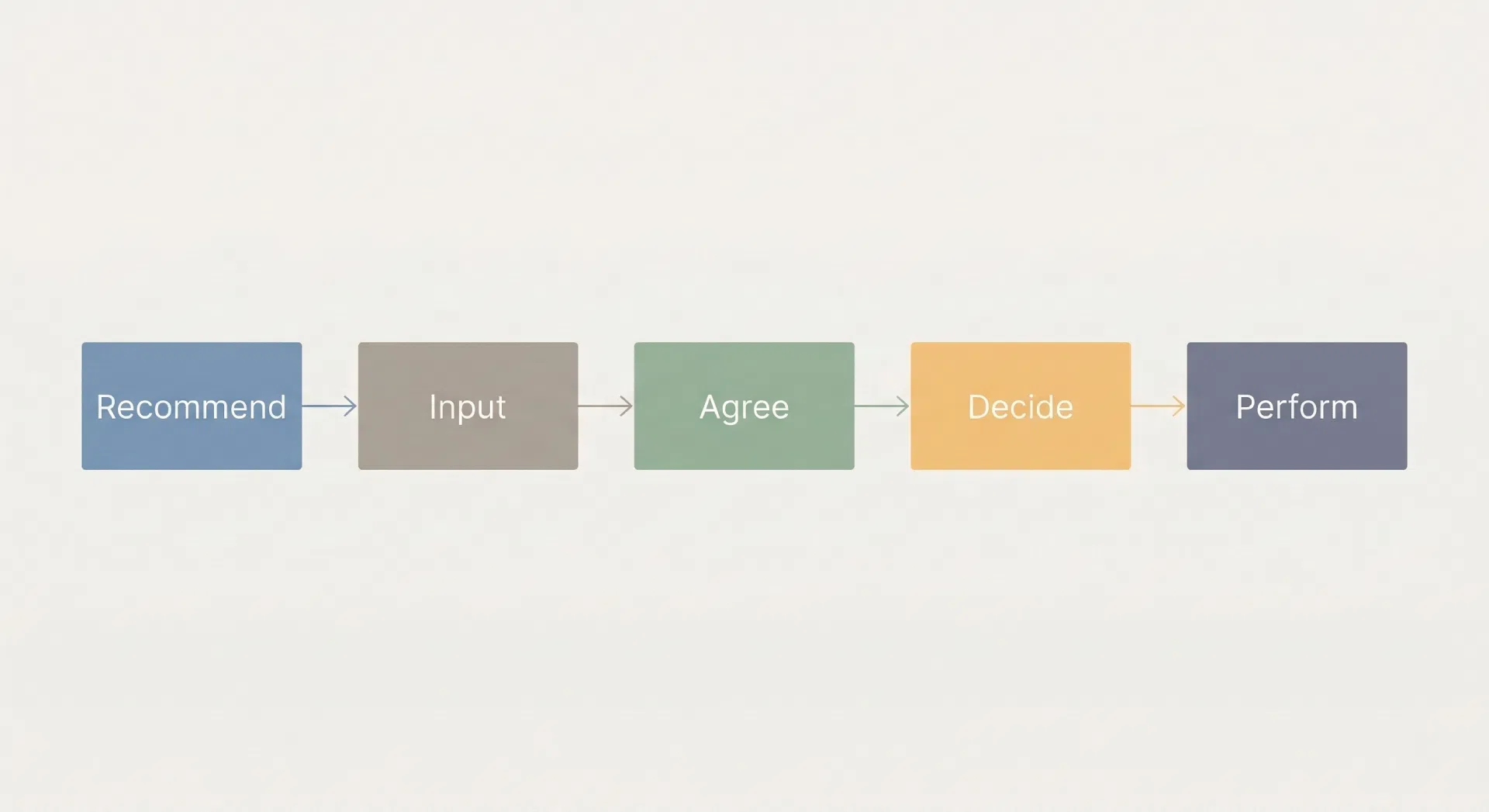
The roles overlap, but the boundaries are explicit. That’s what keeps the process from collapsing into negotiation.
The key nuance: only one person should decide per decision.
If a group decides, define the closure mechanism upfront. Shared decision authority without a tiebreaker turns RAPID into a negotiation without a resolution.
3. Voting: Convergence Tool, Not a Decision
Dot voting and multivoting narrow large option sets.
You give each person dots or points to distribute across many ideas, and the ideas with the most votes rise to the top. It’s fast, transparent, and democratic-feeling, which is exactly what makes it easy to misuse.
Say an innovation manager has 50 submitted ideas and needs to narrow to 12 for deeper review. Voting handles that well.
The crowd surfaces its preferences quickly, and the manager walks away with a shortlist that reflects broad input rather than one loud voice.
But keep the distinction clear:
- What voting does: Surfaces crowd preference and narrows a large option set to a manageable shortlist
- What it doesn’t do: Make the actual call. The shortlist still needs someone with decision authority to evaluate against strategic criteria.
The real decision (which ideas actually get resources) happens after voting.
Treat it otherwise, and authority goes to whoever can mobilize the most supporters, not whoever’s accountable for outcomes.
4. Deliberation: When Input Quality Matters
Deliberation is structured discussion designed to surface distributed expertise, hidden risks, and second-order impacts.
NGT and Delphi methods use multivoting to prevent dominant voices from crowding out less vocal expertise.
The quiet engineer who’s spotted a fatal flaw gets the same airtime as the executive sponsor who loves the idea. Use deliberation when knowledge is genuinely distributed and the decision’s downside is irreversible.
These are the calls where the cost of missing a perspective dwarfs the cost of a longer meeting:
- Exiting a market category
- Betting a year of R&D on unproven technology
- Any change that touches regulatory compliance or customer safety
The critical rule: deliberation must have a named decider and a closure mechanism. Deliberation and voting co-depend; voting provides the closure that deliberation needs.
Structure the discussion around three areas before calling the decision:
- Evidence: What do we know, and where are the gaps?
- Alternatives: What are we actually choosing between?
- Risks: What could go wrong, and who in the room is most likely to see it coming?
Close with a decision, either by vote or by the accountable person calling it based on what they heard.
Without that closure step, deliberation drifts into open-ended debate, and the meeting ends with everyone feeling heard but nothing actually decided.
Matching Method to Decision Type
Not all innovation decisions are equal.
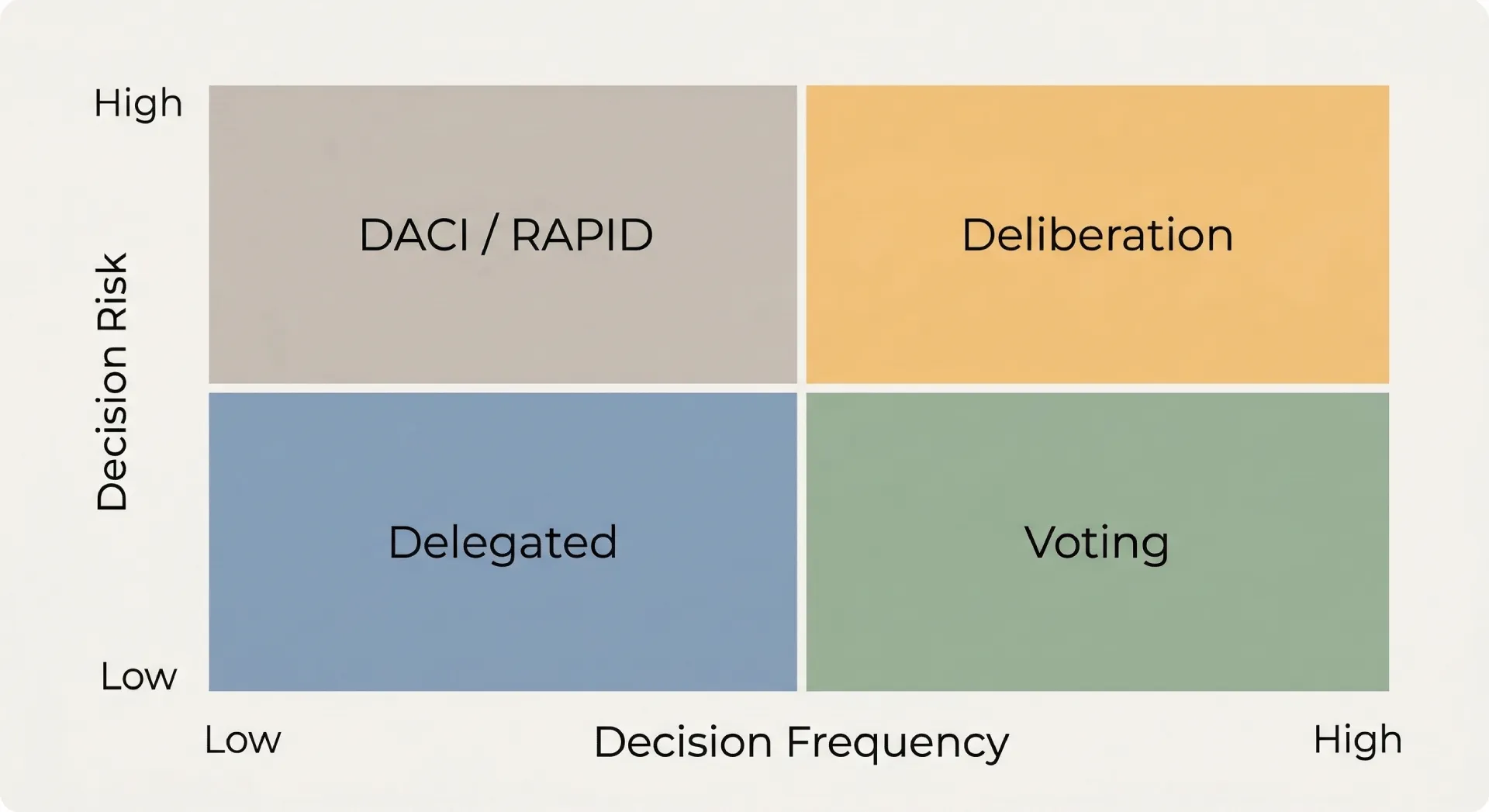
McKinsey groups them by frequency and risk:
| Decision Type | Characteristics | Recommended Method | Key Principle |
|---|---|---|---|
| Delegated | Frequent, low risk, clear owner | Lightweight, close to the work | Reversible decisions need a light-weight process |
| Cross-Cutting | Frequent, high risk, affects multiple teams | RAPID or DACI | Clear roles before the meeting |
| Big-Bet | Infrequent, high risk, high stakes | Deliberation + named decider | Structure debate, then close |
| Convergence/Prioritization | Narrowing many options | Voting as input, then decision | Voting surfaces preference; a decision-maker picks the winner |
| High-Conviction Disagreement | Stalemate on strategic choice | “Disagree and Commit” | One person decides; others commit to execution |
Delegated decisions are the most common and the most consistently mishandled. A team choosing which three ideas to prototype shouldn’t need executive review if the criteria are clear.
Delegate those decisions to those closest to the work.
Amazon’s “two-way door” principle is a useful test: reversible decisions should use a lightweight process; irreversible ones should be rigorous.
Cross-cutting decisions need structure because the fallout is wider. A decision to launch a skunkworks innovation program touches strategy, finance, talent, and operations.
RAPID or DACI clarifies who can block and who commits, before anyone gets in the room. Big-bet decisions need deliberation followed by a clear call.
Amazon’s “disagree and commit” is the mechanism: one person calls it based on conviction, and the rest commit to execution. Commitment matters more than agreement.
One important caveat: governance varies by industry context.
A fast-moving software company can delegate more decisions than a regulated life sciences firm. The framework is a guide, not a universal prescription.
The Consensus Trap
Consensus sounds inclusive.
- It feels democratic.
- It avoids hard calls.
In practice, consensus redistributes accountability away from the person responsible for the outcome. Consensus sets the wrong goal.
The room stops working toward the best decision and starts negotiating what everyone can tolerate. Tolerance-seeking reliably produces the wrong answer.
Large meetings amplify this dynamic. Here’s the chain reaction:
- More voices in the room
- More objections surface
- The timeline stretches
- The decision that should have taken an hour takes four
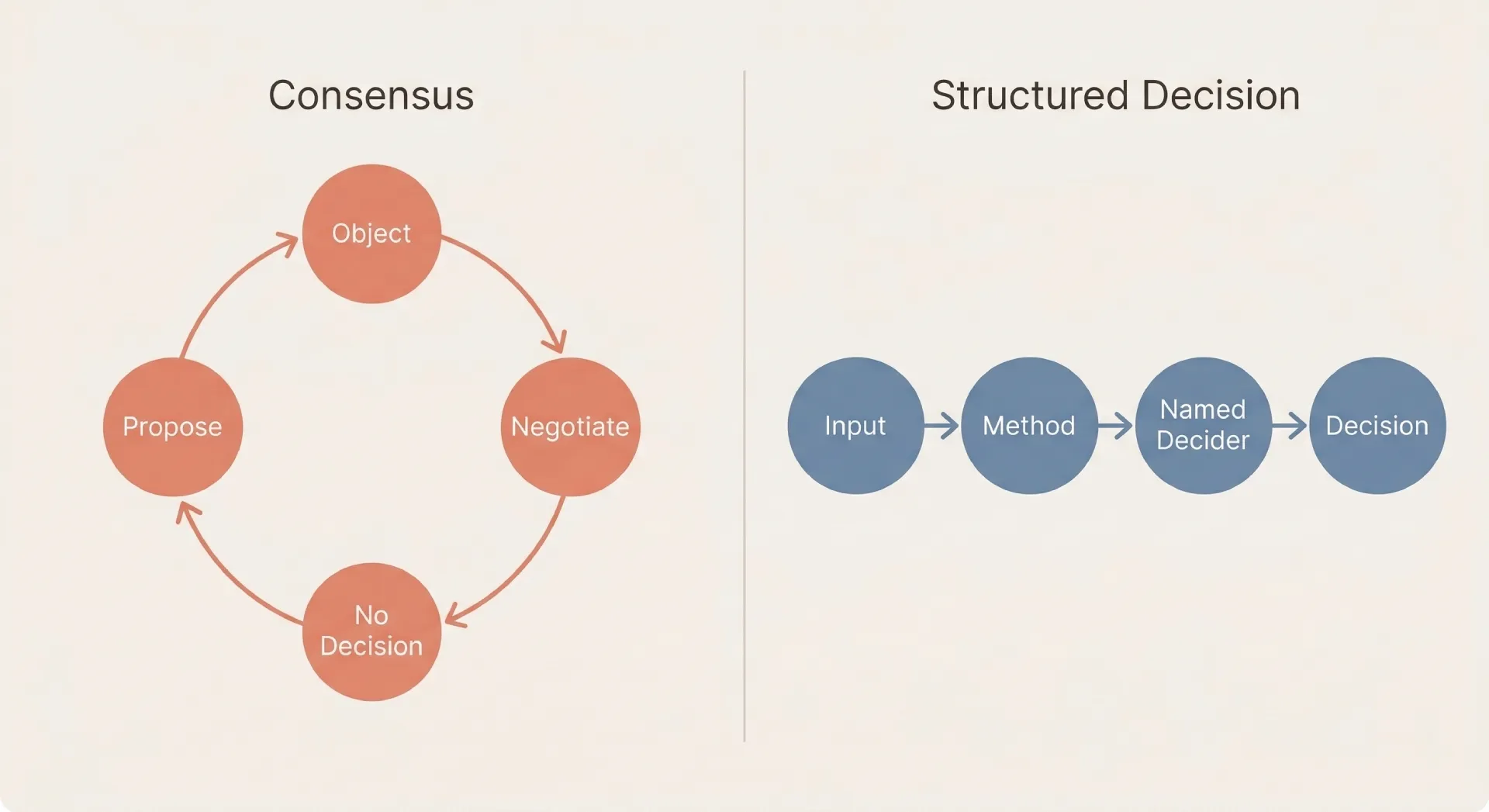
And whoever has the energy to keep pushing wins, not whoever has the strongest argument.
Amazon called this the default dispute resolution mechanism: exhaustion, with a quick escalation as the cure.
Consensus is appropriate in one context: a genuinely small, aligned team making a reversible, low-stakes decision where shared ownership adds value.
| Decision | Use Consensus? | Why |
|---|---|---|
| Weekly standup timing | Yes | Low stakes, reversible, shared ownership adds value |
| Which three ideas to prototype next | Maybe | Only if the team is small, aligned, and owns the outcome |
| Vendor selection for a new platform | No | Cross-functional impact, needs a named decision-maker |
| $5 million innovation bet | No | High stakes, irreversible, requires structured deliberation |
Voting without decision rights is consensus dressed up as process. You hold a vote, count hands, call the majority winner. But if no one owns the outcome, you’ve just run a political exercise.
Majority rule feels objective; actual authority feels political. The vote becomes a way to avoid accountability rather than exercise it.
Transparency about method and authority is what fixes this:
- It assigns ownership. Who does what is designed before the meeting, so the group can move.
- It separates deliberation from decision. Everyone speaks during input; one accountable person calls it.
- It documents the rationale. People understand the choice, even if they disagreed.
Treat Decision-Making as a Repeatable Practice
Only 20% of organizations excel at decision-making. But decision speed, done with structure, correlates measurably with firm performance.
The organizations closing this gap treat decision-making like any other repeatable process.
- They measure it.
- They name the failure modes.
- They iterate on method.
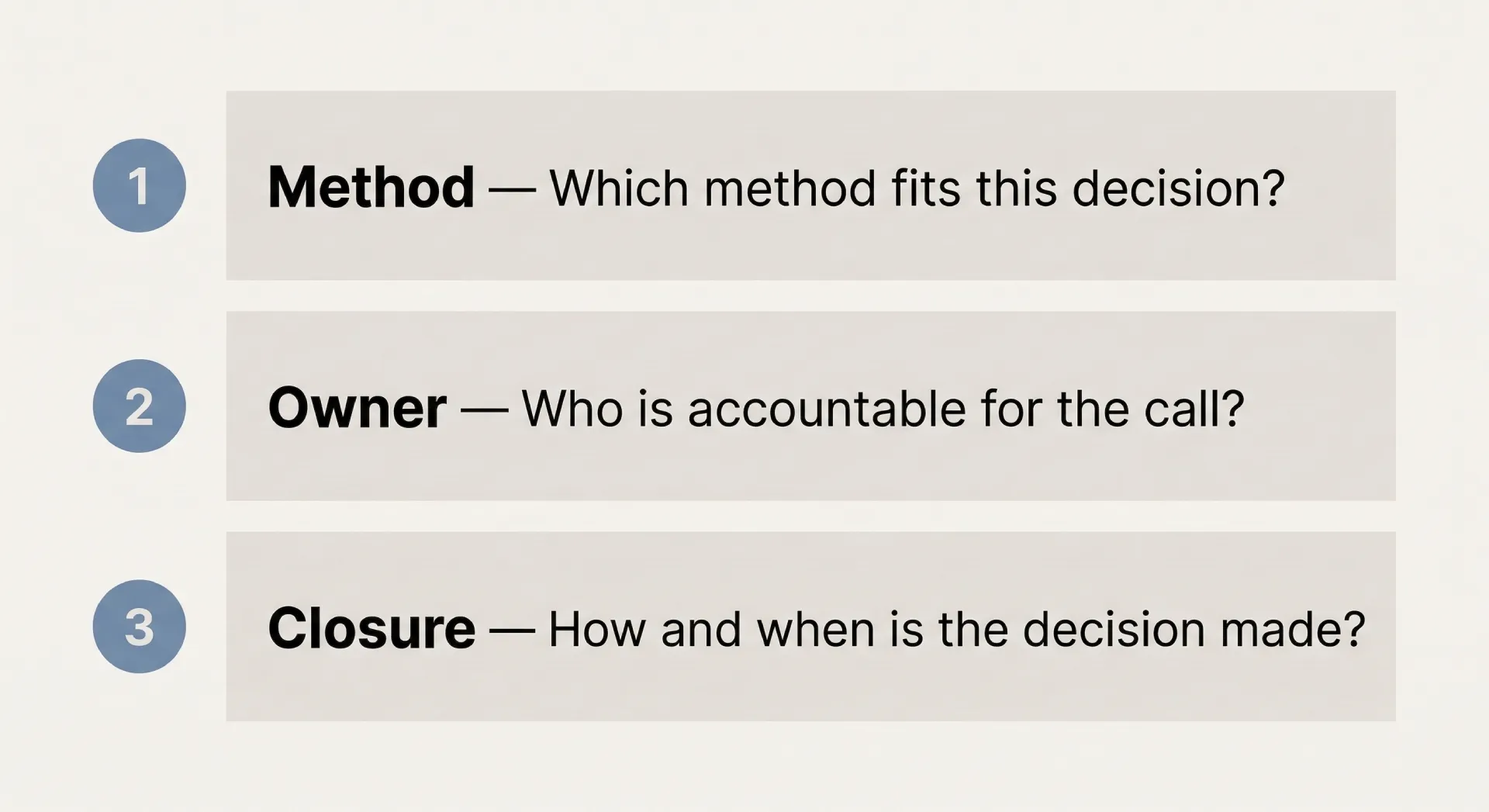
The practical starting point is consistent: before any group decision, define three things.
| Define This | Ask | Example |
|---|---|---|
| Method | Which method fits this decision type? | Delegated (lightweight), cross-cutting (RAPID or DACI), or big-bet (deliberation plus decision) |
| Owner | Who decides? Not who’s invited; who’s actually accountable for the call? | One named person with authority to make the final call |
| Closure | What’s the closure mechanism? How do you know the decision is made, and by when? | Vote by end of meeting, or approver calls it within 48 hours |
Document the rationale. Write down why you chose DACI over RAPID, or why you’re using voting as input rather than final authority. This builds organizational memory and gives you data to improve on.
Organizations that treat decision-making as a structured, transparent process see 20 to 30 percent time savings in managing ideas and projects through centralized overviews and structured workflows.
Method First, Meeting Second
The governance upgrade most innovation teams need is designing the method before the meeting starts:
- Before the agenda
- Before the invites
- Before the preparation deck
When roles are clear and the closure mechanism is defined upfront, contributors know when their input matters, the decision-maker knows what they’re deciding and when, and the group moves.
When a decision culture replaces a consensus culture, the primary question shifts from “Can everyone agree?” to “What’s the right method for this decision, and who owns the call?”
That shift is where most of the latent governance capacity in an innovation team actually lives.
Ready to stop losing momentum to meetings that end without a decision?
Download our ebook on structuring innovation governance for clarity and speed, or book a demo to see how Accept Mission handles structured scorecards, decision workflows, and centralized decision logs.










 English
 Dutch
Dutch Portuguese
 Spanish
 French
 German
 Arabic