
Why Your Innovation Scorecard Fails When It Matters Most11 min read

Your scorecard looked bulletproof on paper.
Weighted criteria, clear rubric, a governance committee that met monthly to refine it. Then the first evaluation cycle ran, and something broke.
A few things you probably recognized:
- A promising idea from a junior team scored lower than expected.
- A safe, incremental project from a VP’s division climbed to the top.
- Reviewers disagreed on “market readiness,” and by mid-cycle the weights had shifted without anyone quite remembering why.
Governance is the missing layer.
A scorecard without it is a theater prop: a visible surface that humans optimize against, predictably, because ambiguous incentives invite exactly that.
Why Scorecards Get Gamed
This isn’t about intentional deception. Innovation managers and reviewers aren’t trying to rig the system. What happens is far more subtle.
When you ask a group of people to score an idea against vague or overlapping criteria, they fall into psychological patterns that are nearly universal.
Anchoring
The first score someone mentions becomes an anchor. Everyone else’s judgment drifts toward it, even if they started with a different number.
Anchoring is faster than most people realize: in hiring contexts, first impressions solidify within four minutes, with everything after serving as rationalization.
Scorecard reviews work the same way. Once a number is on the table, it’s the reference point everyone else calculates from.
The Halo Effect
One strong criterion bleeds into others. If an idea scores high on “executive support,” reviewers unconsciously boost its “execution readiness” score, even if execution readiness is genuinely unclear.
Research on how linguistic similarity shapes trait judgments shows that shared terminology creates invisible correlations: people assume co-occurrence between concepts that sound alike.
Even when the actual relationship isn’t there.
Social Pressure
Nobody wants to be the contrarian. Reviewers feel pressure to align with colleagues, especially if those colleagues carry more authority.
A controversial but promising idea gets dinged because the room agreed to interpret it conservatively. A safe project from a senior sponsor sails through because everyone’s already nodding.
Weight Optimization
One team’s “high market potential” is another team’s “speculative bet.” A criterion labeled “strategic fit” gets interpreted as “helps my department’s roadmap.”
These aren’t character flaws. They’re how human cognition works under uncertainty. If strategic alignment is weighted at 40% and innovation is weighted at 15%, people know what matters.
Ideas that tick the weighted boxes score higher, even when unweighted criteria should have raised red flags.
That’s rational response to incentive structure. Your scorecard looks impartial, and your outputs reflect neither randomness nor merit.
The Three Most Common Gaming Mechanisms
The biases above are invisible at the moment. The mechanisms below are what they produce – the observable patterns you can actually spot in your scoring data:
| Mechanism | What It Looks Like | Why It’s Hard to Catch |
|---|---|---|
| Score inflation for favored projects | A mid-stage idea from a connected sponsor consistently scores 1–2 points higher than comparable ideas from other teams. The gap doesn’t match the actual quality difference. | Scoring happens behind closed doors, in different review meetings. No baseline comparison exists until the ranking is published. |
| Criterion interpretation drift | “Market demand” scores vary by 3–4 points across reviewers for the same idea. One person interprets it conservatively; another sees potential. | Scorecards assume shared vocabulary. They don’t. Criterion definitions exist on paper; interpretation happens in isolation. |
| Weight manipulation mid-process | Weights shift between review cycles or even mid-cycle, often without documentation. A criterion suddenly matters more because the outcome would have been different otherwise. | Weight rationale isn’t recorded. By the time anyone notices, the change is rationalized as a correction or oversight. |
Weight-setting bias is real and cross-departmental. The same criterion means different things to different functions:
- Marketing weights innovation differently than operations.
- Finance’s “resource efficiency” doesn’t map to R&D’s view of the same criterion.
- Scores get anchored during target-setting when leaders decide “10.3” rather than “8” or “12,” a choice that’s inherently subjective but gets forgotten once written down.
By evaluation time, more information exists than during setup, making informed judgment more valuable than mechanical measurement.
Yet most teams treat the original scorecard as gospel. Run it three cycles without recalibrating, and it’s measuring politics, not potential.
Calibration: The Fix Most Teams Skip
Calibration is the answer nobody implements.
Before anyone scores a single idea, the review committee aligns on what each criterion means and what each score level represents. Not in the abstract. In practice, with anchor examples.
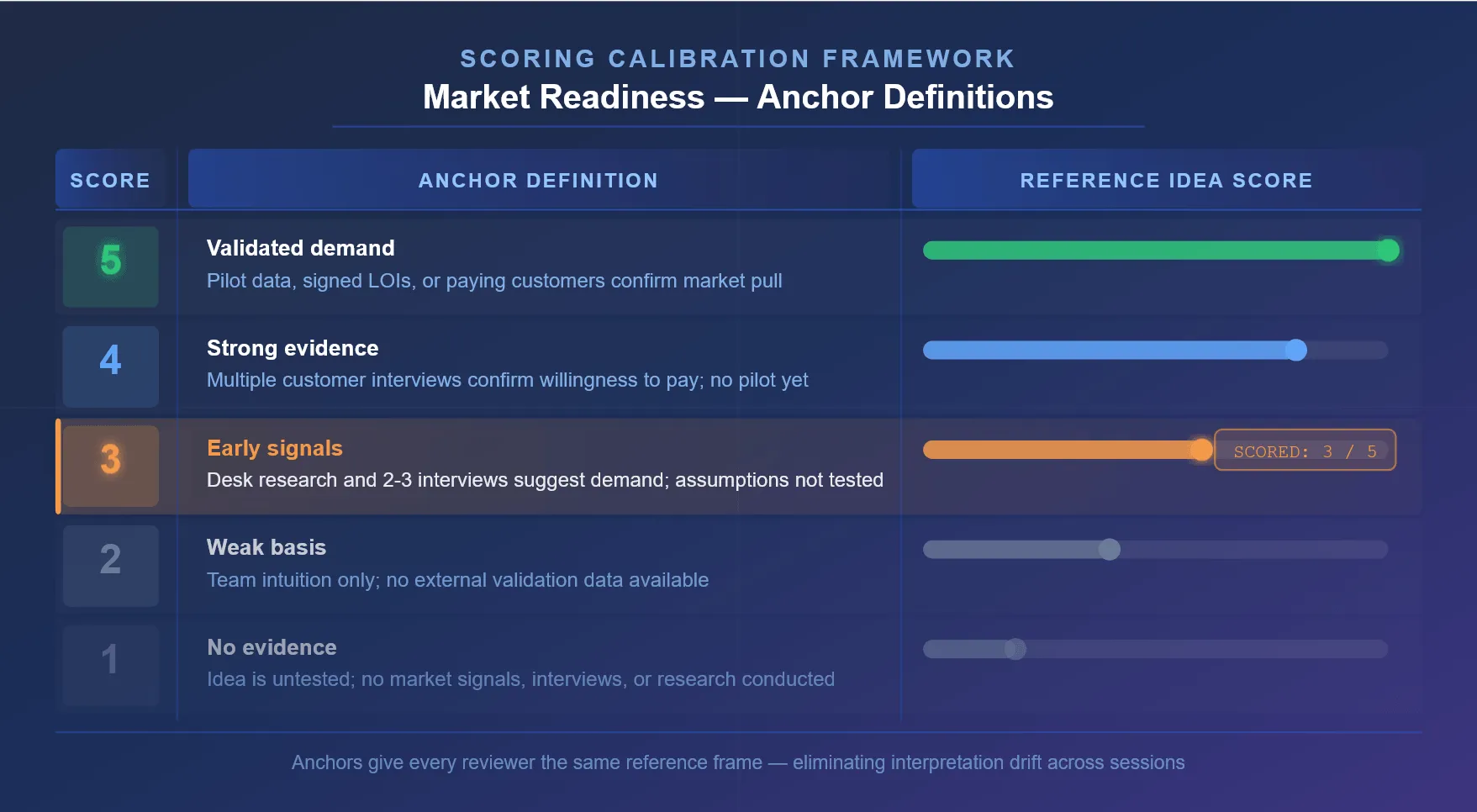
Take “market readiness.” On a 1–5 scale, what does a 3 look like versus a 4? Most scorecards don’t define that, so reviewers guess.
Calibration means scoring a reference idea together: a past project, a known competitor’s move, a hypothetical scenario. The group agrees on the number, and alignment carries into every cycle after.
Structured evaluation processes make teams 17% more likely to back their decisions with evidence, and outperform human instinct by at least 25% even when humans had more information.
Calibration should happen before each evaluation cycle, not once at launch. What “high execution risk” meant in 2024 may mean something different in 2026.
Here’s what actually works:
Pre-scoring calibration sessions. Reviewers score reference examples together. Discussion surfaces interpretation gaps before they become scoring disagreement.
Someone says, “I’d score that a 2 on market demand.” Someone else says, “I’d score it a 4.”
Now you talk about why. You reach alignment on the number, and that alignment carries into the next cycle.
Anchor examples in the scorecard itself. If “strategic alignment” lives on a 1–5 scale, the scorecard should define what each level looks like:
- A 3: “Solves a known problem in a non-core area.”
- A 4: “Solves a problem in a core area with clear stakeholder buy-in.”
- A 5: “Core problem, urgent timeline, executive priority.”
Reviewers score faster and more consistently when the reference is explicit.
Post-scoring review sessions. After the first round, bring reviewers together to discuss outliers. If one person scored an idea 1 and another scored it 5, talk through it.
Often you’ll surface a misunderstanding about the idea itself, not the criterion. Sometimes you’ll find genuine interpretation drift and adjust for the next cycle.
Calibration is a recurring governance layer. Every cycle, you recalibrate. Every cycle, you close interpretation gaps before they become output distortion.
Governing the Weights, Not Just the Scores
Most governance conversations focus on the scores. Weights are the neglected layer, and they’re where the real decisions happen.
A scorecard with seven criteria creates a surface of democracy. But weights are where your true priorities live.
If innovation is weighted at 15% and strategic fit is weighted at 40%, you’ve made a strategic choice about what kind of ideas you want.
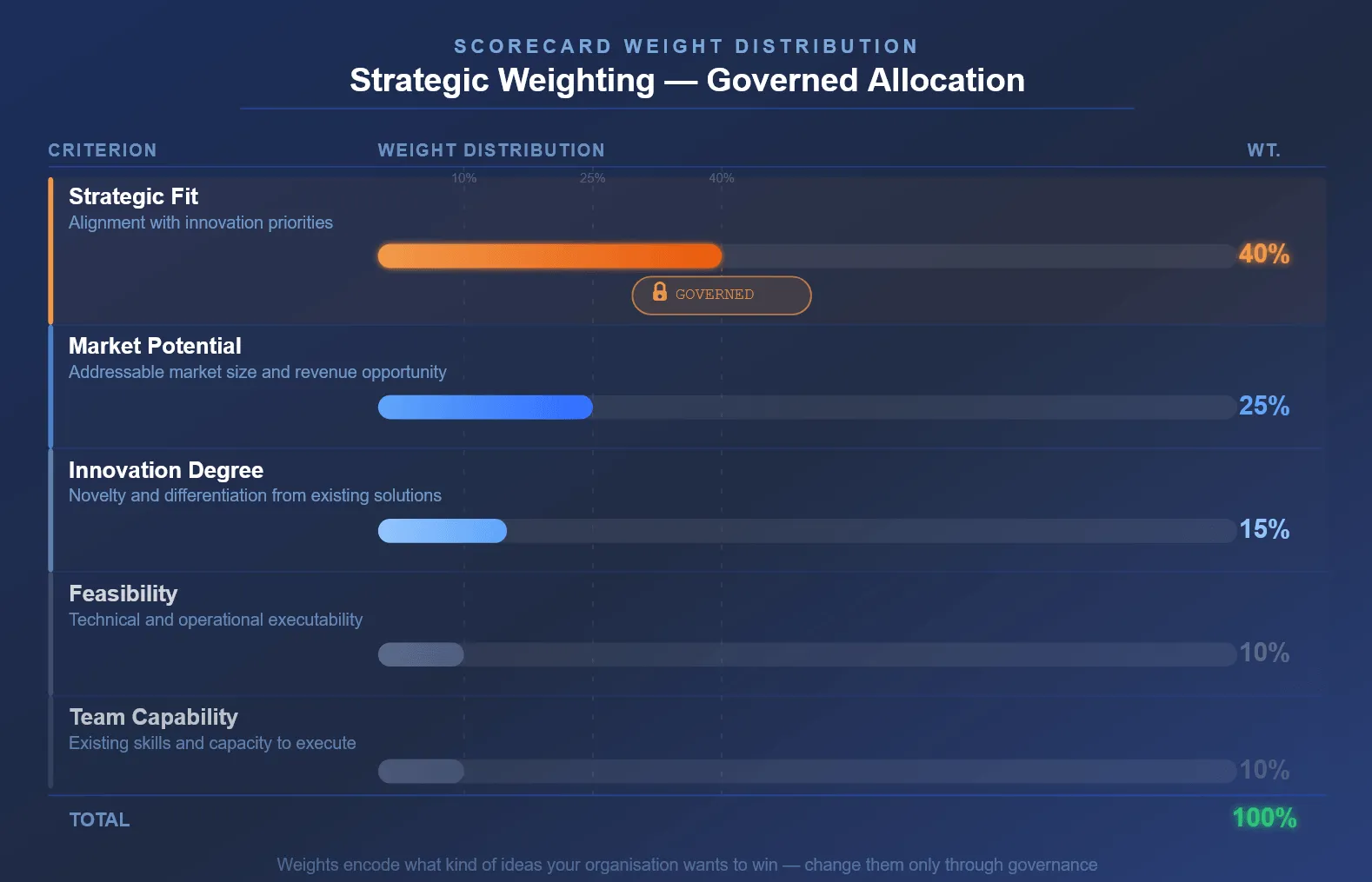
Yet most teams set weights once, at launch, without revisiting them or documenting the rationale. Weight-setting carries bias across departments, and finance and product rarely agree on priorities.
When weights shift mid-process, even by small amounts, they reshape outcomes. An idea that ranked third suddenly ranks first because one weight ticked up by 5 percentage points.
Use this table to audit your current process:
| Weight Governance Question | Who Owns It | How Often Reviewed |
|---|---|---|
| Who sets the weights and on what evidence? | Cross-functional committee, not one person or function. | Before each evaluation cycle. |
| When are weights revisited, and what triggers a change? | Documented trigger (strategy shift, portfolio imbalance, new business priority). | Explicitly, not mid-cycle. |
| What’s the audit trail? Why do these weights exist? | Weight rationale documented and stored with scorecard version. | Available for review and challenge. |
Weight changes are policy decisions disguised as calibration. If your innovation committee decides mid-cycle that “technical feasibility” should jump from 20% to 30%, that’s a strategic call.
It should be visible. It should be deliberate. It should be reversible if it wasn’t the right move.
In practice: lock weights before scoring starts, document the rationale in plain language, and if weights need to change, call it a separate decision and version the scorecard.
Weight governance is what separates a scorecard that evolves deliberately from one that drifts silently.
Blind Scoring: When It Helps and When It Doesn’t
Anonymity solves one specific problem. It doesn’t solve the others.
When reviewers don’t know whether an idea came from a top-25 institution or a less prestigious one:
- Top-25 institutions’ award share dropped from 75% to 45%.
- Institutions ranked 26–50 saw award rates increase from 0.23x to 0.91x of baseline.
That’s meaningful. Sponsor prestige bias is real, and blinding reduces it.
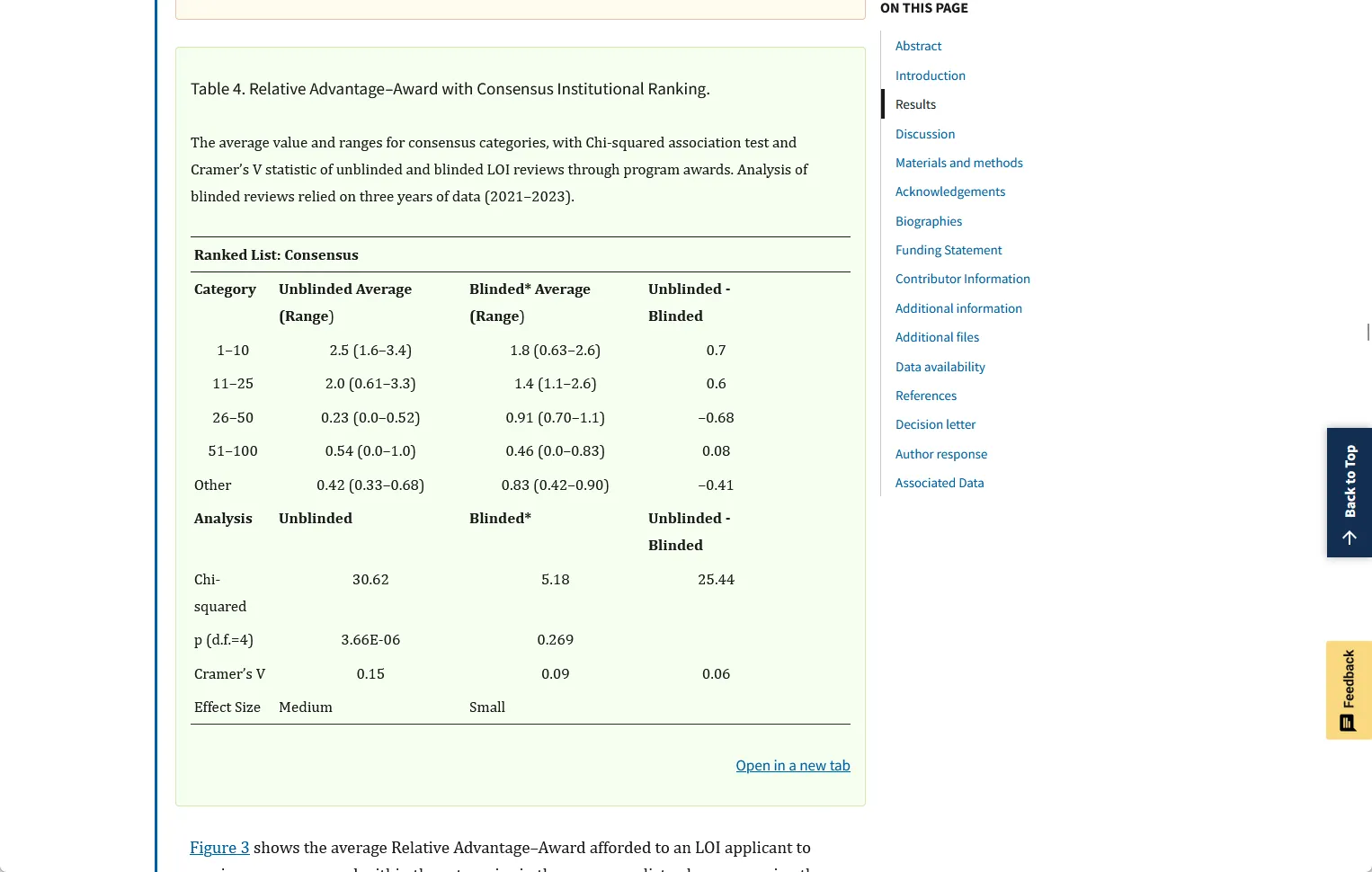
But blinding doesn’t fix criterion drift, weight manipulation, or anchoring. Once scores are visible to the group, the anchor effect kicks in again.
When blind scoring is worth implementing:
- Early-stage evaluation, before ideas have sponsor names attached and prestige bias could dominate.
- Mature ideas with controversial sponsors, where knowing the source would shift perception.
- Cross-functional panels where institutional bias is documented (R&D doesn’t trust operations, finance sees engineering as high-risk by default).
When it’s less critical:
- Later-stage evaluation, where idea merit is less ambiguous and sponsor context is actually useful.
- Systems where reviewer accountability is already high and calibration sessions happen regularly.
Full anonymity is friction. Reviewers sometimes need context to evaluate thoughtfully.
The practical version is partial blinding: strip the sponsor name but keep the idea summary and maturity level. This reduces prestige bias without creating information loss.
What Transparent Infrastructure Actually Enables
Most innovation teams use spreadsheets, email, or lightweight tools without audit trails. Scoring happens.
Rankings come out. Nobody documents what changed or why.
Without a system that logs scores, timestamps reviews, and makes scoring history visible, you lose the ability to govern:
- Calibration becomes anecdotal (you remember discussing it, but there’s no record).
- Weight changes go undocumented (next cycle, nobody can find the rationale).
- Score inflation is invisible (you can’t compare this idea’s score to last year’s comparable ideas).
- Accountability diffuses (whose score did that outlier come from? What was their reasoning?).
Here’s what transparent infrastructure actually enables:
- Surface calibration gaps before they compound. If one reviewer consistently scores “market demand” 1–2 points higher than peers, a good system flags that pattern. You see it happening, not after the fact.
- Audit weights and weight changes. Where did this weighting system come from, and how has it evolved? The system becomes a record, not a black box.
- Track idea velocity and outcomes. Three years later, you can see: “We scored this idea a 7 on execution readiness and it failed.” That feedback loop is how you improve the scorecard itself.
- Run scoring consistency checks. If the same idea scored by two different reviewers gets wildly different results, the system flags it. You improve the criterion definition based on where interpretation broke down.
That’s what organizations see through data-driven scoring and group decision-making: less time pursuing projects that political dynamics favored over merit, and more signal in the decisions that matter.
AI-assisted scoring support adds another layer. It can flag when an individual reviewer diverges from the group baseline, surfacing calibration gaps before they compound across the funnel.
The system amplifies human judgment rather than replacing it.
Build the Governance First, Then Trust the Score
A scorecard is only as reliable as the governance around it.
Strong innovation evaluation comes from repeatable discipline around three things:
- Calibration sessions before every cycle, with anchor examples and documented rationale.
- Weight governance that’s explicit, documented, and version-controlled.
- Transparent, auditable infrastructure that makes scoring history and anomalies visible.
Do those three things before your next evaluation cycle.
Add them incrementally if you have to, but add them. A scorecard that looks rigorous while producing theater is worse than no scorecard at all.
When good ideas consistently lose to political dynamics, the scorecard isn’t the problem. The governance around it is.
Download our ebook on enterprise idea management, or book a demo to see how Accept Mission handles automated routing, escalation workflows, and audit trails.



 English
 Dutch
Dutch Portuguese
 Spanish
 French
 German
 Arabic