
The 70-20-10 Innovation Rule Only Works With Governance Behind It9 min read

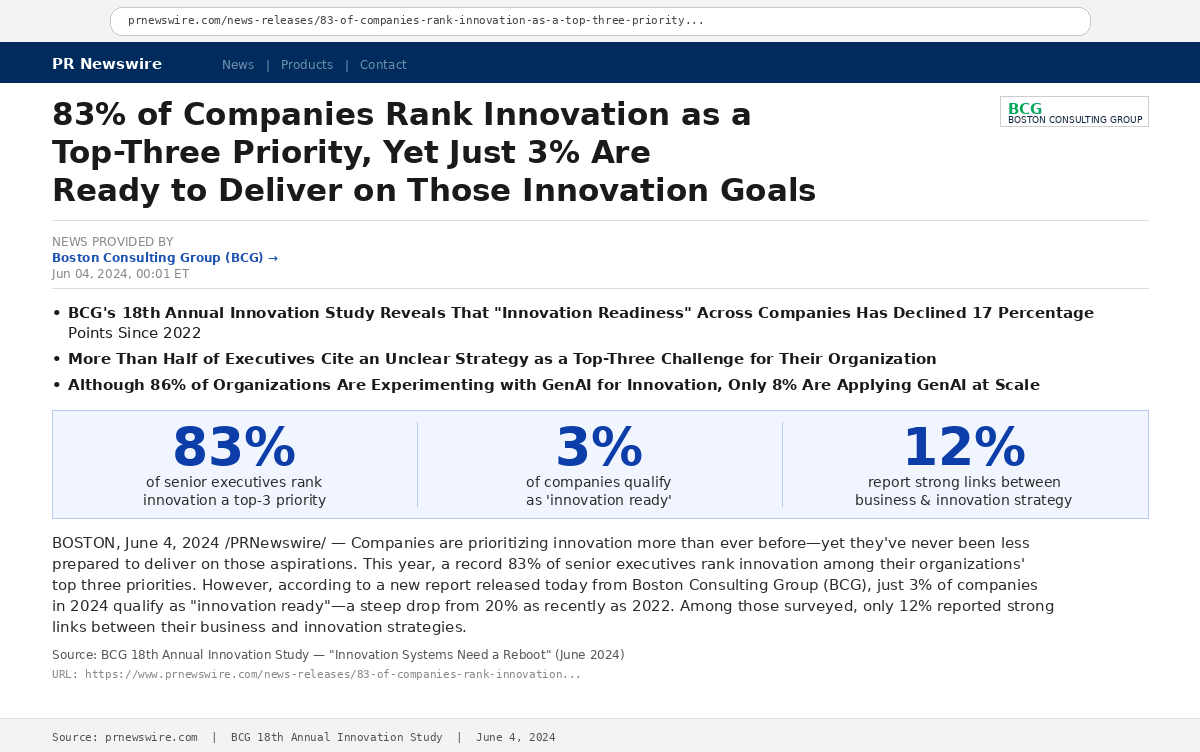
Eighty-three percent of senior executives rank innovation as a top-three priority. Yet only 3% of companies qualify as innovation ready.
Most organizations know the formula:
- 70% of resources go to core business improvements
- 20% to adjacent opportunities
- 10% to transformational bets
In practice, nearly every company gets it wrong. One analysis found companies allocating 49-28-23 in 2018 and approximately 48-26-26 by 2020.
The gap between prescription and practice is a governance problem. Organizations understand the rule. They just lack the system to protect it.
The companies that consistently hit the 70-20-10 target have something in common. They built structure around the rule, not just intention.
What the Rule Actually Says
The three horizons aren’t arbitrary buckets. They’re distinct work streams with different time horizons, risk profiles, and success metrics.
| Horizon | Time Frame | Risk Level | Resource Intensity | Primary Success Metric |
|---|---|---|---|---|
| Horizon 1 (Core) | 0–1 year | Low | Operational | Efficiency gains, revenue |
| Horizon 2 (Adjacent) | 1–3 years | Medium | Development-focused | Market entry, margin expansion |
| Horizon 3 (Transformational) | 3+ years | High | Exploration-heavy | New capabilities, paradigm shift |
Horizon 1 keeps the lights on. Incremental improvements compound and operational excellence is competitive, but without discipline, H1 naturally gravitates to 80% or 90% of a portfolio.
Horizon 2 expands the business into adjacent spaces: a software company building consulting services, a manufacturer launching a digital platform. Medium risk, medium payoff, clear commercial logic.
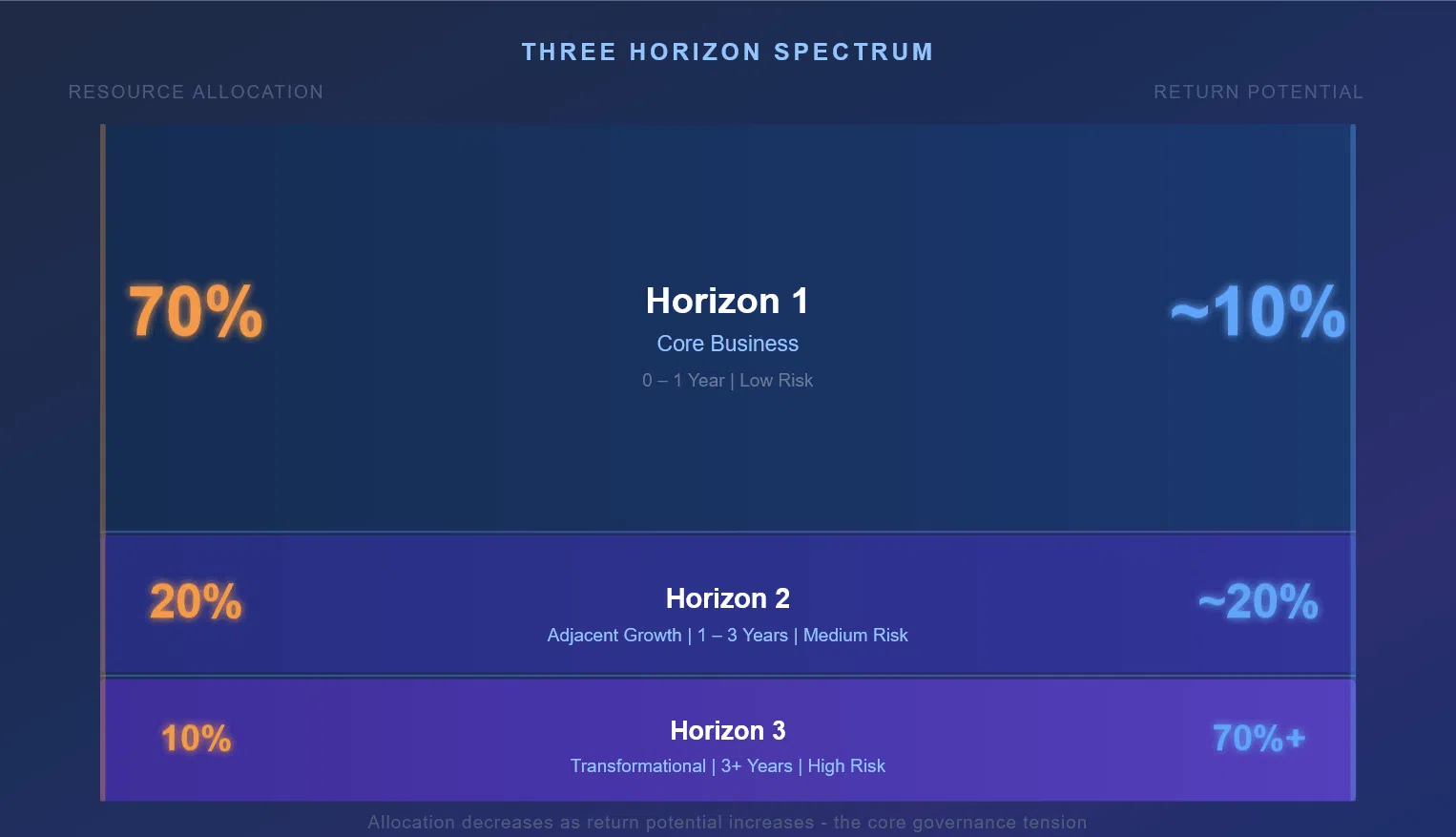
Horizon 3 creates an entirely new layer: new business models, entirely new markets, capabilities that don’t yet exist. These rarely succeed, but when they do, they matter.
The Return Paradox That Makes This Hard to Follow
Here’s the uncomfortable part. The return ratio is inverse to resource allocation.
Core business typically returns around 10% annually and adjacent innovations around 20%. Transformational bets that succeed often return 70% or more, sometimes orders of magnitude higher.
| Horizon | Typical Return |
|---|---|
| H1 Core | ~10% annually |
| H2 Adjacent | ~20% annually |
| H3 Transformational | 70%+ when successful |
This creates a perverse incentive. If the big returns live in H3, why allocate to the 70% that yields modest gains?
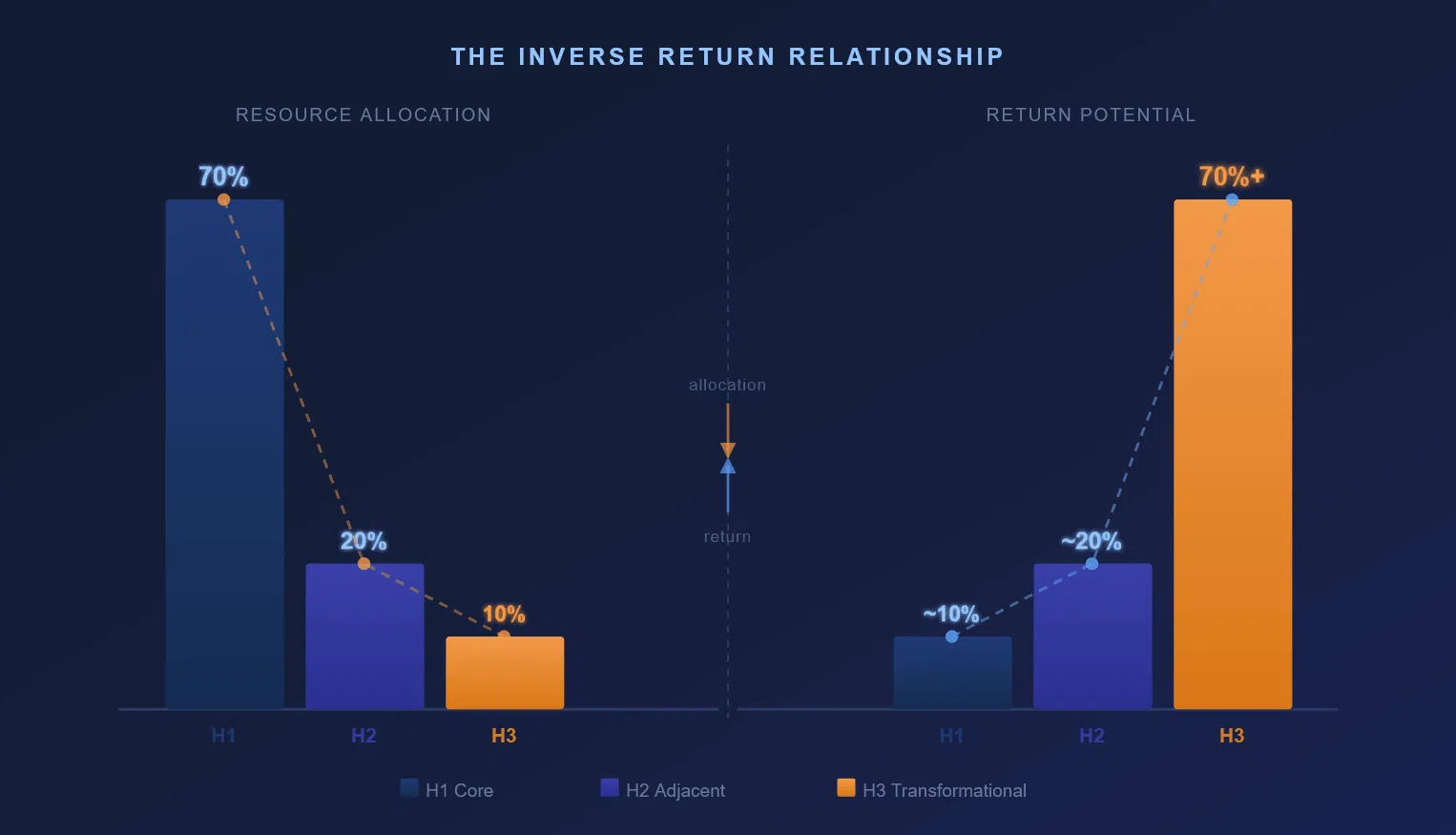
The answer is portfolio resilience. No company can predict which Horizon 3 bet will work.
A portfolio weighted toward moonshots collapses when bets fail, and most do. A portfolio locked in core improvements is mathematically doomed as markets shift and competitors innovate.
The 70-20-10 structure gives H3 time to mature before the core becomes obsolete. IBM proved it by feeding the pipeline; GE disproved it by starving core execution.
The rule balances survival with growth. That’s hard to justify in a spreadsheet, but it’s the only thing that works.
Where Organizations Actually Go Wrong
The persistent gap between 70-20-10 prescription and actual 49-28-23 practice tells us something.
The rule doesn’t fail because companies don’t understand it. It fails because the default system doesn’t protect it.
Three failure patterns show up repeatedly:
- Mislabeling: Organizations routinely classify cost-reduction or feature refresh work as transformational to hit innovation targets. The portfolio reads balanced on paper while resources still concentrate on core.
- No ring-fenced budget: H2 and H3 resources compete in the same pool as core. When revenue softens, their budgets are cut first and the portfolio collapses to 95/5 or worse.
- Annual reviews instead of quarterly rebalancing: Annual reviews miss quarterly drift. Three years later, 70-20-10 quietly becomes 80-16-4 and H3 starts feeling like a luxury.
Without deliberate governance, resource allocation drifts toward core. Core has quarterly reviews, board metrics, and revenue pressure on its side.
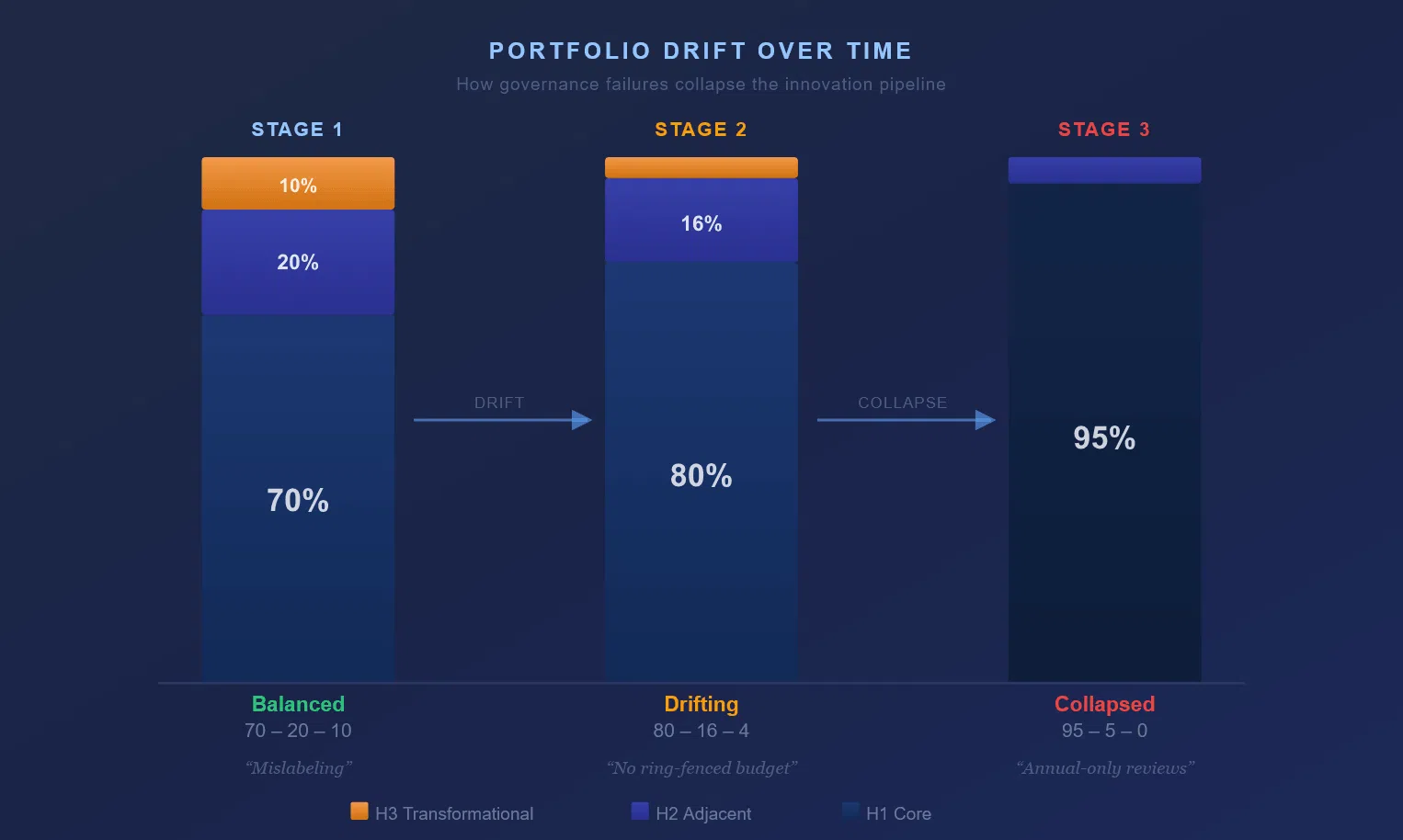
Horizon 2 and 3 work gets starved because no mechanism exists to protect it. Core projects have executive sponsors, and that visibility compounds the drift.
The 95/5 illusion is real:
A company claims innovation priority while 95% of resources go to incremental work. The math is clear but the governance doesn’t follow.
What IBM Got Right
IBM survived multiple market collapses, from tabulating machines to mainframes to cloud and AI. Each transition was by design, not luck.
The pattern held across every transition: IBM built new capabilities before old ones declined. Its approach was pipeline discipline, not moonshot culture.
| Declining Era | New Capability Being Built |
|---|---|
| Tabulating machines | Mainframe architecture |
| Mainframes | Services and software |
| IT services | Cloud and AI |
Greg Satell‘s insight cuts to the core:
“The one absolute certainty about innovation is that you need to constantly feed your pipeline with new ideas or you will inevitably begin to decline.”
IBM didn’t just believe this. It structured the organization to ensure it happened.
The 70-20-10 allocation is about survival. Core keeps it running, adjacent expands the reach, and transformational keeps new paradigms alive long enough to mature.
IBM sustained itself by ensuring no single horizon dominated by default. That discipline, applied consistently, is what kept the pipeline alive.
How to Apply the Rule With Discipline
Start with an audit. Know your actual distribution before you redesign anything.
Go through your active projects. Classify each one by three criteria
- Time horizon to impact
- Risk level
- What new capability it creates
Then measure the actual resource allocation. If you claim 70-20-10 but your audit shows 49-28-23, that gap is your starting point.
Use these practical questions for a portfolio allocation review:
- How many of your active projects are truly transformational versus relabeled incremental work?
- What percentage of your best technical talent is allocated to H3 work?
- When Horizon 2 or 3 projects miss milestones, do they get terminated or perpetually extended?
- Do you rebalance quarterly, or do you review the portfolio once a year?
- Are Horizon 2 and 3 projects evaluated on distinct success criteria, or held to core business metrics?
Next, ring-fence resources by creating separate work streams with distinct budgets, governance, and success metrics. Don’t let H2 and H3 compete in the same pool as core.
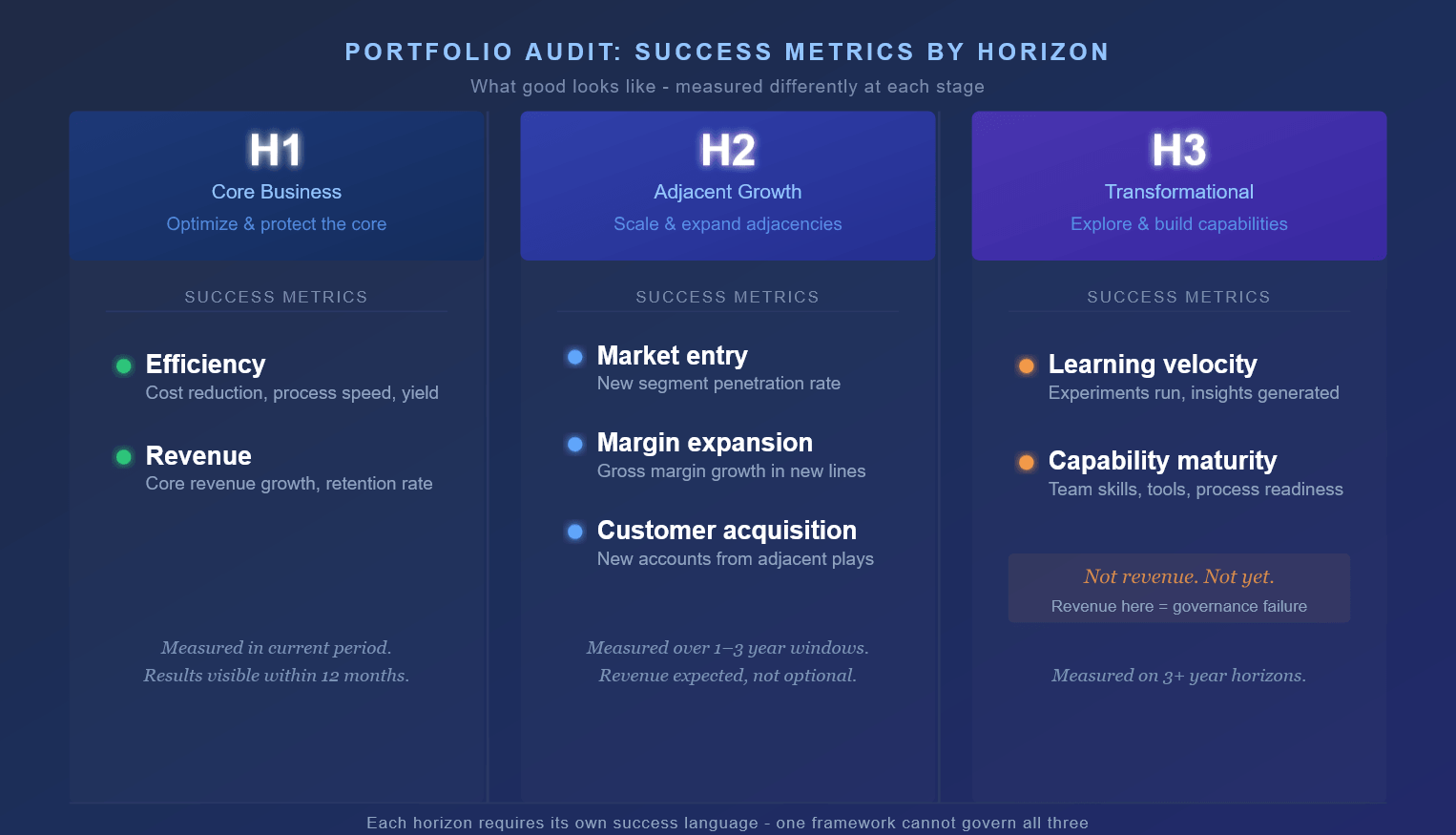
H1 metrics are efficiency and revenue; H2 metrics are market entry, customer acquisition, or margin expansion. H3 metrics are learning and capability maturity, not revenue yet.
The ratio adapts by context. Consumer goods companies often run 80-18-2 allocations; tech companies often allocate 45-40-15.
Heavy industry and regulated sectors lean 80%+ to core. What matters is that any allocation reflects a conscious choice, not a default drift.
Why the Rule Breaks Without a Governance Layer
A portfolio left unattended slides toward core. The Vanguard analogy applies: a 60-40 investment portfolio left unchecked over three decades will shift to 80-20 or worse.
People raid the risky allocation when they need cash. The portfolio drifts, and the same logic applies to innovation portfolios.
Governance requires three structural elements:
- Quarterly evidence reviews where the portfolio is measured against actual allocation targets
- Pre-committed kill criteria for each project, evaluated on schedule, not on intuition
- Visible portfolio dashboards that surface allocation at all organizational levels
Annual reviews aren’t sufficient. By the time the next review happens, the cultural default has shifted and “we’ll get to moonshots next year” becomes permanent.
Only 12% of organizations report their innovation strategy is strongly linked to business strategy. The gap is structural: organizations understand the rule but lack the governance to enforce it.
When resource allocation is made without visible criteria, the loudest exec and nearest deadline win. Data-driven scoring and transparent evidence reduce that bias.
Organizations that apply structured portfolio governance and AI-supported scoring see higher success rates across all three horizons.
The governance layer keeps the rule alive. Skip it, and the portfolio drifts.
Feed the Pipeline Before It Runs Dry
Satell’s insight reframes the whole conversation. The rule is about pipeline maintenance.
IBM survives because it continuously feeds all three horizons. GE stumbled because it didn’t.
The companies that consistently apply the rule share the same pattern:
- IBM: built new capabilities before old ones declined, across every market transition
- Google: operationalized the three-horizon model at an organizational level
- 3M: embedded H3 at the individual level with 15% time for side projects
The difference between companies that apply the rule and those that don’t comes down to structure. Structure compounds over time.
Do you know your actual portfolio distribution right now? If you can’t answer immediately, you’re guessing, and guessing is what creates the 95/5 illusion.
The rule works because it forces continuous choice. Every quarter, every decision either reinforces the three-horizon balance or tilts it.
Download our free ebook Project Portfolio: From Opportunities to Value to learn how to establish a deliberate portfolio balance across all three innovation horizons.
Request a demo to see how Accept Mission gives you portfolio visibility, structured governance, and AI scoring to keep all three innovation horizons on track.



 English
 Dutch
Dutch Portuguese
 Spanish
 French
 German
 Arabic