
Zombie Projects: Why Innovation Portfolios Are Full of Them (And How to Kill Them)9 min read

Every innovation manager knows this project. It hasn’t moved in months. Nobody stopped it.
This is a zombie project. Most portfolios are full of them:
- Launch criteria exist, but stop criteria don’t
- New ideas get visibility, but stalled ones don’t
- Accountability is diffuse and nobody is empowered to close them
That’s how a portfolio accumulates projects the way a garden accumulates weeds. Killing them is a governance problem, and governance can be fixed.
What Makes a Project a Zombie
A zombie project is alive enough to consume resources but not alive enough to make progress.
It’s different from a paused or held project. When you deliberately pause something, you know why, when you’ll reconsider it, and who’s responsible for deciding whether to restart it.
A zombie just drifts.
Four characteristics define the pattern:
- No visible milestone progression
- Unclear ownership for the next stage
- No formal kill criteria written into its stage gates
- No urgency to resolve the stall
The project isn’t openly failing, it’s just stuck. Nobody’s calling meetings to decide its fate.
It’s waiting for someone else to decide. And that person is waiting for someone else.
Most importantly, a zombie has no defined exit trigger. Something would have to change dramatically before anyone would seriously consider closing it.
Why They Accumulate
Zombie projects don’t appear randomly. They’re created by structural gaps in how organizations build and run their innovation funnels.
Five root causes consistently explain why they take hold:
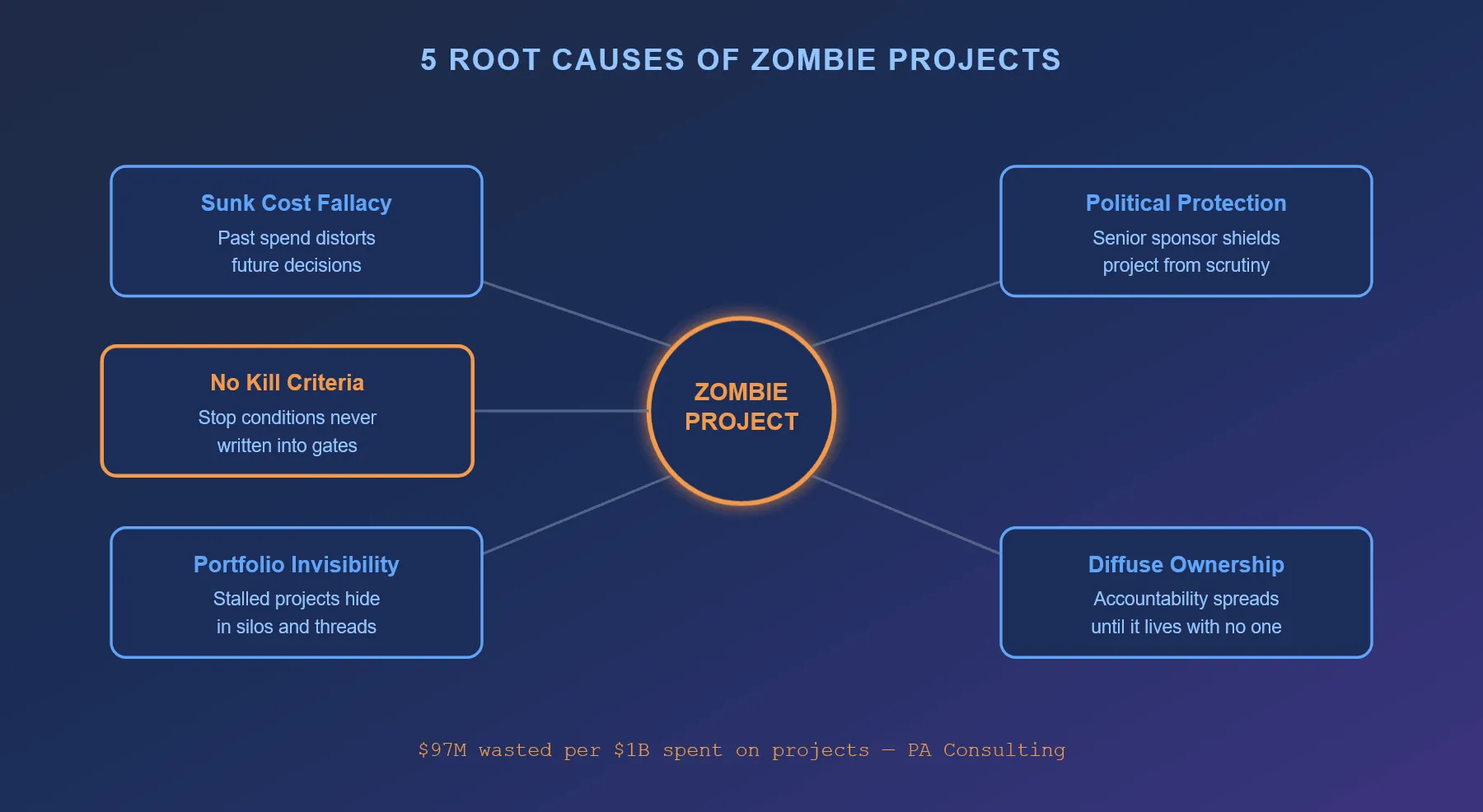
Sunk Cost Fallacy
Past investment distorts future decisions. When researchers told aerospace engineers a stealth plane project was 90% complete, 85% wanted to spend an additional $1 million to finish it.
When told the project hadn’t started, only 17% would commit the same funds.
The NHS Connecting for Health project started at £2.3 billion and escalated to £12 billion before discontinuation. Each year’s decision-maker inherited a “we’re almost there” narrative.
Political Protection
A senior sponsor shields the project from scrutiny. Killing it becomes a personal slight.
Without a structured process, the decision stops being data-driven. Most people would rather avoid the conflict than face the sponsor.
No Formal Kill Criteria
Organizations obsess over launch criteria: what needs to be true before a project moves forward. But they rarely define stop criteria: what needs to be true before a project closes.
Gate reviews ask “should we continue?” but aren’t authorized to kill anything without consensus or sponsor approval.
Portfolio Invisibility
Stalled initiatives don’t surface. They hide in email threads, spreadsheets, and departmental silos. Without a centralized view of project status, there’s nothing to trigger a conversation about shutting them down.
Diffuse Ownership
When accountability for a decision spreads across multiple people, it lives with no one.
“That’s really a question for the product team” becomes “actually, it’s an operations decision” becomes “I think marketing owns that now.” Everyone waits for someone else to act.
The resource cost is staggering. Organizations globally waste $97 million per $1 billion spent on projects due to poor governance and zombie project proliferation.
That’s not failed learning or bad timing. That’s money walking out the door because the system didn’t kill what it should have.
The Visibility Problem
You cannot kill what you cannot see.
Most organizations run their innovation portfolios on fragmented systems. Project updates live in email threads, spreadsheets, or tools that nobody in leadership actually checks.
Status meetings surface only the projects people feel confident talking about. Stalled initiatives drift quietly, invisible until someone notices two years later that nothing has happened.
Without centralized visibility, you lose visibility on all of it:
- Whether a project has stalled at all
- How long it’s been sitting at the same stage
- Whether resource consumption matches progress
- Patterns like “every project with this sponsor either succeeds quickly or dies slowly”
The intelligence that would trigger a kill decision never surfaces.
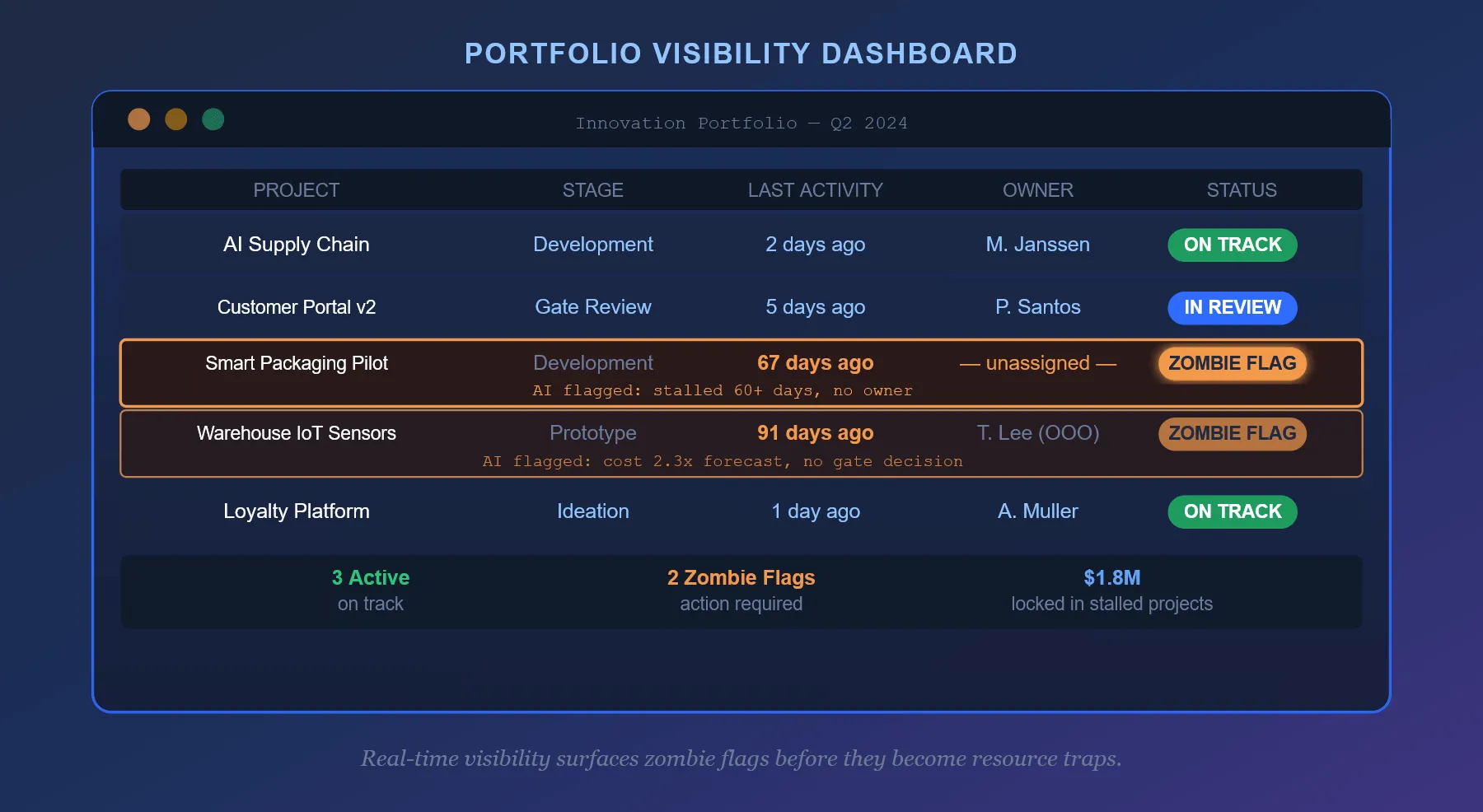
Real-time portfolio dashboards provide the critical foundation for kill decisions. When you can see project health across your entire funnel at a glance, you create the conditions for accountability.
Modern platforms use AI-assisted dashboards to surface stalled projects automatically. They flag initiatives that haven’t moved in weeks, highlight ownership gaps, and give portfolio leads the signal to act.
Portfolio visibility doesn’t make the kill decision easier emotionally. But it removes the excuse that nobody noticed a project was in trouble.
What a Kill Mechanism Actually Looks Like
Killing zombie projects requires a structure.
The structure looks like this: clear exit criteria defined at every gate, one accountable owner per stage, and a quarterly portfolio hygiene review that surfaces stalled initiatives before they calcify.
Organizations with stage-gate governance achieve a 78% success rate versus 24% for ad-hoc approaches. The difference isn’t mystical.
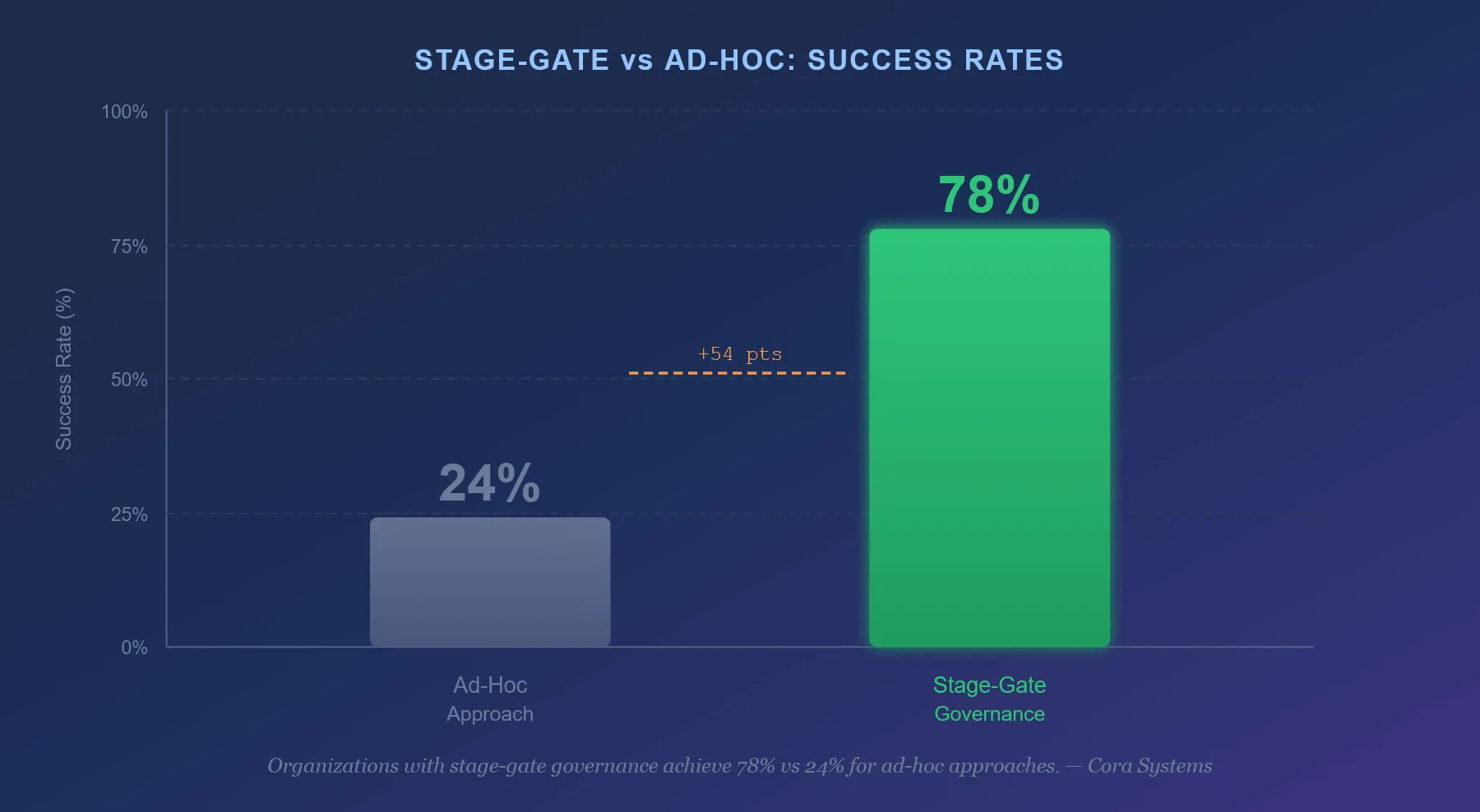
Stage-gate works because it separates the decision (go/hold/kill/recycle) from the emotion. You write the criteria beforehand and measure the project against them.
The kill decision is structured, not personal.
Every stage gate needs clear exit criteria: the specific conditions that would warrant killing the project. These are different from entry criteria (what you need to move in), and they’re essential.
Here’s what a practical kill-trigger framework looks like:
| Signal | What It Means | Recommended Action |
|---|---|---|
| No milestone progress in 60+ days | Execution stalled | Hold review with sponsor; investigate blockers |
| Strategic misalignment detected | Business case invalid | Kill or redesign against new priorities |
| Resource consumption > 2x forecast | Scope expanded unsustainably | Gate review required; recalibrate or close |
| No named owner for next stage | Ownership gap | Assign immediately or close project |
The table makes it concrete. You’re not killing the project based on a hunch. You’re killing it because it crossed a line you defined months ago.
Single-point accountability prevents diffusion of responsibility and project languishing. Ownership matters just as much as criteria.
One person is accountable for each stage: not responsible (that can be shared), not consulted, but the person whose name is on the decision.
When you actually kill a project, make it a structured event: document the rationale, reallocate the resources, and capture what you learned.
This ritual removes the shame from the decision. It signals to future teams that stopping a project is a legitimate outcome, not a sign something went wrong.
Who Decides, and How
Kill decisions are inherently political. Someone’s pet project is ending. Someone’s team is being reassigned. Someone’s budget is disappearing.
Which is exactly why they need structural support.
Without a defined process, kill decisions become personal negotiations. They favor whoever has the loudest voice or the closest relationship with leadership.
PA Consulting recommends four structural solutions for organizations serious about eliminating zombie projects:
- Acknowledge that zombie projects exist within your portfolio
- Implement robust portfolio management with strong governance
- Define consistent value metrics that enable meaningful project comparison
- Build a culture where teams can flag declining benefits without career risk
The critical move is this: write your kill criteria before you approve the project.
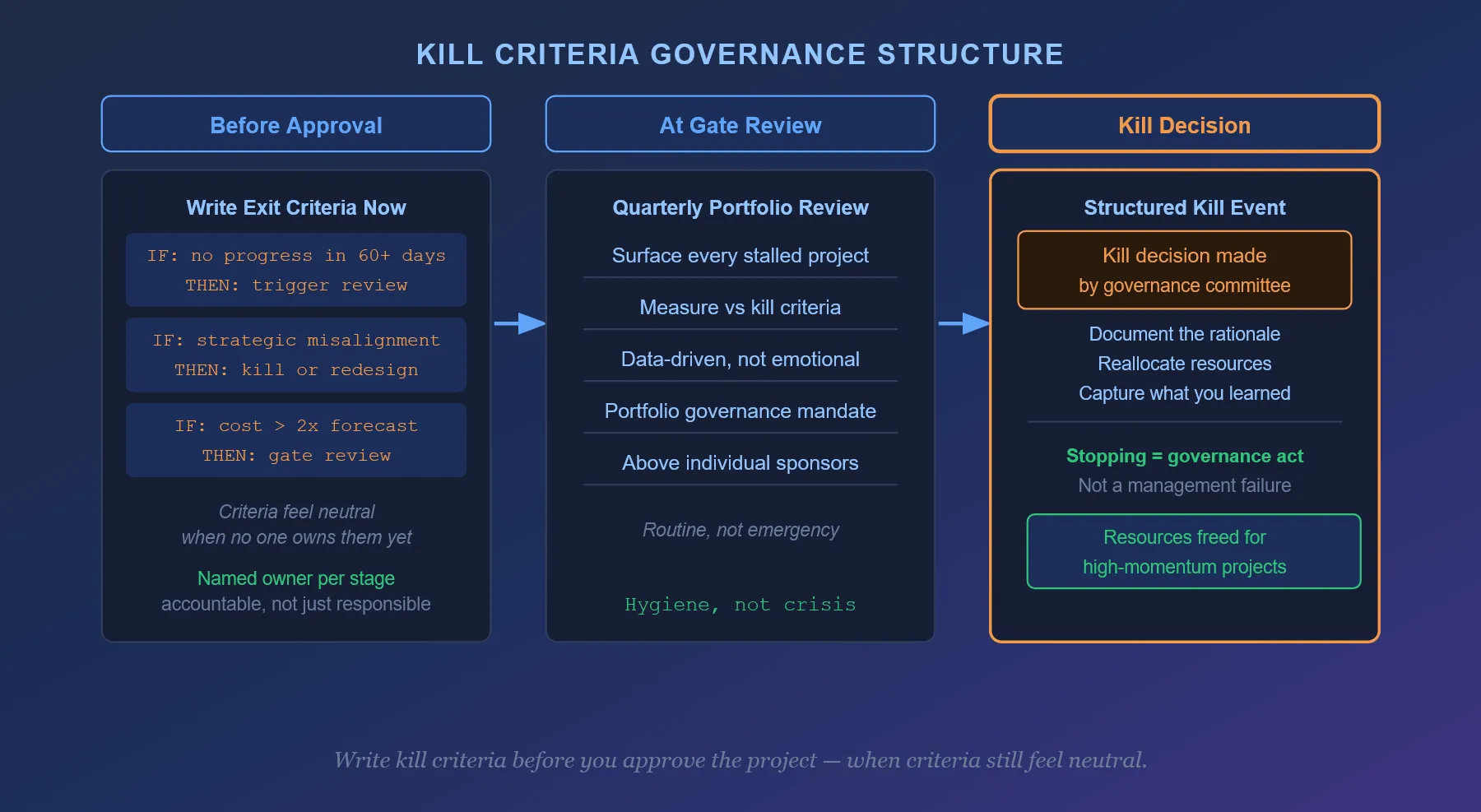
If you wait until a project is stalled and politically fraught to decide whether it should close, you’ve already lost.
The criteria get negotiated in the moment. The decision becomes about who pushes harder.
But if you write the exit criteria when you approve the project, when everyone still trusts the business case and nobody’s identity is wrapped up in it, the criteria feel neutral and fair.
This requires a decision-making layer above individual project sponsors.
Someone (usually a portfolio governance committee) needs the mandate to look at the entire funnel and call projects that no longer fit.
That mandate matters. Without it, project teams will always argue for one more quarter.
Portfolio Hygiene as a Recurring Practice
Zombie projects don’t get killed in emergency interventions. They get killed through routine.
A quarterly portfolio review is your operating rhythm. You’re not in crisis mode, you’re just doing hygiene. Every quarter, you:
- Review every stalled initiative
- Measure it against your kill criteria
- Make structured decisions
- Reallocate resources and move on
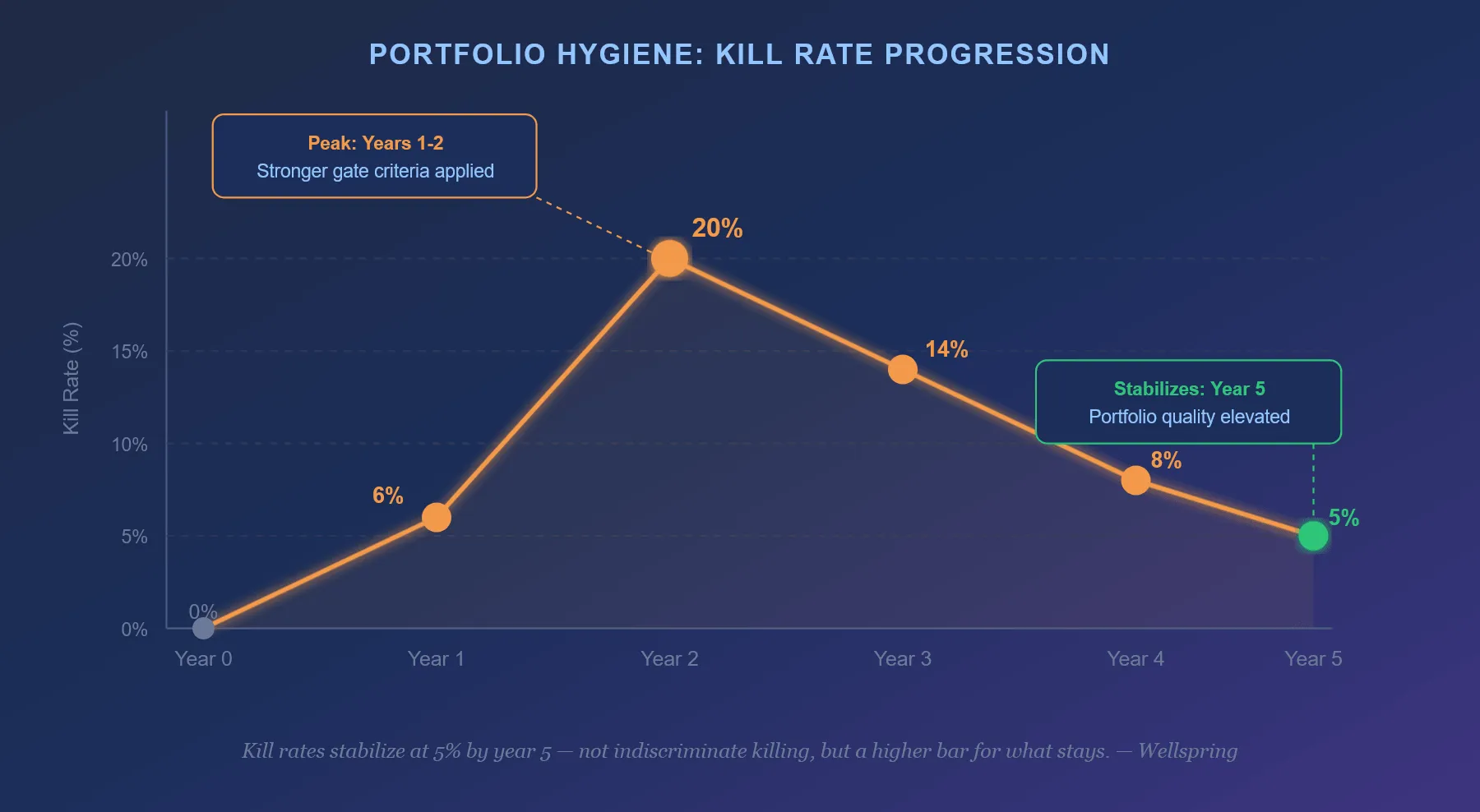
The data on this is encouraging. Kill rates escalate from 6% to 20% in years 1-2 as organizations apply stronger gate criteria, then stabilize at 5% by year 5.
That stabilization matters. You’re not creating a culture of indiscriminate killing. You’re raising the bar for what stays in the portfolio.
Each project that closes frees resources for initiatives with actual momentum. Those freed resources compound over time.
Year 3 of strong portfolio hygiene looks different from year 1. Not because you’re smarter about which projects to start. Because you’ve stopped carrying the ones that should have ended.
Portfolio hygiene also shifts the emotional tone. When teams know that stalled projects will surface in a quarterly review and decisions will be transparent, they flag problems earlier.
The conversation shifts from “we have to protect this project” to “what do we actually need from this project, and is it delivering?”
Stop Projects on Purpose
Zombie projects survive because the system allows it. Your innovation managers can see the problems. But they can’t fix them without a structure that makes killing legitimate.
Killing a project is not a management failure. It’s a governance act.
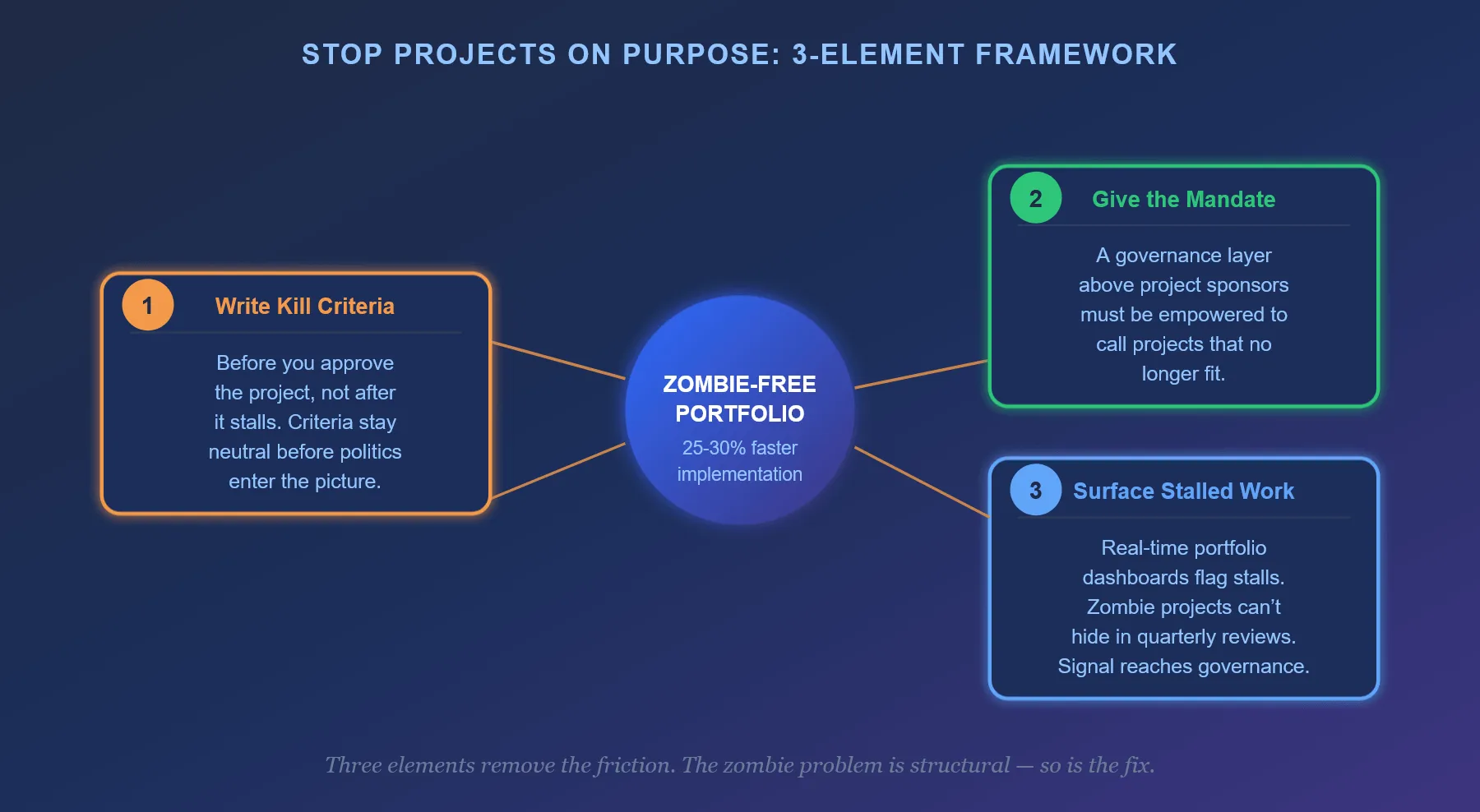
The fix comes down to three things:
- Write kill criteria before you approve the project
- Give someone the mandate to act on them
- Surface stalled initiatives so they can’t hide
Build a portfolio structure with those three elements and the friction disappears. Research shows 25-30% faster implementation through standardized funnels and improved governance.
Your zombie problem isn’t unique. But your answer to it can be.
Download our free ebook Project Portfolio: From Opportunities to Value to learn how to build a portfolio structure that stops zombie projects from accumulating.
Request a demo to see how Accept Mission gives you real-time portfolio visibility, structured stage gates, and clear ownership at every stage.








 English
 Dutch
Dutch Portuguese
 Spanish
 French
 German
 Arabic