
Governance Cadence: Monthly, Quarterly, or Continuous?8 min read

Most innovation programs inherit their governance rhythm from somewhere else. Not from first principles. Not from where they actually stand.
The defaults are familiar:
- Quarterly, because finance reports quarterly
- Monthly, because the board meets monthly
- Or whatever a respected peer is doing
They pick it by accident, and then they’re stuck with it.
The cadence you choose determines whether governance moves decisions forward or just fills calendars.
The right cadence isn’t a best practice you copy. It’s a design decision that tracks where your program actually sits.
Why Cadence Is a Design Decision, Not a Default
A governance cadence answers one question: when do decisions happen? It’s separate from decision rights, which answer who decides.
And this distinction matters enormously.
Defaulting to a cadence without thinking shows up in two specific ways:
- Slow decisions: If your program needs monthly funding decisions but you review quarterly, you’ve built a three-month queue. Ideas age, teams lose momentum, and competitive windows close.
- Wasted effort: Early-stage programs attempting continuous governance without clean data create noise, not clarity. The processes aren’t stable and meetings become hard to read.
Most organizations don’t realize they’ve made this mistake. They say “the steering committee decides” (decision rights) and then schedule it for quarterly meetings (cadence).
But what happens to ideas in month one? They sit in month two and finally get reviewed in month three.
That’s rationing disguised as governance.
Here’s what actually works: ask what your program needs to decide and how fast. Then design a cadence that fits.

Three Cadence Models and What They’re Actually For
These three models represent distinct governance rhythms. They’re not equally suitable for every program, and they’re not always mutually exclusive.
But each one has a job.
| Cadence Model | What It Looks Like | What It Solves |
|---|---|---|
| Monthly | Venture board convenes, teams present evidence-based cases for funding tranches, kill criteria are enforced, decisions move forward or ideas are redirected. Focus: operational governance. | Keeps the pipeline moving, prevents stagnation, maintains decision authority over resource allocation, surfaces blockers in real time. |
| Quarterly | Portfolio health sync with executive stakeholders, learning velocity reported, strategic realignment happens, next quarter’s budget and focus areas are set. Focus: strategic governance. | Bridges innovation rhythm with corporate financial cycles, ensures leadership alignment, creates accountability for measurable outcomes, justifies continued investment. |
| Continuous | Live dashboards show funnel health, automated routing pushes decisions to the right owners at the right time, escalation paths have defined SLAs, teams see what’s happening without waiting for a meeting. Focus: real-time signals. | Eliminates decision queues, reduces cycle time, catches emerging issues immediately, lets operational teams move without approval theater. |
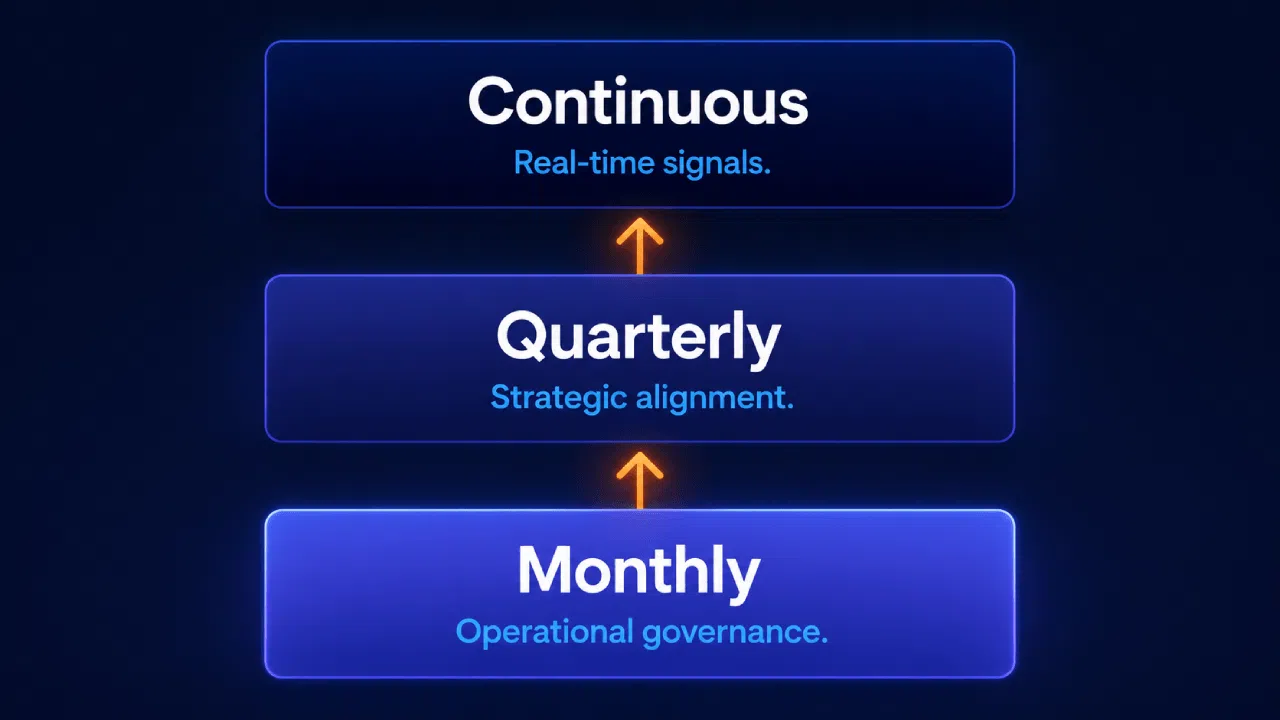
The most advanced programs use all three. Monthly reviews handle the operational rhythm, quarterly syncs handle strategic alignment, and continuous monitoring handles the signal layer in between.
Together, they create structure and transparency across the full innovation portfolio. Decisions are visible, value is tracked, and nothing falls through the gaps between review cycles.
But not every program is ready for that stack. And forcing it creates overhead without payoff.
The Maturity Dimension: Which Cadence Fits Where You Are
This is where the framework becomes practical. Your program sits somewhere on a maturity curve, and your cadence should track that position.
Most organizations move along this progression. Few should skip steps.
| Maturity Level | Typical Signals | Recommended Cadence |
|---|---|---|
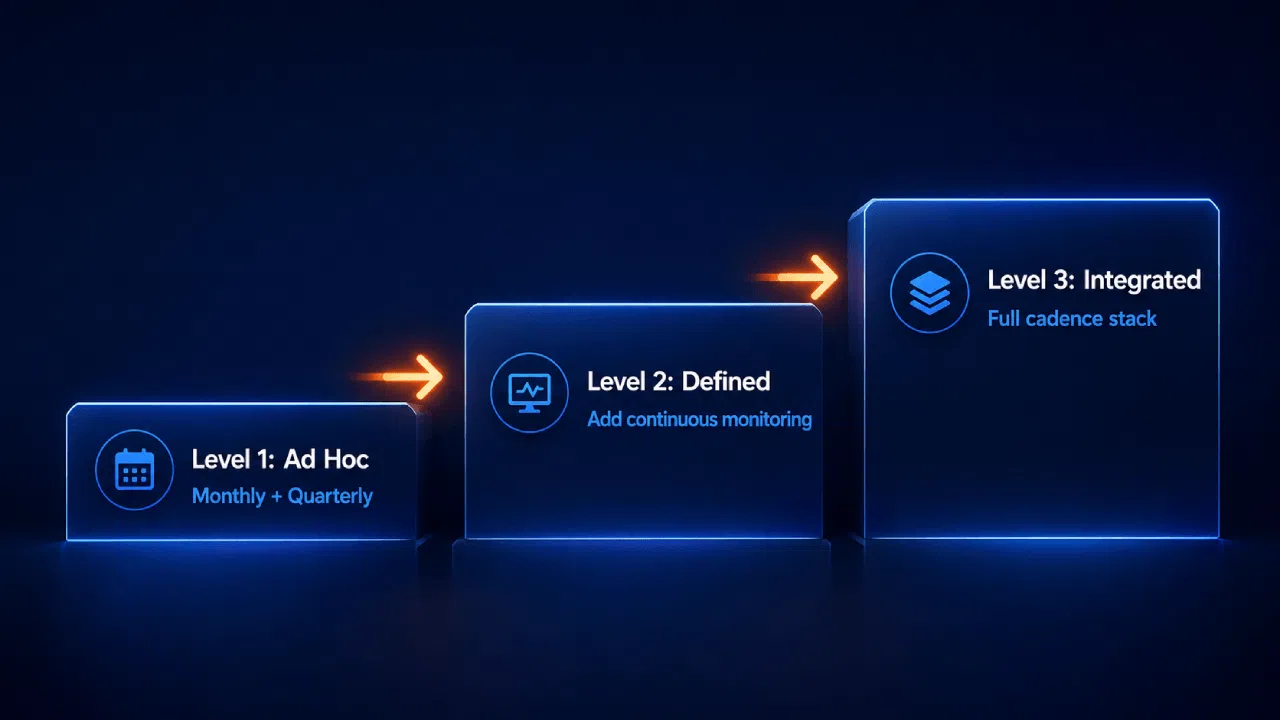
| Level 1: Ad Hoc / Reactive | No standardized workflow. Ownership is unclear. Decisions made on gut feel or politics. Ideas live in email, spreadsheets, or people’s heads. | Monthly + Quarterly. No continuous yet. Build the data foundation first. |
| Level 2: Defined | Processes are documented. Some dashboards exist. Partial automation. Teams know where ideas go. Not everything is automated, but the path is visible. | Monthly + Quarterly, with light continuous monitoring. You’re ready to add signals. |
| Level 3: Integrated | Automated routing. Structured funnels. Real-time data. Escalation paths are embedded. Governance is distributed, not centralized. | Full cadence stack: Monthly operational reviews, quarterly strategic alignment, continuous signals and automated routing. |
Let’s be clear about what happens when you skip levels. A Level 1 program attempting continuous governance is gambling.
Without data infrastructure, without clear ownership, without stable processes, “continuous governance” becomes constant chaos. What starts as “continuous” becomes “ad hoc with better branding.”
Dashboards show red flags that nobody acts on. Escalation paths have no authority behind them.
The inverse trap is also real. A Level 3 program reviewing only quarterly is like a fire department inspecting the building once a quarter.
Decisions that should happen monthly queue up. Ideas stagnate, and teams start working around the process.
Monthly vs. Quarterly: How to Use Both Without Duplication
The dual-cadence model is worth explaining because it’s what most mature programs run, and it’s often misunderstood as duplication.
The key difference is what gets decided.
- Monthly venture board: Operationally focused. Reviews the current funnel, decides which ideas get the next funding tranche, and enforces kill criteria. The question it answers: are we moving things forward?
- Quarterly sync: Strategically focused. Reviews portfolio balance, aligns resourcing with corporate priorities, and reports learning velocity. The question it answers: are we moving the right things forward?
These are different questions. They require different participants and different prep.
For the monthly review, teams bring evidence packets, not status updates: here’s the idea, here’s what we learned in the last 30 days, here’s what we’re asking for next.
Kill decisions happen here, funding moves forward, and the meeting is tight and disciplined.
For the quarterly review, leadership brings strategic perspective. This is where the portfolio gets pressure-tested against strategy and priorities cascade back into the monthly rhythm.
The two cadences feed each other. Without both, you either move quickly without strategic alignment, or you have perfect strategic alignment and nothing ships.
What “Continuous” Actually Means (And What It Doesn’t)
Continuous governance is perhaps the most misunderstood term in innovation management.
It doesn’t mean constant meetings or daily decisions. It means decisions happen when they should, not all at once in a scheduled review.
What continuous governance actually requires is infrastructure:
- Live dashboards that show current funnel state
- Automated workflow triggers that route decisions to the right owner when criteria are met
- Escalation paths with defined SLAs
- Role-based visibility so teams see what’s relevant to them without information overload
Continuous governance on spreadsheets and email can’t work. Without a platform, “continuous” becomes “managers swimming in data, unable to find the signal.”
Add digital infrastructure, and continuous governance becomes viable. Blockers surface immediately, and decisions get routed to the right owner.
AI-supported scoring and routing amplify this. It’s a value amplifier in scoring and routing, supporting better decisions without replacing human judgment.
At Level 1 maturity, adding a platform creates clearer chaos, not clarity. At Level 3, the right platform makes a mature program frictionless.
Signals That Your Cadence Needs to Change
Most teams know when their cadence is broken, but they attribute it to something else.
Here are the actual signals that your rhythm is mismatched to your maturity:
- Your pipeline is clogged between review cycles. Ideas sit for 30+ days with no status change because nobody has authority to move them forward until the next review.
- Your review meetings produce no actionable decisions. You discuss trends and adjourn without changing resources, priorities, or next steps.
- Teams are working around the governance cycle. Decisions happen in side conversations or Slack, and the formal process feels irrelevant.
- Your dashboard shows red flags that nobody acted on between reviews. A metric drops. A timeline slips. Nothing happens until the next scheduled sync.
- Your governance feels like theater. Rigorous agendas, good attendance, thorough discussion, but strategic outcomes don’t shift and decision velocity doesn’t improve.
Any one of these is worth taking seriously. Multiple signals mean your cadence is out of sync with where you actually are.
The temptation is to blame the team, the process, or the tool. The signals almost always point elsewhere.
A mismatched cadence isn’t a people problem. It’s a design problem, and design problems have design solutions.
Start With Your Current State, Not Someone Else’s Process
The right cadence matches your current maturity, not the one you admire from a more advanced program.
Most programs follow a predictable build sequence:
- Start with monthly operational reviews plus quarterly strategic alignment
- Add continuous monitoring once that foundation is solid
- Add AI-assisted routing once monitoring is mature
Each step builds on the previous one. When decision rights and cadence align with maturity, bottlenecks disappear and teams move.
Download our ebook on innovation governance and structured workflows, or book a demo to see how Accept Mission handles automated routing, escalation workflows, and audit trails.



 English
 Dutch
Dutch Portuguese
 Spanish
 French
 German
 Arabic