
The Innovation Review Board Playbook: Roles, Agendas, and How to Actually Make Decisions11 min read

Most innovation review meetings run 90 minutes and end with a single sentence: “Let’s discuss this further next time.”
The pattern is always the same:
- Gatekeepers absorb information in real time and lean on instinct, because no pre-read arrived in advance
- Roles are vague, so everyone weighs in equally and no one is actually accountable for the decision
- Scorecards are referenced once at the start, then quietly ignored when the discussion turns political
- Projects exit the session with no logged outcome, no owner, and no kill rationale on file
The problem is structural. Each dysfunction traces back to a fixable gap in how the review is designed.
An Innovation Review Board (IRB) is the structural fix. Each session becomes a governance event with one job: produce a clear, logged decision on every idea reviewed.
Four things determine whether that happens: who holds which role, what the pre-read contains, how the agenda is designed, and what decisions the board is authorized to produce.
Why Innovation Reviews Break Down
Review boards rarely fail because the people in them are wrong. They fail because the structure around the people is wrong.
The same dysfunctions appear in organization after organization. They trace back to a small number of structural gaps.
| Symptom | Root Cause |
|---|---|
| Gatekeepers ask basic context questions | No pre-read distributed in advance |
| Everyone weighs in, no one decides | No named Approver, unclear authority |
| Scorecards built but rarely cited | Criteria not enforced as the decision basis |
| Projects neither approved nor killed | No defined outcomes, no logged decisions |
| Same ideas reappear every quarter | No kill discipline, no documented rationale |
Gatekeepers walk into the room without having read anything. They absorb information in real time, ask surface-level questions, and lean on instinct.
According to Wellspring, this is how gatekeepers end up making “low-confidence choices” on decisions that commit real capital.
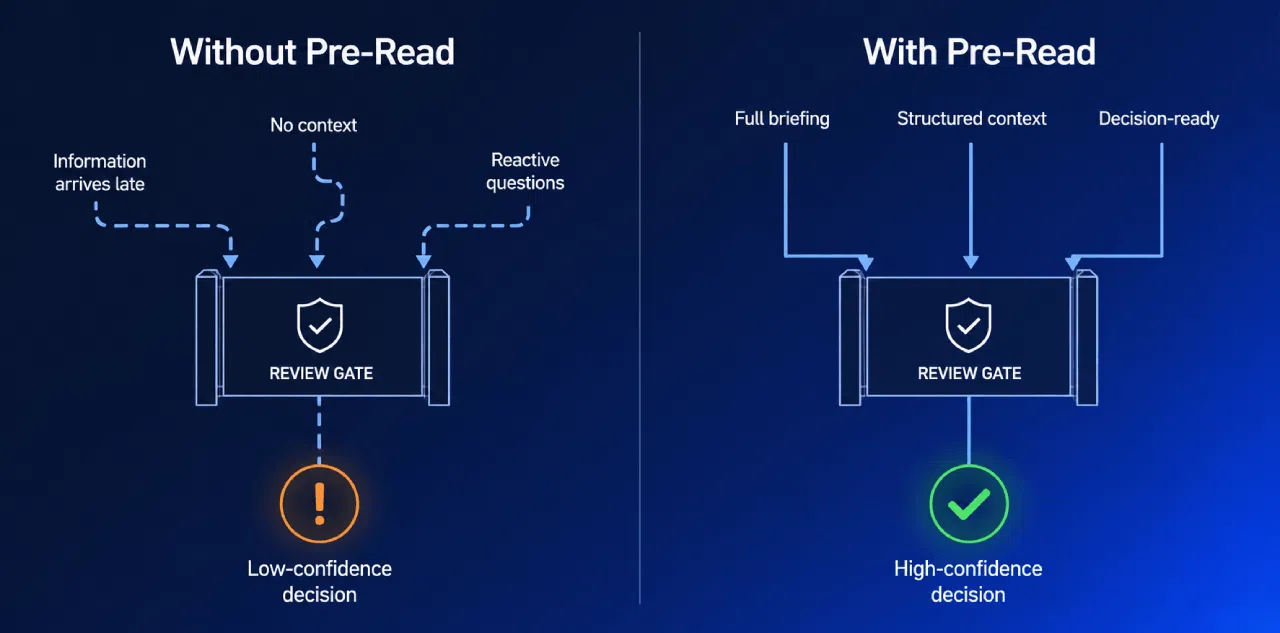
Roles are vague. Everyone in the room feels entitled to weigh in equally, which means no one is accountable for the decision.
Authority fog sets in. The meeting drifts toward consensus rather than judgment.
Criteria exist on paper but not in practice. As Wellspring notes, decisions end up driven by “gut feelings, political pressure, or a project’s momentum.”
The scorecard is referenced once, then quietly ignored. When the meeting ends, the outcome is some version of “let’s see where this goes.”
ReallyGoodInnovation notes that a board lacking enforced kill authority quickly becomes irrelevant. Fortunately, every identified symptom corresponds to a specific, fixable structural gap.
The next four sections work through each one.
The Five Roles Your Review Board Needs
A working IRB demands five clear roles, assigned before the meeting using DACI or RAPID, which avoids ambiguity and the mistake of treating the board as a committee of equals.
This structure is vital because a committee of equals produces consensus, and consensus is the enemy of kill decisions.
| Role | Core Responsibility | What They Do NOT Do |
|---|---|---|
| Decision Authority (Board Chair) | Makes the final Go, Kill, Hold, or Recycle call | Run the meeting logistics or present the idea |
| Cross-Functional Gatekeepers | Evaluate against criteria from their domain (Finance, Ops, Technical) | Vote democratically or override the Chair |
| Innovation Manager (Facilitator) | Runs the agenda, enforces time-boxes, captures decisions | Advocate for or against specific ideas |
| Idea Owner | Presents context, answers clarifying questions | Vote, lobby, or participate in the decision discussion |
| Recorder | Logs the decision, rationale, owner, and next gate date | Influence the decision or join the debate |
The Idea Owner role is often misread; organizations invite the project lead into the decision discussion. The owner advocates and applies subtle pressure.
This behavior contaminates the process. In a well-run IRB, the owner presents, answers questions, and then leaves the meeting’s decision portion.
This discipline protects the integrity of all other decisions on the table.
The Decision Authority needs real budget authority, not senior rank. Without it, a ‘Kill’ is just a recommendation, and the IRB structure will erode quickly.
What Goes in the Pre-Read Package
The pre-read is the single highest-leverage piece of the entire IRB system.
It’s the difference between a meeting where gatekeepers arrive ready to decide and one where they spend 30 minutes catching up.
Amazon’s model is worth borrowing from: a short narrative memo, distributed in advance, with silent reading at the start of the meeting.
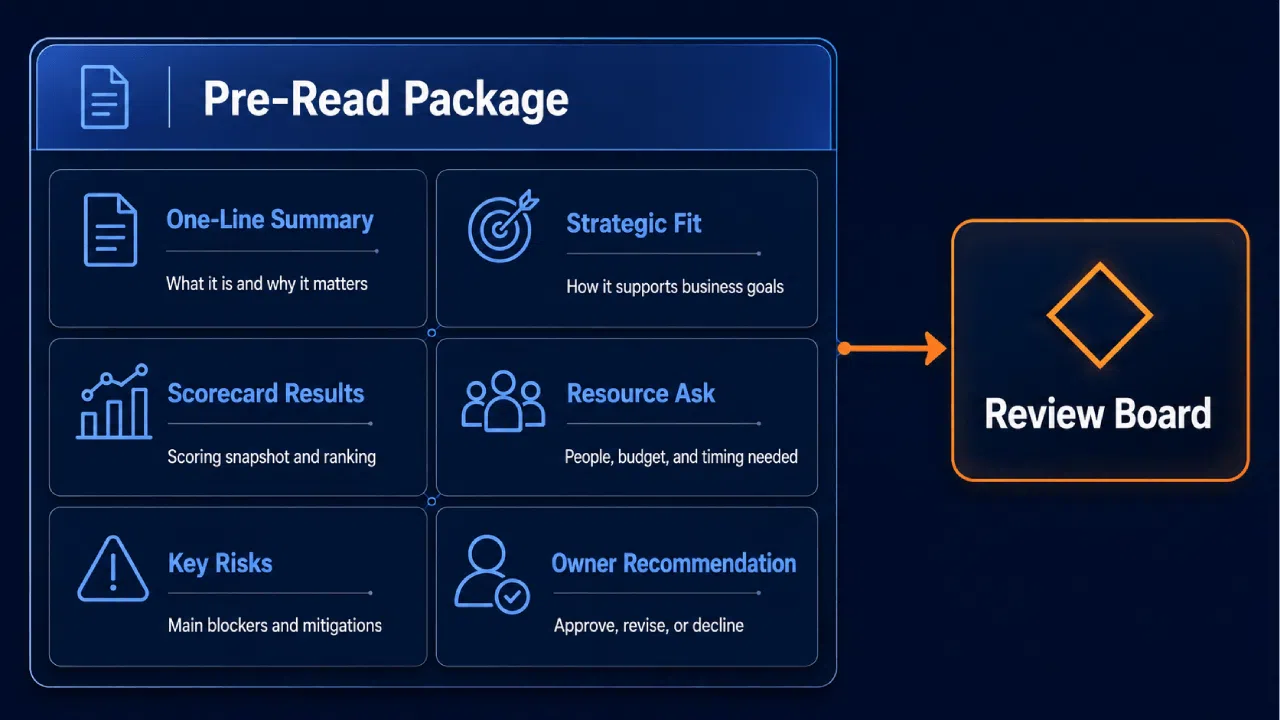
The specific format is secondary to what the document achieves. The pre-read has one job: give each reviewer enough context to contribute meaningfully to a decision.
The innovation manager and idea owner build the package together. The owner provides substance; the manager enforces format, length, and clarity.
Distribution happens 48 to 72 hours before the session, no later. If the pre-read arrives the morning of, the meeting reverts to a presentation by default.
A working pre-read includes:
- One-line summary of the idea and the decision being requested (Go to next gate, Kill, Hold, Recycle)
- Strategic fit statement linking the idea to a named enterprise target or portfolio theme
- Scorecard results against the standard gate criteria, with any flagged risks called out
- Resource ask for the next stage: budget, headcount, timeline, dependencies
- Key risks and open questions the team has not yet resolved, stated honestly
- Recommendation from the Idea Owner, explicitly framed as a recommendation rather than a decision
The recommendation field is where most pre-reads fail. Owners write a sales pitch, and the board has to do extra work to separate signal from advocacy.
Coach owners to write a recommendation the way an analyst would: what they would do, why, and what would change their mind.
In practice, the pre-read converts the meeting from an information session into a decision session. Without it, the rest of this playbook does not hold.
How to Structure the Agenda
An IRB session should run 45 to 75 minutes per idea. Anything beyond that signals the pre-read failed or the criteria are too subjective.
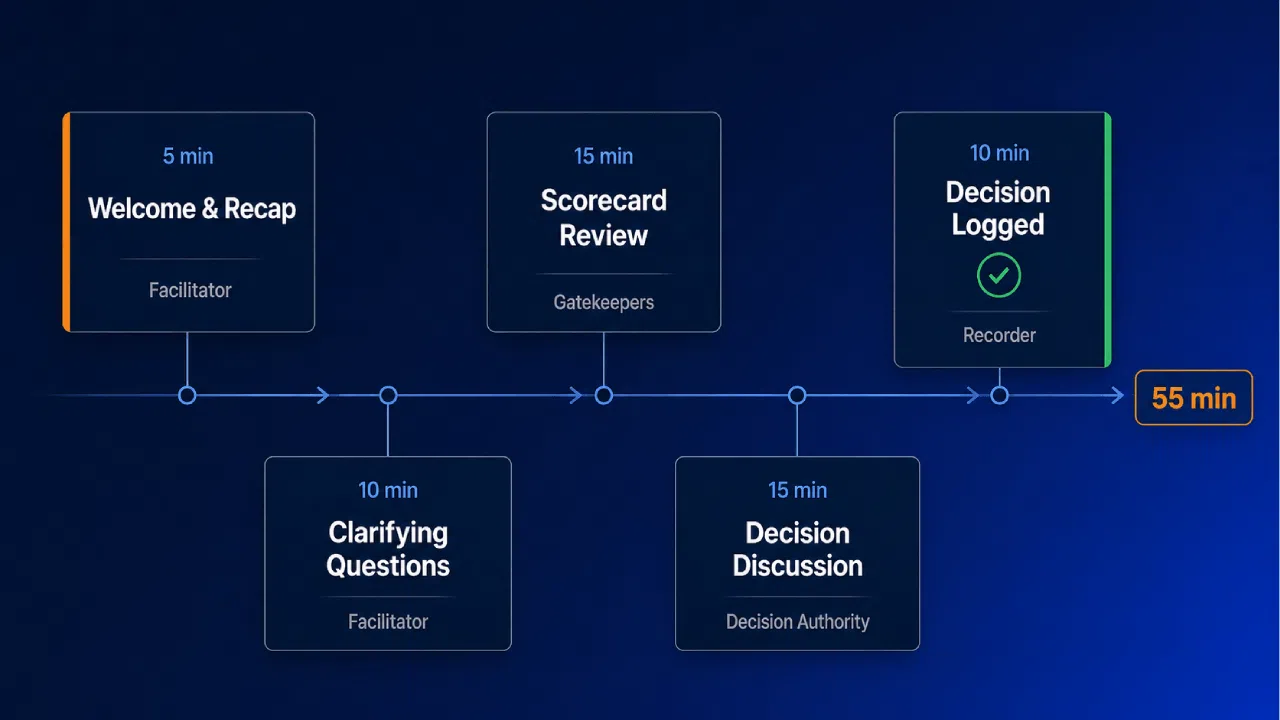
The agenda is built backward from the decision: every block exists to get the room to a logged outcome.
The structure below is decision-driven: the Idea Owner presents nothing in the traditional sense and answers questions instead.
The work is in the criteria, the scorecard, and the discussion against both.
| Agenda Block | Time | Purpose | Who Leads |
|---|---|---|---|
| Welcome and recap | 5 min | Confirm decision requested, restate criteria | Facilitator |
| Clarifying questions only | 10 min | Reviewers ask, Owner answers, no debate | Facilitator |
| Structured scorecard review | 15 min | Walk through scores against gate criteria | Gatekeepers |
| Decision discussion against criteria | 15 min | Owner exits, Board debates against criteria only | Decision Authority |
| Decision logged and ownership assigned | 10 min | Outcome recorded, next steps and owner named | Recorder |
Two design choices matter here. Clarifying questions are separated from the decision discussion, and the Owner is present for one but not the other.
This single rule kills most of the political pressure that creeps into review meetings. Second, the scorecard block sits before the discussion block, not inside it.
The score is the anchor, and the discussion interprets it.
If a session repeatedly runs long, the issue is almost always upstream. The pre-read was thin, or the criteria are too subjective to apply cleanly.
Fix the upstream gap rather than expanding the meeting.
The Four Outcomes (and What Follows Each)
Every idea reviewed must end the session in one of four states. Not “we’ll circle back,” and not “let’s get more data and revisit.”
One of four, logged in writing, with an owner attached.
A Go decision, as Wellspring frames it, “isn’t an endorsement of an idea. It’s a capital commitment.”
That framing applies in reverse: a Kill reallocates capital to better bets. Naming the outcome cleanly is how you stop carrying dead projects.
| Outcome | Definition | What Happens Next | Owner |
|---|---|---|---|
| Go | Approved to next gate with confirmed resourcing | Budget released, team staffed, next gate date set | Idea Owner |
| Kill | Project stopped, learnings captured | Documented rationale logged, team reassigned, post-mortem scheduled | Innovation Manager |
| Hold | Paused pending a specific, named condition | Trigger condition documented, review date set, owner monitors | Innovation Manager |
| Recycle | Returned to team for specific rework | Rework scope defined in writing, re-submission date agreed | Idea Owner |
The Hold outcome is the most abused. Hold should mean a specific, written trigger: a market signal, a partner decision, a budget cycle.
If you cannot name the trigger, the project is a Kill in disguise. Hold without a trigger is how portfolios accumulate zombies.
Recycle comes with a defined scope and a deadline. The rework scope and re-submission date go in the log at the end of the session.
If an idea is recycled twice without clear progress, it converts to kill at the third gate. State this rule once, in writing, and enforce it.
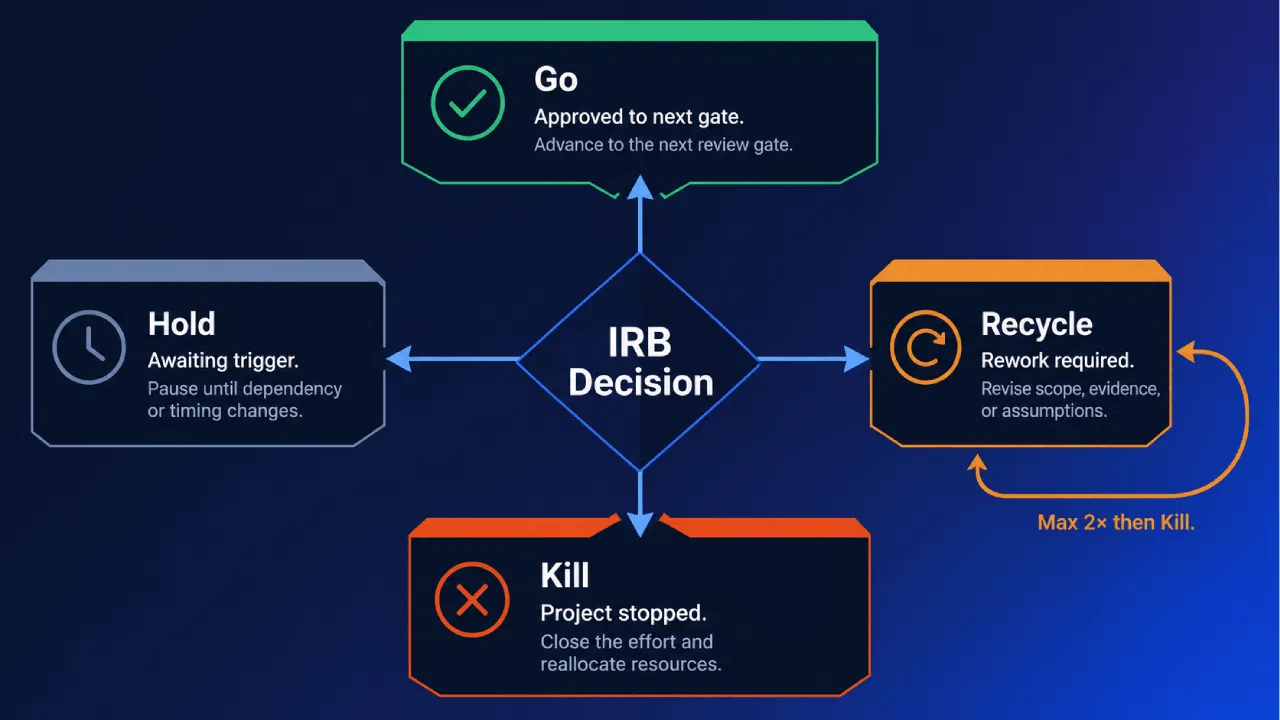
A working IRB should produce a high kill rate. Kill rates are evidence of a functioning system.
When the Board Breaks Down Anyway
Even with the structure in place, three failure modes will reappear. They are system pressures that erode governance whenever the structure is not actively defended.
Here is how each one appears and what to do about it:
| Failure Mode | What It Looks Like | Fix |
|---|---|---|
| Kill authority without enforcement | A senior leader overrides a Kill because they sponsored the project, or because the team “worked so hard.” | Log every override with written rationale. Review it at the full board’s next session. |
| Criteria drift | Gatekeepers start scoring on instinct and using criteria as post-hoc justification. The scorecard becomes ceremonial. | Audit a sample of decisions every quarter against the documented criteria. Divergence means the criteria need a rewrite or the gatekeepers need recalibration. |
| Board size creep | Every quarter, someone new gets added “for visibility.” Within a year, the room has 14 people and no one is accountable. | Cap the standing board. Treat additional attendees as Informed observers, not Contributors. |
One undocumented override makes every future kill decision negotiable. Board size creep dissolves accountability slowly enough that no one notices until it is too late.
All three share the same root: the structure was not actively defended when it was first tested. Governance doesn’t decay all at once, but erodes one exception at a time.
Build the Process Once, Then Protect It
The IRB is a governance system. Governance systems erode the moment they stop being defended.
The platforms that keep IRB structure intact share a few traits:
- Standardized funnels and scorecards, so criteria are applied consistently across every gate
- Automated routing and escalation, so decisions do not stall waiting for an inbox
- AI-assisted scoring that flags consistency gaps before the review session begins
- Audit trails on every Kill, Hold, and override, so the system stays honest
Let one Kill go undocumented, one Hold skip its trigger, one quarter pass without a criteria review. The structure quietly returns to what it was before.
The structure holds only if it is applied consistently, session after session.
Download our ebook on innovation governance for a practical look at how teams build the decision infrastructure behind a working IRB.
Book a demo to see how Accept Mission handles automated routing, escalation workflows, and audit trails.

![[Discussion] The role of a Chief Innovation Officer (CINO)](https://www.acceptmission.com/wp-content/uploads/2022/02/boss-shaking-hands-with-employee-at-meeting-500x383.jpg)






 English
 Dutch
Dutch Portuguese
 Spanish
 French
 German
 Arabic