
Project Funnel vs. Kanban: Where Each One Wins (and Where It Breaks)12 min read

Both models sit inside serious innovation organizations. You’ll find Kanban boards running engineering sprints and stage-gate funnels governing the portfolio, often in the same building.
The right model depends on four things:
- Work type
- Decision weight
- Governance needs
- Portfolio complexity
That coexistence is the clue. These two systems were never built for the same job, even though teams treat them as interchangeable defaults.
The honest answer to “which one should we use” is that it depends on the work in front of you.
This is a decision guide. First, where each model wins. Then, where each one breaks when applied to the wrong kind of work.
Why Innovation Work Defies Standard Execution Logic
Innovation work is structurally different from standard task execution. The difference shows up across three dimensions:
- Uncertain requirements: At the start, you don’t know what “done” looks like. The problem itself is still being defined as you go.
- Strategic resource competition: Multiple initiatives chase the same scarce engineers, budget, and leadership attention. Funding one is a choice to starve another.
- Irreversible investment risk: Committing too early to the wrong bet is expensive, and that cost is rarely recoverable once people and money are spent.
Standard task management tools assume known workflows. Kanban was designed for exactly that situation: a steady stream of well-understood work moving through predictable steps.
Innovation work violates all three of those assumptions at once. The requirements shift, the resources are contested, and the bets are hard to unwind.
That’s why the execution model choice is a structural fit question, not a matter of team preference.
Pick the model that matches the work, and most downstream problems get easier to manage.
What These Models Are Actually For
Most innovation managers already know how both systems operate. The useful distinction sits in what each was designed to solve.
A stage-gate funnel is a portfolio governance model. Work moves through defined stages, releasing the next round of investment at each gate based on accumulated evidence.
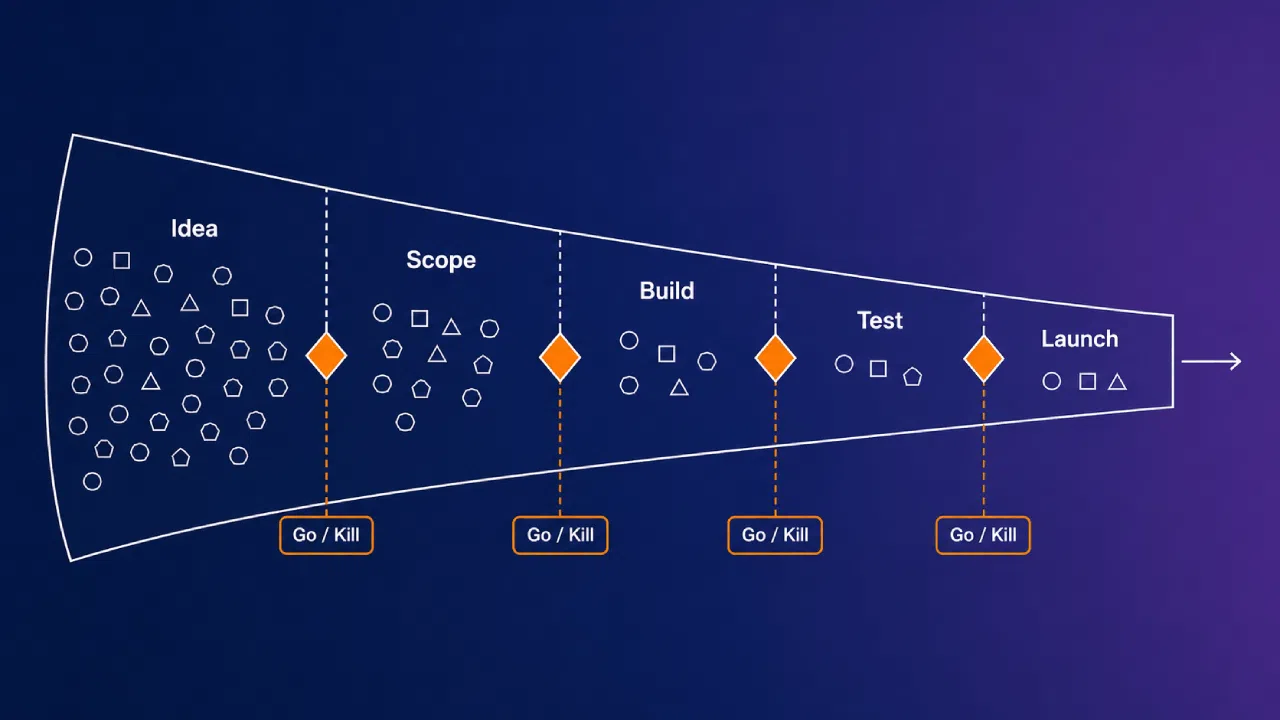
Investment scales as uncertainty drops. You commit small early, then commit more only when the evidence justifies it.
Kanban is a flow management tool. It pulls work through a visual board, limits work in progress, and surfaces what is moving and what is stuck.
It excels at throughput on known, repeatable work. There are no Go or Kill gates because Kanban was never built to make portfolio-level investment decisions.
The two tools solve fundamentally different problems. One governs where money and attention go; the other governs how work flows once that decision is already made.
The Dimensions That Determine the Right Fit
Choosing between the two starts with naming the dimensions that actually drive the decision. The table below shows where each model belongs.
| Dimension | Stage-Gate Funnel Wins | Kanban Wins |
|---|---|---|
| Work type | Novel, high-investment, exploratory with uncertain requirements | Repeatable, continuous, known-workflow execution |
| Governance needs | High: regulatory compliance, capital gating, executive sign-off | Low: team-level flow visibility is sufficient |
| Portfolio complexity | High: multiple projects competing for resources | Low: single-team, single-workstream flow |
| Investment size | Large: staged resource commitment essential | Small to medium: continuous resourcing with WIP limits |
| Failure tolerance | Explicit kill criteria needed | Continuous improvement, no binary go/kill decisions |
| Time horizon | Long-cycle NPD (months to years) | Short-cycle delivery (days to weeks) |
| Industry context | Pharma, automotive, aerospace, CPG, energy | Software, digital, marketing operations |
Two dimensions carry most of the weight: work type and portfolio complexity.
Novel, uncertain work needs deliberate checkpoints where you can stop, reassess, and redirect before committing more capital.
Repeatable work doesn’t need that. When the path is known, gates only add friction, and Kanban’s continuous flow fits better.
Portfolio complexity shifts the equation again. When several initiatives compete for the same budget and people, you need a model that surfaces those trade-offs and forces a choice.
Kanban shows a single stream beautifully. It wasn’t designed to arbitrate between twelve of them.
Where Kanban Breaks Down in Innovation Contexts
Kanban is a tactical tool. Applied as a strategic governance model for an innovation portfolio, it fails in predictable ways.
Three structural failures show up when teams stretch it beyond its design:
- No Go or Kill mechanism. Cards move until someone intervenes or resources run out, so weak projects keep consuming capacity. Healthy funnels do the opposite: 40 to 60% of early-stage ideas are killed at early gates.
- Portfolio blindness. Cards show task status, but never resource contention, strategic dependencies, or whether a project still aligns with company objectives.
- The maturity gap. David J. Anderson created the Kanban method, and his school warns that scaling it into a governance layer too early is “doomed to failure”.
Google Glass is the cautionary version of this pattern.
The company committed to manufacturing and marketing before it had validated real demand, and the privacy, battery, and use-case problems surfaced only after the device reached users at $1,500.
A gate would’ve caught those problems earlier. Without deliberate decision points, work continues on momentum, and momentum isn’t a strategy.
When to Kill a Project (And How to Make It Stick)
The 40 to 60% early-gate kill rate in healthy portfolios is a feature, not a bug. Most organizations kill far fewer projects than they should.
The reason is rarely a lack of insight. Teams usually sense when a bet has gone cold; what they lack is the structural permission to act on it.
Stage-gate creates that permission. It defines kill criteria in advance, gives a gate the authority to decide, and separates the decision from its champion.
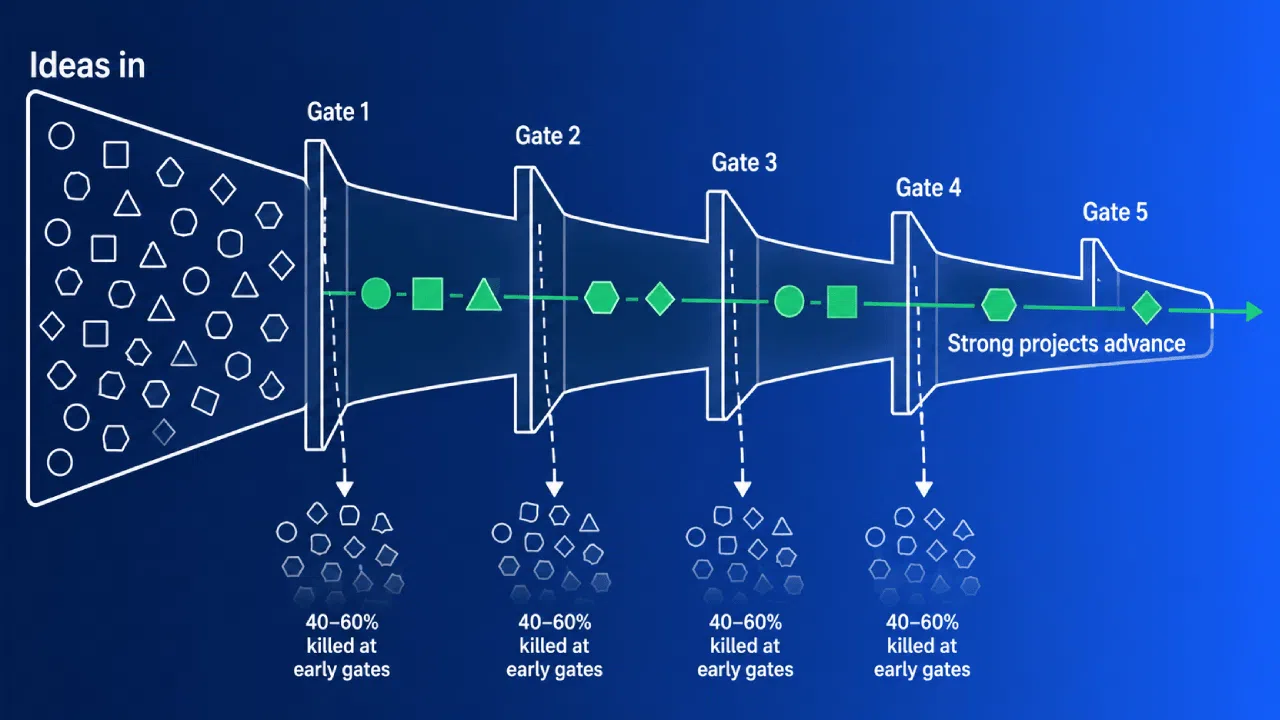
Kanban has no equivalent mechanism. A card can sit in progress indefinitely, with no one holding the authority, or the obligation, to end it.
In practice, useful kill criteria are concrete and agreed on before the stage begins. Here are four that hold up across most portfolios:
- A technical feasibility threshold the prototype fails to clear
- A market signal that demand is weaker than the business case assumed
- A resource constraint trigger, where the project needs people committed elsewhere
- Strategic misalignment, where priorities have shifted away from the project’s premise
The kill decision should sit with the gate committee, not the project team. People rarely vote to end their own work, and asking them to is a design flaw, not a character test.
The political resistance is real, and the way through it is to separate “kill this project” from “reject this person.”
Good teams produce dead projects all the time; that’s what disciplined experimentation looks like.
This matters because of the zombie problem. Projects that survive past their natural end quietly drain people and budget from the strong bets.
Organizations that apply execution-project thinking to innovation see failure rates between 40 and 90%. The kill mechanism is what prevents that outcome.
Where Project Funnels Break Down
Stage-gate has its own well-documented failure modes, and pretending otherwise would be dishonest. The difference is where the failure originates.
The most common trap is gate theater. Teams optimize for passing the gate over delivering value, so reviews become performances and the evidence gets shaped to fit.
A second trap is false certainty: forcing a detailed business case too early biases the system against transformational ideas, the ones you can’t forecast cleanly.
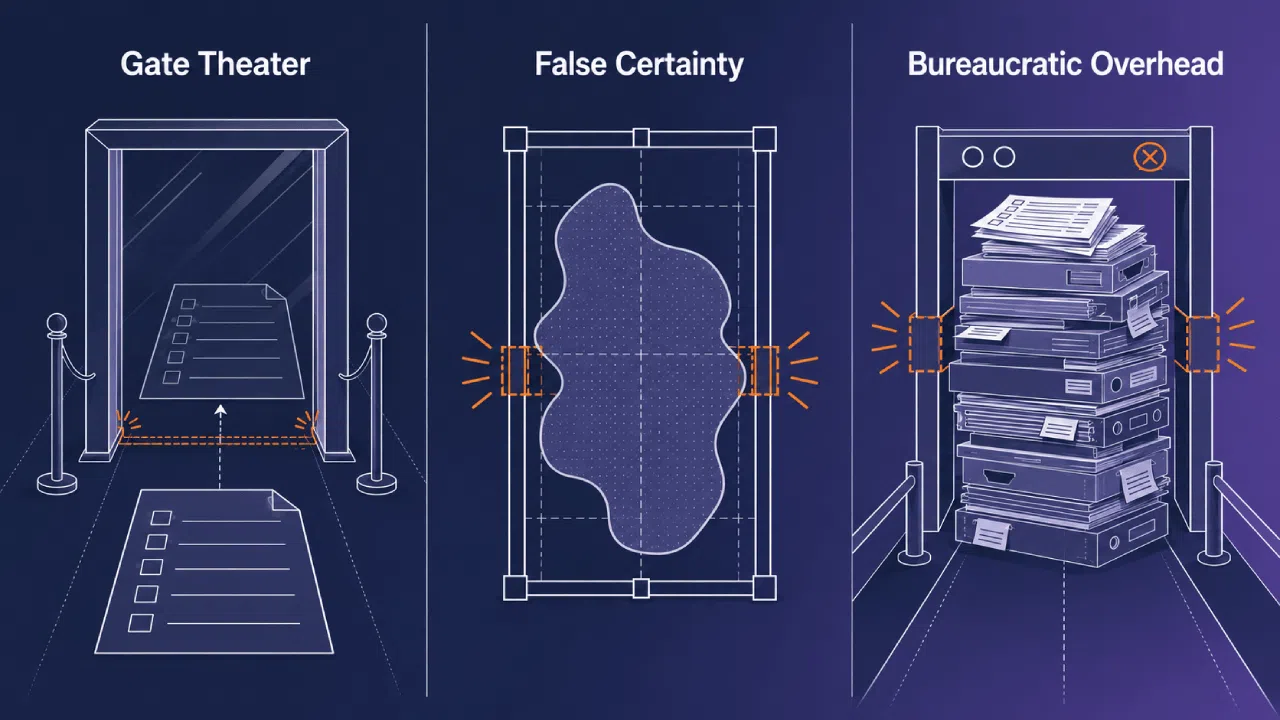
Then there’s plain bureaucratic overhead. Gates staffed by politics instead of evidence slow everything down and reward the loudest sponsor rather than the strongest project.
Here’s the thing about all three traps: they’re implementation failures, not flaws in the model itself.
Robert Cooper, who created Stage-Gate, warned that a rigid process becomes bureaucratic. That’s why his later versions push for an adaptable, accelerated approach.
A funnel run on evidence-based gates with real kill criteria avoids these traps. A funnel run on theater doesn’t.
What Good Gates Actually Look Like
Gate theater is a documented failure mode, but what does the alternative actually look like? A good gate has three concrete components.
- Deliverables: specific evidence the team brings to the gate, such as customer validation data, a cost estimate, and a technical feasibility assessment. Not a slide deck.
- Scoring criteria: pre-defined criteria the panel evaluates that evidence against, applied consistently across every project in the portfolio.
- An explicit output: not just “go” or “kill,” but a resource commitment, a timeline, and a named owner for the next stage.
The deliverables point is where most gates fail. A polished narrative is easy to assemble and tells you almost nothing; evidence is harder to fake and more useful.
Panel composition matters just as much. Members should be senior enough to commit resources, but not so senior that the gate turns into theater nobody can challenge.
There’s one rule that does more work than any other: set the gate criteria before the stage begins, not after.
Teams that define criteria after running a stage will always find a way to pass.
The evidence gets reverse-engineered to fit the outcome the team already wants. That single habit, more than any structural change, separates real gates from theater.
The Hybrid That Most Innovation Teams Actually Need
Most serious practitioners treat these as complementary layers, not competing choices. They operate at different altitudes.
Stage-gate governs the portfolio. It owns the Go and Kill decisions, resource allocation, and strategic alignment across many projects at once.
Kanban and Agile, meanwhile, govern execution inside those stages. Squads run sprints on boards while the macro governance stays gated.
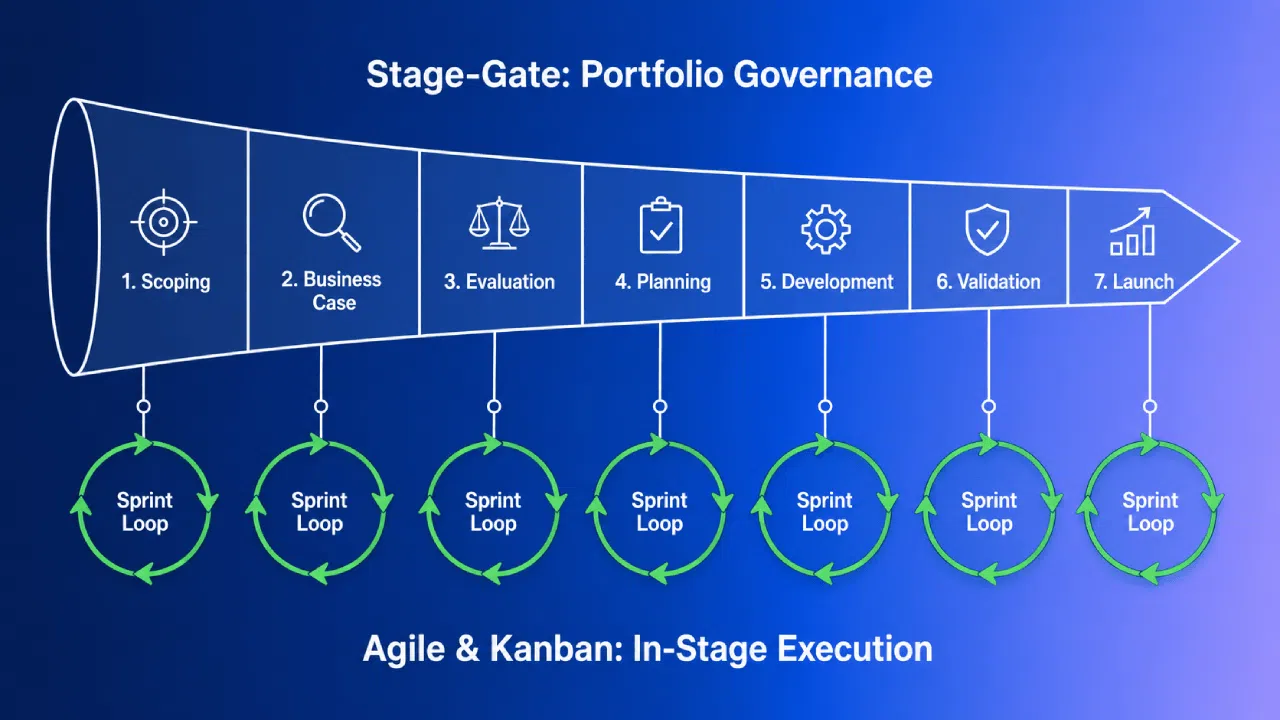
The two systems reinforce each other rather than pulling in opposite directions.
Two large Brazilian firms showed this in a peer-reviewed study. Leadership engaged at the gates while squads ran sprints with Kanban boards for visual management.
Both companies reported better productivity and customer engagement.
Cooper’s later NexGen approach formalizes this, integrating Agile at the stage level while keeping gates at the portfolio level. It’s where serious innovation has converged.
The payoff shows up in practice. Firms adopting hybrid Agile-Stage-Gate have estimated roughly a 30% improvement in time-to-market, alongside similar gains in team productivity.
A Practical Guide: When to Use Each Model
The decision gets simpler once you sort by the type of work in front of you. Use this as a quick filter.
- Use a stage-gate funnel when work is novel, investment is large, multiple projects compete for resources, or leadership needs visible accountability for where capital goes.
- Use Kanban when work is repeatable, the workflow is known, throughput matters more than gating, and a single team owns a continuous stream.
- Use both when you’re running real innovation at scale: gates for portfolio decisions, boards for in-stage execution.
That middle layer is where structure and transparency actually pay off. Running both keeps portfolio oversight clean without slowing down in-stage execution.
A stage-gated funnel gives leadership a clear, evidence-based view of every project’s status. That visibility makes portfolio decisions defensible rather than political.
Structured governance also delivers measurable speed gains.
Standardized funnels and improved oversight can drive 25 to 30% faster implementation of innovation projects. AI-assisted scoring sharpens the evidence each gate decision rests on.
The structure exists to show, with data, why each project moves forward or stops.
Reading the Signals: When Your Model Is Wrong
Most innovation managers can sense when something is off in their execution model, even when they can’t name it.
Here are five signals that the model itself, not the team, is the problem.
- Projects never get killed. If nothing ever dies in your process, you have no kill discipline. Kanban can’t supply it, and a checklist gate won’t either.
- Leadership can’t see what’s moving. When portfolio reviews are spent explaining status instead of making decisions, you have a governance visibility gap.
- Your team is overwhelmed but your board looks fine. WIP limits mask resource contention across projects; if teams are overloaded while the cards keep flowing, the board is lying to you.
- Strategic priorities keep shifting mid-project. When projects lose direction after kickoff, governance usually failed upstream: no clear gate criteria, no kill mechanism, no one with the authority to redirect.
- Good projects keep getting delayed by weak ones. Zombie projects consuming shared resources are the signature failure of a process with no real kill discipline.
You don’t need all five to have a problem. One persistent signal is usually enough to justify a hard look at the model.
The fix is rarely a new tool. It’s almost always a governance layer the current model was never built to provide.
Choose the Model That Fits the Work
The choice follows directly from what you’re managing. Repeatable execution wants flow. Strategic innovation wants gates.
At any real scale, the funnel earns its keep because it:
- Demonstrates accountability to leadership
- Defends every resourcing decision with evidence
- Stops weak projects before they drain the strong ones
That discipline has a measurable return. Data-driven scoring and group decision-making can deliver roughly a 30% reduction in resource waste.
The teams that struggle most run Kanban everywhere, without noticing they’ve quietly removed governance from the picture.
Boards tell you what’s moving. Only gates tell you whether it should be. Map the model to the work, and the rest gets easier.
Download our ebook Project Portfolio: From Opportunities to Value to structure gates, portfolio scoring, and resource allocation in one view.
Request a demo to see how Accept Mission delivers real-time portfolio visibility, structured gate decisions, and unified scoring across your projects.







 English
 Dutch
Dutch Portuguese
 Spanish
 French
 German
 Arabic