
How to Make Cross-Functional Decisions Without Politics10 min read

Your cross-functional decision meeting is scheduled for 2 p.m. By 3:15 p.m., you’ll have spent 75 minutes debating the same idea with no resolution.
Three things set the stage for failure:
- Different departments arrive with different data
- Priorities conflict, with no shared weighting
- No one defined the evaluation criteria in advance
The result: the meeting becomes a negotiation between departments, not a structured decision.
The fix has two parts: pre-alignment before the meeting and a standardized evidence packet that gives every stakeholder the same factual base.
These moves convert a political discussion into a structured evaluation. The decision happens in the room, but the groundwork happens before it fills up.
Why Cross-Functional Decisions Break Down
Most cross-functional decisions don’t fail because of bad ideas. They fail because of the conditions surrounding the decision.
Three patterns show up in nearly every dysfunctional process. Each one hands control to politics before the evidence enters the room.
1. Information Asymmetry
Each department controls its own data:
- Finance presents cost modeling that supports their position
- Product shows market validation that supports theirs
- Operations highlights resource constraints that support theirs
No one is lying, but no one is working from the same set of facts.
The data shows this is pervasive:
- 84% of marketers report high collaboration drag from cross-functional work
- Organizations with high collaboration drag are 37% less likely to achieve their revenue goals
When information is unevenly distributed, people fill the gap with politics. Information asymmetry enhances uncertainty, ultimately leading to imprecise decisions.
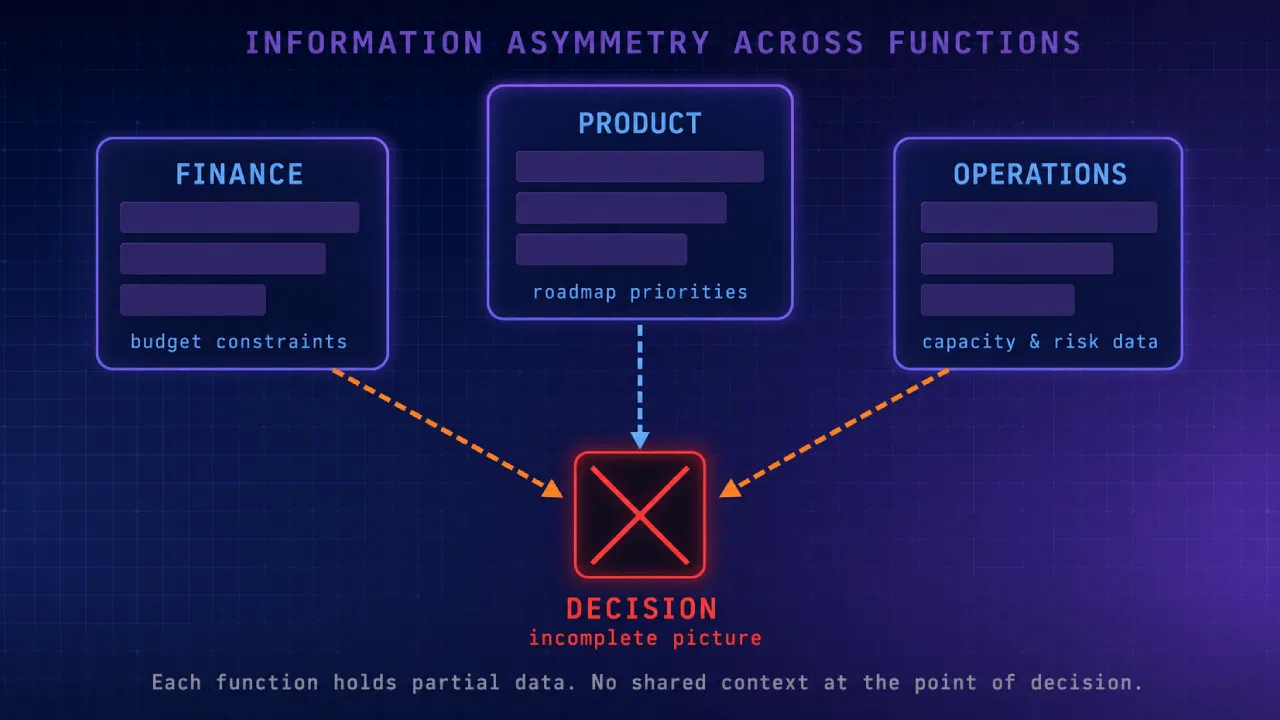
The solution is ensuring information is equitable and understood before the meeting, not presenting more data during it.
2. Unclear Decision Rights
Three questions that rarely get answered upfront:
- Who decides independently?
- Who needs to be consulted?
- When does it require consensus?
75% of cross-functional teams are dysfunctional, and unclear decision rights is consistently among the root causes. When the organization doesn’t answer these questions upfront, politics fills the vacuum.
People jockey for influence, hierarchy substitutes for process, and the discussion devolves.
3. The HiPPO Problem
HiPPO stands for “Highest Paid Person’s Opinion.” When decision criteria aren’t defined in advance, the most senior voice wins by default.
The meeting becomes a social negotiation:
- Who has credibility in the room?
- Whose department is bigger?
- Whose boss attended last week?
These dynamics override evidence. A good idea from a junior contributor gets dismissed because the VP didn’t mention it.
A mediocre idea gets greenlit because the senior director championed it before anyone saw the data.
What Pre-Alignment Actually Means
Pre-alignment means surfacing objections and resolving information gaps before the meeting starts.
It’s the work that happens in 1:1 conversations, not a group consensus round.
Map Your Stakeholders by Role
Not everyone plays the same role in a decision. Conflating them slows everything down.
| Role | Example | What They Need | When to Engage |
|---|---|---|---|
| Approver | Innovation director | Final call supported by evidence | At the gate, after pre-read |
| Contributor | Finance, Legal, Operations | Their specific concerns answered | 3–5 days before |
| Informed | Portfolio managers, team leads | Summary of outcome | After the decision |
| Driver | Innovation manager | Accountable for packet and process | Throughout |
This framework (DACI, developed at Intuit) demonstrates a 25% higher success rate in meeting objectives and timelines when applied consistently.
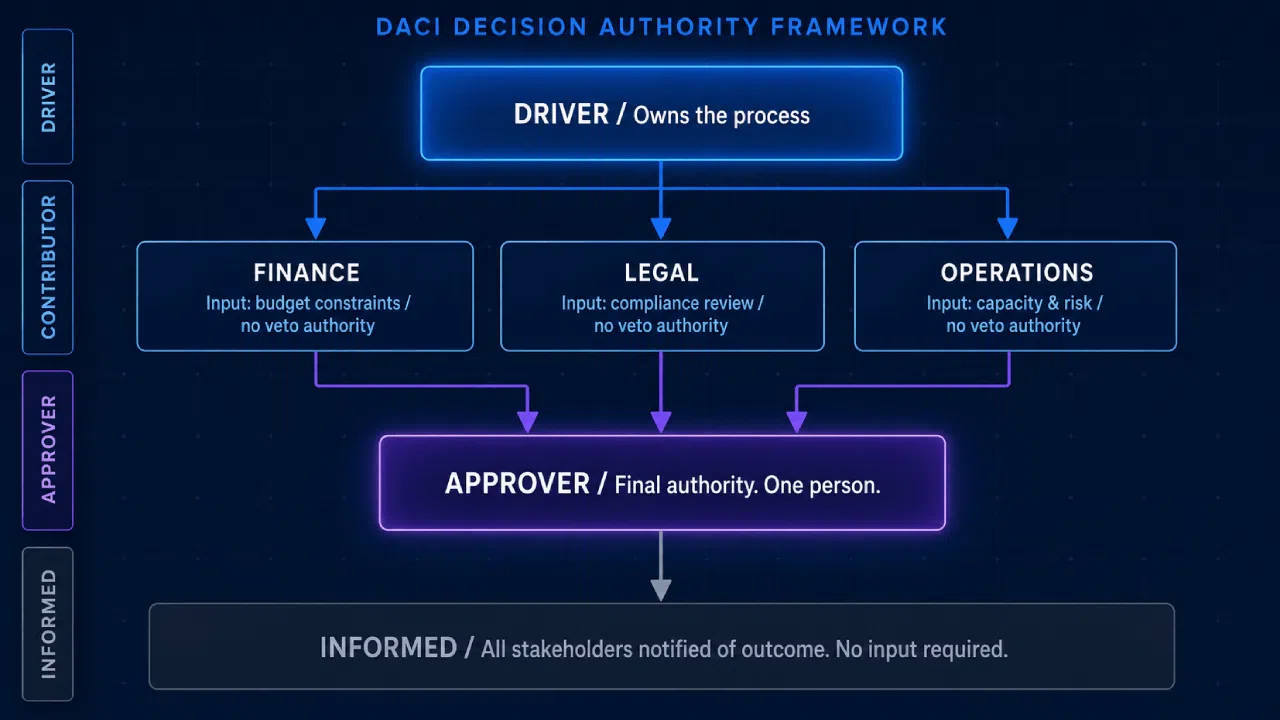
The key insight: a single approver eliminates approval-by-consensus gridlock. Contributors give input; the approver owns the call.
Run a 1:1 Pre-Alignment Round
Before the meeting, talk to each contributor individually, not to sell them, but to understand.
Ask three questions:
- What would make you comfortable supporting this?
- What’s missing from the current proposal?
- What’s your biggest concern?
These conversations surface blockers early. Finance might flag a cost assumption that’s wrong. Legal might identify a compliance gap. Operations might see a resource constraint nobody mentioned.
When you find these objections before the meeting, you have time to fix them. When you find them in the meeting, you have a 90-minute standoff.
Resolve Blocking Issues in Advance
If finance is worried about cost modeling, update the numbers before the meeting. If legal has a compliance flag, get a pre-read answer.
If operations can’t resource it in the proposed timeline, find a different timeline now.
Enter the meeting with no unresolved blockers. This sounds simple, but most organizations don’t do it.
What to Do When Pre-Alignment Fails
Pre-alignment resolves most blockers. Not all of them.
Sometimes finance and product have a genuine disagreement that 1:1 conversations can’t settle. Sometimes a compliance flag needs legal input that can’t happen before the meeting.
When you enter with an unresolved blocker, you have three options:
- Escalate before the meeting. If the blocker is above Finance or Product’s authority, a 15-minute escalation call with leadership beats a 90-minute standoff in the room.
- Timebox the disagreement. Give the issue a fixed window in the meeting: 10 minutes. If it’s unresolved at the end, the Approver makes the call and the group moves forward.
- Delay the decision explicitly. If the blocker needs more information to resolve, name what’s missing, who owns it, and when the group reconvenes.
A named delay is a process move. An undecided meeting is a political vacuum.
What you can’t do is walk in without a plan for the open issue. Silence on a known blocker hands control to whoever raises it first.
Building the Evidence Packet
An evidence packet is a standardized set of inputs distributed before every decision meeting.
Its purpose is singular: give every reviewer the same factual base so the discussion is about the decision, not the data.
What Goes in an Evidence Packet
- Problem statement and strategic fit: why this idea matters and which organizational objective it serves
- Scorecard data: how the idea scored across defined criteria (feasibility, impact, strategic alignment, customer value)
- Evidence quality: what validation exists (customer feedback, pilot data, market research, competitive analysis)
- Risk summary: top 2–3 risks and proposed mitigations
- Resource requirement: headcount, budget, timeline estimate
- Recommendation: what decision is being requested (fund / kill / park / develop further)
Evidence-to-decision frameworks support more structured evaluation of recommendation-related criteria than ad hoc approaches.
They also move faster. When criteria are transparent in advance, people don’t spend meeting time discovering them.
The packet is a focused recommendation brief with supporting evidence. It answers one question: “Given all the evidence, what are we deciding, and why?”
The Pre-Read Rule
Distribute the packet 48–72 hours before the meeting. No first-reading in the room.
Everyone comes prepared to decide, not to absorb.
Organizations that enforce this discipline see measurable gains. Time spent in meetings drops, and every reviewer walks in with the same picture.
Running the Meeting Itself
Pre-alignment does most of the work before the meeting starts. The meeting has one job: reach a clear decision efficiently.
Start with Agreement on Criteria, Not the Idea
The first five minutes matter more than the next 55.
The approver should open by confirming three things:
- The scoring criteria and decision thresholds
- What constitutes a strong yes, a maybe, or a no
- Whether anyone needs to adjust the criteria before the idea is discussed
This removes goal-post shifting. If someone objects to the criteria, that debate surfaces now, not buried in a feasibility discussion.
If criteria are clear in advance, you’ve already won half the battle.
Structured Discussion, Not Open Floor
Go around the room. Each contributor raises exactly one concern or endorsement, not five.
This prevents the vocal from dominating and ensures everyone gets air time. The approver speaks last to avoid anchoring.
If the director says “I think we should fund this” at the beginning, half the room defaults to agreement and the other half defends against it.
Save the approver’s perspective until everyone else has contributed.
Log the Decision and the Rationale
The meeting ends with a written decision log: what was decided, who decided, on what basis.
The rationale matters as much as the outcome. A decision log prevents re-litigating the same idea three months later when political winds shift.
It also creates organizational memory. New people joining the team can understand why decisions were made, not just what was decided.
Shared decision-making frameworks shorten decision cycles from weeks to days. Faster decisions compound over time.
Common Mistakes That Let Politics Back In
The process works when it’s followed consistently. Politics creeps back in through small deviations that seem harmless at the time.
Five mistakes to watch for:
- Rotating who owns the evidence packet. When ownership shifts each cycle, consistency breaks and reviewers stop trusting the format.
- Skipping the pre-read. If reviewers see the evidence for the first time in the meeting, you’ve reintroduced information asymmetry. Distribute the packet 48–72 hours out without exception.
- Letting the Approver speak first. When the senior voice opens with a position, the room anchors to it. Structured discussion requires the Approver to go last.
- Letting one department control the scoring criteria. If Finance sets the criteria without input from Product and Operations, every idea is measured against one department’s priorities.
- Not logging the rationale. Decisions without documented reasoning get re-litigated when new stakeholders join or priorities shift.
The pattern behind every mistake is the same: an undocumented step creates a gap, and politics fills it.
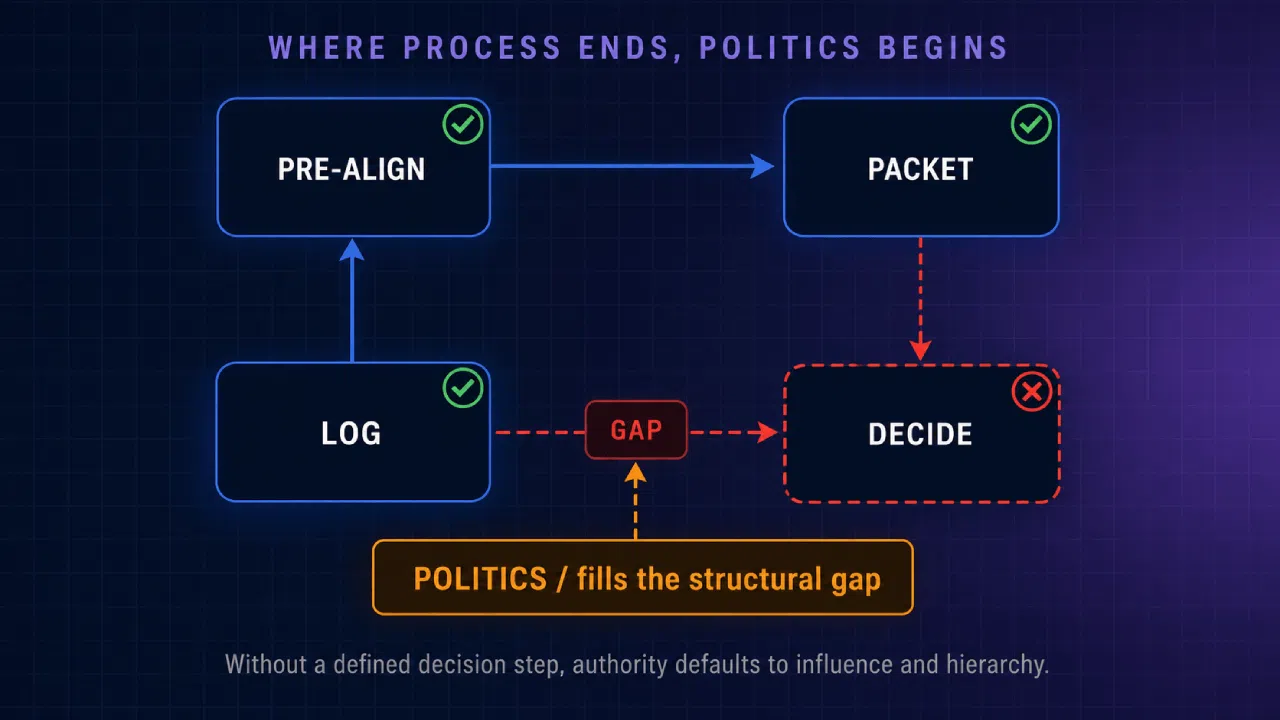
The fix isn’t stricter rules. It’s making the process visible enough that deviations are obvious before they calcify into habits.
After three or four decision cycles, run a short audit. Ask which steps got skipped, who absorbed extra work, and where the format drifted.
The goal isn’t a perfect process on day one. It’s a process that flags its own gaps and gets tighter each cycle.
When to Use a Platform vs. a Spreadsheet
A shared document template works fine for small teams, but if you’re evaluating ten or more ideas per cycle, a spreadsheet becomes a bottleneck.
At that scale, three gaps emerge:
- No consistency without someone manually tracking fields
- No visibility into how Finance scored versus Product before the meeting
- No automatic aggregation for the evidence packet
This is where a platform earns its weight. AI-assisted scoring aggregates reviewer inputs so the evidence packet reflects group data, not one person’s analysis.
This solves the “my spreadsheet vs. your spreadsheet” dynamic that breeds politics. Everyone sees the same scorecard data.
There’s no hidden modeling revealed as a surprise in the meeting. The real question is always the process: the tool follows discipline.
Make the Process Repeatable
A one-off pre-alignment round is a workaround. A standard pre-alignment protocol is a system.
Three things to codify:
- Who owns the evidence packet
- When it goes out
- What the minimum fields are
Review after three to four cycles:
- Where did politics creep back in?
- What field was missing?
- What conversation should happen earlier?
Innovation directors should be able to step into any review meeting and find the same format, criteria logic, and decision flow.
Structure and transparency are what repeatable cross-functional decisions look like in practice. That’s what makes this scale.
Download our ebook on group decision-making frameworks, or book a demo to see how Accept Mission handles automated routing, escalation workflows, and audit trails.









 English
 Dutch
Dutch Portuguese
 Spanish
 French
 German
 Arabic