
Scoring Calibration: Why a Shared Rubric Still Produces Inconsistent Ratings11 min read

Five reviewers score the same five ideas with the same scorecard and criteria. On one criterion, the spread comes back ranging from 2 to 8.
The scorecard works fine, but four things sit underneath it:
- A shared definition of what each score level actually means
- Anchor examples reviewers can compare against, not just discuss
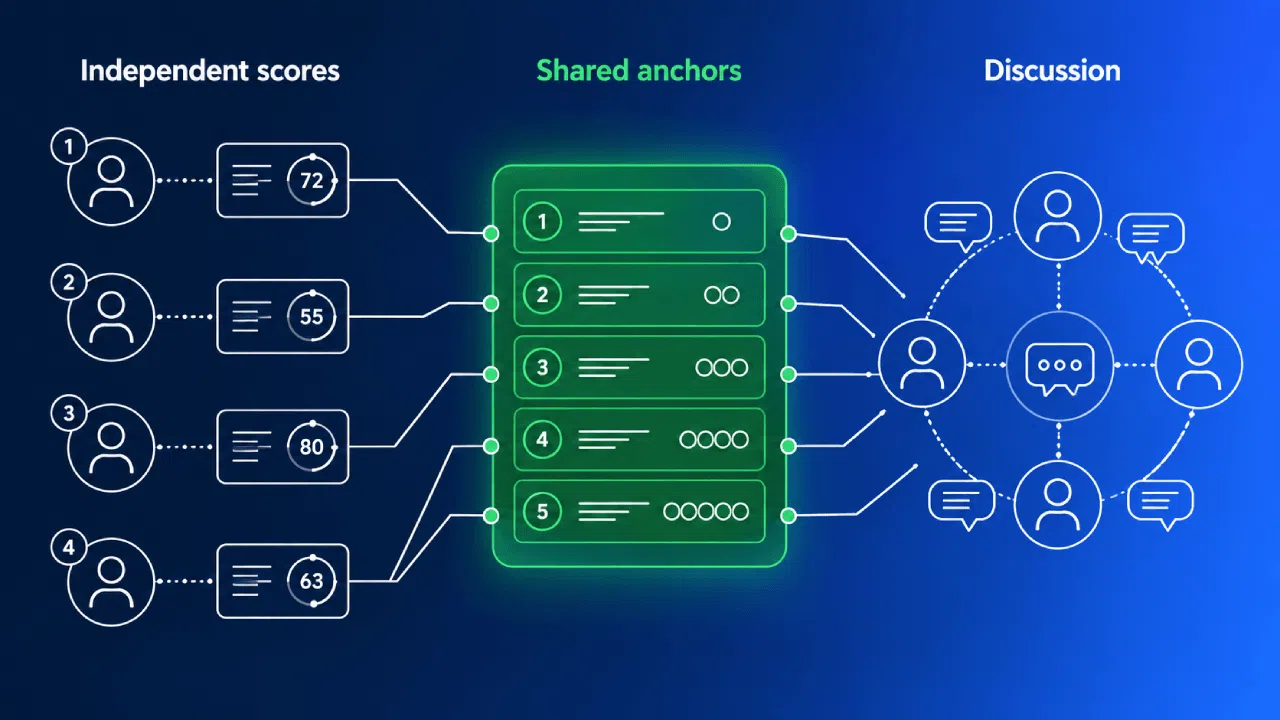
- A structured session that keeps early opinions from biasing the room
- A way to catch drift as cycles pass and new reviewers join
None of this requires a new scorecard. It requires reviewers who read the same criteria the same way, every time.
This is the gap that makes a “structured” process feel subjective anyway. Calibration is the practice that closes it, and most teams skip it entirely.
Here’s how that discipline actually works, from building anchor examples to keeping a panel aligned as reviewers change.
A Scorecard Is Not a Guarantee
A rubric tells reviewers what to consider. It doesn’t tell them how to weigh what they see.
Two people can read the same criterion and apply it in opposite directions, both convinced they followed the instructions. That happens because most rubrics are written in the abstract.
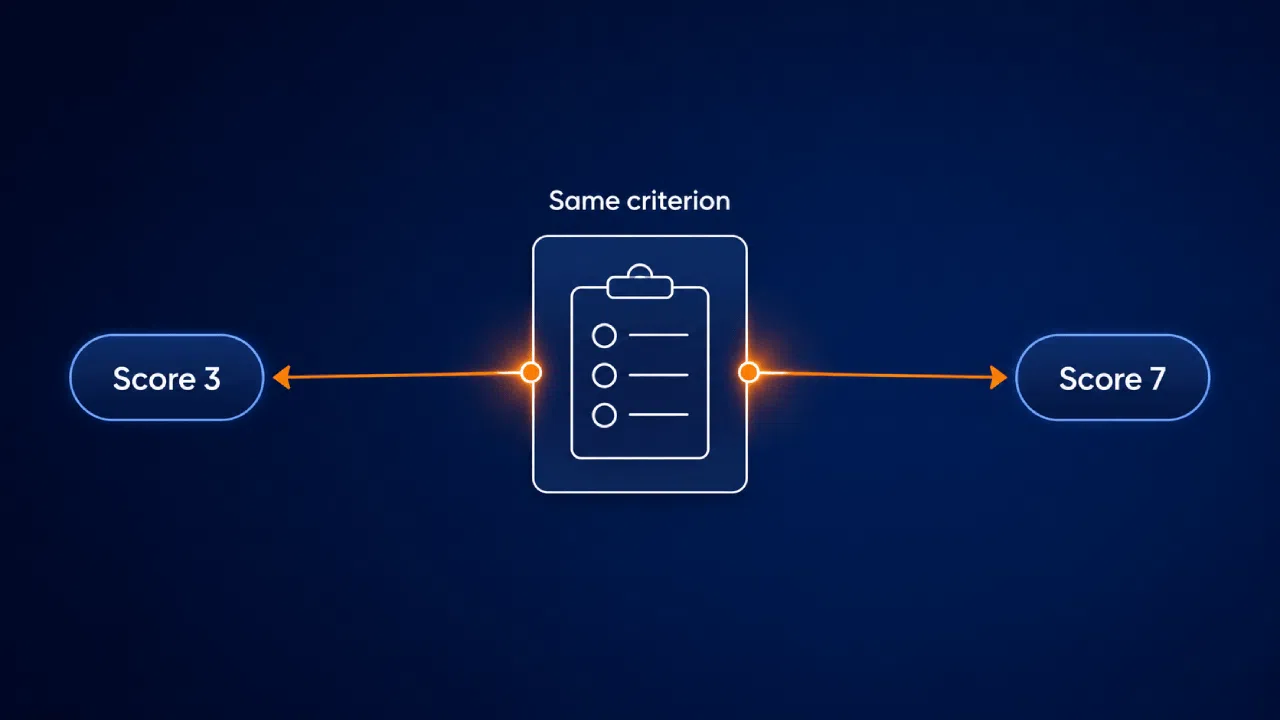
As one calibration protocol puts it, even when raters agree on a rubric, they often apply it differently because the wording is open to interpretation.
Feasibility tends to show weaker agreement than criteria like originality or clarity. It asks reviewers to judge resource and execution realities the idea itself doesn’t fully reveal.
Feasibility is where reviewers drift apart the most, and the root causes are consistent:
- Vague criteria descriptors that leave too much open to interpretation
- No shared reference examples for reviewers to compare against
- Anchoring bias from whoever happens to score first
Each one widens the distance between “we have a structured process” and “we have consistent scoring.” They’re not the same thing, and one doesn’t produce the other.
What Calibration Actually Means
Two thoughtful reviewers can look at the same idea and reach different conclusions. That’s often appropriate.
What calibration aligns is meaning: what each criterion actually refers to, and what each score level is supposed to represent.
Think of it as a vocabulary exercise.
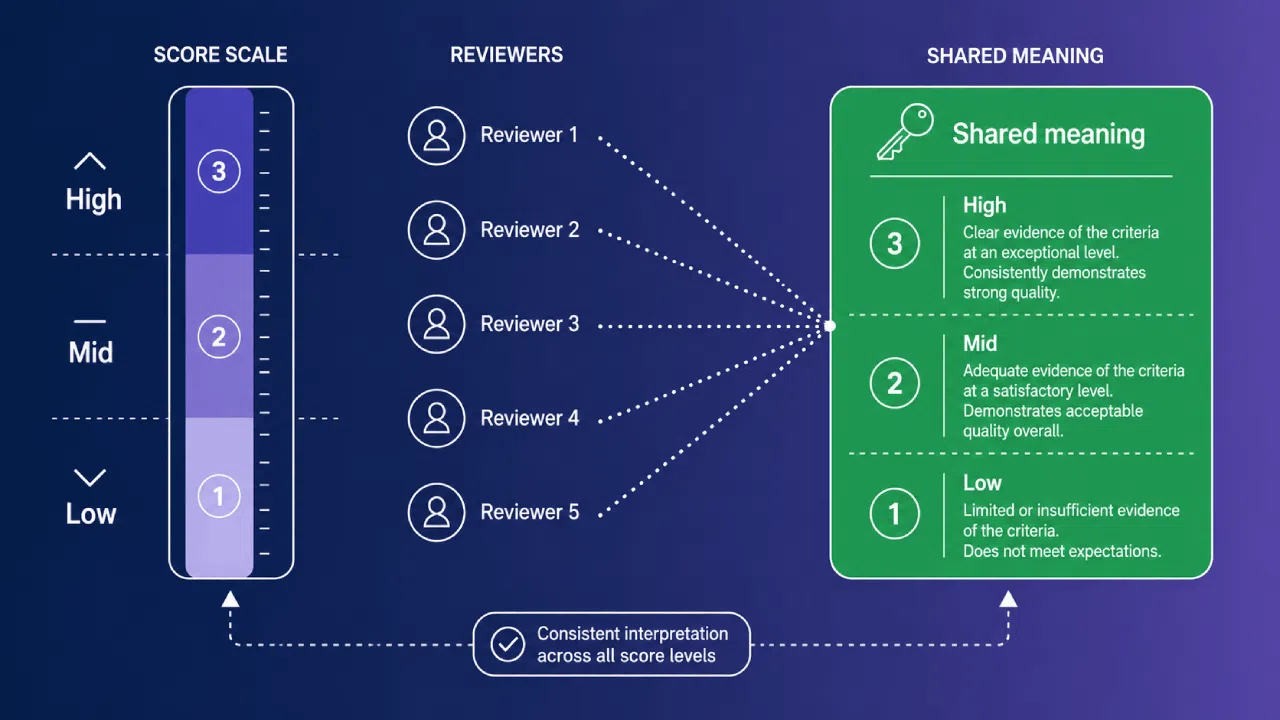
As one practitioner frames it, calibration makes evaluators agree on what the criteria mean “so that disagreements become signal rather than noise.”
A well-calibrated panel produces decisions people can stand behind, a shared judgment with a clear record of how it was reached.
Build Your Anchor Example Set
Anchor examples are the single most underused tool in calibration. Each one is an idea labeled with its “correct” score and an explanation of why it earns that score.
Anchors move reviewers from inference to observation. Instead of asking “does this feel like a 7,” a reviewer compares the idea against an agreed reference point.
| Score Level | Example Description | Why This Score |
|---|---|---|
| 2 (Low feasibility) | Idea requires a regulatory approval the company has never obtained, with no internal owner and no precedent in the market. | Multiple hard blockers with no path identified. Score reflects effort that outweighs any realistic near-term return. |
| 5 (Moderate feasibility) | Idea fits the existing tech stack but needs a new vendor contract and cross-team capacity that is not yet confirmed. | A viable path exists, but real dependencies remain unresolved. Mid-scale signals genuine uncertainty, not a placeholder. |
| 8 (High feasibility) | Idea uses tools already in place, has a named owner, and a comparable version shipped in a prior campaign. | Clear path, proven precedent, minimal new dependencies. Reserved for ideas the team could realistically start this quarter. |
How many anchors do you need? Aim for two to three per score level, weighted toward the middle of the scale where reviewers struggle most to discriminate.
The extremes are easier, since a clear winner and a clear non-starter rarely cause arguments.
Feasibility deserves extra investment given its weak agreement in innovation contexts. Build more anchors there, and make every descriptor behavioral.
You can source anchors from three places:
- Past ideas you’ve already scored, anonymized before reuse
- Synthetic constructions written to illustrate a specific level
- Adapted examples pulled from similar campaigns
“Has a named owner and an approved budget line” beats “realistic to execute,” because one is observable and the other is a feeling.
The goal is a small, sharp set that captures how your team actually thinks.
Calibrating Multi-Criteria Scorecards
Most real scorecards don’t measure one thing. They rate an idea across several weighted criteria:
- Feasibility
- Market fit
- Strategic alignment
- And more
Calibrate each criterion on its own. Aligning reviewers only on the final composite score hides where the disagreement actually lives.
Two reviewers can land on the same total for opposite reasons: one high on feasibility, low on fit, the other reversed. The composite masks scattered judgment.
Scoring order matters more than teams expect.
A many-facet Rasch analysis found the halo effect grows measurable when reviewers rate related criteria back-to-back, letting one strong impression color the criterion that follows.
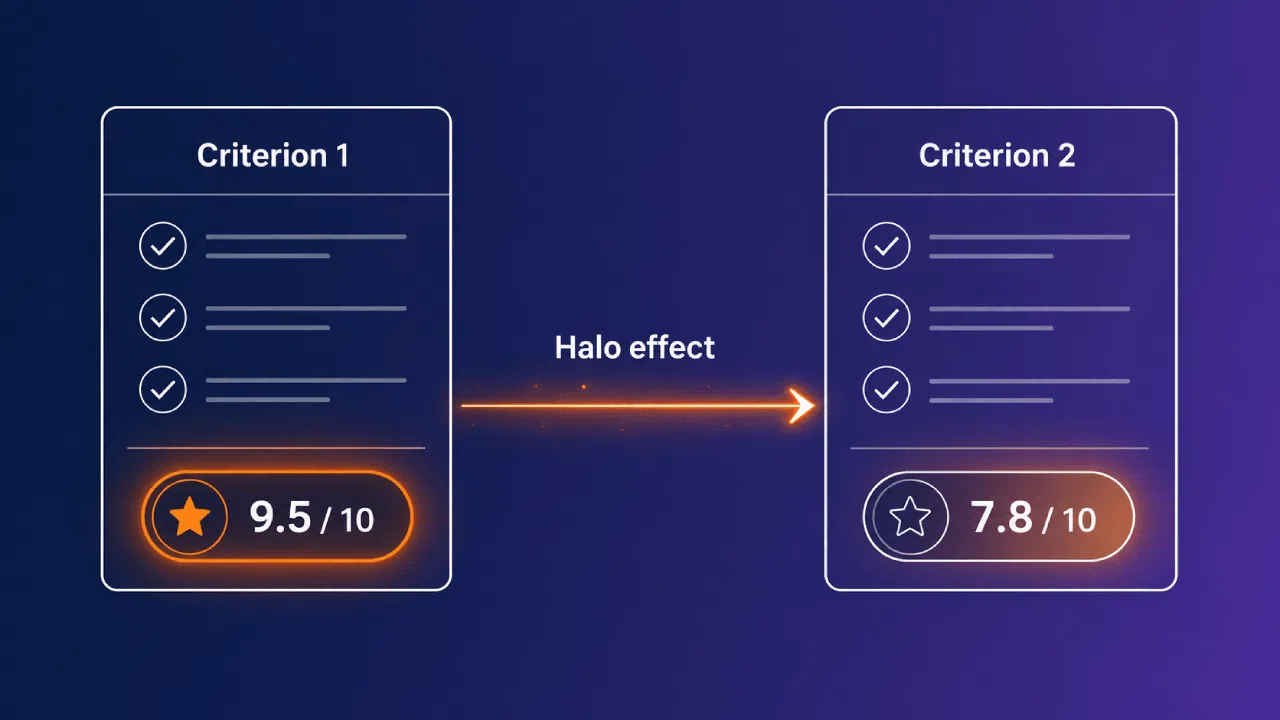
Weighting doesn’t rescue a criterion that’s scored inconsistently. A heavier weight on a noisy criterion amplifies its influence, not its accuracy.
This is why one generic anchor set falls short. A “7” for feasibility and a “7” for strategic fit describe different evidence, and a reference set flattens that distinction.
Build a criterion-specific anchor set for each dimension that matters. Reuse the same two-to-three-per-level structure, but write the descriptors against what that particular criterion is actually measuring.
The extra work is front-loaded and pays back every cycle. Once each criterion has its own anchors, reviewers stop borrowing logic from one dimension to justify another.
How to Run a Calibration Session
Pre-work is non-negotiable.
Reviewers score the anchor examples independently before the session, ideally with a 48-hour window, or the meeting turns into evidence hunting instead of calibration.
The session itself follows a deliberate order so that early opinions can’t quietly bias everyone else:
- The facilitator sets context: which criterion, which anchors, what the scale means.
- The group silently examines the rubric and the sample idea together.
- Reviewers ask clarifying questions only, no scoring talk yet.
- Each reviewer records an independent score with a written justification.
- Scores are shared one at a time, without explanation, so the spread is visible before anyone defends a number.
- The facilitator opens discussion on the divergences, then the group debriefs on what to standardize.
Keep sessions to 45 to 90 minutes with four to eight participants, sized to the cycle. Longer than that and fatigue starts doing the scoring for you.
The key rule sits inside step five: no one speaks their score until everyone has one. This controls anchoring bias, since scores influence people in the order they’re revealed.
Then there’s the dominant reviewer. When one person consistently diverges and argues hard, the facilitator holds the shared standard as the reference point for the room.
Run a short bias checklist out loud during the discussion:
- Recency effect
- Halo and horn effects
- Central tendency (everything clustering at 5)
- Affinity bias toward ideas that sound like the reviewer’s own
A neutral facilitator naming these in real time keeps the conversation grounded. Putting a name to a pattern is what stops it from quietly shaping the score.
Common Calibration Mistakes
Calibration can be run in good faith and still backfire. A few failure patterns show up repeatedly:
- Treating open discussion as the fix. Unstructured group talk raises agreement inside a panel while worsening divergence between panels, so two panels calibrated separately drift further apart, not closer.
- Exempting veteran reviewers. Experience doesn’t immunize anyone against drift; refresher training raised reliability even among seasoned scorers.
- Rewriting the rubric and stopping there. A cleaner rubric alone doesn’t deliver consistency, because reviewer experience outweighs rubric format as the driver of reliable scores.
The first mistake is the most counterintuitive. A discussion that makes a room feel aligned can quietly train that room into a local consensus no other panel shares.
Structure is what prevents it. Independent scoring before discussion, and a shared anchor set, keep the conversation tethered to a standard instead of the loudest voice.
The veteran exemption is tempting for a simple reason. Experienced scorers are confident, and confidence reads as accuracy even when the two have quietly come apart.
Rubric redesign has the same seductive quality. It feels like progress because it produces a visible artifact, while the harder work of aligning people goes untouched.
None of these mistakes are fatal on their own. They become expensive when a team assumes the calibration is done and stops checking.
Catching Drift Between Cycles
Calibration isn’t a one-time event, and the maintenance routine is lighter than it sounds.
Reviewer interpretation drifts as cycles pass, new people join, and memory of the last session fades. Two threshold numbers are worth monitoring:
- A 10-point average delta between reviewers means the rubric needs updating.
- Reliability below 75 percent agreement after four sessions means the anchors need a rewrite, not more discussion.
Hold monthly check-ins and keep a shared decision log that records why borderline ideas scored the way they did. That way the reasoning carries forward instead of getting re-litigated.
A scorer who runs high or low against the group average is offering a useful data point. That pattern shows exactly where the next calibration conversation should start.
Onboarding New Reviewers
A new reviewer joining a calibrated panel doesn’t require a full session reset. The panel already holds the standard; the task is bringing one person up to speed.
Start by qualifying them against your pre-scored anchor set. This mirrors formal scorer qualification, requiring a passing match rate on benchmark items before live scoring.
A phased ramp keeps a new reviewer from importing their own private scale:
- Observe. Sit in on a live calibration or scoring session without scoring, to absorb how the panel reasons out loud.
- Co-score. Rate the same ideas alongside a veteran, then compare scores and talk through every gap.
- Score solo. Move to independent scoring once the co-scoring deltas fall within the panel’s normal range.
The direct research on this exact scenario is thin.
Onboarding into an established, calibrated panel hasn’t been studied on its own. Read this sequence as sound extrapolation from established qualification practice, not settled fact.
Set a concrete gate between co-scoring and solo work. Match rate against the anchors, or a small delta from the veteran, tells you the reviewer is ready.
Keep the first solo cycle under a light second read. A quick spot-check on borderline scores catches early drift before it settles into a habit.
Where AI Fits In
AI works best here as a scaffold that supports the review panel’s judgment.
It makes the implicit standard visible, surfaces where two scores diverge, and gives the panel a consistent reference to react against.
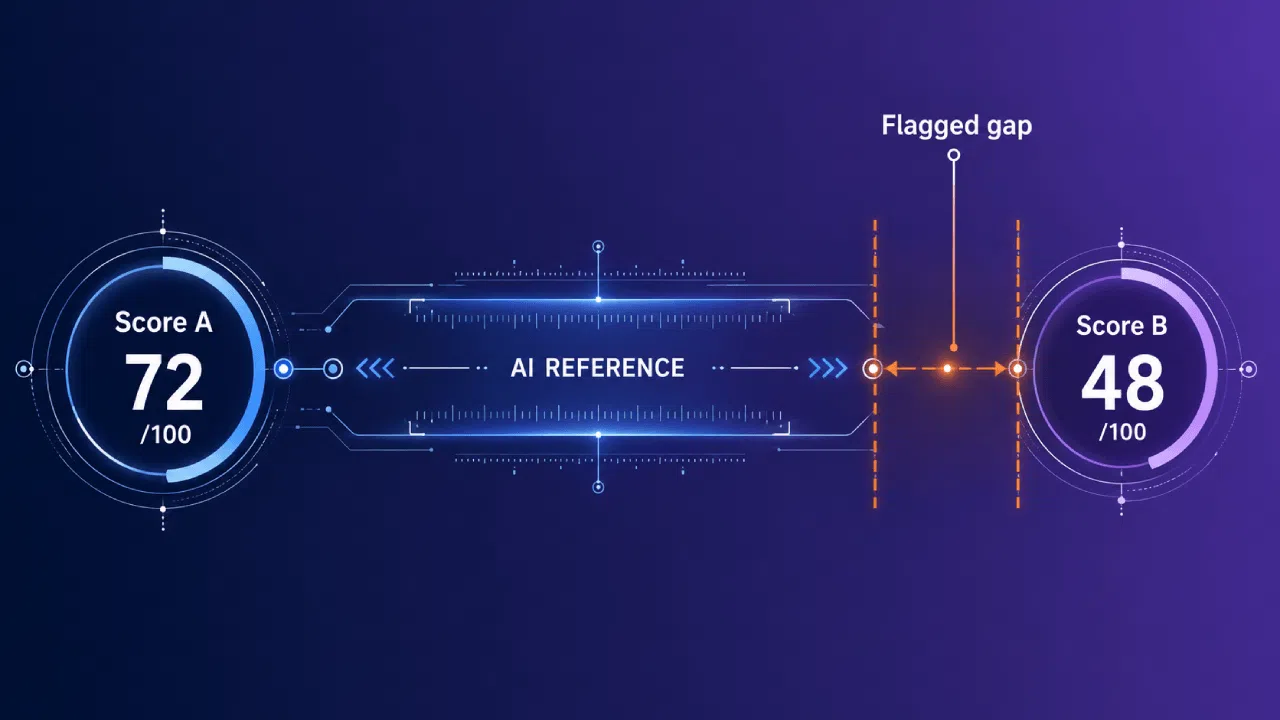
The evidence favors collaboration over either extreme.
A peer-reviewed study found human-AI collaborative marking reduced deviation from expert benchmarks more than either approach alone.
This is where structured AI scoring support fits:
- Consistent criteria
- Configurable scales
- Automatic flags for inconsistency
This frees reviewers to focus their judgment where it matters.
The result is measurable: fewer disputed scores, faster consensus, and decisions the panel can defend with evidence instead of instinct.
Calibration Is the System Behind the Scorecard
A scorecard is only as good as the shared understanding behind it. The numbers look objective, but they carry whatever meaning the reviewers brought to them.
Calibration turns that shared understanding into something durable:
- A common vocabulary for what each score level actually means
- A session structure that keeps early opinions from steering the room
- A way to catch drift before it quietly resets what “good” means
- A faster path for onboarding new reviewers without losing the standard
Teams that invest in it make decisions that hold up. They re-review less, defend their scores with evidence, and build reviewer confidence that comes from structure.
Treat it as a trainable discipline. One session won’t align a team for good, but the work compounds across cycles.
Start with the anchor examples. They’re the highest-leverage move you can make this quarter, and everything else builds on them.
Download our ebook on idea evaluation and governance, or book a demo to see how Accept Mission handles automated routing, escalation workflows, and audit trails.








 English
 Dutch
Dutch Portuguese
 Spanish
 French
 German
 Arabic