
From Approved Idea to Delivered Outcome: Designing a Project Funnel10 min read
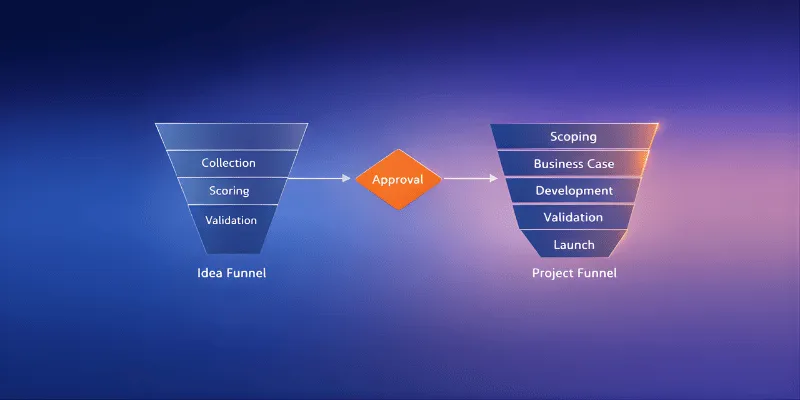
Most innovation failures don’t happen in the idea funnel. They happen after approval.
You’ve validated customer demand, scored the idea, built the business case, and secured the green light. Then the project stalls:
- It sits in a backlog indefinitely
- Gets reassigned three times across different teams
- Disappears into “pilot purgatory” where successful experiments never scale
The problem isn’t the idea, but the delivery system between approval and launch.
Organizations treat approval as the finish line when it’s actually the handoff point. The idea funnel proves something is worth building, while the project funnel builds it, scales it, and transitions it to operations.
What Is a Project Funnel (And Why It’s Not an Idea Funnel)
To put it simply, a project funnel is the system that turns an approved idea into a real, running solution.
Think of it this way:
- The idea funnel answers, “Is this worth building?”
- The project funnel answers, “Can we actually build this, scale it, and run it?”
Once an idea is approved, it enters the project funnel (more on this later). From there, it moves through clear stages, from scoping, to development, to testing, to launch.
The project funnel exists to prevent approved ideas from stalling, getting stuck in pilots, or dying in backlogs. Its job is simple, make sure good ideas don’t just get approved, they get delivered and sustained.
What Happens Between Approval and Launch
After approval, projects move through five distinct stages. Each stage has a clear objective, specific evidence requirements, and evolving ownership.
The typical progression looks like this:
- Scoping and feasibility: Define boundaries and confirm the project is technically and financially viable before committing major resources.
- Business case development: Build investment rationale with data-driven analysis that proves the project justifies full-scale funding.
- Development and prototyping: Transform the concept into a functional MVP that validates core functionality.
- Validation and testing: Verify the solution works reliably through user acceptance testing, security audits, and pilot programs.
- Launch and scaling: Deploy the solution and transition operational ownership to the team that will run it long-term.
What makes these stages work is clarity about what changes at each transition. For example, in scoping, the innovation team still leads, but the delivery team begins early involvement.
The evidence standard also escalates. Early stages accept feasibility assessments and preliminary risk plans. Later stages require working prototypes, pilot results, and verified KPIs.
This progression ensures you’re not scaling unproven concepts or building solutions that operations can’t support. Here’s how ownership, evidence, and decision authority evolve:
| Stage | Primary Owner | Evidence Type | Decision Authority |
|---|---|---|---|
| Scoping | Innovation Team | Feasibility assessments | Innovation Manager |
| Business Case | Innovation + Finance | Financial projections, customer data | Leadership approval required |
| Development | Engineering | Working prototypes, technical specs | Tech Lead + Product Owner |
| Validation | Ops + Compliance | Pilot results, audit reports | Operations + Compliance |
| Launch | Operations | KPI achievement, stable performance | Operational Owner |
The key pattern is that ownership broadens as you move through stages, then narrows at the end.
You start with innovation, add more stakeholders during development and validation, then hand off to a single operational owner.
This prevents the “everyone is responsible, no one is accountable” problem that kills so many approved projects.
The Critical Handoff: From Innovation Team to Delivery Team
The most common failure point in the project funnel is the handoff from innovation to delivery.
Innovation teams focus on discovery and experimentation. Delivery teams focus on reliability and scale. They have different priorities, different timelines, and different success metrics.
When the handoff fails, projects enter what’s called “pilot purgatory.” The experiment worked, but it never becomes a permanent fixture in the business.
What a Warm Handover Looks Like
Most handoffs fail because they’re treated as administrative transactions. Someone sends a document. Someone else receives it. No real transfer of knowledge or accountability happens.
A warm handover is different. It’s a formal transfer of responsibility through effective communication, not just document exchange.
Four elements make handoffs work:
- Early engagement: Involve the delivery team during scoping, not after approval. They catch feasibility issues early and take ownership before building starts.
- Designated operational owner: Assign the person who will run this project after launch before you start building it. If no one in operations wants it, the project isn’t ready.
- Knowledge transfer sessions: Capture implicit knowledge through recorded walkthroughs and joint consultations where teams explain reasoning and ask questions.
- Shared success criteria: Align both teams on what “done” looks like. Innovation defines success differently than operations. Reconcile these definitions early.
Transitional Squads for Complex Projects
For high-complexity projects, some organizations create transitional squads, which are small, cross-functional teams that co-own the delivery process.
These squads typically include:
- Five to nine people from product, design, engineering, QA, and compliance
- Collaborative work from scoping through launch
- Reduced handoffs and less finger-pointing when problems surface
The tech lead in these squads acts as a bridge. They understand both the business “why” and the technical “how.” They translate strategic intent into execution reality.
If you can’t name the person who will wake up thinking about this project next Monday, you have an ownership gap.
How to Design Your Project Funnel for Flow
A well-designed project funnel balances speed with governance. You need structure without bureaucracy, accountability without micromanagement.
Here’s how modern organizations build delivery systems that work.
1. Stage Gates vs. Continuous Flow
Traditional stage-gate models treat each gate as a hard stop.
Nothing moves forward until every requirement is met. Modern systems use adaptive gates that allow parallel processing when information is reliable enough.
To implement adaptive gates:
- Define which decisions require formal gates (budget approval over $100K, compliance sign-off, operational readiness)
- Allow teams to start next-stage work when confidence reaches 70-80%, not 100%
- Set clear “go/no-go” criteria for each gate based on risk level, not completion percentage
- Use weekly check-ins instead of monthly reviews to catch issues early
- Document assumptions that allow parallel work, then validate them before the formal gate
The practical decision is:
Can we afford to be wrong about this assumption? If the cost of being wrong is low and reversible, proceed. If it’s high or irreversible, wait for the gate.
2. Metered Funding: Approve Milestones, Not Budgets
Instead of approving full project budgets upfront, approve only enough funding to reach the next validation milestone.
To structure metered funding:
- Break the project into learning milestones (customer validation, technical proof-of-concept, pilot test, scaled deployment)
- Set budget thresholds for each milestone ($50K for validation, $200K for pilot, $2M for scale)
- Define clear evidence required to unlock next funding (20 customer interviews, working prototype, pilot success metrics)
- Assign kill criteria at each milestone (if conversion rate is below 10%, stop)
- Schedule funding reviews 2 weeks before milestone completion to avoid delays
For example:
Approve $50,000 to validate core assumptions through customer testing and an MVP. If the evidence is strong, approve the next $200,000 for pilot deployment. If assumptions fail, stop and redeploy resources.
This model encourages teams to “kill early” and prevents scaling unvalidated concepts.
3. Flow Metrics That Replace Status Reports
Traditional project management tracks whether you’re “on time and on budget.” Flow-based systems track whether you’re delivering value.
To measure and use flow metrics:
- Cycle time: Measure days from approval to launch for completed projects. Set targets based on project type (30 days for incremental, 90 days for experimental). Track monthly trends.
- Throughput: Count completed projects per quarter. Compare to team capacity. If throughput drops below 3 projects per quarter, investigate bottlenecks.
- Flow efficiency: Calculate active work time divided by total elapsed time. If efficiency is below 20%, you’re spending more time waiting than working.
- Work-in-progress (WIP): Count active projects per team. Limit to 3-5 concurrent projects. When WIP exceeds limits, pause new starts until something finishes.
Use these metrics in monthly portfolio reviews. When cycle time increases or throughput drops, dig into handoffs, decision delays, and resource conflicts.
4. The Single-System View
Your idea funnel and project funnel should connect in one portfolio dashboard that shows the entire innovation lifecycle.
To create a single-system view:
- Use one platform or integrated tools where ideas and projects share the same database
- Tag every project with its originating idea and validation evidence
- Create dashboard views that show: ideas approved this quarter, projects in development, projects launched, outcomes delivered
- Track conversion rates at each stage (ideas to projects: 20%, projects to launch: 80%)
- Calculate portfolio-level innovation ROI by dividing total impact by total investment across both funnels
This lets you answer critical questions: Are we building the right things? Are we building them efficiently? Are they delivering expected outcomes?
When the two funnels work as one system, accountability flows from customer evidence through delivery to measurable impact.
5. Limit Work-in-Progress
The biggest mistake organizations make is approving too many projects at once. More concurrent projects means slower delivery, not faster.
To set and enforce WIP limits:
- Calculate team capacity (if a team can actively manage 3 projects, set WIP limit at 3)
- Make WIP limits visible in your portfolio dashboard
- Implement a “finish before starting” rule: no new projects until something completes or gets killed
- When new urgent requests arrive, force prioritization: which current project gets paused or stopped?
- Run monthly WIP audits to identify zombie projects consuming capacity without progress
Modern portfolio management finishes what it starts before starting something new. This creates focus, reduces context-switching, and speeds up time-to-market.
From Approval to Impact
Approval is not permission to build. It’s a license to gather more evidence.
The project funnel works when:
- Ownership, evidence standards, and decision rights are explicit at every stage
- The innovation team knows exactly who will own the project after launch
- The delivery team participates in scoping before building starts
- Leadership documents the “why” behind decisions so those decisions don’t get relitigated later
Handoffs determine success more than any single stage.
A perfect prototype doesn’t matter if no one in operations knows how to scale it. A validated business case doesn’t help if engineering wasn’t involved in feasibility discussions.
The project funnel isn’t a bureaucratic checklist. It’s a structured system that moves ideas from approval to delivery without losing momentum, clarity, or accountability.
Organizations that master this bridge deliver measurable innovation. They don’t just approve ideas…they ship outcomes.
Want to go deeper on project portfolio management?
Download our project portfolio ebook to learn how to turn selected opportunities into an execution portfolio with transparency and progress control.
Or request a demo to see how Accept Mission connects your idea funnel and project funnel into one system that tracks innovation from approval to measurable impact.









 English
 Dutch
Dutch Portuguese
 Spanish
 French
 German
 Arabic