
Project Funnel Stages: The 7-Step Model for Innovation Delivery11 min read
Most organizations have figured out how to generate and evaluate ideas.
Idea competitions, crowdsourcing platforms, structured reviews: the front end of innovation has gotten a lot of attention.
But the real delivery bottleneck sits downstream. The fix is a structured project funnel, one that covers:
- The 7 stages every project moves through, with exit criteria at each gate
- How to right-size the model by innovation type
- What causes funnels to break down, and how to prevent it
An idea gets approved, handed to a team, and suddenly the structure that governed its selection disappears entirely.
Six months later, nobody knows if it’s progressing or stalling. A year later, it’s still running but nobody remembers why it mattered.
That’s the moment the funnel should continue, not stop.
Why the Handoff from Idea to Project Is Where Innovation Gets Lost
The moment an idea passes selection, it moves from the idea funnel into the project realm.
Without a structured delivery model waiting on the other side, three things happen consistently:
- Momentum stalls. The energy that carried an idea through selection dissipates into competing priorities.
- Visibility collapses. Project owners track their work in spreadsheets, but nobody in leadership knows which projects are progressing and which are drifting.
- Zombie projects take root. Teams continue working on initiatives that have lost strategic value because nobody has formally killed them. The sunk cost fallacy takes over, and the project keeps running even when it should stop.
An idea funnel is built for filtering: evaluation criteria, governance gates, decision owners. Once approved, those structures vanish, and drift begins.
Without structured delivery, 75-85% of new products fail even after approval and funding. Structured stage-gate methodologies achieve nearly 78% success rates.
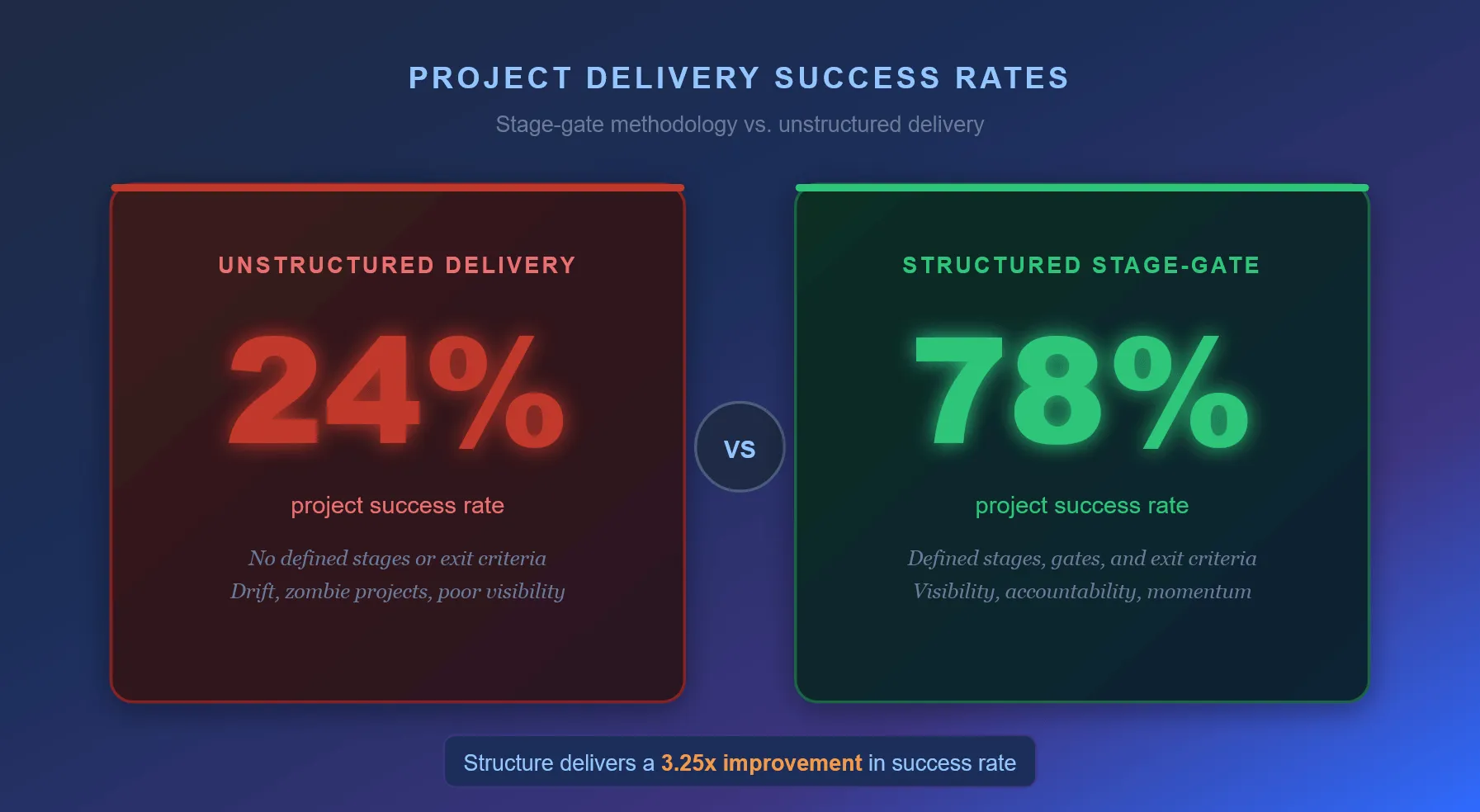
The difference isn’t the quality of the ideas. It’s whether the delivery model held up after approval. That gap is predictable. A project funnel closes it.
What a Project Funnel Is
A project funnel is a staged delivery model where projects earn the right to move forward by demonstrating readiness at defined checkpoints.
Each stage has specific deliverables and exit criteria. Each gate is a formal decision point: go, kill, hold, or recycle.
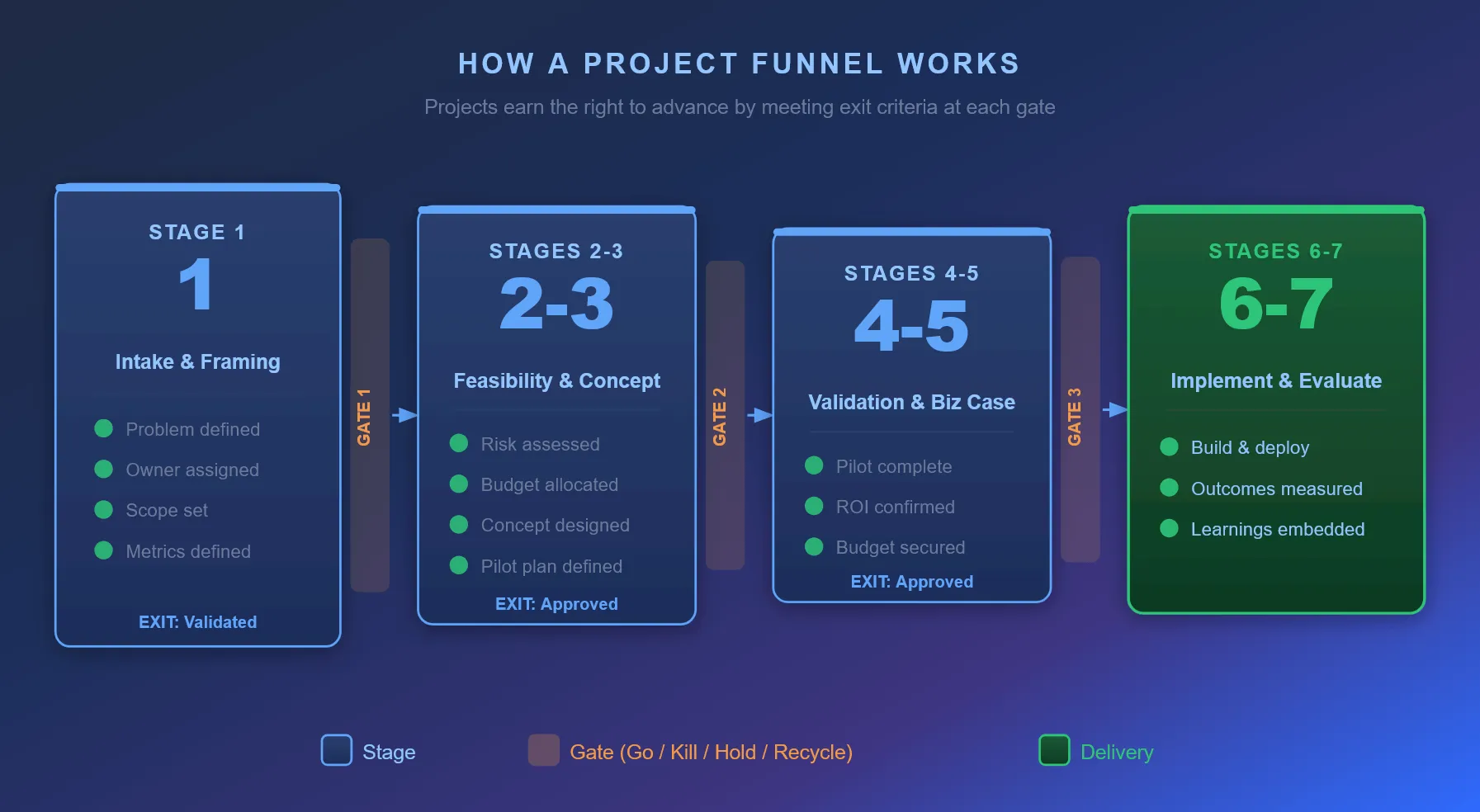
The funnel enforces decision quality at every phase. It creates visibility into portfolio health, not just individual task completion.
It gives leadership permission to kill underperforming projects because the framework makes it clear when that’s the right call.
A project funnel is governance with forward momentum.
The 7 Stages of an Innovation Project Funnel
Each stage has a defined purpose, a set of deliverables, and an exit criterion that must be met before the project moves forward.
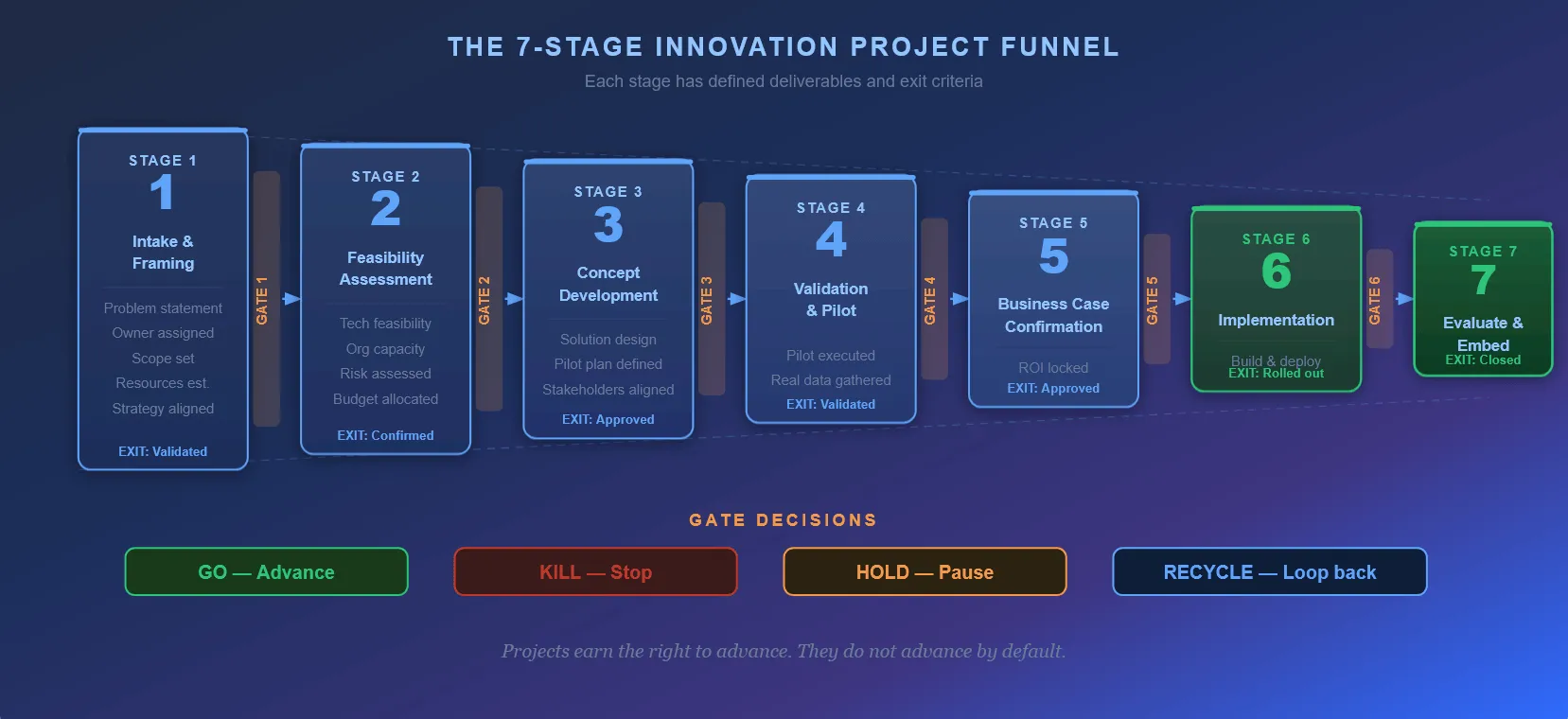
Here’s how the model works end to end.
Stage 1: Intake and Framing
An approved idea enters the system with enthusiasm but often without clarity. The intake stage defines what you’re actually solving for.
The project owner is assigned. The problem statement is written with precision: not “improve customer experience” but “reduce time to onboard new enterprise customers from 14 days to 5 days.”
Success criteria are defined upfront. What does done look like, what metrics matter, and who decides whether the project succeeded?
This stage is short but critical. It’s the difference between a project with direction and a project with momentum in the wrong direction.
Exit Criterion:
- Problem statement validated against strategy
- Project owner confirmed
- Scope boundaries set
- Estimated resource level understood
Stage 2: Feasibility Assessment
Now you stress-test the idea. Is it technically feasible, and does your organization have the skills and capacity to execute?
A quick investigation happens here: desk research, preliminary technical assessment, stakeholder conversations. The goal is to surface what you don’t know and estimate what it will cost to find out.
You’re not building anything yet. You’re figuring out whether building is realistic.
Risk level gets assessed. Is this a straightforward project or a moonshot? That assessment drives how rigorous the rest of the funnel needs to be.
Exit Criterion:
- Preliminary feasibility confirmed
- Risk level assessed
- Initial budget allocated
- Major obstacles identified or ruled out
Stage 3: Concept Development
The concept is built out in detail: what exactly you’re building, how it works, and who needs to be involved.
Solution architecture gets defined. If it’s a product feature, what does it do? If it’s a process change, how does the workflow differ?
Stakeholder mapping happens. Who wins? Who might resist, and who needs to be in the room from the start?
For most innovations, a pilot scope gets outlined. What’s the smallest, fastest way to prove the concept in real conditions?
Options typically include:
- A prototype for software-based innovations
- A limited rollout for process changes
- A test market for new offerings
Exit Criterion:
- Detailed concept document approved by gatekeepers
- Pilot plan defined
- Stakeholders aligned on approach
Stage 4: Validation and Pilot
Run the pilot and gather real data.
This is the learning stage. You’re validating the core assumption: does the solution actually solve the problem?
Does it perform as expected in real conditions? Do users or stakeholders embrace it? What didn’t you anticipate?
The pilot should be fast and focused: designed to answer specific questions, not to be a scaled version of the final delivery.
Exit Criterion:
- Pilot completed
- Performance data reviewed
- Concept validated against success criteria
- Major adjustments identified or none needed
Stage 5: Business Case Confirmation
After validation, the business case gets locked.
ROI projections now have real pilot data behind them. Resource requirements are refined and risk assessment is updated based on what you learned.
This is where the full investment case gets made. The CFO sees real evidence that the investment is warranted.
The executive sponsor confirms ongoing commitment. Timelines and budgets are firmed up.
Exit Criterion:
- Business case approved by gatekeepers
- Budget confirmed
- Timeline locked
- Resource commitments secured
Stage 6: Implementation
Full execution. This is where the project gets built, deployed, or launched, with structured progress tracking at milestones and clear ownership of scope, timeline, and resources.
This is where most organizations think innovation happens.
In reality, this stage should feel structured and straightforward. The work of clarifying what you’re solving, validating the solution, and confirming the business case happened in the stages before.
Exit Criterion:
- Implementation milestones met
- Rollout complete
- Systems and processes updated
- Training delivered
Stage 7: Evaluation and Embedding
Measure outcomes against the success criteria from Stage 1.
Did you hit the targets? What’s the actual ROI, and what would you do differently next time?
Learnings get documented and shared. Success stories become organizational knowledge. Failures become input for the next cycle.
This stage closes the loop. It answers the question that most innovation programs fail to answer: did this matter?
Exit Criterion:
- Outcomes measured and reported
- Impact against success criteria documented
- Learnings embedded
- Project formally closed
| Stage | Key Activity | Exit Criterion |
|---|---|---|
| 1. Intake & Framing | Define problem, owner, success metrics | Problem statement validated, owner confirmed, scope set |
| 2. Feasibility Assessment | Test technical and organizational feasibility | Feasibility confirmed, risk assessed, budget allocated |
| 3. Concept Development | Build detailed solution design and pilot plan | Concept approved, pilot scope defined, stakeholders aligned |
| 4. Validation & Pilot | Run controlled test; gather real data | Pilot complete, concept validated, surprises identified |
| 5. Business Case Confirmation | Finalize ROI, resources, timeline | Business case approved, budget confirmed, resources secured |
| 6. Implementation | Execute build or deployment; track milestones | Rollout complete, systems updated, training delivered |
| 7. Evaluation & Embedding | Measure outcomes and document learnings | Impact measured, learnings embedded, project closed |
Gates: The Decision Points That Prevent Drift
Gates function as governance forums, not routine check-ins.
Timelines have dates. Funnels have standards. Gates are where those standards get applied.
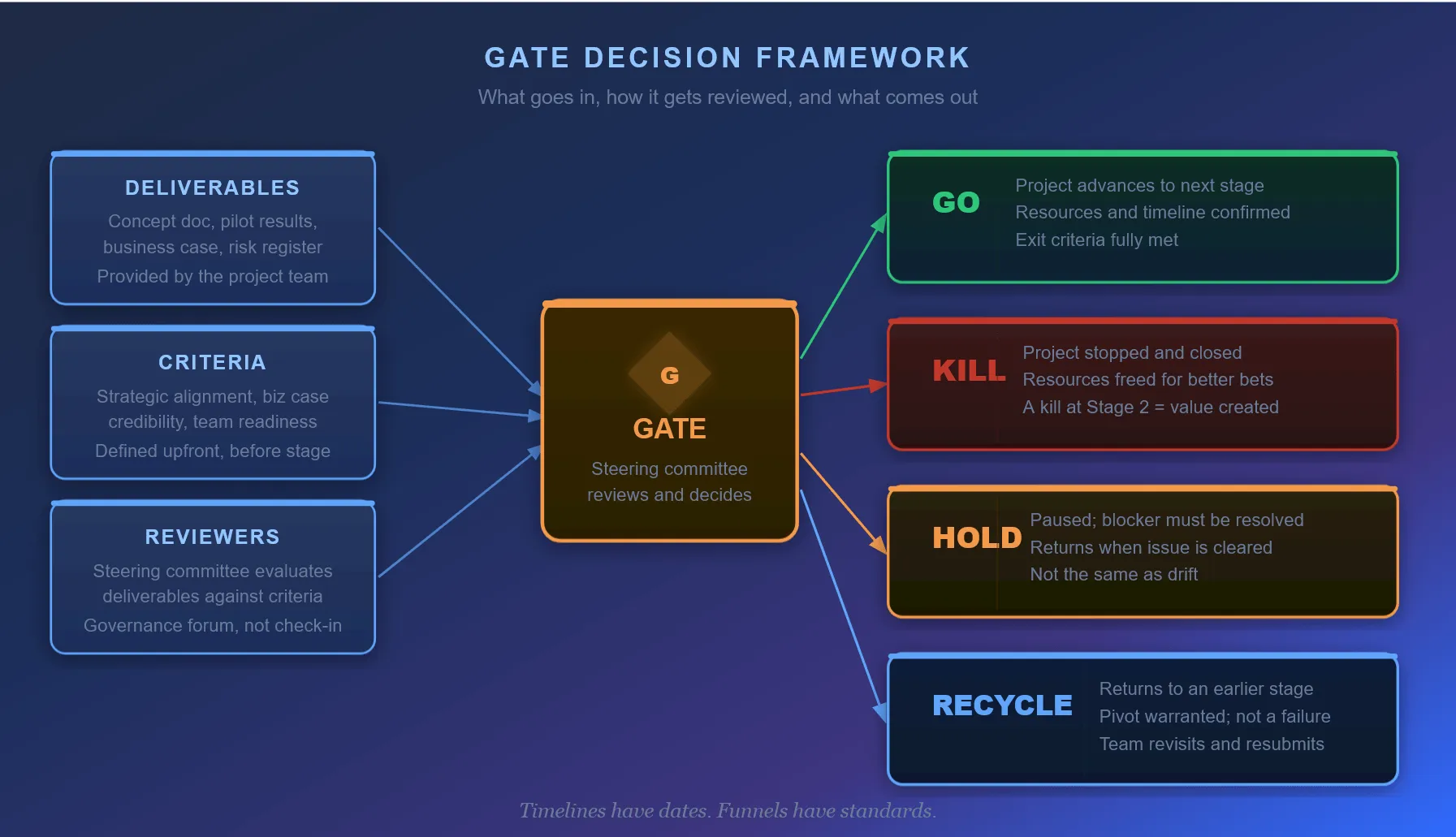
Each gate contains three components:
- Deliverables. What must the project team provide for review? (concept document, pilot results, business case, etc.)
- Criteria. Against what standard will this be evaluated? (Does it align with strategy? Is the business case credible? Is the team ready?)
- Outputs. What decision gets made? Go, Kill, Hold, or Recycle. And if Go, what resources and timeline are confirmed?
The steering committee reviews, evaluates, and decides. Some projects advance, some hold for refinement, some get killed.
Some return to an earlier stage because the pivot warrants it.
Skip the gates and the cost shows up later. Projects drift, teams optimize for progression rather than outcomes, and zombie projects accumulate.
Structured approaches reach nearly 78% success rates versus 24% for unstructured processes.
The gate is where structure becomes power.
Funnel Variants: Adjusting the Model to Innovation Type
Not every project needs to run all seven stages at full depth. The principle is right-sizing: aligning rigor to actual risk.
Incremental or Efficiency Improvements
These are lower-risk projects. The impact is predictable, and the unknowns are minimal.
A simplified 3-4 stage funnel works: define the problem and success metrics, develop the solution, validate it, deploy it.
Gates can be lighter (internal team review rather than executive steering) and cycle time is shorter.
Adjacent Innovation
You’re extending into a new customer segment or building a related offering.
There’s more uncertainty here, but you’re building on known capabilities.
Use a 5-6 stage funnel, with more rigorous feasibility assessment. Validation is mandatory because adjacency means you’re testing new assumptions.
Gates are formal but not burdensome. Timeline is moderate: you’re reducing uncertainty, not eliminating it.
Breakthrough or Transformational Innovation
You’re entering new territory, where feasibility is genuinely uncertain and validation is complex.
This is where you need the full seven-stage model.
Gates are rigorous because the stakes are higher. Teams need to bounce between stages, returning to concept development after a validation surprise. That’s a feature of the system, not a failure.
The cycle is longer because you’re working through genuine unknowns.
As Lean Stage-Gate practitioners put it: “Processes need to be aligned to the level of risks in projects.”
| Innovation Type | Recommended Stages | Gate Intensity | Typical Cycle Time |
|---|---|---|---|
| Incremental / Efficiency | 3-4 stages | Light; internal review | 2-6 months |
| Adjacent | 5-6 stages | Moderate; formal review | 6-12 months |
| Breakthrough / Transformational | Full 7 stages with bounce gates | Rigorous; executive steering | 12-24+ months |
What Breaks Funnels in Practice
Funnels work in theory. In practice, four failure patterns emerge repeatedly.
| Failure Pattern | What Happens | The Fix |
|---|---|---|
| No defined exit criteria | Gates become conversations instead of decisions. Projects coast forward because nobody says stop. | Define exit criteria upfront, in writing, before the stage starts. |
| Gate reviews too infrequent | Projects finish in month two and wait until month four for a decision. 40% of blocked items point to the same bottleneck: gate scheduling, not staffing. | Gate frequency should match project pacing, not the executive calendar. |
| No single owner per stage | Stage three is “owned” by three teams, which means it’s owned by nobody. Progress stalls because there’s no clear decision-maker. | Assign one stage owner, give them decision authority, hold them accountable. |
| Progression-seeking behavior | Teams are rewarded for shipping. When a project should die, they call it “on hold.” The project lingers. | Reward teams that kill bad projects early. A kill at Stage 2 is as valuable as a ship at Stage 6. |
Build the Funnel Before You Need It
Design your project funnel when the portfolio is healthy, before projects are stuck and zombie initiatives take root. The structure is portable. In SaaS it might mean four months. In pharma, it spans years.
Organizations with structured project funnels see measurable results:
- Implementation speed increases by 25-30% through standardized delivery and improved gate quality
- Teams spend less time debating process and more time executing
- Portfolio visibility becomes real: you know which projects are advancing, which are stuck, and which should be killed
- Real-time dashboards replace status email chains
- Gate preparation time drops from 40+ hours to 4-6 hours with AI-assisted decision support
That’s the gap this model closes: from approval to delivery, with visibility and accountability at every step.
Download our free ebook Project Portfolio: From Opportunities to Value to learn how to build a clear delivery model from approved idea to outcome.
Request a demo to see how Accept Mission gives you structure and transparency across every stage of your project funnel, from intake to evaluation.







 English
 Dutch
Dutch Portuguese
 Spanish
 French
 German
 Arabic