
Why Portfolio Reviews Stall and How a Canvas Fixes It11 min read

Portfolio review meetings rarely produce decisions worth the time they cost.
Three structural problems keep driving the same outcome:
- No evidence requirement
- No decision authority in the room
- No time pressure on decisions
A pre-filled canvas addresses all three. It standardizes the inputs, moves the information work into preparation, and converts reviews from reporting sessions into decision events.
Better inputs are what change the meeting. That’s what the canvas is ultimately for.
Why Portfolio Reviews Stall
Most reviews fail in the meeting itself, where the design of the conversation quietly works against good decisions.
Linden Innovation identifies three structural causes that show up again and again:
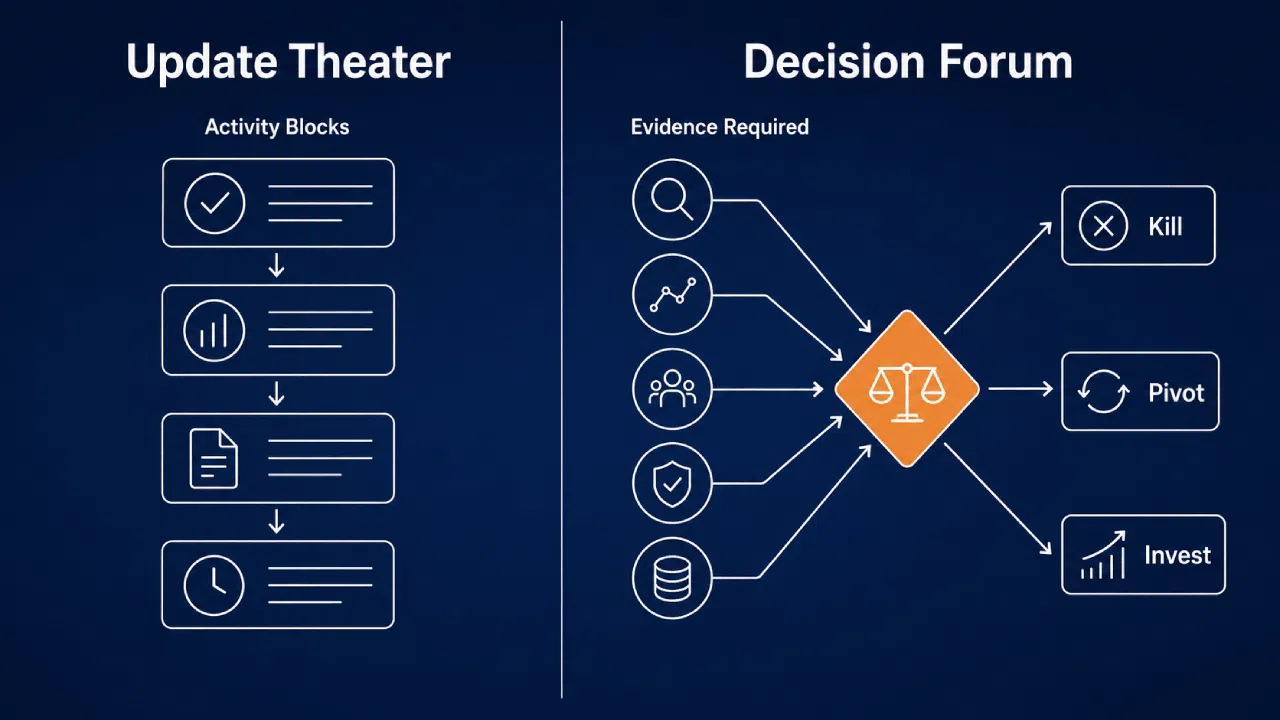
- No evidence requirement. Teams report activities instead of evidence. A project can be “on track” for timeline while validating zero assumptions, which is activity without evidence.
- No decision authority in the room. Attendees can recommend but can’t decide. Real calls get deferred to a later conversation that may never happen.
- No time pressure on decisions. Without explicit gates, projects drift indefinitely. “Zombie projects” survive for years without a documented kill decision.
When projects present inconsistently, the board spends its time filling information gaps. The meeting becomes a data-gathering exercise dressed up as a decision forum.
Preparation gaps compound the problem. A survey of 30 organizations found only 10% prepared their sponsors for their role in gate reviews.
That gap held even though 70% already had project management methodologies in place. The methodology existed, but sponsors were rarely prepared for their role.
What a Canvas Actually Does
A canvas standardizes inputs before the meeting starts. That single shift moves the bulk of the work out of the room and into preparation, where it belongs.
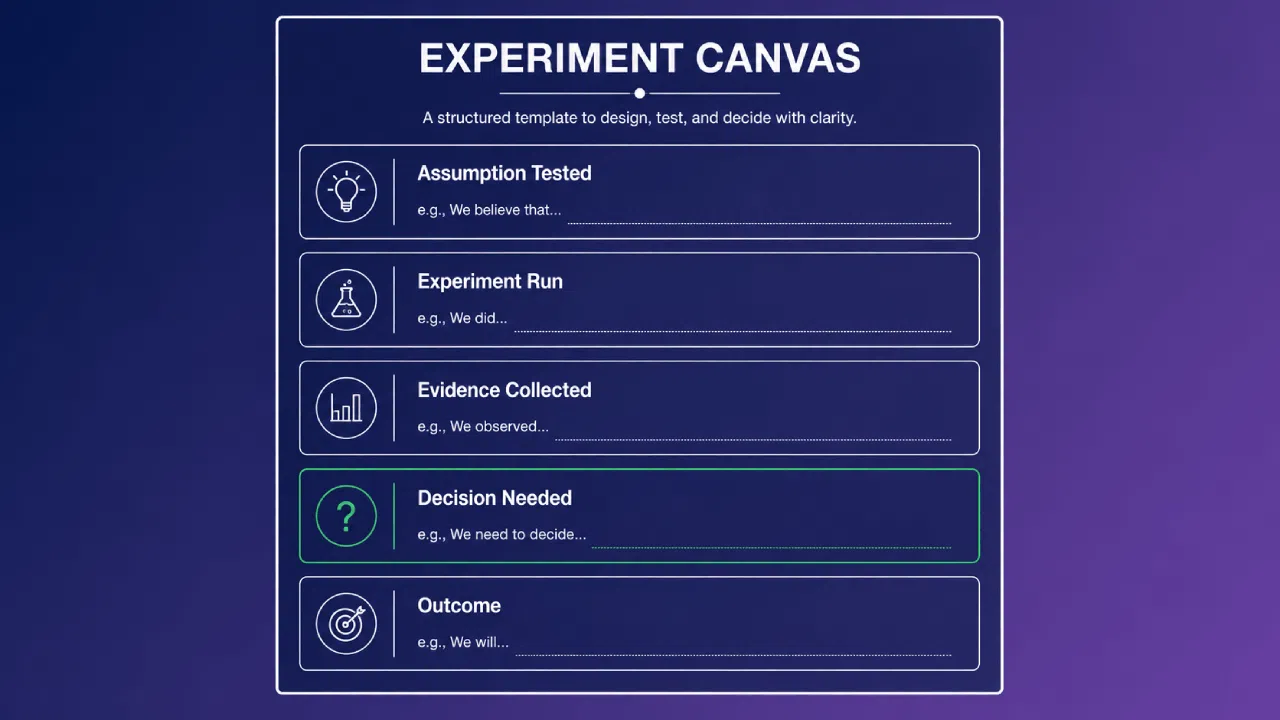
Each team submits a one-page canvas before the review: assumption tested, experiment run, evidence collected, decision needed. The board reads it in advance.
| Without a Canvas | With a Canvas | |
|---|---|---|
| Meeting opens with | Status presentations | Shared, pre-read inputs |
| Board spends time on | Filling information gaps | Weighing trade-offs |
| Decisions | Deferred to “next time” | Made in the room |
| Cognitive load | Preparation anxiety, unclear roles | Clear inputs, clear ask |
Meeting time then shifts from presenting data to discussing trade-offs and making real decisions.
There’s a cognitive payoff too. Research on meeting design shows that mental load drops when participants know why they’re gathered.
The guiding principle is simple: fix the data fields and the format of the brief, and let teams work their own way internally.
The Fields That Make a Canvas Useful
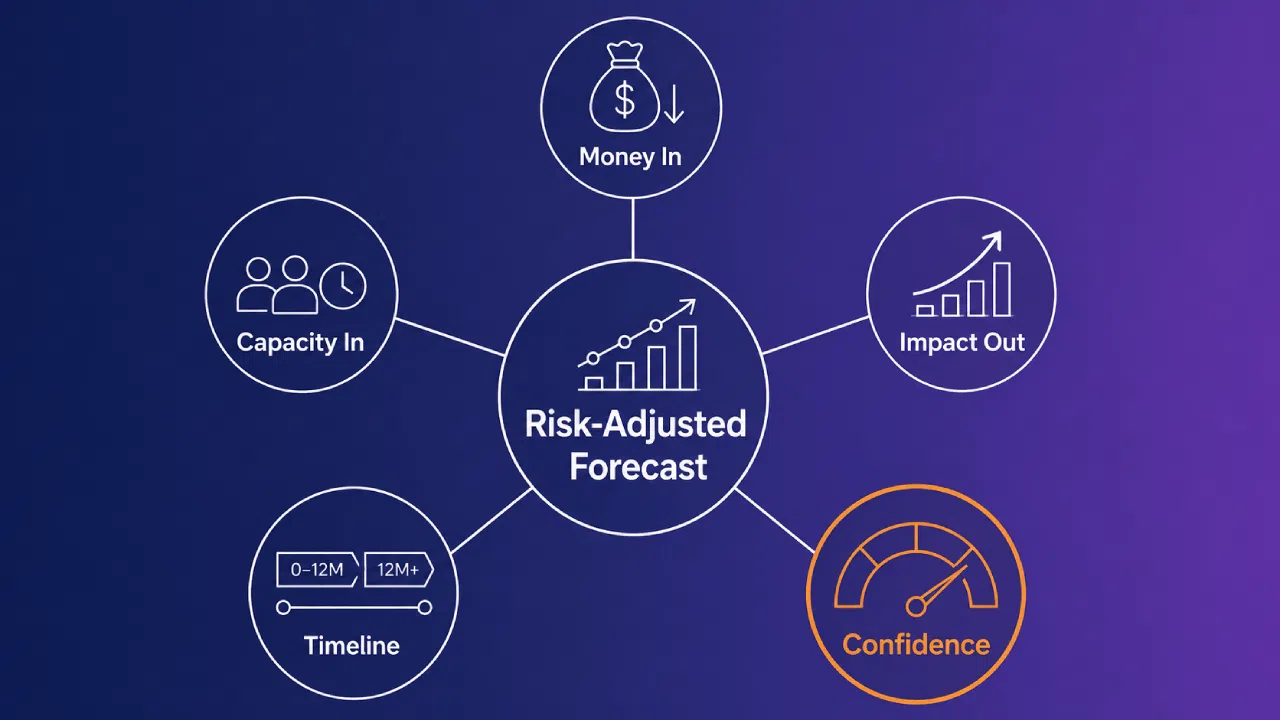
A canvas is only as good as its required fields. A practical minimum viable data set has five standard fields for confidence-weighted, comparable project views.
| Field | What It Captures | Why It Matters for Portfolio Decisions |
|---|---|---|
| Money in | Budget required to reach the next stage | Anchors every project to a specific, realistic funding ask |
| Capacity in | People and time demanded | Surfaces the hidden resource conflicts that kill delivery |
| Impact out | Revenue, savings, or strategic value | Requires a measurable business case tied to real outcomes |
| Timeline | Time to first value and time to scale | Separates quick wins from long bets so the board can balance the mix |
| Confidence | Probability weighting on the forecast | Turns optimistic numbers into risk-adjusted ones you can actually compare |
Confidence is the field most teams skip. A project at 20% confidence is a different bet from one at 90%, and the canvas makes the gap visible.
Two more fields round out the canvas. The first is a go/no-go scoring model covering strategic alignment, value generation, feasibility, risk, and timing.
The second is kill criteria defined at entry, before resources and commitment accumulate. Together they remove the two biggest sources of portfolio drift.
Canvas Types for Different Review Purposes
One canvas doesn’t fit every review. The right template depends on what the meeting is actually deciding.
Three distinct canvas formats cover the most common review scenarios:
| Canvas Type | Best Used For | Key Fields |
|---|---|---|
| One-page evidence brief | Monthly operational reviews | Assumption tested, experiment run, evidence, decision needed |
| Business model / lean canvas | Strategic fit reviews | Problem, solution, key metrics, value proposition |
| Base plus custom criteria | Portfolio-level prioritization | Funding volume, scaling stage, plus thematic or intent criteria |
The one-page brief is the monthly workhorse: lightweight, fast to fill, and built around a single question. What did we learn, and what do we need to decide?
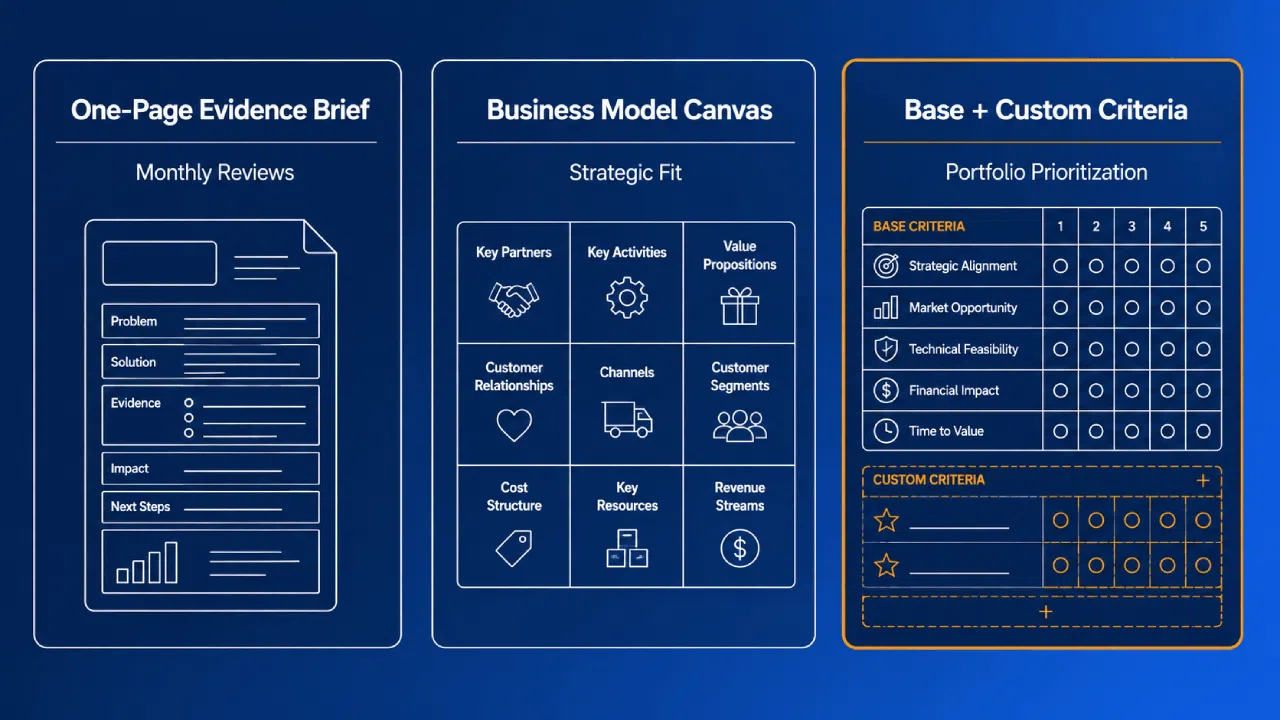
The business model view suits strategic fit reviews, weighing whether a project belongs in the portfolio at all.
The OECD approach scales to diverse portfolios by pairing base criteria with custom ones for optimization or exploration. The canvas becomes a recurring instrument, used each review cycle.
Reviewing and prioritizing those custom criteria is itself a way to accelerate strategy, according to OECD researchers.
A Common Spine, Local Flexibility
Here’s where most teams hesitate. They worry a template will add admin overhead or flatten the judgment that makes good reviewers good.
That worry runs backwards. A canvas gives reviewers clean, structured inputs so their judgment has something solid to work on.
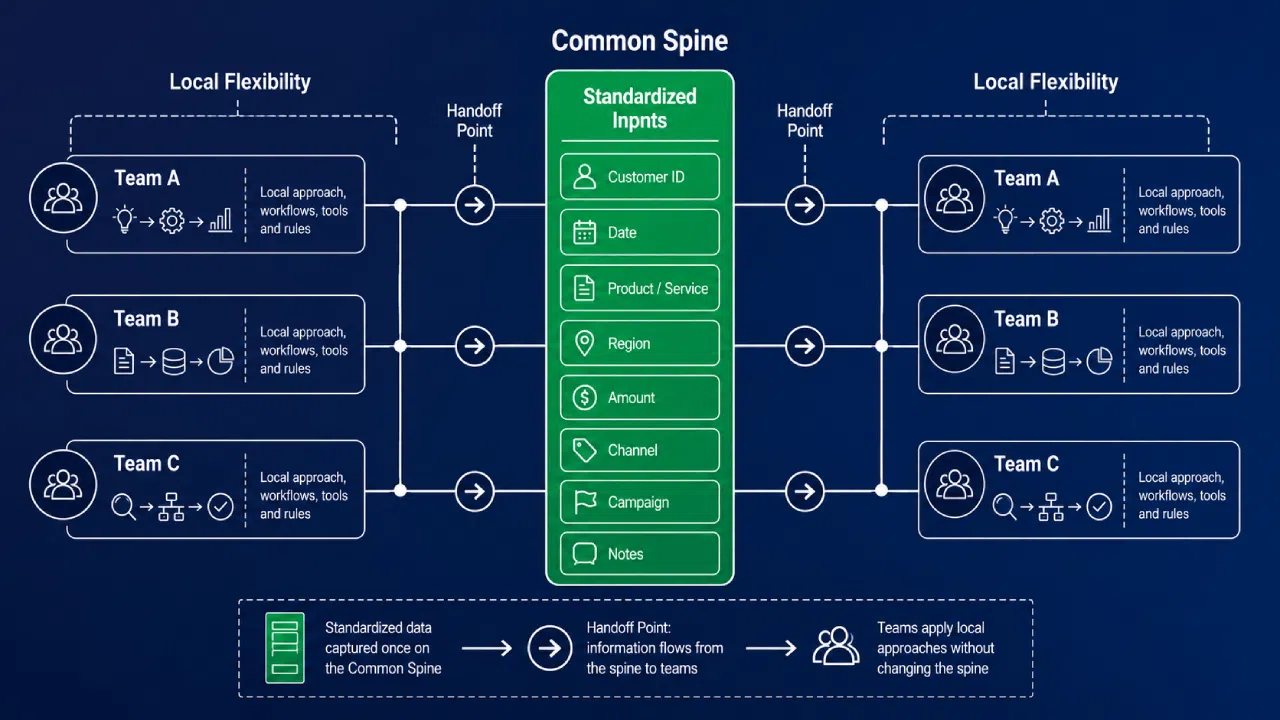
What practitioners keep coming back to is “local flexibility, common spine.” You standardize the inputs every project hands the board, and let teams work their own way.
The canvas is a handoff point. It governs the moment a project enters the review, and says nothing about how the team got there.
Design matters, but adoption is critical – even great canvases fail without buy-in. Ensure success by communicating value, celebrating quick wins, and allowing the template to evolve.
Build the Canvas-First Cadence
A canvas changes individual meetings. A cadence changes the system.
Three tiers define the rhythm:
| Review Tier | Cadence | Canvas Used | Decision Type |
|---|---|---|---|
| Evidence review | Monthly, 90 min, 4 projects | One-page evidence brief | Kill, pivot, or invest per project |
| Allocation review | Quarterly, half-day | Base plus custom criteria | Rebalance resources across the portfolio |
| Strategic review | Annual | Full portfolio canvas | Align composition to 3 to 5 year strategy |
The dominant recommended rhythm, as Linden Innovation describes it, runs from monthly evidence reviews to quarterly allocation reviews to an annual strategic review connecting portfolio composition to longer-range strategy.
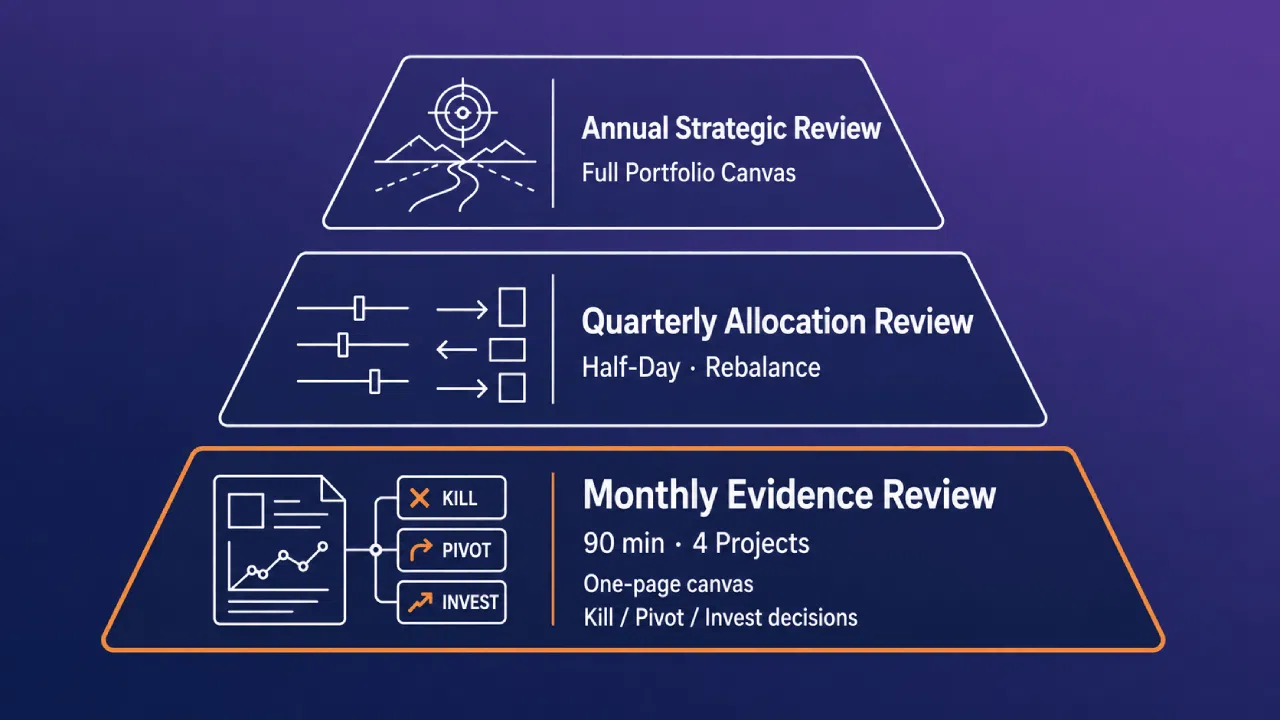
The monthly cadence is where discipline lives:
- Four projects
- 10 minutes each
- Canvas submitted 48 hours in advance
When inputs arrive early, the meeting becomes a focused decision session.
That shift from presentation mode to decision mode is what the canvas is ultimately for. Every other benefit follows: faster reviews, clearer accountability, fewer zombie projects.
How to Run the First Canvas Review
Send each team the canvas template the moment the date is locked, with a hard 48-hour deadline.
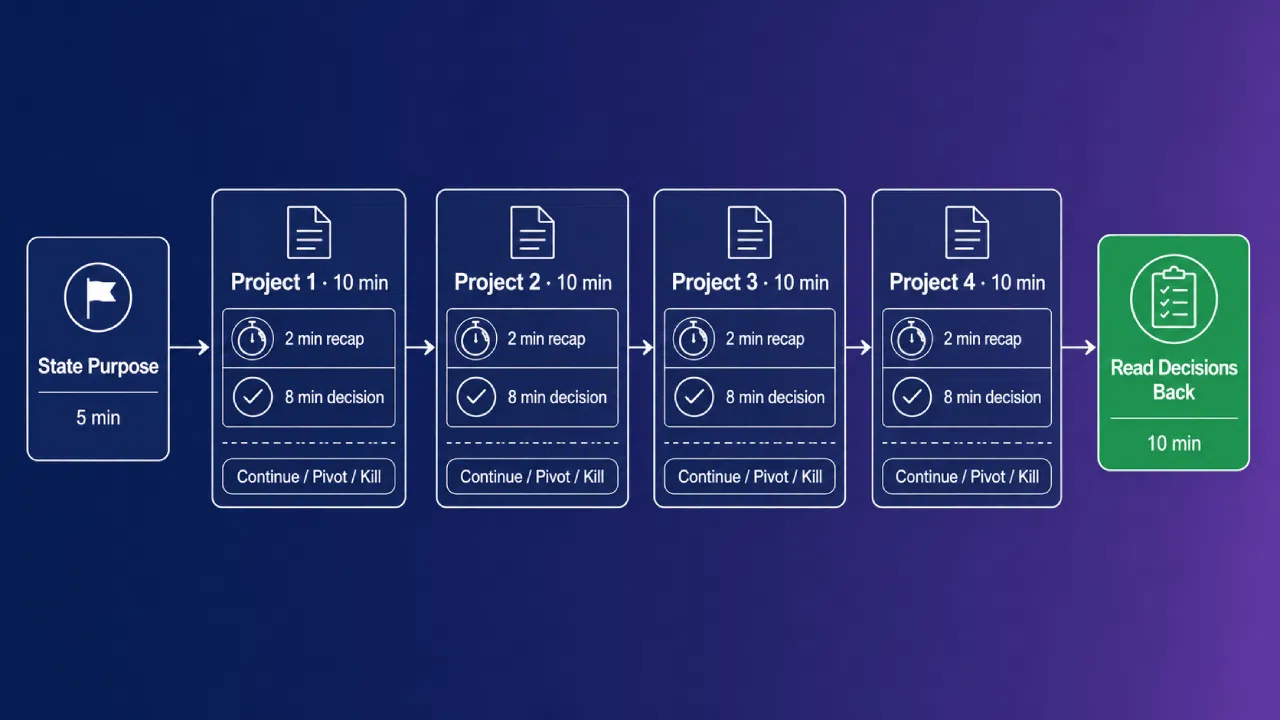
The meeting runs on a fixed structure:
- Open with the purpose. This is a decision meeting. State that once and move straight to the first project.
- Ten minutes per project. The board has already read the canvas. Two minutes on what changed, the rest on the decision.
- The facilitator holds time. Keep conversations on the decision needed and make sure someone with authority says “continue,” “pivot,” or “kill” before each slot closes.
- Close by reading decisions back. Every project leaves with a documented call, an owner, and a next date.
Anything that arrives after the deadline is read cold in the room, and teams only let that happen once.
Missing or incomplete canvases have a standing rule, decided before the first meeting: review them as-is, with gaps treated as unknowns.
That rule does more for adoption than any reminder email. By the third cycle, the 90-minute block starts to feel like enough.
Common Reasons Canvases Fail
Most canvas rollouts survive the first cycle and then quietly fall apart. The failure modes are predictable, which means they’re avoidable.
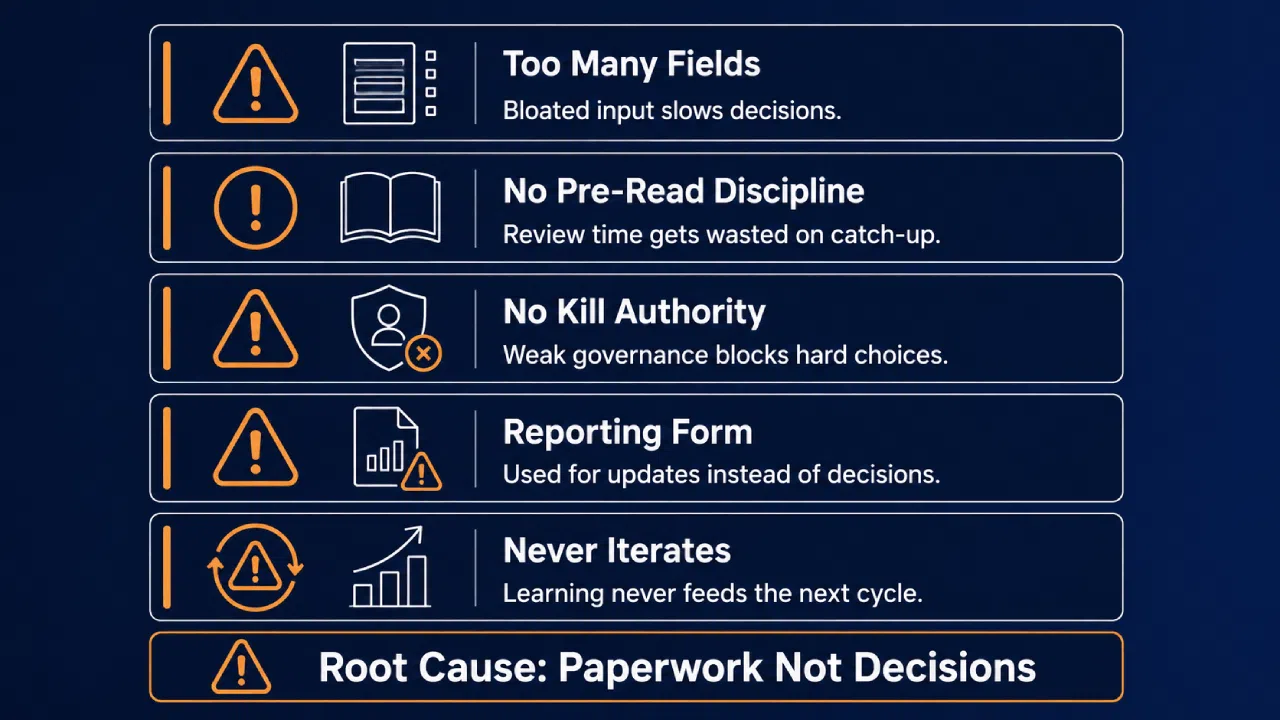
Here are the five that come up most often:
- Too many fields. When the canvas balloons past a single page, teams either game it or skip it entirely. Five core fields beat fifteen optional ones.
- No pre-read discipline. If the canvas arrives at the meeting rather than before it, the board is back to reading in the room. The model collapses.
- No kill authority. When nobody present can actually stop a project, reviews produce polite recommendations that nobody acts on.
- Treated as a reporting form. Teams fill it in to look compliant rather than to surface a real decision.
- Never iterates. A canvas frozen at v1 stops fitting the portfolio it was built to describe.
Each of these traces back to the same root: the canvas gets adopted as paperwork rather than as the thing that drives the decision.
Fixing these patterns means enforcing the pre-read, naming who holds kill authority, and revisiting the fields every few cycles so the canvas keeps earning its place.
Catch these early and the canvas holds. Miss them and you’re back to update theater, just with better formatting.
How to Get Leadership Buy-In
Canvas implementations fail at the sponsorship stage more often than the design stage. The pitch is wrong before the first template is ever shared.
Frame it in their terms, shorter reviews and better budget calls, and avoid the word “template” entirely because it signals admin overhead.
Here’s what to show in the first 30 days:
- Meetings running shorter
- One decision that the canvas made possible
The right sponsor is someone who already feels the pain of slow, inconclusive reviews, usually the person who owns the portfolio budget and answers for its returns.
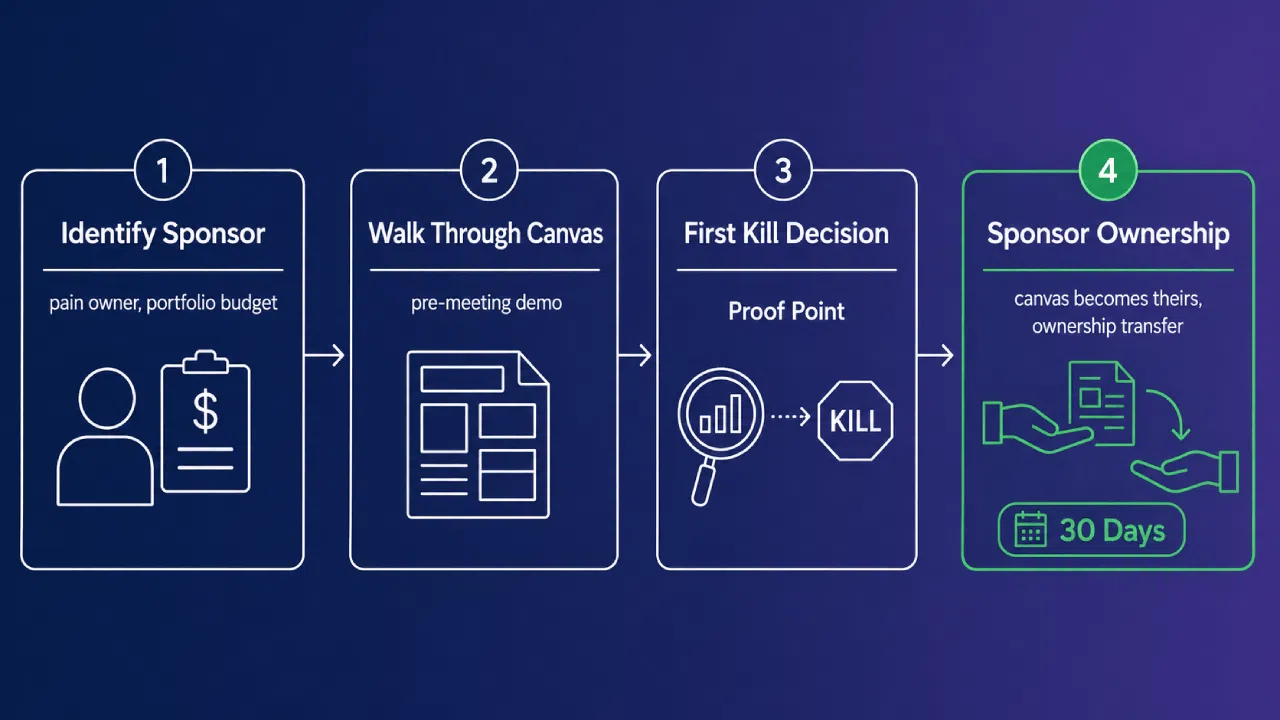
Cultivate that person before the rollout: walk them through one filled canvas and ask whether it gives them enough to make a real call.
The proof point is the first kill decision. When a project stops on evidence and the resources move to something better in the same cycle, skeptics become defenders.
After that, the canvas stops being your initiative and starts being theirs.
Make Templates Stick
Adoption is the hard part:
Getting people to use the canvas consistently, review after review. Simpler frameworks applied consistently outperform sophisticated ones applied unevenly.
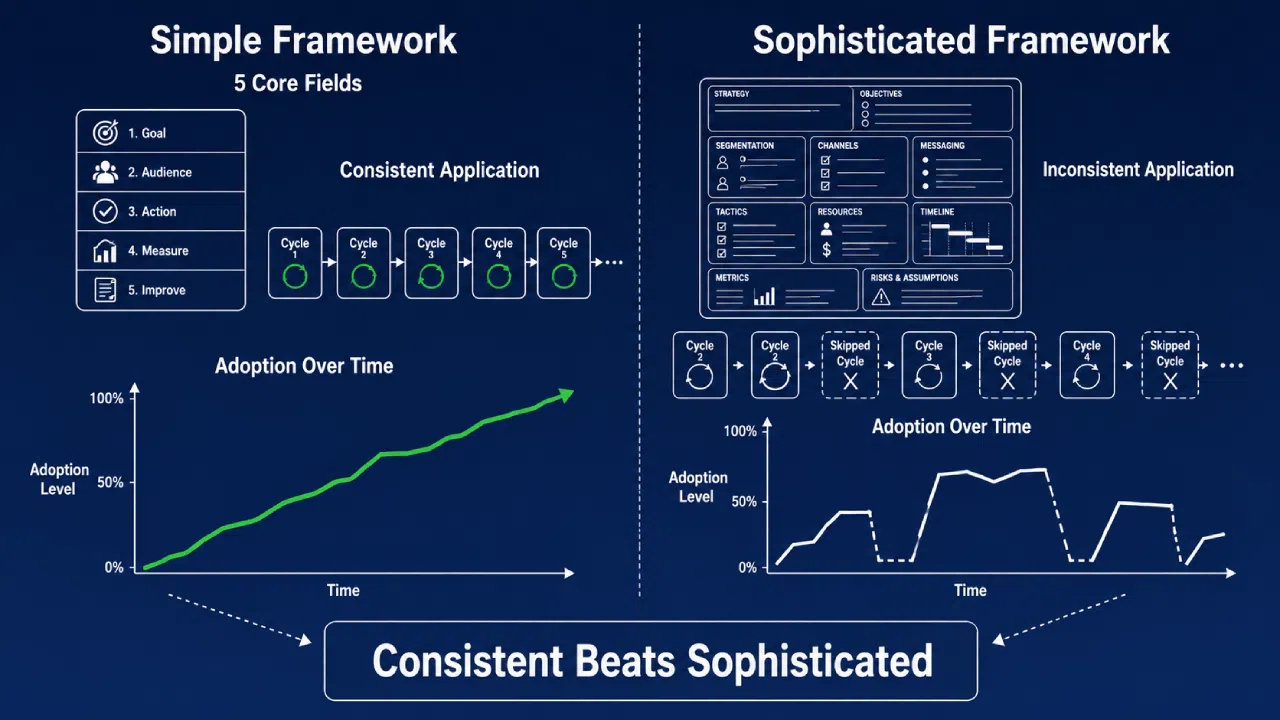
The practical starting point is five core fields plus a fixed pre-read format, required before the next monthly review.
A well-adopted canvas converts review meetings into resource allocation events, bringing structure and transparency to the moment that decides where your innovation budget goes.
The judgment in the room stays human. The canvas just makes sure that judgment has something real to act on.
What Changes After Six Months
Two full quarterly cycles in, the shifts are concrete enough to point at. None of them are dramatic, which is rather the point.
The changes show up across four areas:
- Meeting duration. Reviews that ran two hours settle closer to 90 minutes.
- Kill rate. Projects that drifted for years start getting stopped on evidence.
- Sponsor readiness. Executives walk in ready to decide rather than asking for context.
- Reallocation speed. Resources freed by a kill move to the next bet in the same review cycle.
Teams that make the switch report meaningful reductions in resource waste as data-driven scoring and group decisions replace gut-feel prioritization.
The numbers matter, but the cultural shift matters more. Killing a weak project stops feeling like failure and starts feeling like good portfolio hygiene.
That change is the real return on a canvas-first cadence, and it’s what makes the practice worth standing up properly.
Download our free ebook Project Portfolio: From Opportunities to Value to learn how to build a single transparent source of truth across your innovation portfolio.
Request a demo to see how Accept Mission delivers real-time visibility, data-driven scoring, and one unified source of truth across your entire innovation portfolio.








 English
 Dutch
Dutch Portuguese
 Spanish
 French
 German
 Arabic