
The Decision Matrix: How to Score and Compare Ideas Without the Spreadsheet Chaos12 min read

You know the spreadsheet. Rows of ideas, columns of criteria, a tab for each reviewer who promised to fill it in by Friday.
The chaos arrives on schedule:
- Three people used an old version.
- Two left half the cells empty.
- Someone is recalculating totals by hand at 11 p.m.
- The comparison meeting becomes an argument about the spreadsheet, not the ideas inside it.
The chaos is not a sign your team worked carelessly. Spreadsheets were never built to hold a multi-reviewer scoring process.
A decision matrix fixes this. It gives scoring the structure and transparency it needs, so the output is a ranked list you can actually defend.
What a Decision Matrix Actually Is
A decision matrix evaluates every idea against the same set of criteria: each criterion carries a weight, each idea earns a score, and the result is a single comparable number per idea.
That number combines qualitative judgment and quantitative data into one defensible output. Strategic fit sits alongside potential ROI, and both feed the same total.
The Go/No-Go scoring model works on exactly this principle.
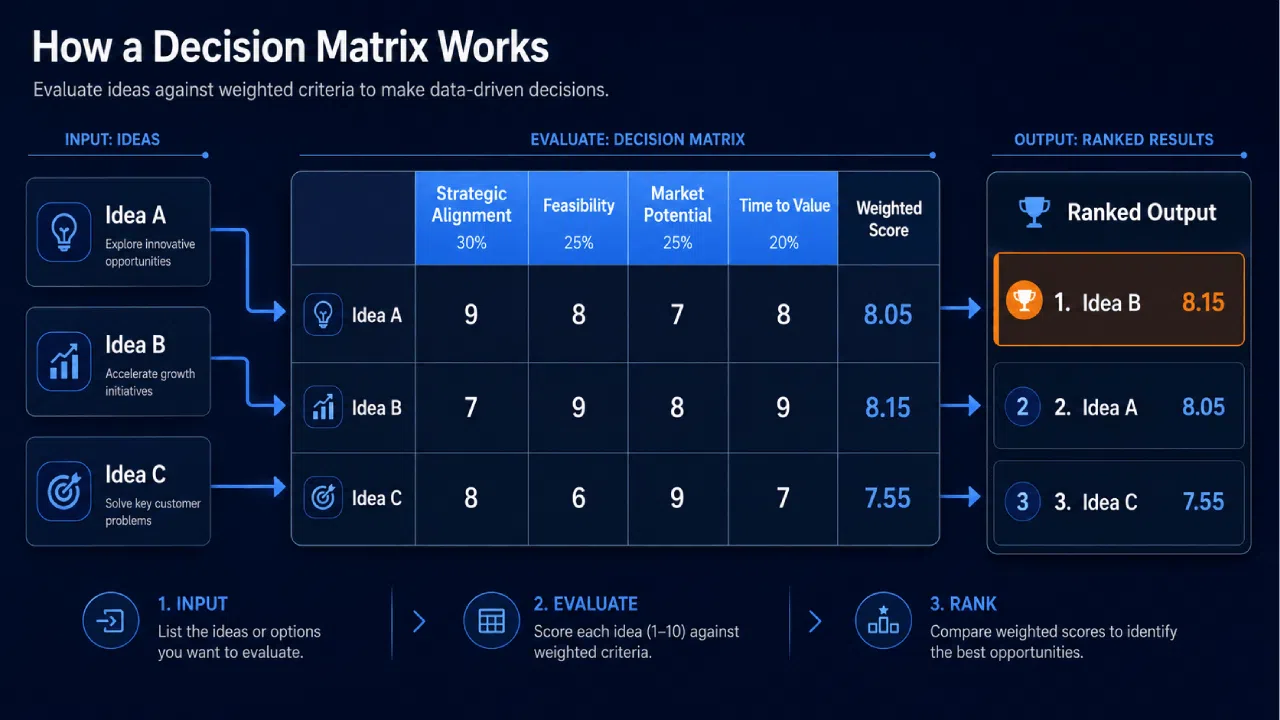
The structure is what separates it from looser methods. Voting captures popularity, gut feel captures whoever spoke last, and an unweighted list treats every criterion as equal.
What a decision matrix really does is separate the what from the who.
The criteria define what good looks like before any idea is scored. That means the reviewer’s mood or seniority stops driving the result.
| Approach | What it measures | Where it breaks |
|---|---|---|
| Decision matrix | Ideas against weighted, shared criteria | Needs upfront agreement on criteria and weights |
| Voting | Popularity and visibility | Favors familiar ideas, not strong ones |
| Gut feel | Individual instinct in the moment | No traceability, swayed by the loudest voice |
| Unweighted list | Criteria scored, all treated equally | Trivial factors outweigh strategic ones |
The table above shows why structure matters. Each alternative method has a specific failure point that weighted criteria eliminate.
How to Build Your Criteria Before the Matrix Runs
Good scoring starts before the first idea is entered. The criteria you choose and the weights you assign determine whether the output is defensible or decorative.
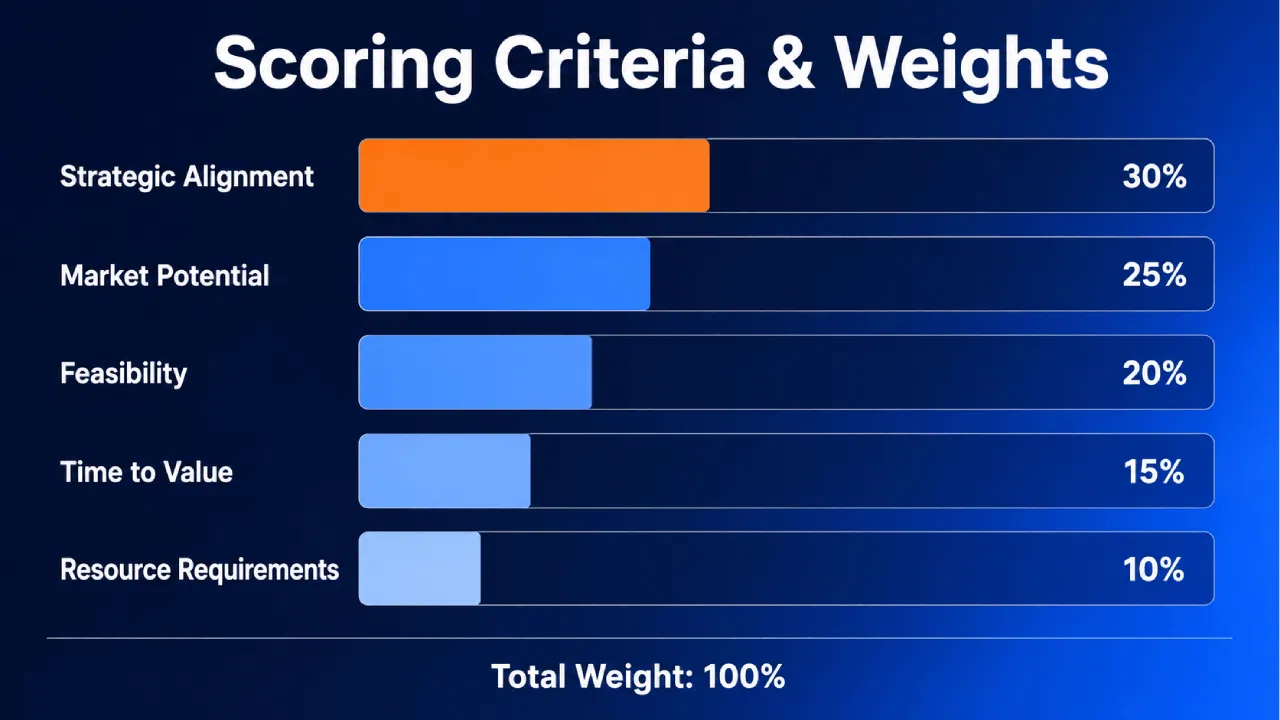
Pick criteria that map to real trade-offs. Every criterion should reflect something your organization actually uses when deciding where to allocate resources.
Strategic alignment, feasibility, market potential, time to value: these are common because they represent genuine tensions in most innovation decisions.
Write each criterion specifically. “Impact” scores differently depending on who reads it.
“Revenue impact in year two, assuming current distribution channels” does not. The tighter the label, the less interpretation drift you get across reviewers.
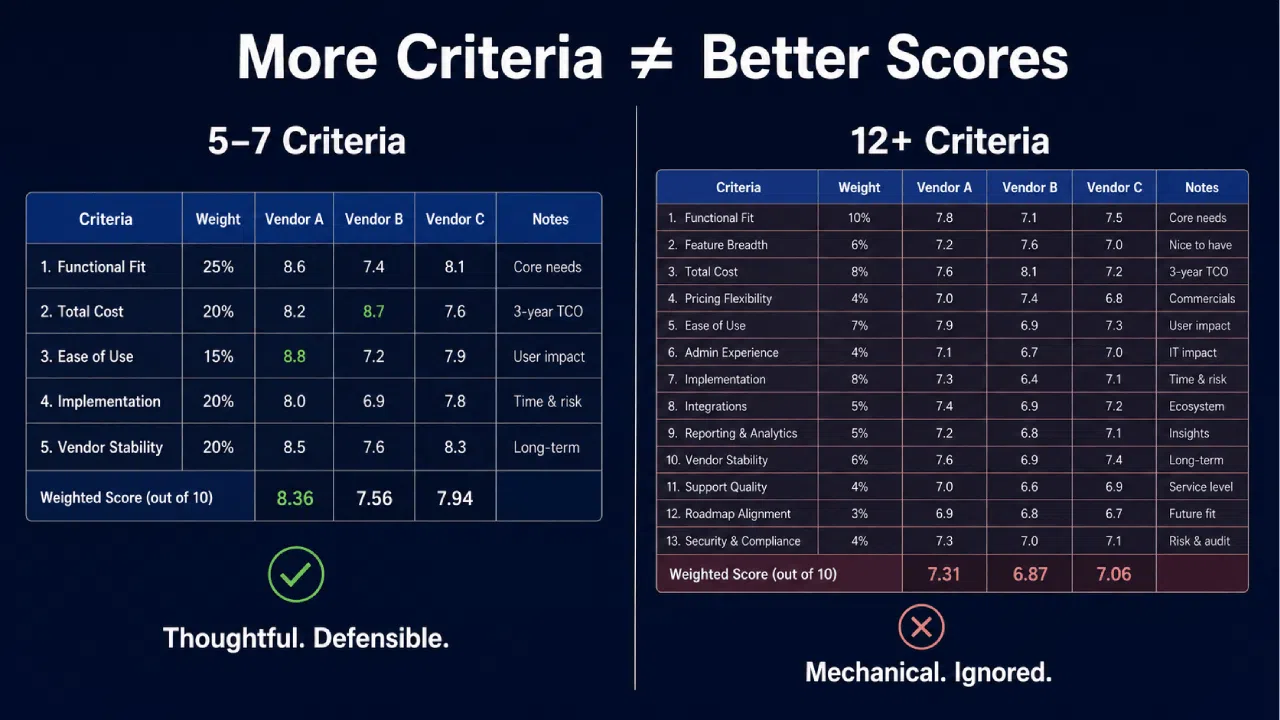
Keep the set short. Five to seven criteria is the practical ceiling for most teams.
Beyond that, reviewers start treating low-weight criteria as noise. The scoring becomes mechanical rather than thoughtful.
Weight by what actually matters, not by what looks balanced. A 20% weight on every criterion is not neutral.
It’s a claim that strategic fit matters exactly as much as implementation risk. Assign weights based on your actual priorities, not an equal split.
Set the weights before any ideas are visible. Post-hoc changes, even small ones, compromise the output.
If a weight shifts after scores are in, the ranking changes without explanation. The result is no longer defensible.
Why Side-by-Side Scoring Breaks Down in Spreadsheets
The spreadsheet is not failing because people are sloppy. It’s failing because it has no enforcement layer.
Nothing keeps reviewers consistent. Nothing records what changed.
These are the failure modes that show up almost every time:
- Version drift. Five reviewers, five files, and no single source of truth when the totals disagree.
- Criterion interpretation drift. A vague label like “Market demand” scores three to four points apart across reviewers who all think they are right.
- Score inflation. Favored projects quietly collect generous numbers because nothing flags the pattern.
- Weight manipulation. Someone adjusts a weight mid-process, and the change leaves no trace.
- No audit trail. Months later, nobody can reconstruct how a Go decision was actually reached.
Each failure mode chips away at something more important than tidiness. It degrades the quality of the decision itself.
The data backs this up. Around 78% of companies want to be more data-driven, yet two out of three data leaders watch their executives ignore the numbers anyway.

When the scoring process looks unreliable, people stop trusting its output. They fall back on instinct instead.
That is the real cost. A messy spreadsheet does not just waste an evening; it quietly trains your organization to distrust its own evaluation.
The Decision Matrix in Your Idea Funnel
The Decision Matrix is a scoring and comparison view that lives directly in the idea funnel. You find it under Innovation Studio, then Ideas, then the Decision Matrix tab.
The layout is the part teams notice first. Ideas appear as rows.
Your Scorecard criteria appear as columns, grouped under their parent scores.
You score each idea directly in the matrix, and the total recalculates automatically. No manual addition, no broken formulas, no version question.
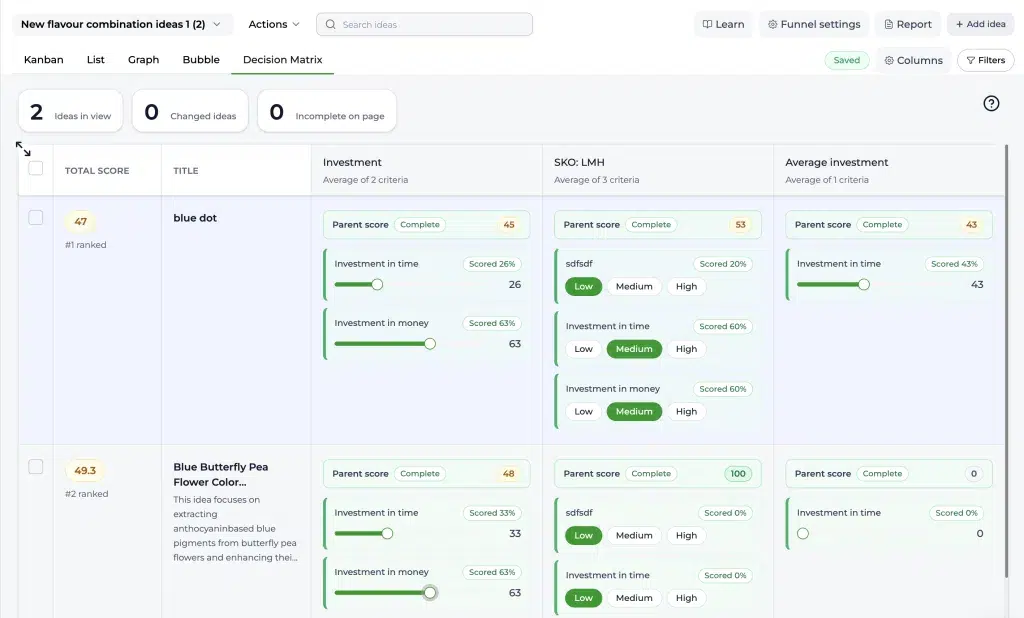
The ranked list updates as you work.
Here’s how a typical scoring pass runs:
- Open the Decision Matrix tab and confirm the right Scorecard is applied.
- Score each idea against the visible criteria, row by row.
- Click an idea title to open its context popup for the full description, comments, and strategic alignments before committing a score.
- Sort the total score column to surface the highest-ranked ideas.
- Apply Filters to narrow the set, and use Columns to add or remove what you see.
A few details make the daily workflow easier. The first columns, selection, total score, and idea title, stay frozen while you scroll horizontally through Scorecard columns.
You never lose track of which idea you are scoring. The title column also carries AI-supported idea summaries.
When scanning a long list, that quick summary helps you reach an informed score without opening every idea in full.
This is the power-user view: fast, repeatable, built for the innovation manager working through a funnel week after week. It keeps comparison structured without slowing the process down.
The Decision Matrix in Evaluations
Funnel scoring is a daily workflow. Evaluations are a different scenario: a structured group process where you collect scores from a specific set of people.
Those people might be a management team, a jury, an expert group, or a department. Scoring becomes a deliberate, assigned exercise rather than ongoing funnel maintenance.
Evaluations offer two scoring modes, and the choice depends on what the evaluator needs to do.
| Scoring mode | How it works | Best used when |
|---|---|---|
| Step-by-step | Guides evaluators through ideas one page at a time | Each idea needs careful reading, or you want a focused experience |
| Decision matrix | Shows all assigned ideas and criteria in one overview | Evaluators must compare ideas while scoring, or a large set needs scoring efficiently |
Matrix mode earns its place when comparison is the goal. Seeing every assigned idea against every criterion in one overview lets an evaluator calibrate as they go.
That matters because scoring each idea in isolation makes it harder to judge relative strength. The matrix removes that problem by keeping everything visible at once.
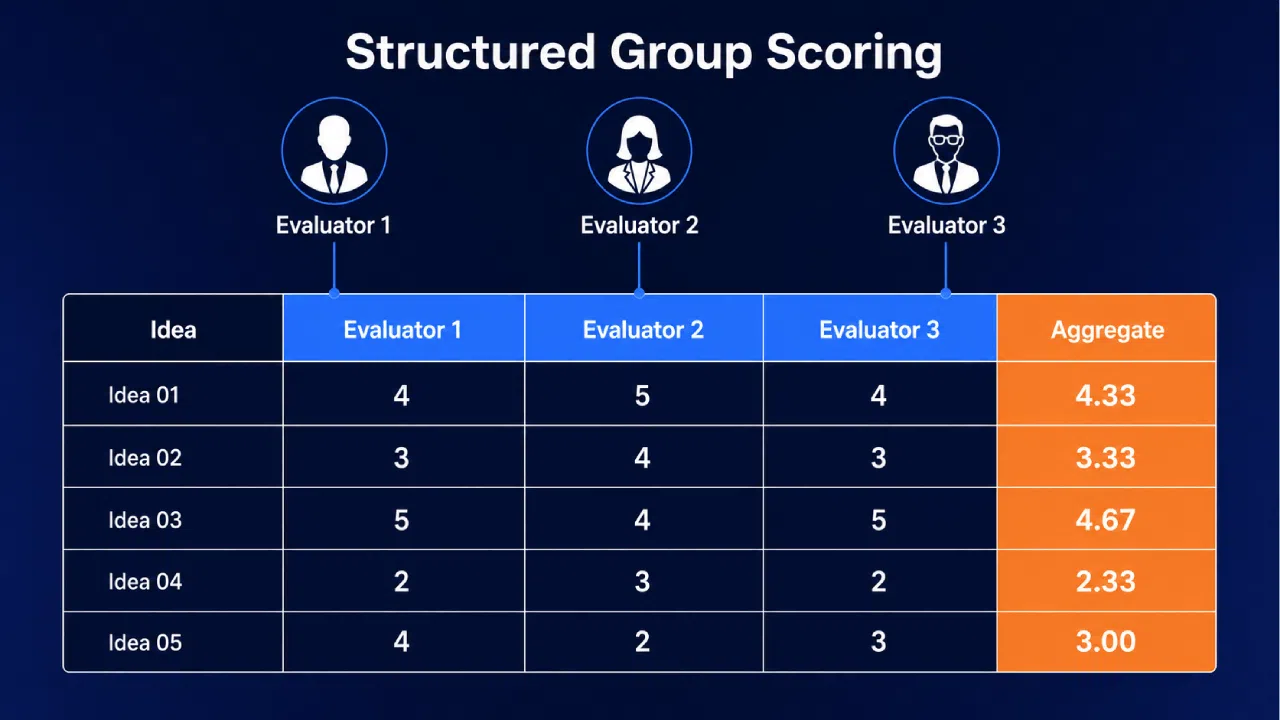
The evaluation workflow itself stays simple. The owner selects the ideas, assigns a Scorecard, and chooses the evaluators.
The evaluators complete their scoring, and results collect into an evaluation report. That report helps the owner compare scores and move into the next Decision step.
You will find this under Innovation Studio, then Evaluations. Open an evaluation, and the Decision Matrix is the first tab.
Because evaluators score against the same assigned Scorecard, the report compares like with like. There is no reconciliation step, no merging of five files, no question about whose version is current.
Best Practices for Structured Idea Scoring
The decision matrix eliminates technical confusion; strong habits remove human bias. This ensures honest, defensible scoring results.
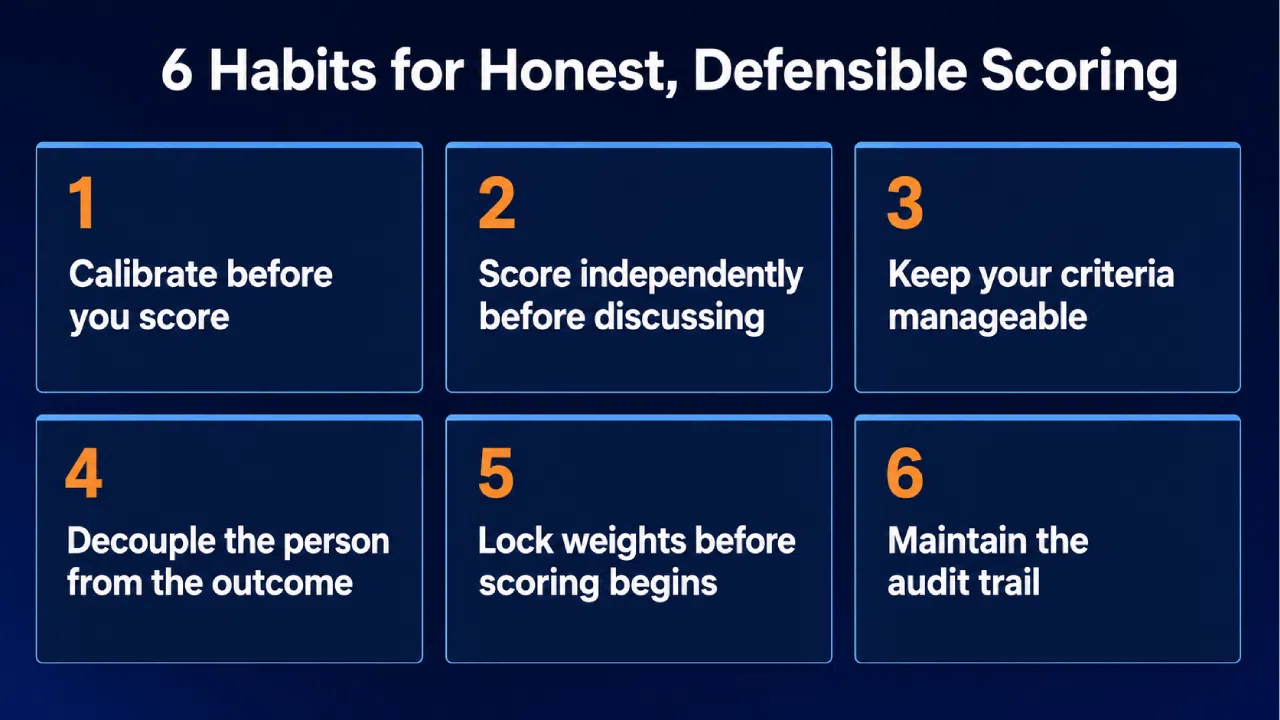
Calibrate before you score. Align reviewers on what each criterion means before the first idea is touched.
Embed anchor descriptions directly in the scorecard.
For example: a 3 on Strategic Alignment solves a known problem in a non-core area, while a 5 means a core problem with urgent executive priority.
Score independently before discussing. Have reviewers score on their own first, then aggregate before any group conversation.
This defends against anchoring and social pressure. It also surfaces the quiet expert insight that groupthink usually buries.
Keep your criteria manageable. Almost 60% of companies use five or fewer criteria to measure innovation, and that restraint is a feature.
Wellspring, drawing on 250-plus enterprise implementations, found the most common mistake is over-complicating the process.
Decouple the person from the outcome. Score the evidence, not the personality behind the idea.
A 2023 peer-reviewed study found people rated the same decision far more favorably when it happened to succeed. That is outcome bias in plain sight.
Lock weights before scoring begins. Agree the criteria weights up front and freeze them.
A weight that shifts mid-process, undocumented, is one of the fastest ways to lose trust in a result.
Maintain the audit trail. Keep a record of who scored what, against which criteria, and when.
Six months on, that history is the difference between explaining a decision and defending a guess.
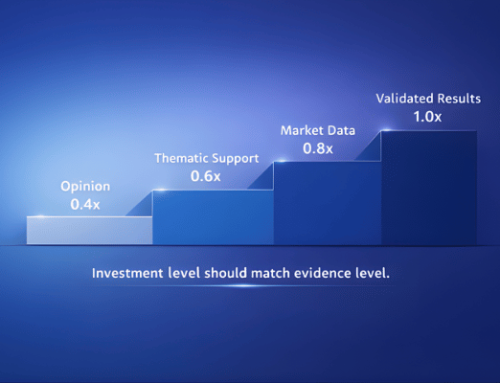
This test applies to all of it. The strongest scores should go to ideas with real evidence behind them.
As Strategyzer’s Dr. Tendayi Viki puts it, the question is not whether an idea looks promising, but how much evidence the team has that their model actually works.
What to Do With the Scores After
The matrix produces a ranked list. That list is not a decision.
Scores are evidence. They tell you which ideas performed best against your criteria, in the order they performed.
What they do not tell you is whether to advance an idea, reject it, or hold it for more data. That judgment still belongs to the people in the room.
Read the tiers, not just the rankings. A list of 20 ideas sorted by score creates an illusion of precision.
An idea in third place might be functionally identical to one in sixth, separated by a point because one reviewer interpreted a criterion differently.
Treat close scores as ties requiring a conversation, not a ranking to accept.
Expect outliers and investigate them. When a strong idea scores unusually low, or a weak one scores high, the matrix is doing its job.
It is surfacing a disagreement about how criteria were weighted or interpreted. That is information worth following up on before anyone commits to a direction.
Document your overrides. A high-scoring idea might face a regulatory hurdle, a resource constraint, or a dependency the matrix cannot see.
Overriding the scores is sometimes right. Recording why it happened, who decided, and what the rationale was keeps the process credible when the decision is reviewed later.
Use the scores to structure the conversation, not end it. The output is a short list worth discussing and a longer list to defer or close.
The decision meeting should focus on the top tier. There is no need to re-litigate every criterion for every idea.
Score Once, Decide With Confidence
The spreadsheet was never just an inconvenience. Its real damage is to decision quality, because a process people cannot trust produces decisions people will not stand behind.
A structured decision matrix brings what a spreadsheet cannot:
- A single source of truth that every reviewer scores against
- Weighted criteria that reflect your actual priorities, not equal splits
- An audit trail that answers questions six months later
- A ranked list built on shared logic, not on who spoke last
The result is a portfolio that reflects actual merit. Fewer pet projects advance on momentum, fewer strong ideas disappear because the review was chaos.
That is structure and transparency applied to the part of the innovation journey where it matters most.
Move scoring into a structure built for it, and let the matrix do the comparison so your team can focus on the decision.
Download our ebook on enterprise idea management to see how structured scoring fits into a complete, transparent innovation funnel from first idea to decision.
Or book a demo to see the Decision Matrix in action, with weighted Scorecards, automated totals, and a full audit trail.










 English
 Dutch
Dutch Portuguese
 Spanish
 French
 German
 Arabic