
Your Funnel Said Go: When Does an Idea Become a Project?12 min read

Your funnel’s gate said Go in March. By September, the idea has no owner, no budget line, and nobody’s logged an hour on it.
You’ve likely seen some of these:
- An approved idea waits for a sponsor who never quite says yes.
- A pilot ends, and nobody decides what happens next.
- A project starts with a 3-line business case and half a team.
- A portfolio review spends an hour on work nobody would approve today.
Each of these starts at the same moment. Your funnel says Go, and everyone treats that Go as the start.
But the funnel’s Go is only half the answer. An idea becomes a project when the portfolio signs too, with an owner, funding, a slot, and fit.
Call it the funnel-to-portfolio handshake. The funnel proves the idea is ready to leave, and the portfolio proves it’s ready to receive it.
Why a Funnel’s Go Isn’t the Same as a Start
Here’s the thing about approval: it’s cheap. A gate can say Go without naming who’ll do the work or whose budget pays for it.
So ideas become projects by drift. Someone starts a slide deck, someone else borrows 2 engineers, and 6 months later it’s on the portfolio list.
Robert Cooper and the PMBOK both treat a Go very differently:
- Cooper, 2021: in his 2021 paper on pipeline gridlock, a Go is “an investment decision, a decision to commit people and funds.”
- Cooper, 2023: his 2023 Stage-Gate article calls the “Go to Development” decision “one of the most important resource commitment decisions in the NPD process.”
- The PMBOK charter: a PMI practitioner article quotes the 2004 3rd edition’s definition, which “formally authorizes the existence of a project.”
- The charter’s authority: it also “provides the project manager with the authority to apply organizational resources to project activities.”
Drift skips all of that. Nobody decided to start the idea, and nobody can say what it was supposed to prove before it got there.
And gates that skip that step lose their weight. A 2017 McKinsey article describes traditional gates as “process formalities that lack teeth.”
Its authors add that at those gates, “funding is rarely delayed or halted.” So a Go that commits nothing becomes a status update with a vote attached.
That’s why approval and start need to be 2 separate events. An approval with no owner attached is a decision nobody has to keep.
Two Ways a Missing Handshake Fails
When the handshake is missing, the idea fails in 1 of 2 directions. It stalls before the portfolio, or it enters too soon.
On a status report, both look like progress.
The Orphaned Idea
The 1st failure is quiet. The idea’s approved, the pilot runs, and then nobody owns the next step.
A 2018 PM Network article cites evidence on how long that can last, and where it breaks:
- Scale: a 2017 McKinsey study of IoT pilots found “less than 30 percent of companies with IoT pilot projects had even started to scale.”
- Duration: the same study found “more than 80 percent of those projects were languishing in the pilot phase for more than a year.”
- The break point: the article also cites Innovation Leader research: “Most pilot projects or initiatives stumble in the hand-off from the R&D team to the execution team.”
Those 2 McKinsey figures come from IoT, so treat them as a signal.
A handoff needs someone to receive it. Per PMI’s 2018 Pulse, cited in PM Network, 1 in 4 organizations blame failed projects primarily on inadequate sponsor support.
Sponsor engagement tracks with better results. A 2014 PMI article found 75% of projects meet goals where sponsors frequently enact all 5 engagement actions.
Where sponsors frequently take none of them, it’s 57%. And only 11% of organizations report sponsors who often enact all 5.
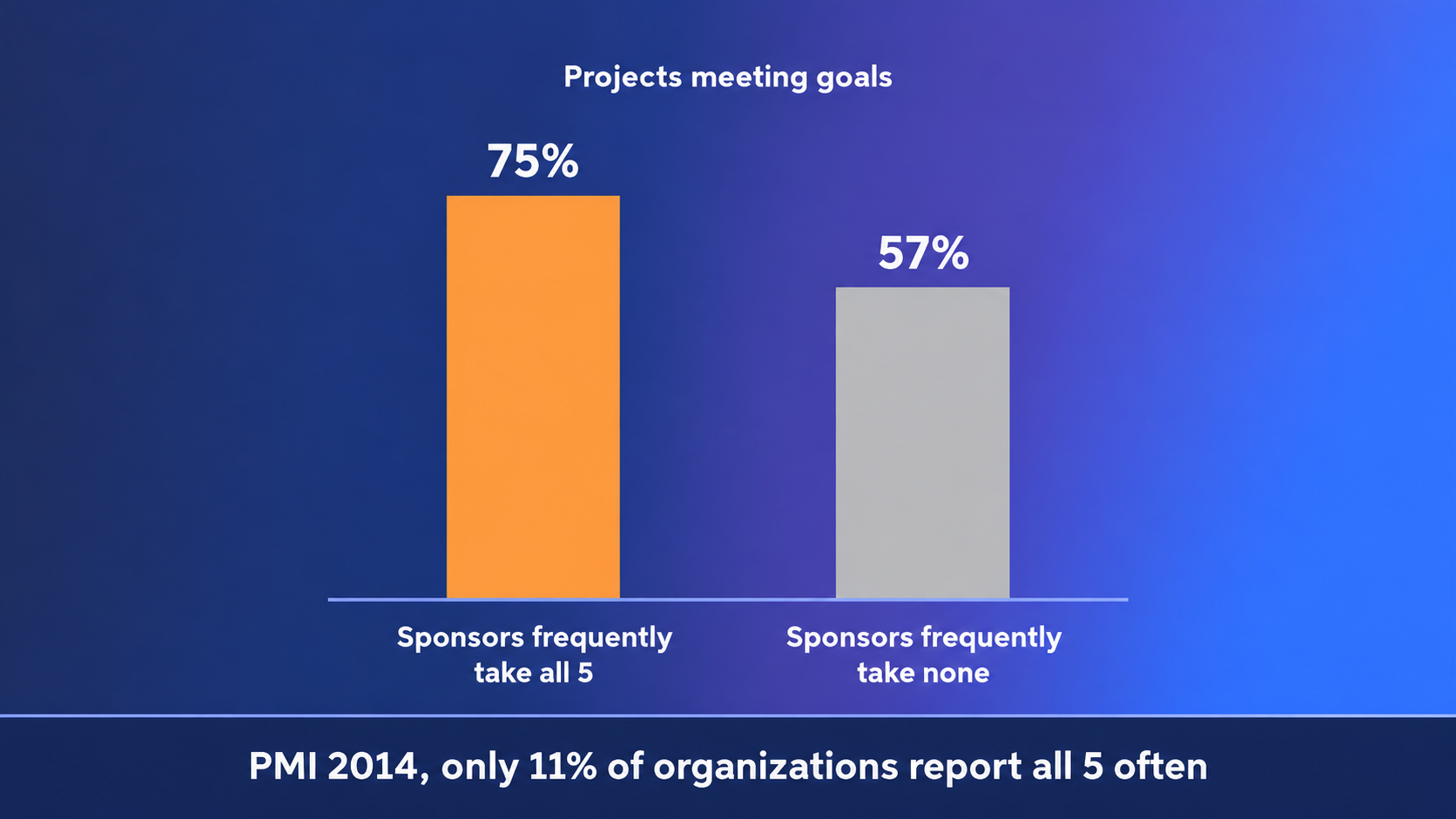
So an idea approved without a named owner has nobody to secure that sponsor support. Approval gave it permission, and nobody gave it a home.
The Premature Project
The 2nd failure is louder. An idea enters the portfolio before the evidence is in or anyone has checked whether there’s room for it.
Cooper’s 2021 paper calls an overloaded pipeline “a common but serious complaint,” where “people resources are spread too thinly across too many projects.”
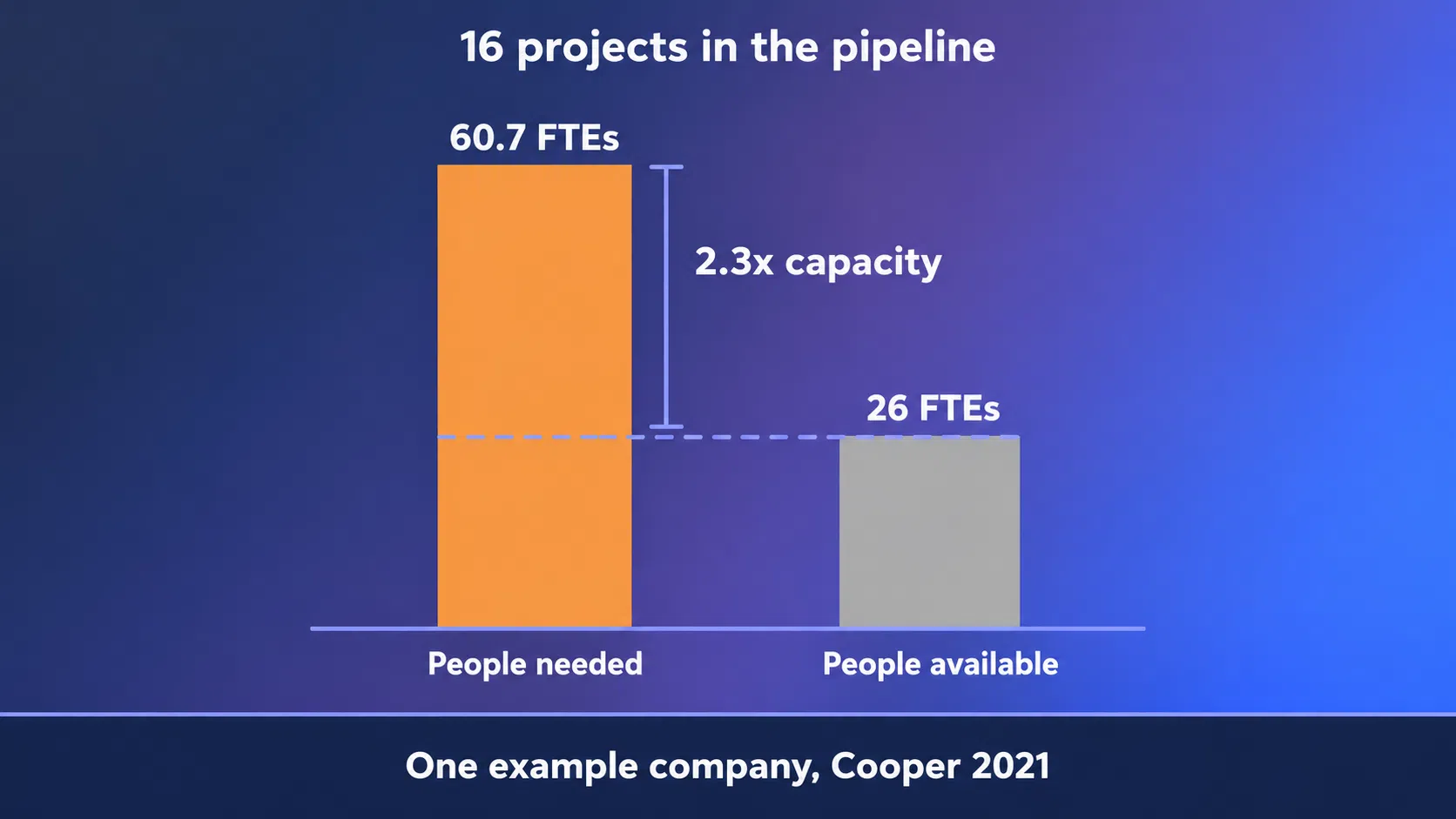
In one example company he describes, the numbers looked like this:
- Projects: 16
- People needed: 60.7 FTEs
- People available: 26 FTEs
- Load: demand ran at 2.3 times the capacity
Queueing math shows why overload hurts more than it looks. A 2015 Kellogg piece notes waiting times “more than double” when a server is busy 80% of the time.
At 90%, it “doubles again.” So every half-validated project you admit pushes the whole queue further up that curve.
Premature projects can also be hard to remove. In Royer’s 2003 HBR analysis, RCA’s SelectaVision videodisc tied up resources for 14 years.
It had cost the company $580 million by the time RCA finally killed it in 1984.
Admission without a capacity check is how zombies start. And each of those 14 years held people and budget the next good idea could have used.
The Handshake Is a Two-Sided Test
UK government delivery guidance writes both sides down. The GOV.UK Service Manual asks teams leaving alpha for beta to show evidence on 2 fronts.
They must be confident “you can create something that meets users’ needs and is cost-effective.” They also need “the budget and people necessary to deliver what you need to.”
| Side | What It Must Prove | Evidence at the Gate |
|---|---|---|
| Funnel | The problem’s real and scoped | A 1-page problem statement with scope and exclusions |
| Funnel | The riskiest assumption’s been tested | Results from a test, a pilot, or customer interviews |
| Funnel | Success can be measured | 2 or 3 measures, each with a target and a date |
| Funnel | The cost is roughly known | A cost range for the next stage and for full delivery |
| Portfolio | Someone owns it | A named owner with authority over budget and people |
| Portfolio | Money’s available | Funding approved for at least the next stage |
| Portfolio | There’s capacity | A free slot under the portfolio’s WIP limit |
| Portfolio | It fits the strategy | A stated link to a current portfolio priority |
The funnel’s Go covers the top 4 rows. The idea becomes a project only when the portfolio signs the bottom 4 too.
The UK’s project delivery standard, GovS 002, covers the portfolio side in plain terms. “The senior responsible owner … shall be appointed.”
Its gates check “there are funds and resources to complete the work and support any outcomes.” The justification comes 1st, in “a strategic outline case (or equivalent).”
Corporate innovation units face the same test. Westerman’s MIT research brief says they should insist on “shared funding, participation, and ownership by business units.”
Innovators who are too separate from the business “often have difficulty with adoption,” the brief notes. The handshake is where shared ownership gets signed.
What the Funnel Must Prove
The funnel side is about evidence. Before an idea leaves, it should carry 4 things:
- A defined problem and scope: who has the problem, how big it is, and what’s out of scope.
- Evidence on the riskiest assumption: the 1 belief that would sink the idea if it’s wrong, tested rather than argued.
- Success measures: 2 or 3 numbers the project will be judged on, each with a target and a date.
- A rough cost range: enough to size the next stage, with detail matched to the bet.
Match the business case to the bet, too. Cooper’s 2023 article says the concept stage is “not meant to be definitive,” and the business case after it goes deeper.
Precision should grow with the money at stake. Demanding a big-bet case for a small pilot mostly rewards confident guessing.
The riskiest assumption matters most here. If the funnel can’t name it, the idea isn’t ready to leave, however good the pitch.
And the success measures do 2 jobs. They tell the receiving owner what done looks like, and they give the next gate something to check.
What the Portfolio Must Prove
The portfolio side is about commitment. Before it accepts an idea, it should show 4 things:
- A named owner with authority: 1 person who can assign people and spend money.
- Funding: an approved budget for at least the next stage.
- A capacity slot: a place under the WIP limit, backed by FTEs that are actually free.
- Strategic fit: a link to a portfolio priority someone can point to today.
Start with the owner, who takes this on next to other work. In the 2014 PMI article, sponsors reported handling about 3 projects and programs at a time.
PMI’s charter article puts the requirement plainly: “It is essential that a person with sufficient authority approve the charter and stand by it.”
Capacity is easy to fake. A slot counts only if real people are free, or a project that’s ending will free them.
Strategic fit sounds soft, but it’s testable. If nobody on the portfolio board can name the priority it serves, the idea doesn’t fit yet.
Who Signs, and What Happens When Only One Side Is Ready
Each side needs a signer. The innovation lead signs for the evidence, and the portfolio board signs for the owner, money, slot, and fit.
Edgett and Cooper make the authority point on the Stage-Gate blog: Gate 1 gatekeepers “must have enough authority to approve these resources on the spot.”
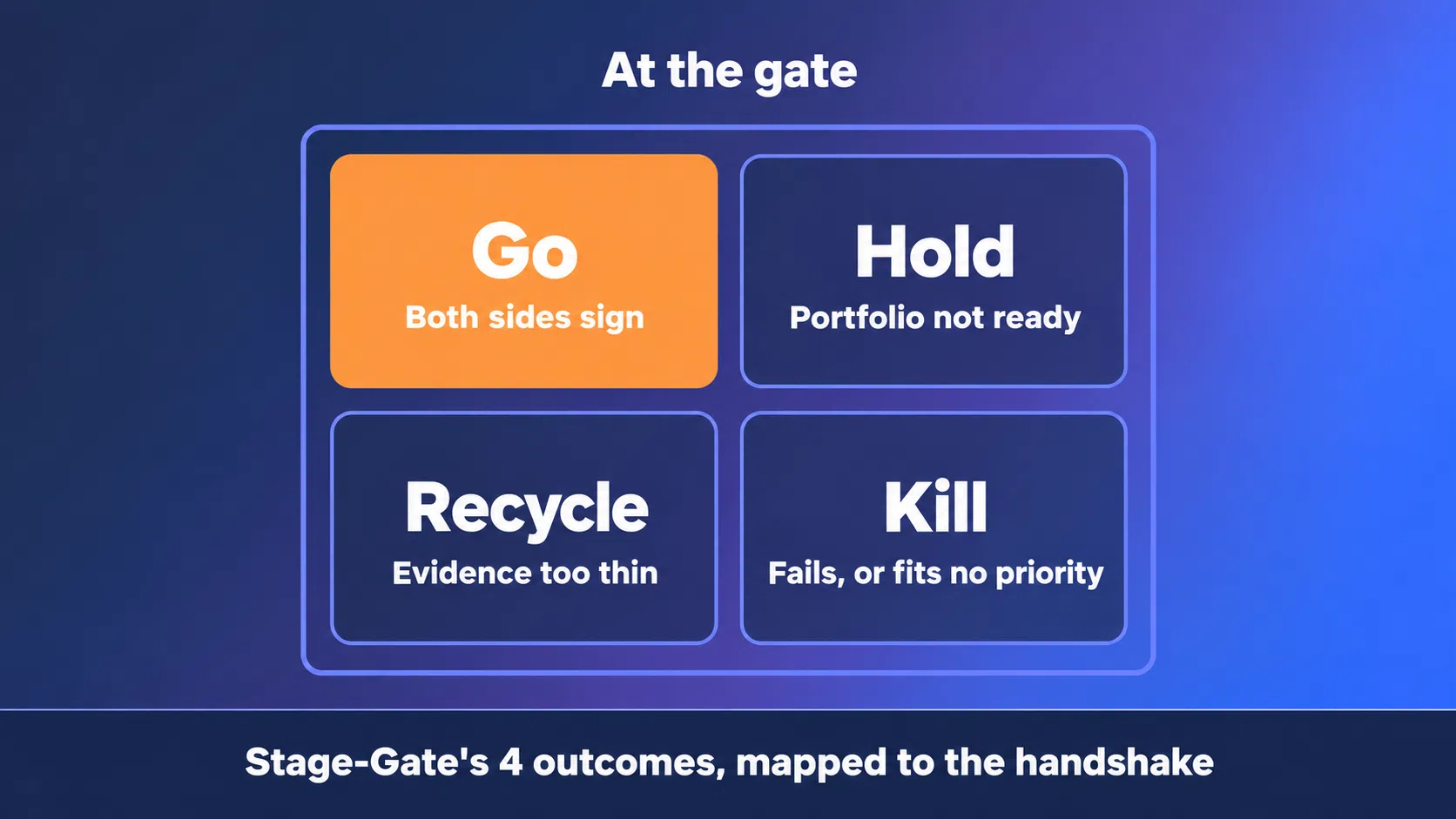
The Stage-Gate process already offers 4 gate outcomes: Go, Kill, Hold, and Recycle. Here’s how we’d map each one to the handshake:
- Go: both sides sign, and the idea becomes a project with an owner and a start date.
- Hold: the funnel’s said Go and the idea fits, but the owner, money, or slot isn’t there yet.
- Recycle: the idea fits a priority, but the evidence is thin, so it goes back to the funnel with the specific gap to close.
- Kill: the evidence fails, or the idea serves no current priority.
Hold is legitimate only with an expiry date, say 1 review a quarter out. If the portfolio can’t commit by then, the idea gets recycled or killed.
Don Reinertsen’s admission rule from his 2011 QCon talk fits here: “We will stop admitting work when we reach our preset WIP limit.”
So a full portfolio means Hold, even for a strong idea. Admitting it anyway means stopping something already in flight, and that call needs an owner too.
And in a 2019 McKinsey piece, a food producer’s “project killer” culled “from more than 560 projects to just over 200” in 3 years.
An admission rule at the handshake lets you make cuts like that before the work starts, while they’re still cheap.
Setting the Bar Without Choking the Flow
To be fair, strict criteria have a cost. Set the bar too high, and bold ideas stall while safer ones win.
Set it too low, and the portfolio floods. You’re back to 60.7 FTEs of demand against 26 of supply.
Three guardrails keep the bar firm without choking the flow:
- Scale the proof to the bet: a small internal pilot shouldn’t face the same proof as a new product line.
- Keep both signers: use a short checklist for small bets and the full table above for large ones, and the 2 signers stay put either way.
- Give Kill a respectable exit: without one, teams will stretch the evidence to avoid a visible Kill.
On scaling, a 2009 PMI paper on tollgates notes “the effort invested in the methodology has to be proportional to the size and relevance of the project.”
On exits, GOV.UK’s discovery guidance says: “It’s not a failure to stop at the end of the discovery phase if your research shows that’s the best thing to do.”
A Kill at handoff is cheap next to a zombie in the portfolio. And a clear Kill keeps the funnel honest about what ready means.
Homework counts: Cooper and Kleinschmidt (1994), cited in a TUHH working paper, found “the greatest differences between winners and losers … in the quality of execution of predevelopment activities.”
So a firm handoff protects the funnel’s homework. Watch the flow for a cycle or 2, then deliberately adjust the bar.
Write the Handshake Down Before Your Next Gate
When your funnel says Go, it feels like progress, so it’s easy to stop there. But a Go with no owner, money, or slot changes nothing on the ground.
Make these 4 moves this quarter:
- Write both sides down: list the funnel’s 4 proofs and the portfolio’s 4 commitments, scaled to project size.
- Name the signers: the innovation lead for the evidence, and a portfolio board with authority over people and budget.
- Set the Hold rules: a WIP limit for admission, plus an expiry date on every Hold.
- Test your last 5 Go decisions: ask whether both sides would’ve signed each one, and which side was missing.
Once you’ve run that test, expect a pattern. Orphans mean the portfolio never committed an owner, and zombies mean work got in without evidence or a slot.
From there, fix the weaker side first, because that’s where your next stalled idea is most likely to come from.
So when does an idea become a project? It’s the moment the portfolio signs beside the funnel’s Go, committing an owner, funding, a slot, and fit.
Download our ebook on idea evaluation and governance.
It covers structured pipelines, enrichment, scoring, governance frameworks, and the handoff from approved ideas into portfolio management.
Or book a demo to see how Accept Mission handles gate decisions, owners, Hold states, and the handoff from idea funnel to project portfolio in one place.









 English
 Dutch
Dutch Portuguese
 Spanish
 French
 German
 Arabic