
Task Tracking for Innovation: Six Fields, Four Statuses13 min read
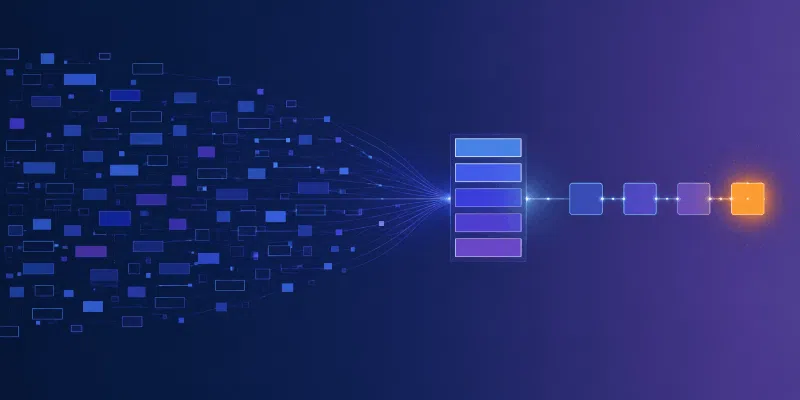
Most innovation teams get task tracking wrong in one of two directions. One camp imports the delivery organization’s Gantt charts and twelve-field schemas, and the other barely tracks anything.
Both end in the same place, so here’s the whole alternative in three parts:
- Six fields, each one defensible at a review because changing its value changes a decision
- Four statuses, with a kill path that closes work instead of parking it indefinitely
- A monthly evidence review, where teams arrive with data rather than a list of activities
The principle underneath all of it is worth stating plainly. The right amount of tracking is the smallest system that still produces decisions, and everything past that’s decoration.
That gives you a test you can apply to any field on any form. If changing its value wouldn’t change what someone decides, it doesn’t belong in the system.
Most of what sits in a typical task schema fails that test immediately, which is the real reason these systems go stale within a quarter or two.
Why Innovation Task Tracking Breaks in Both Directions
Heavyweight project tooling assumes predictable work, built for execution environments where scope is known, sequencing is stable, and the main risk is coordination.
Innovation work isn’t that. The plan goes stale the week after you write it, because the point is learning something you didn’t know.
MIT CISR calls this minimum viable governance: the least amount of governance required to manage risk while still letting the organization sense and seize opportunities.
There’s a ceiling and a floor. Above the ceiling you get bottlenecks and workarounds, which is exactly how shadow spreadsheets are born.
Below the floor you get compliance gaps and nobody accountable for anything.
| Over-Engineered | Under-Tracked | |
|---|---|---|
| Symptoms | Stale fields, shadow spreadsheets, long status decks | No owners, no dates, no roll-up |
| Root cause | Tooling designed for predictable delivery work | No agreed minimum, tracking treated as optional |
| What leadership sees | A dashboard that looks complete and says nothing | Nothing, until the slippage is months old |
Weak delivery discipline shows up in the numbers. Two findings from PMI’s project success research frame it:
- The global Net Project Success Score has stayed flat, at 36 in 2024 and 37 in 2025.
- Teams practicing all four behaviors in PMI’s M.O.R.E. mindset reach a score of 94. With none of them, it’s 27.
So having the disciplines clearly beats having none. But discipline doesn’t guarantee visibility, and that’s where over-engineered systems fall down.
The overhead shows up in how the week actually gets spent:
- Collaborative work has grown 50% or more in two decades, and at many companies people now spend around 80% of their time in meetings or answering requests
- Over 25 minutes is what it takes to return to an interrupted task, which is the real cost of chasing updates
- Collaboration overload is almost always a “symptom of some deeper organizational pathology”, Bain argues, and in task tracking that usually means unclear ownership
Both failure modes produce the same outcome. Leadership can’t tell which bets are progressing and which ones are quietly dead.
What decides the outcome is whether anyone can act on what the system shows them.
The Test Every Field Must Pass
Here’s the design rule for every element of the system. A field earns its place only if changing its value forces a changed call.
MIT CISR’s four design characteristics are worth holding onto as you build:
- Structurally agile: the system bends when the work changes shape
- Trustworthy by design: oversight is built into the system, not bolted on afterward
- Integrated end-to-end: captured once, visible everywhere
- Opportunity-sensitive: treats moving too slowly as a risk in its own right
Run that test against a typical task schema and most of it fails immediately. Percent complete doesn’t survive it.
Neither does a priority score nobody re-scores after intake. The MIT CISR research cited earlier puts numbers on what minimum viable governance buys.

Organizations with well-developed minimum viable policy practices cut complex decision time in half. They also spot new opportunities at three times the rate of peers.
One structural note before the specifics: tasks, projects, and portfolios are different layers with different rhythms. Where teams confuse them is covered elsewhere.
Capture data once at the task level and let it roll up. Duplicate entry is one of the fastest ways to lose a tracking system.
The Six Fields Worth Keeping
Six fields. That’s the recommendation, and every one of them is defensible at a review.
| Field | What It Answers | Why It Earns Its Place |
|---|---|---|
| Owner | Who can close, escalate, or change this without asking permission? | Authority is what turns an owner into a decision point |
| Next decision | What call is this work heading toward? | Ties activity to an outcome; makes stalled work visible |
| Evidence status | What has actually been learned so far? | Replaces generic red/amber/green with something reviewable |
| Next checkpoint date | When does this get looked at again? | A strong early signal of slippage when it goes stale |
| Blocked reason | On what is this stuck? | Required whenever the status is Blocked; converts silence into a routable problem |
| Stage or lane | Where does this sit in the funnel? | Enables portfolio balance without a separate reporting layer |
Now the harder half of the design, which is what you deliberately leave out:
- Percent complete. In uncertain work it’s a guess dressed as data, and it hides the fact that the hardest learning usually comes at the end.
- Effort estimates in hours. They invite resource-loading conversations that innovation work can’t support honestly.
- Sub-sub-tasks. If a task needs three levels of decomposition, it’s a project. Promote it.
- Custom statuses per team. The moment two teams use different vocabularies, the roll-up stops meaning anything.
- Priority scores nobody re-scores. A number set once at intake and never revisited is decoration.
Each omission removes a place where the system can quietly go stale. A field you don’t have is one nobody maintains, defends, or explains in a review.
If you add a field back later, make it earn entry the same way. Something has to have gone wrong that the field would demonstrably have prevented.
The Four Statuses and the Kill Path
Four statuses, maximum: Not Started, Active, Blocked, Closed. The one non-negotiable is that Closed must carry a reason.
So Closed never travels alone. Every closure carries one of four reasons:
- Done: the deliverable exists and the decision was made
- Killed: the evidence didn’t support continuing or starting, with a one-line note on what killed it
- Merged: absorbed into another initiative, named explicitly
- Parked: deliberately paused, with a mandatory review date
Parked is the one that reopens. When its review date lands, the owner either moves it back to Active or closes it again under another reason.
A status set without a real kill path guarantees zombie work. The classic case is a product that ran 14 years and cost $580 million before anyone killed it.

Three things keep dead work alive:
- Escalation of commitment. Managers keep pouring in resources instead of terminating or redirecting the failing work
- Sunk-cost thinking. Months of effort feel too expensive to write off, though that spend is already gone
- No named owner of the kill decision. Nobody holds the authority to call it dead, so “still open” wins by default
Parked without a date is just a zombie with better manners. The date’s what makes the status honest.
The waste is measurable. PMI’s 2018 Pulse of the Profession put it at 9.9% of every dollar lost to poor project performance.
This is also where ownership becomes a decision right. When the owner holds explicit kill, pivot, and invest authority, closing something is simply the job.
Cadence: What to Review, and How Often
Task-level check-ins can be weekly. Portfolio-level review works on a slower clock.
The argument against a weekly portfolio cadence is practical: innovation teams rarely produce meaningful new evidence in seven days.
Monthly gives enough time to run a real experiment and come back with data. Here’s a cadence to start from, not a benchmark to hit:
| Rhythm | Frequency | Who Attends | The One Output |
|---|---|---|---|
| Task check-in | Weekly | Team plus its owner | Blockers routed, checkpoint dates refreshed |
| Evidence review | Monthly, 90 min to 2 hrs | Small board with budget authority | A documented kill, pivot, or invest call per project |
| Allocation review | Quarterly, half day | Portfolio lead plus sponsors | Portfolio balance adjusted against target |
| Strategic rebalancing | Annual, full day | Executive sponsors | Next year’s allocation thesis |
The evidence review format is what makes the monthly rhythm work. Each team gets ten minutes to answer four questions:
- Which assumption was the riskiest?
- What experiment tested it?
- What evidence came back?
- What decision is needed now?
Compare that to what usually happens, and call it update theater. Teams report activities (“we ran three workshops, interviewed 15 customers, built a prototype”) and the meeting produces nothing.
The three structural causes of update theater are worth naming:
- No evidence requirement, so teams report activity instead
- No decision authority in the room
- No time pressure, so projects drift between reviews
Fix all three, or the format quietly degrades back into a status recital.
Meeting quality is a known problem, honestly. Bain found 85% of executives dissatisfied with the effectiveness of meetings at their companies.
The fix is a hard rule: every review ends with a documented decision, logged where the tasks live. If nothing was decided, the meeting failed.
Who Owns What
Strategic innovation advisor Ton van der Linden describes a chemicals company whose review board had 14 people. Meetings ran four hours and produced nothing.
Nobody wanted to make a call in front of 13 others. They cut the board to five, and decisions started happening in the first meeting.
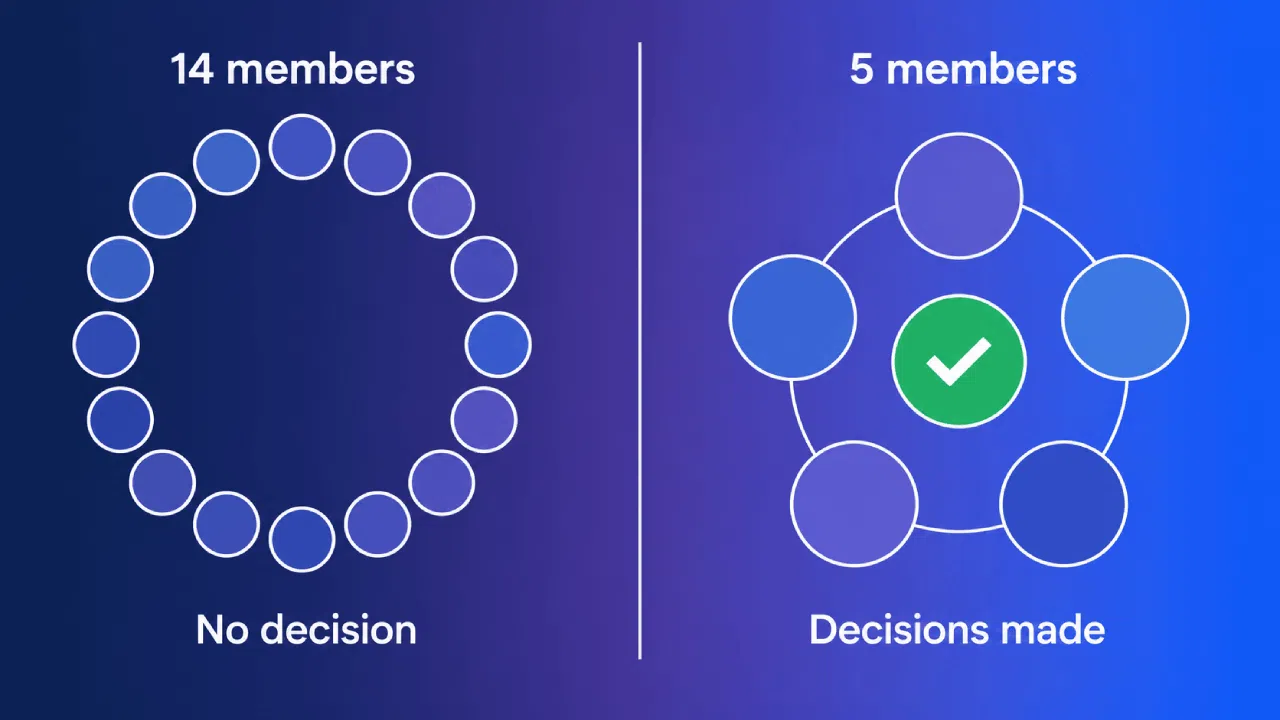
That story’s about authority density. A room where responsibility is diffuse defaults to gathering more information, which always feels safer than deciding.
Bain puts a number on the same effect: every attendee past seven reduces the likelihood of a good, quick, executable decision by 10%.
| Level | The Question to Ask | What Breaks Without It |
|---|---|---|
| Review board | Who in this room can kill a project today? | Meetings gather information instead of deciding |
| Task owner | Who can close or escalate this item alone? | Every small call queues behind someone more senior |
An owner field is useless unless that owner can change status, escalate, or close the item without asking upward.
WIP limits belong here too, and they work as attention management. The real question is how many bets this team can actually attend to.
One rule on where limits apply: put explicit WIP limits on every stage except intake, which SAFe calls the funnel.
Idea capture should never be gated, because constraining the entrance solves a problem you don’t have while creating one you do.
In practice, most leadership teams can hold only a handful of bets in genuine attention. Set the limit low and the prioritization conversation gets a lot more honest.
Catching Slippage Before the Deadline Does
Traditional project performance measures are lagging indicators. By the time a milestone is missed, the decision that would have prevented it was available weeks earlier.
PMI’s research on early warning signs is blunt about this. Project professionals are “not very good at detecting early warning signs” and even less good at acting on them.

Emerging problems display only weak signals early on. That paper also cites evidence that people and process risks outrank product ones.
So the signals worth watching are behavioral, not technical. Here’s what those six fields surface once you track them over time:
- A checkpoint date that passes without anyone updating it
- An owner who has to ask upward before deciding anything
- Items that stay blocked across two monthly reviews
- Evidence status unchanged since the last checkpoint
- The same next decision restated month after month
- A stage or lane that hasn’t moved in two or more reviews
This is where the push-versus-pull distinction matters. A status update is a pull mechanism: someone asks, someone answers, and the picture goes stale immediately after.
In a push model, the system surfaces stale dates, missing owners, and blocked items on its own. People convene only when a real decision is flagged.
AI belongs in exactly this slot and no larger one. It flags quiet items, catches inconsistent scoring, and assembles the shortlist of real decisions before anyone meets.
The system does the noticing, and the room does the deciding. Judgment stays human, and the right call reaches the right person while acting is still cheap.
Start Smaller Than Feels Safe
The instinct when a tracking system fails is to add to it. Another field, another status, another weekly sync to catch whatever the last one missed.
Try the opposite for one quarter:
- Strip the schema to six fields, and delete anything that wouldn’t change a decision
- Cut to four statuses, and force every closure to carry one of the four reasons
- Run one monthly evidence review where each team answers all four questions, ending with the call it needs
Then hold the line on additions. Add a field back only when its absence has demonstrably cost you a decision, and make yourself name that decision out loud.
What you’ll find after a quarter is that most of the missing visibility traced back to unclear ownership and a missing kill path, not to a missing field.
No amount of schema complexity fixes either one. The measure of a tracking system is how quickly a real problem reaches someone with the authority to act on it.
Download our free ebook Project Portfolio: From Opportunities to Value to learn how to structure evidence-based reviews that turn tracking into faster, documented investment decisions.
Request a demo to see how Accept Mission gives you task-level ownership, evidence status, and portfolio visibility in one structured workflow, without the reporting overhead.






 English
 Dutch
Dutch Portuguese
 Spanish
 French
 German
 Arabic