
 Doc Summary
Why this feature is needed #
Innovation work creates a large amount of valuable information over time. Teams discover problems, define assumptions, run experiments, record risks, make decisions, and collect lessons. Without structure, that intelligence often ends up spread across documents, spreadsheets, presentations, and conversations.
When that happens, context gets lost, communication becomes weaker, and decisions are harder to make. Innovation intelligence helps teams keep all relevant information connected to the innovation itself, so ideas and projects become sharper, more focused, and easier to manage.
What this feature is #
Innovation intelligence is the structured set of tools in Accept Mission that helps teams capture, manage, and connect all critical insights generated during an innovation process.
This feature is available for both ideas and projects. It allows teams to keep context inside the platform instead of managing important information in disconnected tools. Innovation intelligence supports collaboration, prioritization, validation, and Decision-making throughout the full innovation lifecycle.
It is especially useful in discovery work, innovation sprints, pilots, experiments, and longer innovation projects where teams need to keep track of what they are learning and why certain choices are being made.
Access level #
You need access to the relevant idea or project in the Innovation Studio to work with innovation intelligence elements.
Navigation path #
Navigation path: Innovation Studio → Ideas → Open idea → Work
How to use this feature #
Innovation intelligence is used inside ideas and projects to capture the context around innovation work. Instead of only managing one description or one status, teams can build a structured body of intelligence that supports execution and learning.
This allows teams to work on the innovation itself while also keeping track of what has been discovered, what still needs validation, what risks exist, what decisions were made, and what actions need to happen next.
Step by step instructions #
- Open Innovation Studio.
- Choose whether you want to work inside an idea or a project.
- Open the relevant idea or project.
- Go to the Work area.
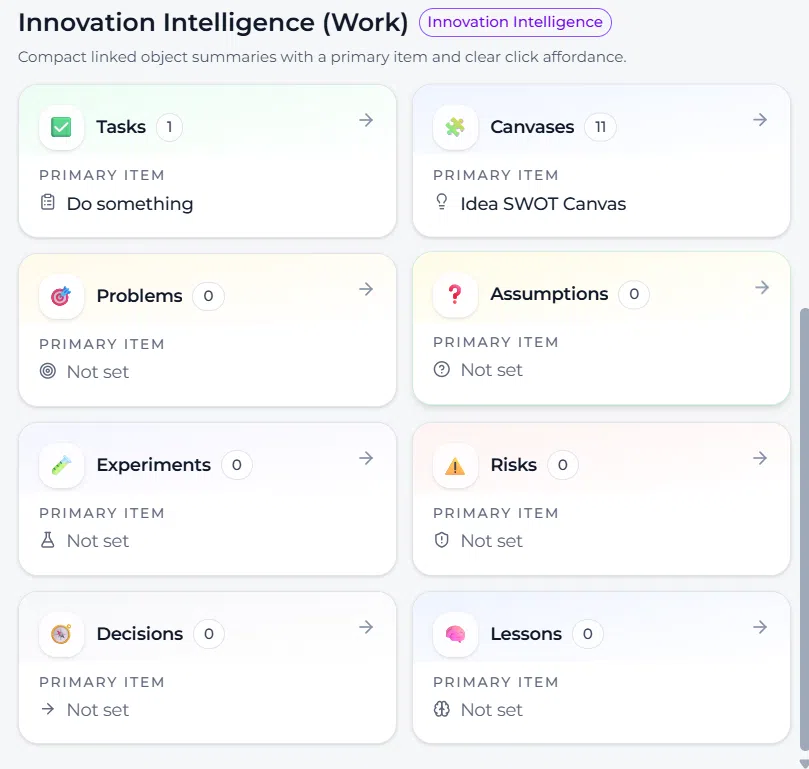
- Open the relevant intelligence tab or section, such as tasks, canvases, problems, assumptions, risks, decisions, experiments, or lessons.
- Add the information your team has collected.
- Connect related elements where relevant, such as linking an Experiment to an Assumption or a Lesson to an Experiment.
- Update the information as the innovation progresses.
- Use the captured intelligence during team collaboration, prioritization, and Decision-making.
What is included in innovation intelligence #
Tasks #
Tasks help teams manage who does what and when. They provide ownership, deadlines, phase grouping, and visibility through grid and Gantt chart views. This supports structured execution inside the innovation itself.
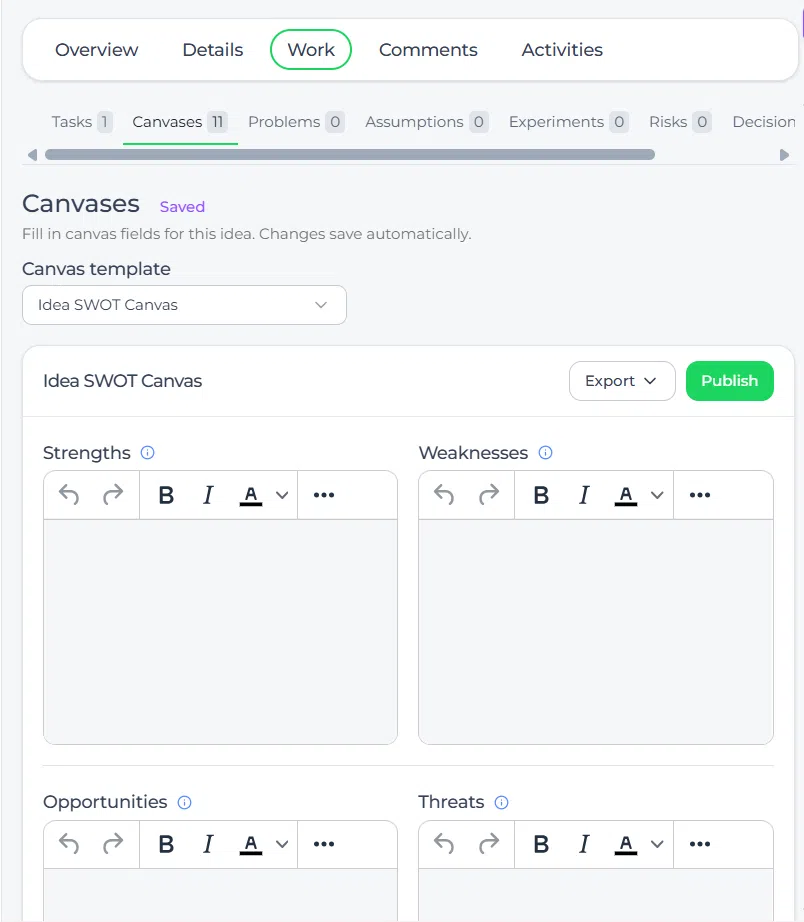
Canvases #
Canvases provide structured templates to guide thinking and documentation. Teams can use them to work on topics such as the real Problem, team structure, business model, persona definition, value proposition, or Solution development.
Problems #
Problems help teams register the issues discovered during the innovation process. This makes it easier to keep focus on the real challenge instead of drifting toward less relevant work.
Assumptions #
Assumptions help teams capture what they believe to be true but have not yet validated. This is important because strong innovation teams do not treat assumptions as facts. Instead, they identify the most critical assumptions and work on validating them.
Risks #
Risks allow teams to maintain a clear register of the threats connected to the innovation. This helps the team see what may block progress or reduce value if not addressed in time.
Decisions #
Decisions make it possible to record the important choices made along the way. This improves transparency and helps teams understand why a certain direction was taken.
Experiments #
Experiments help teams track the tests they run to validate assumptions, reduce uncertainty, and learn what works. This is especially useful in pilots, discovery work, and sprint-based innovation approaches.
Lessons #
Lessons allow teams to capture what they learned during the process. This supports reflection inside the innovation and helps organizations reuse knowledge in future work.
Connected and contextual #
A major strength of innovation intelligence is that the elements can be connected to each other. This means the team does not just collect separate notes, but builds a connected context around the innovation.
For example, an Experiment can validate an Assumption, a Decision can be linked to a related Risk, and a Lesson can result from the outcome of an Experiment. This improves traceability and makes the full story of the innovation easier to understand.
Where teams use innovation intelligence #
Innovation intelligence can be used in multiple working methods and innovation situations.
- Innovation sprints where teams need fast structure and clear ownership
- Discovery phases where assumptions, risks, and experiments need to be documented
- Pilot projects where learnings and decisions need to stay connected to the work
- Longer innovation projects where context builds over time and needs to remain visible
How this improves innovation outcomes #
By structuring intelligence inside the innovation itself, teams improve the way they work together and the quality of the outcomes they create.
This helps teams:
- Improve communication between team members
- Keep the scope of the innovation clear
- Prioritize what really matters
- Make better and faster decisions
- Avoid treating assumptions as facts
- Improve scalability and value creation
Configuration and adjustments #
Innovation intelligence is used inside both ideas and projects, which means the same structured approach can support early-stage exploration and later-stage execution.
To work with this feature in ideas, follow this path:
Navigation path: Innovation Studio → Ideas → Open funnel → Open idea → Work
To work with this feature in projects, follow this path:
Navigation path: Innovation Studio → Projects → Open project → Work
To keep the feature valuable, teams should update intelligence regularly and use it as part of their normal collaboration rhythm. The more consistently the team captures tasks, assumptions, risks, experiments, and lessons, the stronger the context becomes.
Innovation intelligence works best when it is not treated as extra administration, but as the central place where the team keeps the logic, evidence, and progress of the innovation connected.
Practical example – Innovationlands #
Innovationlands is exploring a new guest experience concept that starts as an early discovery and later becomes a pilot project. At first, the team does not even call it a full project yet, but the innovation still needs structure and context.
Inside the idea, the team captures the main Problem they want to solve, registers key assumptions about guest behavior, and creates experiments to test those assumptions. They also use a canvas to sharpen the concept and create tasks for interviews, prototype work, and stakeholder validation.
As the innovation progresses, the team records risks, important decisions, and lessons learned from the pilot. When the work grows into a formal project, the intelligence remains connected to the innovation instead of being lost in separate documents or spreadsheets.
This helps Innovationlands keep communication sharp, improve the quality of its decisions, and make sure the innovation creates real value as it moves from discovery into execution.



 English
 Dutch
Dutch Portuguese
 Spanish
 French
 German
 Arabic