
 Doc Summary
Why this feature is needed #
Innovation work always involves uncertainty. Teams need to test assumptions, validate problems, assess Solution directions, and reduce risks before moving forward with confidence.
Without structured experiments, teams may rely too much on discussion or intuition. Innovation experiments help teams move from uncertainty to evidence by making validation work visible, structured, and connected to the innovation itself.
What this feature is #
Innovation experiments in Accept Mission are part of the broader innovation intelligence feature and help teams design, plan, and track the experiments needed to validate an innovation.
This feature can be used for both ideas and projects. It allows users to register all experiments related to the innovation, define what should be tested, plan when the Experiment should happen, and track which Experiment is the most important at a given stage.
Experiments can also be connected to other innovation intelligence items such as assumptions, problems, risks, decisions, and canvases. This helps teams make sure that every Experiment serves a clear purpose in the innovation process.
Access level #
You need access to the relevant idea or project in the Innovation Studio to work with innovation experiments.
Navigation path #
Navigation path: Innovation Studio → Ideas → Open funnel → Open idea → Work → Experiments
How to use this feature #
Innovation experiments are used inside ideas and projects to structure the validation work around an innovation. Teams can register experiments, define what they want to learn, plan when to run them, and connect them to the uncertainties they are meant to address.
This makes it easier to focus on the right validation work and keep the innovation process evidence-based instead of Assumption-based.
Step by step instructions #
- Open Innovation Studio.
- Choose whether you want to work inside an idea or a project.
- Open the relevant idea or project.
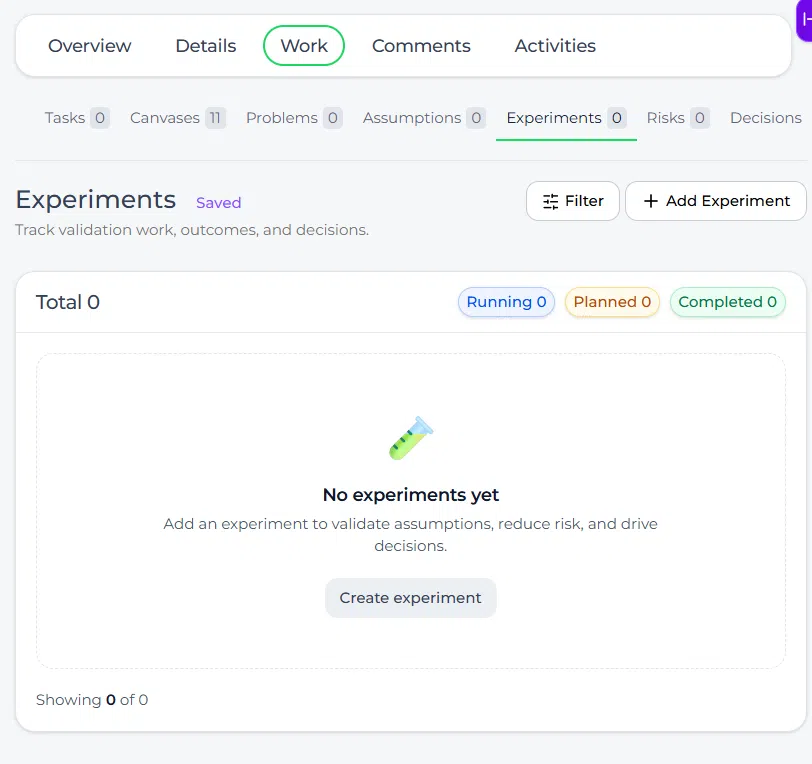
- Go to the Work tab.
- Open the Experiments tab.
- Add a new Experiment.
- Enter the Experiment title.
- Describe what you want to test or learn.
- Set the timing or planning details if needed.
- Save the Experiment.
- Repeat this for all relevant experiments connected to the innovation.
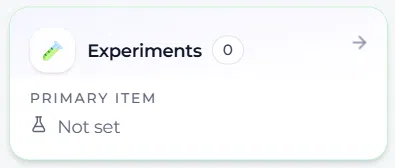
- Select which Experiment should be marked as the primary Experiment.
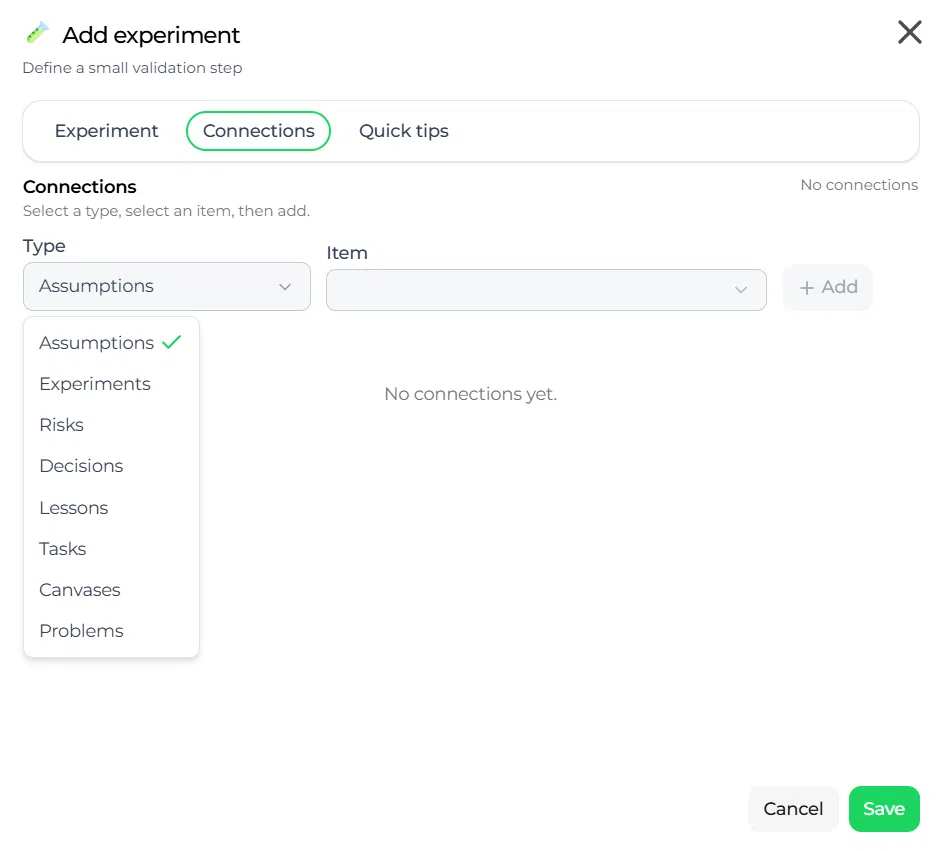
- Connect the Experiment to related innovation intelligence items where relevant.
What you can do with innovation experiments #
Within the Experiments tab, teams can:
- Register all experiments related to an innovation
- Define what should be tested or learned
- Plan when experiments should be executed
- Track Experiment progress
- Mark the most important Experiment as the primary Experiment
- Connect experiments to other innovation intelligence items
This creates a clear overview of how uncertainty is being addressed throughout the innovation process.
Primary Experiment #
Not all experiments have the same importance. Some are exploratory, while others are critical for deciding whether the innovation should move forward at all.
That is why you can define one Experiment as the primary Experiment. This helps the team focus on the validation activity that delivers the most important insight at that moment.
Connecting experiments to other items #
A key strength of this feature is that experiments can be linked to other innovation intelligence elements, such as assumptions, problems, risks, decisions, and canvases.
This creates a connected workflow where experiments are directly tied to what needs to be validated.
For example:
- An Experiment can validate a critical Assumption
- An Experiment can test whether a Problem is real and relevant
- An Experiment can reduce a specific Risk
- An Experiment can support a Decision on whether to proceed
This connected structure improves traceability and ensures experiments are always purposeful.
Examples of experiments #
Common types of experiments include:
- Customer interviews
- Surveys
- Prototype testing
- A/B testing
- Pilot implementations
- Landing page tests
- Desk research
Each Experiment should be designed to answer a specific question or validate a specific uncertainty.
How this supports the team #
Innovation experiments help teams move from assumptions to evidence.
This is especially useful for:
- Structuring validation efforts
- Focusing on the most critical uncertainties
- Avoiding solutions built on untested ideas
- Improving the quality of Decision-making
- Maintaining momentum by turning uncertainty into clear next steps
Innovation intelligence feature page #
Innovation experiments are one of the tools within the broader Innovation intelligence feature. This broader feature helps teams capture structure, insights, decisions, and learning directly inside ideas and projects.
Configuration and adjustments #
Innovation experiments are available in both ideas and projects, which means the same structured validation approach can be used during exploration and during execution.
To work with this feature in ideas, follow this path:
Navigation path: Innovation Studio → Ideas → Open funnel → Open idea → Work → Experiments
To work with this feature in projects, follow this path:
Navigation path: Innovation Studio → Projects → Open project → Work → Experiments
To keep this feature useful, teams should define experiments with a clear learning goal and connect them to the Assumption, Problem, Risk, or Decision they are meant to support. This improves focus and makes the validation process easier to review later.
Practical example – Innovationlands #
Innovationlands is exploring a new guest experience concept for reducing frustration in park queues. The team has identified several assumptions about guest behavior, a few important risks around adoption, and different possible Solution directions.
Inside the idea, the team opens the Experiments tab in the Work area and registers a set of experiments, including guest interviews, a simple prototype test, and a small pilot with one attraction queue. They decide that the prototype test is the most important activity at this stage and mark it as the primary Experiment.
The team also connects this Experiment to the main Assumption about guest willingness to use the concept and to a Risk about operational feasibility. This helps Innovationlands keep its validation work focused and evidence-based before deciding whether the innovation should move into a larger pilot or project phase.



 English
 Dutch
Dutch Portuguese
 Spanish
 French
 German
 Arabic