
 Doc Summary
Why this feature is needed #
Innovation work always involves uncertainty. Teams may face risks related to timing, quality, adoption, dependencies, budget, or execution. If these risks are not captured and reviewed in a structured way, important threats can be missed and decisions can become weaker.
Innovation risks help teams keep Risk management visible inside the innovation itself. This makes it easier to monitor uncertainty, focus on the biggest threats, and improve the quality of decisions throughout the process.
What this feature is #
Innovation risks in Accept Mission are part of the broader innovation intelligence feature and help teams create and manage a structured Risk register for an idea or project.
This feature can be used for both ideas and projects. It allows users to capture all relevant risks connected to an innovation, maintain them over time, and identify which Risk should be treated as the primary Risk.
Risks are different from problems and assumptions. A Problem is a challenge that already exists. An Assumption is something that still needs validation. A Risk is a possible issue or threat that could negatively affect the innovation.
Access level #
You need access to the relevant idea or project in the Innovation Studio to work with innovation risks.
Navigation path #
Navigation path: Innovation Studio → Ideas → Open funnel → Open idea → Work → Risks
How to use this feature #
Innovation risks are used inside ideas and projects to keep track of the threats connected to the innovation. Teams can add risks quickly in a simple way or describe them in more detail when more context is needed.
After multiple risks are listed, the team can indicate which Risk is the primary one. This helps the innovation team stay focused on the threat that needs the most attention.
Step by step instructions #
- Open Innovation Studio.
- Choose whether you want to work inside an idea or a project.
- Open the relevant idea or project.
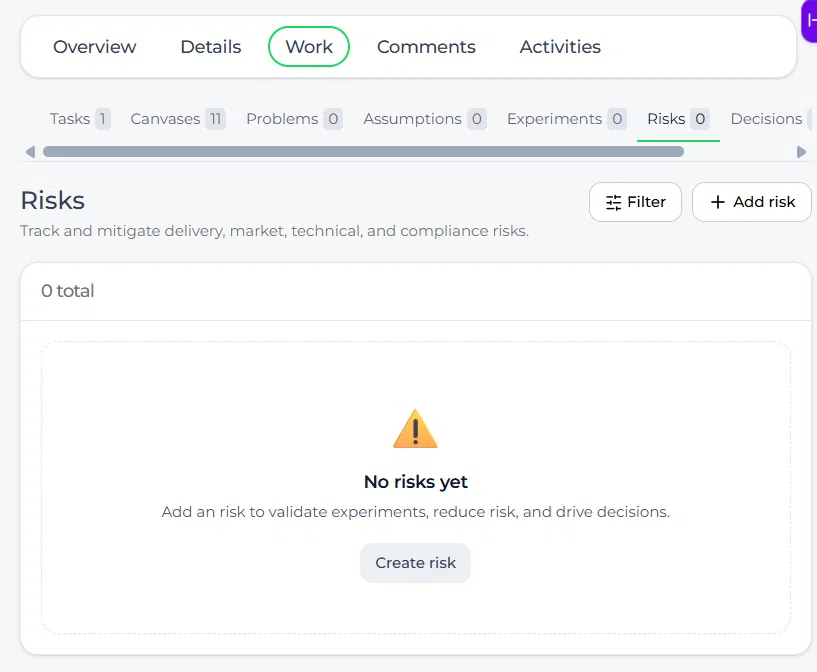
- Open the Risks tab.
- Add a new Risk.
- Enter the Risk title.
- Add more detail if needed.
- Save the Risk.
- Repeat this for all relevant risks connected to the innovation.
- Select which Risk should be marked as the primary Risk.
- Review the innovation overview to confirm that the main Risk is shown as part of the summary.
How innovation risks work #
Within an idea or project, users can create a list of risks related to that innovation. This helps teams maintain a structured Risk register and keep important threats visible throughout the process.
A Risk can be added in a simple way by entering only the title, or it can be worked out in a more advanced and detailed way when more context is needed. This gives teams flexibility during early exploration and later execution.
Primary Risk #
One of the key functions of this feature is the ability to indicate which Risk is the primary Risk.
Not every Risk has the same importance. Some risks are minor and can be monitored in the background. Others are critical and can strongly affect whether the innovation succeeds. Marking a primary Risk helps the team align on the most important threat.
Where the main Risk appears #
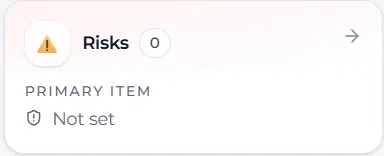
After a primary Risk has been selected, it becomes visible in the innovation itself.
When you open the related idea or project and go to the Overview tab, the main Risk is shown there as a summary. This helps users and stakeholders immediately understand the most important Risk without opening the full Risk register.
How this supports the team #
Innovation risks help teams manage uncertainty in a more structured way.
This is especially useful for:
- Keeping Risk management visible throughout discovery and execution
- Staying focused on the biggest threats
- Improving discussions and Decision-making
- Reducing the chance of missing critical issues
- Creating stronger outputs by managing uncertainty more deliberately
Innovation intelligence feature page #
Innovation risks are one of the tools within the broader Innovation intelligence feature. This broader feature helps teams capture structure, insights, decisions, and learning directly inside ideas and projects.
Configuration and adjustments #
Innovation risks are available in both ideas and projects, which means the same structured Risk approach can be used during exploration and during execution.
To work with this feature in ideas, follow this path:
Navigation path: Innovation Studio → Ideas → Open funnel → Open idea → Risks
To work with this feature in projects, follow this path:
Navigation path: Innovation Studio → Projects → Open project → Work → Risks
To keep this feature useful, teams should register risks regularly and review which one is the primary Risk as the innovation progresses. This helps keep uncertainty visible and supports better prioritization and mitigation discussions.
Practical example – Innovationlands #
Innovationlands is developing a new guest experience concept that begins as an idea and later grows into a pilot project. During discovery, the team identifies several risks, including unclear guest adoption, limited internal capacity, supplier dependency, and possible delays in technical integration.
Inside the idea, the team opens the Risks tab in the Work area and registers all of these threats. During review, they decide that supplier dependency is currently the most important issue because it could delay the full pilot timeline. They mark this as the primary Risk.
After that, when other users open the idea or project and go to the Overview tab, they can immediately see the main Risk in the summary. This helps Innovationlands keep the team focused on the biggest threat while still maintaining a full Risk register for the innovation.



 English
 Dutch
Dutch Portuguese
 Spanish
 French
 German
 Arabic